Pediatric Chiropractic integrity faces new challenges

Yesterday the BBC reported that the University of Wales is to cease validating “other degrees”.

Accrediting degrees from private colleges has no doubt been lucrative for the Uni of Wales. But it’s also proven to be a slur on expected standards. Early last November the BBC reported on the Uni. of Wales suspending accreditation of degrees from a controversial Malaysian business college. Overseas accreditation was always a risky venture and this debacle led to Leighton Andrews, Minister for Education in Wales to claim that Wales itself had been brought into disrepute. The university he said, had let down Higher Education. The Quality Assurance Agency for Higher Education ultimately requested that the Uni. of Wales review the entire caper.

The decision places doubt upon McTimoney Chiropractic College, having its degrees approved. This is nothing less than tremendous news for thinking Australians and anyone concerned about a discipline that runs “seminars” designed to lure paying customers into entrusting their child’s health to unproven guesswork. Such as, How to create the ‘It’s normal for children to be adjusted’ mindset with your clinic and your community, or How to have the majority of your patients as children. These are just a couple of the gigs run by RMIT graduate Glenn Maginness of the Mt. Eliza Family Chiropractic Clinic.

All this comes together if we consider that McTimoney College offer degrees in the McTimoney Chiropractic Method, named after the late John McTimoney. These guys are famous for ordering all members to remove their entire websites at the beginning of the Singh libel case because they were veritable cornucopias of bogus claims. McTimoney always knew they were in the business of scamming when it came to claims about children and feared justified complaints. They also hold claims to fame for having atrocious academic standards in “make believe degrees” as espoused by David Colquhoun.

One of the “special” degrees from McTimoney College happens to be in Pediatric Chiropractic. Indeed, to my knowledge the only degree worldwide in Pediatric Chiropractic comes from McTimoney, and is validated by The University of Wales. From this hub radiates the dangerous and unproven practices and claims from the RMIT pediatric clinic – subject to a highly supported request to close it down reported in the BMJ – the greed of people like Glenn Maginness, potentially lethal antivaccination misinformation from Warren Sipser and Nimrod Weiner and the overarching mystical philosophy of Simon Floreani’s Chiropractors’ Association of Australia.

One hopes this abuse of Higher Education will be challenged, given the lack of evidence for chiropractic in general and the total absence of evidence for pediatric hanky panky. You may have heard of the KiroKids franchise chain in Victoria. In which case you’ll be delighted to know that the “course leader” for the Masters Degree at McTimoney is none other than the brains behind the unconscionable KiroKids scam. Not-a-real-doctor Neil J Davies himself. He boasts:

The MSc degree course now offered to the chiropractic profession by McTimoney College of Chiropractic was designed and written by the Course Leader, Dr Neil J Davies in conjunction with a group of leading paediatricians and other medical specialists and chiropractic advisors.

The course was in development for a period of 4 years and in August 2003 it was duly validated by the University of Wales. The course has been so well accepted by the chiropractic profession that enrolment applications have been received from 14 different countries including the United Kingdom.

Davies waffles about Intelligent Neurological Chiropractic. He has not one research paper published. He does have a text book however, and has won the auspicious Fishslapper of the week prize. Given that UK criticism of chiropractic has been scathing of the “new breed” of outright cons if you will, it may be that validation of McTimoney chiropractic degree ceases. This will put a welcome abrupt halt to the growth of one of the most unfortunate exploitations of vulnerable parents ever witnessed. But it goes further than just scamming a gullible public. They not only cause harm to children’s musculo-skeletal integrity and inflict stroke and death through cervical manipulation. By peddling misinformation and indirectly sustaining falsehoods about conventional medicine their status as a one stop shop for quackery is firm.

Consider this from the abstract of Pediatric vaccination and vaccine-preventable disease acquisition: associations with care by complementary and alternative medicine providers:

Children who saw chiropractors were significantly less likely to receive each of three of the recommended vaccinations. Children aged 1-17 years were significantly more likely to be diagnosed with a vaccine-preventable disease if they received naturopathic care. Use of provider-based complementary/alternative medicine by other family members was not independently associated with early childhood vaccination status or disease acquisition.

Pediatric use of complementary/alternative medicine in Washington State was significantly associated with reduced adherence to recommended pediatric vaccination schedules and with acquisition of vaccine-preventable disease. Interventions enlisting the participation of complementary/alternative medicine providers in immunization awareness and promotional activities could improve adherence rates and assist in efforts to improve public health.

Still, we must remember whilst the claims of chiropractic are primarily nonsense, John Reggars, past president of the Chiropractors Registration Board of Victoria and present vice president of the Chiropractic and Osteopathic College of Australasia, is a voice of sanity. Reggars has been scathing toward tactics (presently backed and encouraged by the CAA), used to increase income for chiropractors and. His article Chiropractic at a crossroads or are we just going around in circles, [Archived copy] published in Chiropractic and Manual Therapies, May 2011, is a compelling read.

Reggars claims the “all-encompassing alternative system of healthcare is both misguided and irrational”. And;

“Chiropractic trade publications and so-called educational seminar promotion material often abound with advertisements of how practitioners can effectively sell the vertebral subluxation complex to an ignorant public,” Mr Reggars said.

“Phrases such as ‘double your income’, ‘attract new patients’ and ‘keep your patients longer in care’, are common enticements for chiropractors to attend technique and practice management seminars.” Mr Reggars, who stressed his support for the “mainstream majority” in the profession, also condemned the use of care contracts, where patients signed up to a fixed number of treatment sessions.

“Selling such concepts as lifetime chiropractic care, the use of contracts of care, the misuse of diagnostic equipment such as thermography and surface electromyography and the X-raying of every new patient, all contribute to our poor reputation, public distrust and official complaints.”

“For the true believer, the naive practitioner or undergraduate chiropractic student who accepts in good faith the propaganda and pseudoscience peddled by the VSC teachers, mentors and professional organisations, the result is the same, a sense of belonging and an unshakable and unwavering faith in their ideology.”

Integrity like that of Reggars reminds us that the option of subjecting students to proper education will always come up in this debate. Many will argue that a change at the institutional level will result in professionalism at the clinical level. Yet chiropractic has always had difficulty selling its song as much more than a jingle. It hasn’t just recently gone awry with brats the like of Floreani, Weiner and Davies, all of whom should be vigorously prosecuted for false claims and fraud under the appropriate health act and advertising codes. There have always been crooks and there probably always will be.

It’s not a discipline. It’s a belief system and it peddles subjective faith on so many levels. Many like Reggars have done an admirable job and we can remain thankful for the attempts of the Chiropractic Boards to address complaints. Yet today chiropractors are expected to provide for the new age worried well. In the eyes of so many real disciplines they are not health practitioners. They practice rituals. The superstitious “result” is achieved by so-called “patients” who think themselves into a state of wellnesss – whatever that is.

The very last demographic we need pushed into this anything-goes nonsense are impressionable children. Let’s hope the decision by the University of Wales has far reaching consequences.

Time for Blackmores to pull that evidence out of a hat

Where are all the people dying in the street from complementary medicines?

Marcus Blackmore – September 2011

Although a seemingly innocuous if not arrogant turn of a logical fallacy called Begging The Question (and a few others as well) I was surprised at how gullible Blackmore may actually take Australians for. Four deaths in two years and 40 serious adverse reactions reported. But, not in the street to my knowledge. Forget the lead, mercury and arsenic poisoning from imported Chinese herbs.

In this case he’s trying to dismiss the vast vacuum of evidence for efficacy of Blackmores hanky panky, by confusing no medicine (or placebo) with a bad medicine. Confusing no effect with malignant effect. It’s also an inconsistent non-sequitur in that he’s applying the logic we would apply to real drugs (or consumer products under fire) to propose the absence of an outcome that by definition, cannot follow. Regardless of how you see this nonsense, it’s a pearler. It encapsulates so much of what’s wrong with regulation of alternative medicine today, in just a dozen words.

Fortunately for consumers it makes Blackmore look quite the villain. It has zero to do with the problem at hand. Namely the current Pharmacy Guild deal done during an evolving awareness of unsustainable claims and corresponding outrage. Although he hasn’t said this in response to recent criticism, he has been scathing of sound criticism, using this phrase before. More to the point it’s a taunting, if rather melodramatic version of What’s the harm? which to skeptics is a huge clanger. Professor Alastair MacLennan head of obstetrics and gynaecology at Adelaide University, cites “four harms of ‘harmless’ therapy”.

In the recent Trick or Treat article by Gary Tippet, MacLennan is summed up:

Probably most important is delay in seeking effective therapy, if there is one; increasing evidence of side effects and drug interactions, which are under-reported; a placebo effect that wears off within months and sees people ”becoming disappointed, disillusioned and depressed as they move along the health food shop counter seeking placebo after placebo”; and a multibillion-dollar industry that is a waste of the scarce health dollar, if they’re not doing any real good.

Interestingly, Marcus Blackmore’s Dirty Dozen words resonates more or less with each of those points. But back to the fallacy. Just because something isn’t doing harm doesn’t mean it’s doing good. Nor can potential benefits (such as supplements suitable for malnutrition) justify wide scale use or the – quite frankly – astonishing prices of Blackmores’ concoctions. Had he asked the question, “Where are all the people wasting money on complementary medicines?”, one could just steer him toward customer exit of any large store.

Fairfax Poll Today

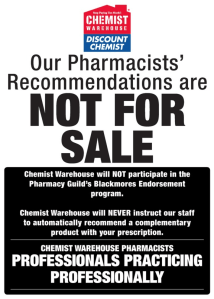
Chemist Warehouse have made their position plain. But don’t abandon your trusted pharmacy/pharmacist. These guys are about slicing trade from competitors. Including (in my suburb) with the 30 plus metre aisle of junk potions bulging with Blackmores’ goods.

Their grab for the “integrity dollar” was written up today in The Age. The Life and Style section included a poll. Of note, the article continued:

However, in a sign the guild is backing away from the deal, it wrote in its latest newsletter that the Blackmores’ prompts in its computer system were a pilot only, which would be reviewed.
”Contrary to some media reports, there is no compulsion whatsoever on pharmacists to sell these products, nor is there any direct incentive to any pharmacist to sell them,” the guild’s newsletter said.

Fortunately the lack of evidence is now evident. In a great interview recently on ABC is Professor Paul Glaziou of Bond University from the Centre for Research in Evidence based practice. He went looking for and couldn’t find the evidence one would expect from Blackmores. He’s asked for them to make it available. He shouldn’t have to – nobody should be left looking for evidence here.

Or download here.

The clash of reality catching up with an industry that survives on social psychological trends such as the need to take control of ones health, distrust of pharmaceutical companies and a prevailing zeitgeist of choosing something – anything – natural in an environment we are erroneously told is highly toxic is getting louder. Marketers of this junk know this and they’ve been fighting a semantic battle against the growing doubts of efficacy, trying to head off reality at the pass.

We’ve gone from “natural”, to “alternative”, to “complementary” and now we’re getting scammed with Integrative. As though this cockypop mix of potion and ritual actually has a place waiting for it within the current model of evidence based medicine. Purveyors of naturopathy, vitamin therapy, supplemental, acupuncture, reiki, massage, kinesiology, meditation, homeopathy, chiropractic (the one stop shop for self-health sabotage) have delighted in maligning “allopathy” for years.

The paucity of evidence to defend the need for unproven products is summed up well by Dr Wendy Morrow, chief executive of the Complementary Healthcare Council:

Quite frankly, if complementary medicines didn’t work it would have been a fad that was here and gone in the blink of an eye. Their increasing use shows they’re not a fad, they do work if used appropriately, and I don’t see that people are going to stop using them.

Which could also be said about any of the useless rituals above which also come bundled with attacks on vaccination, antibiotic therapy, medication in general and ample conspiracies about “allopathy”. However, late on Friday Blackmores did publish a research summary. Bear in mind however that claims made in advertising are subject to the Therapeutic Goods Advertising Code which is something I wish to look into shortly.

Pharmacy news items reported on Monday October 3rd:

Blackmores reports that while there is evidence to suggest that some medications can affect how the body uses nutrients, this is ‘unrecognised or overlooked by many healthcare practitioners’. Blackmores says that the evidence was compiled in line with the TGA’s Levels of Evidence Guidelines for Listed products and demonstrates that ‘some prescription medicines diminish nutrients and that supplementation can improve nutritional status’, adding that the evidence for its Companion range was reviewed in consultation with ‘leading [unnamed] pharmacists’.

NPS have published Examining The Evidence and looked into each of the four “companion medicines”. They find evidence was “absent” except for the probiotic option, which was “limited”. To summarise each area:

  • Supporting evidence for using Co-enzyme Q10 with statins (none)

Evidence does not support the use of Co-enzyme Q10 to prevent myalgia (muscle pain) during treatment with a statin. No trials have shown that taking a Co-enzyme Q10 supplement with a statin prevents myalgia.

Randomised controlled trials of Co-enzyme Q10 to manage statin-associated myalgia have conflicting results and do not support routine use with statin therapy.

  • Supporting evidence for using magnesium supplements with PPI therapy (none)

Magnesium deficiency or ‘hypomagnesaemia’ has been associated with long-term use of proton pump inhibitors (PPIs). Case reports indicate that stopping the PPI is the best way to normalise magnesium levels. Taking a magnesium supplement with the PPI may not be enough to correct the magnesium deficiency.

No studies have investigated the use of a magnesium supplement to prevent magnesium deficiency during PPI therapy. A magnesium supplement should only be considered if a PPI has caused a deficiency in magnesium that requires treatment. Evidence for using a supplement with a PPI to treat magnesium deficiency is based on case reports.

  • Supporting evidence for using zinc supplements with antihypertensives (none)

Routine use of zinc supplements is unnecessary for people taking blood pressure lowering medicines (or ‘antihypertensives’). There is evidence that long-term treatment with certain types of antihypertensives may reduce zinc levels, but it is unclear how often this causes zinc deficiency.

  • Supporting evidence for using probiotics to alleviate antibiotic-associated diarrhoea (some)

There is some evidence from trials that probiotics may prevent antibiotic-associated diarrhoea in some adults and children. But limitations with the trials mean that the true effect of probiotics is uncertain, as is the most effective product or dose.

58 million prescriptions per year. Coke and fries. 90% non-compliance with regulation. No regulatory enforcement because it’s not “cost effective”. A recent audit finding the TGA has failed for decades to counter deceptive, false and misleading advertisements. If compound X is today found to be unable to make claim Y proper policing applies only to new products coming onto the market. Products already on the Australian Register of Therapeutic Goods cannot be edited.

Given what’s been leaking out about the industry and the paper tiger apathy of the TGA, it shouldn’t be surprising Blackmores’ “Coke and Fries” is geared for consumers money, not health benefits.

NPS urges independent advice as Blackmores deal may contravene legislation

Already the myth that the AMA is critical of Blackmores scam to push woo woo at point of sale because of profit jealousy has emerged.

Whilst there are justified criticisms of medical and pharmaceutical industry cooperation, it is frequently blown up to conspiratorial levels. Or misunderstood as being a negative influence on doctors in total. There’s no evidence doctors are immune to incentives – none of us are – but regulations and guidelines exist for a reason. Also, the strongest push to place ethics before the benefits of pharmacy marketing comes from doctors themselves.

Quite frankly though, it also has zip to do with this new problem lapping around the ankles of patients visiting pharmacies to have scripts filled. Drugs work. In the vast majority of cases the consumer can choose a cheaper brand at point of purchase. Alternative products may loosely be said to not so much work, as to carry almost no risk. And this lack of risk, if you pause and think, by definition in the vast majority of cases brings a lack of efficacy. That is, after all, the basis by which they make it onto shelves. That is what differentiates a listed product from a regulated product.

You may have noticed there’s no black market in echinacea. “Naturopath shopping” due to a high tolerance of spirulina or glucosamine isn’t a problem. Clandestine labs aren’t employing criminals to smurf homeopathic tablets so the latest ATS can continue to be supplied. Pharmacies aren’t ram raided in the dead of night so the probiotic fridge or magnesium supplements can be carried off. No cries in emergency departments of “Quick nurse… two teaspoons of Ethical Nutrients fish oil… No – make that Cod Liver Oil. And no fruity flavour Godammit!”.

Alternative medicines have been shown to not work reliably over and again. Those with demonstrable effect suffer from unpredictable results, varying concentration and drug interaction. If Blackmores’ hanky panky does anything well, it’s interferring with the expected effect of real medication. Being not customised per patient needs, it’s impossible to claim one size fits all immediately after claiming it is for something so difficult to quantify as “nutritional deficiency”. A deficiency that may or may not exist at all and if so, demands individual follow up and perhaps a pathology test.

Yet side stepping this final step in patient specificity is exactly what Blackmores seeks to do in mass managing highly specific, and very rare, potential eventualities.

Which brings us back to the grandiose sell being pushed in Blackmores promotion. Claims made in advertising are frequently not backed by evidence. 80 of 82 complaints pertaining to the relevant Advertising Code this year were upheld by the TGA. The two failed complaints were specific to competing companies.

Yet presently there’s no way to follow through and prosecute for non compliance with TGA demands to address false advertising claims. Readers may remember crook and homeopath Fran Sheffield smirking at TGA demands to publish a retraction of outrageous claims on her website. It is simply not cost effective to prosecute, according to the TGA. Indeed it is so cost ineffective, it is not judged to be in the public interest. Pages 130-131 of The Auditor Generals Report into the TGA and Complimentary Medicines, includes;

The TGA’s Advertising Unit is not aware of having successfully used the full range of sanctions, such as seeking a prosecution for breaches:

Due to the very low financial penalties currently available (a maximum of $6600 for individuals and $33 000 for corporations) for advertising offences in the Act and other investigative priorities for the TGA, it is not cost‐effective for the TGA to initiate a formal investigation of an advertising breach with a view to preparing a brief of evidence for consideration of prosecution by the Director of Prosecutions …

It has never been cost‐ effective for the TGA to initiate a formal investigation of an advertising breach with a view to preparing a brief of evidence.

The size of penalties attached to criminal offences may also mean that it is seen as not in the public interest to proceed. This view is consistent with legal advice provided to the Advertising Unit about specific breaches.

The TGA has also observed that “prosecution is currently the only available option where administrative requests fail to achieve compliance”. There have never been any cases that have been referred for prosecution action and accepted.

In 2010 a DoHA review found 90% of products reviewed were found to be non-compliant with regulatory requirements. The infamous 31 products selected at random yielded 68 breaches;

20 medicines had labelling issues such as non‐compliance with labelling requirements and/or breaches which may mislead consumers.
12 included incomplete and/or inappropriate information on the Australian Register of Therapeutic Goods (ARTG).
22 were found to have manufacturing and/or quality issues.
14 did not have adequate evidence to substantiate claims made about the medicines.

It is into this highly unsatisfactory environment the Blackmores Beast is born. Ken Harvey has written an excellent summary in addition to his Fairfax piece noted in the last post. Pharmacies to push supplements as fries and Coke to prescriptions is hosted on The Conversation.

In a change from Pharmacy Guild president Kos Sciavos being “personally thrilled” to announce the deal, it now also emerges;

The National President of the Pharmaceutical Society of Australia, Grant Kardachi, is meeting Blackmores this week and will seek an apology for the damaging and denigrating comments made about the profession of pharmacy.

Mr Kardachi said the “coke and fries‟ comment by Blackmores‟ Chief Executive was more than unfortunate and ill-considered.

One can only await further developments with interest.

In other news…

 The NPS have come out against the deal:

Whilst contravention of legislation has also been raised:

Guild & Blackmores “naive money-grubbing action”

Today’s Letters to the Editor in Fairfax’s The Age offer ample criticism and no praise for the Blackmores scam (see PDF below) outlined here recently. Pharmacist and health store proprietor, Ian Collins writes;

AS A pharmacist and health store proprietor, I find the guild’s action of linking with one company a most naive and money-grubbing action. To be forced to recommend one company bringing out a new range of products, whose composition has not been widely discussed and has no track record, is beyond belief. To attempt to give all people with blood-pressure problems, no matter what the cause, one formula, ignoring all other health factors, is incomprehensible.

There are so many other products from different brands that may be more effective, products with a history of being useful; why pick this small range of untried products? Maybe the answer is that complementary medicine is basically ignored in pharmacy degrees and very few pharmacists have the knowledge to discuss or ask the relevant questions regarding complementary products.
How embarrassing for pharmacists to be caught with their hand in the till.

Prominent Mornington skeptic Graeme Hannigan writes;

I AM a health consumer and am disgusted at this agreement. If it wasn’t enough that pharmacies credulously offer such quackery as ear candles and the good old magic water of homeopathy, the agreement with Big Quacka means that any lingering vestiges of trust in pharmacies has vanished. Pharmacies are putting financial objectives well ahead of the ethical treatment of customers.
All guild pharmacies should come with a health warning and advice to customers to wash off the snake oil after visiting their pharmacy. I trust the guild will also make available the results of the peer-reviewed randomised double-blinded clinical trials of Blackmores Companion preparations so customers can make informed choices.

In a comprehensive Opinion article, Dr. Ken Harvey digs for some evidence to back this caper, finding little more than a business deal. He writes in part;

So what is the evidence to support the use of Blackmores Companions products?

Its Biotic Companion contains the probiotic strain Lactobacillus reuteri, which is claimed to reduce antibiotic-associated bloating, flatulence and diarrhoea. The risk of suffering these side-effects is relatively low. There is some evidence certain probiotics may reduce the incidence of antibiotic-associated diarrhoea in some populations, but routine use is not recommended by medical authorities. In immune-compromised patients, occasional cases have been reported where probiotic organisms have caused serious blood-stream infection.

Anti-HT Companion contains zinc gluconate to complement use of antihypertensive therapy. There are occasional reports that such therapy may lower zinc levels, but I am unaware of any independent medical authority that recommends routine zinc supplements with antihypertensive drugs.

Stat Companion contains coenzyme Q10 and vitamin D3 allegedly to support statin use. Muscle pain occurs in about one to two patients in 1000 receiving statins, especially if a high dose is used. The evidence that coenzyme Q10 and vitamin D3 can relieve statin-associated muscle pain is not clear-cut and the evidence that taking these ingredients together with statins prevents muscle symptoms is even less clear. As a result, the routine use of CoQ10 and vitamin D in statin-treated patients is not recommended.

PPI Companion contains magnesium to aid use of proton pump inhibitors. There are only occasional reports of clinically significant magnesium deficiency occurring in the many patients receiving PPI therapy. If this rare problem is diagnosed, the recommended management is to stop the PPI. Routine supplementation with magnesium for all patients on PPIs is not recommended.
The fine print of the material Blackmores provides about its products states that if a nutritional deficiency is suspected, pharmacists should refer customers to their GPs for further investigations. I agree.

When the rare person develops a nutrient deficiency on a prescription drug, the evidence-based approach is to confirm the diagnosis objectively with a blood test, case by case, and then treat accordingly. Sometimes that might mean prescribing a supplement. There is some evidence to support that.

But what the Pharmacy Guild-Blackmores arrangement implies is supplementation en masse, in the hope nutrient depletion will be prevented. I am unaware of any good evidence to support that. More importantly, this deal unnecessarily adds to the ”medication burden” and financial cost that many elderly patients already struggle with when taking multiple drugs.

Debate over the lack of evidence to justify the move as patient, not profit oriented, was also reported in Pharmacy News. CEO of APESMA, Chris Walton observed;

We are deeply concerned that pharmacists are increasingly being asked to put their expertise and professional ethics aside by pharmacy owners more interested in making money than doing what is in the best interests of their patients

Blackmores promotional material

Blackmores’ black heart: Would you like lies with that?

One can be forgiven for wondering exactly how pharmacist members of The Pharmacy Guild of Australia, will keep a straight face when giving advice about medication.

Not that they don’t have the training to do so. Far from it. Which is what makes the money spinning deal to push Blackmores’ “companion products” to certain medications particularly galling. By it’s very nature this “Coke and fries” (to use Blackmores term) deal is predicated on pharmacists pre-empting doctors and making on the run diagnoses. Diagnoses that they aren’t equipped to make and that may also prove deleterious.

The scam works like this. Blackmores have identified key prescription medicines and isolated potential “nutritional consequences”. They’ve proposed a “companion product” to the prescription with scant regard to the fact that no standing recommendations exist. More so, research into this approach to supplements is both ambiguous and has revealed negative effects.

The four areas you should be terrified about are:

  • Proton pump inhibitors and magnesium deficiency with muscle cramps, vertigo, hyper-irritability, excitability and the inevitable poor concentration. But if you can remember where you’re going for long enough you can limp to the chemist, stagger from wall to wall and unleash your hyper-rage upon stock to ensure a swift diagnosis.
  • Antibiotic treatment, upset GI microflora and the need for probiotics helped along by icky stories of bloating, farting and diarrhoea. Fear not you gaseous, smelly, splattering assault upon polite society, for they have just the probiotic for you.
  • Anti-hypertensives and zinc deficiency along with poor immunity, poor appetite, impaired sense of taste and smell. Topped off with poor skin health (delayed wound healing), GI tract issues with the inevitable diarrhoea which compounds zinc deficiency. Can’t eat, can’t heal, can’t taste, can’t smell and you’re stuck in the toilet. There’s a plus in there somewhere but no doubt you need a zinc supplement.
  • Statins (cholesterol lowering drugs) and myalgia plus (get this) “muscle soreness”. Along with cramping, weakness and fatigue, you clearly need Coenzyme Q 10 and vitamin D3. What a pity you’re already too shattered to get out of bed.

Of course dealing with the nutritional consequences, may have… er, consequences. For example Blackmores go on to tell consumers, CoQ10 may:

• Have hypotensive effects in patients with hypertension and may have additive effects on antihypertensive medications

• Interfere with some types of chemotherapeutic agents. Use with caution

• Decrease the anticoagulant effect of warfarin

• Decrease blood glucose levels in people on hypoglycaemic therapy

Vitamin D3 may theoretically cause hypercalcaemia if taken with thiazide diuretics. Caution is advised in those with hyperparathyroidism, malignancies that increase serum calcium levels or other risk factors for hypercalcaemia. Zinc may decrease absorption and blood levels of tetracycline and quinolone antibiotics unless doses are separated by at least 2 hours.

Magnesium may decrease the absorption and efficacy of tetracycline and quinolone antibiotics, bisphosphonates and chlorpromazine unless doses are separated by at least 2 hours. If using [Blackmores’ probiotic] with antibiotics to which [Blackmores’ probiotic] is sensitive, separate doses by at least two hours.

This is enough to make you pause and think about chatting at length with your doctor. There’s a few other useless spooky observations that the (s)CAM industry simply rock at pulling off. Such as vitamin D deficiency being widespread and associated with poor CV health. Magnesium contributes to healthy teeth, bones, muscle/nerve function, electrolyte balance and normal energy metabolism. Myalgia is one of the most common reported adverse effect of statin use.

Many patients – particularly older ones – may already have poor nutrient intake… 1/3 of Aussies over 18 don’t get the RDI of magnesium. My favourite is the veiled suggestion GP’s aren’t capable of doing their job: “…the TGA have advised prescribers to be alert to hypomagnesaemia in people taking PPIs”. To which I can easily imagine Professor Farnsworth from Futurama saying, “Why yes… which is exactly why cowboy’s like you should stay the hell away from grown up science”.

With the help of Dr. Ken Harvey, who we know here from the SensaSlim saga, we can pin down the extent of frivolity being advanced by this joint venture. The statin claims are particularly bold, given side effects. Also, noting Wyman et al;

Some small clinical trials seem to show that coenzyme Q10 supplements can be used to lower blood pressure and to treat or prevent myalgia caused by hydroxymethylglutaryl coenzyme A reductase inhibitors (statins). However, larger trials are needed to determine if they are truly effective for these purposes.

On the topic of probiotics, The March 2011 issue of Therapeutic Guidelines Antibiotic, states;

There is some evidence that prophylactic probiotics reduce the incidence of antibiotic-associated diarrhoea but the appropriate combination of agents has not been established, so probiotics cannot be recommended for routine use. In immune-compromised patients, occasional cases of probiotic-associated bacteraemia have occurred

Regarding zinc and magnesium supplementation there is no standing recommendation for use with anti-hypertensive therapy and PPI use respectively. As Farnsworth just reminded us, being on the lookout for symptoms is for trained health professionals. Blackmores’ hijacking of professional guidelines is just another trick for selling for the sake of it.

Consumers Health Forum of Australia chief Carol Bennett claims in Fairfax that the entire caper is unethical and urges consumers to demand evidence and report pharmacists who lean on fears. Geraldine Moses, who is a drug safety researcher reminds us of the folic acid related seizures epileptics sustained after taking a supplement to combat the reduction in folate specific to epilepsy medication.

Today The Age reported;

PHARMACISTS have been accused of putting money ahead of patients’ interests after striking a controversial deal to market dietary supplements with prescription medicines.

The Pharmacy Guild of Australia, which represents 94 per cent of Australia’s 5200 pharmacies, has agreed to start recommending a range of Blackmores products to patients when they pick up prescriptions for anti-biotics, blood pressure drugs, cholesterol medicine and proton pump inhibitors.

Last week, Blackmores chief executive Christine Holgate told Pharmacy News the deal meant they could provide ”the Coke and fries” with prescription drugs while providing pharmacies with ”a new and important revenue stream”.

Her comments prompted sharp criticism from doctors and consumer advocates who said it risked turning pharmacies into McDonald’s-like businesses that push products onto patients who do not need them. Under the deal, when a prescription is filled, a prompt in the pharmacist’s computer system will remind them to discuss a particular Blackmores product that has been designed to offset possible side-effects of their prescription drug.

[……]

Australian Medical Association president Steve Hambleton said the move was outrageous and smacked of commercial interest rather than clinical need.

He said he did not know of any solid evidence backing the combination of dietary supplements with the prescriptions included in the deal. ”I think the evidence for Coke and fries is about the same as the evidence for these products,” he said. Dr Hambleton said the recommendations had the potential to confuse patients, who should trust their doctors to prescribe them what they need without any conflicts of interest.

Geraldine Moses, a drug safety researcher and pharmacist based at Brisbane’s Mater Hospital, said she was concerned about the deal because of good evidence that the more drugs a person took, the more likely they were to have adverse reactions and interactions. She said while Blackmores may have evidence showing that prescription drugs reduce particular nutrient levels and that their supplements increase those nutrient levels, it was incorrect to presume that replenishing those levels was the right thing to do.

Outrageous, unethical and potentially dangerous according to experts. This is undoubtedly a grab for money targetting a demographic that is unable to afford trumped up scams with potential risks. Given the appalling performance of the alternative product industry in the recent Auditor General’s Report and concerns raised about regulation of same in the TGA Transparency Review in July, the Pharmacy Guild should be ashamed of itself.

I wish Professor Farnsworth could get a piece of them.