Acupuncture: Essential Facts About A Major Scam

Back in May 1998 a systematic review of published results from clinical trials and the country they are published in was, well… published.

Two studies were conducted. In one, trials in which the outcome of acupuncture was compared to placebo, no treatment or a non acupuncture intervention were studied. In the second study randomised, controlled trials (RCT) of non acupuncture interventions in China, Japan, Russia/USSR, or Taiwan were compared to those published in England. Regarding the study of acupuncture:

Research conducted in certain countries was uniformly favorable to acupuncture; all trials originating in China, Japan, Hong Kong, and Taiwan were positive, as were 10 out of 11 of those published in Russia/USSR.

It was also found that trials in the second group were skewed to produce favourable results in China [99%], Japan [89%], Russia/USSR [97%], and Taiwan [95%]. In England, “75% gave the test treatment as superior to control”.

No trial published in China or Russia/USSR found a test treatment to be ineffective.

Conclusion: Some countries publish unusually high proportions of positive results. Publication bias is a possible explanation. Researchers undertaking systematic reviews should consider carefully how to manage data from these countries.

In 2010 a systematic review of systematic reviews of acupuncture for depression stated in part:

Acupuncture is often advocated as a treatment for depression, and several trials have tested its effectiveness. Their results are contradictory and even systematic reviews of these data do not arrive at uniform conclusions. The aim of this review is to critically evaluate all systematic reviews of the subject with a view of assisting clinical decisions. […]

All the positive reviews and most of the positive primary studies originated from China. There are reasons to believe that these reviews are less than reliable. In conclusion, the effectiveness of acupuncture as a treatment of depression remains unproven and the authors’ findings are consistent with acupuncture effects in depression being indistinguishable from placebo effects.

So on top of favouritism to acupuncture in certain countries, notably China, there is also an overlay of unusually high results. Indeed as shown in many studies and reviews initial study design and publication bias in Asian countries favours acupuncture efficacy. A few minutes searching will confirm this over and again. Thus, we can confidently be skeptical about studies raised in defence of acupuncture and stand firm that it’s “success” stems from study design and publication bias.

Yet, there’s also the issue of mythology and outright fallacies presented time and again regarding acupuncture’s origins. Appeal to antiquity is a major thought stopper when it comes to how acupuncture works and the other hanky panky around “forces” and “energy flows”. Consider:

Acupuncture is a traditional technique developed over two thousand years ago based on the insertion of needles or more recently electrical stimulation, based on the Chinese medical theory that diseases are caused by blockages in the flow of energy within the body.

We can rather swiftly expose that story as a patently modern day fake. Some scam artists know that acupuncture as we know it, is only a few decades old. In reputable organisations or conventional medical service providers where it is offered, a cleverly worded non committal pitch, seems to please legal advisers whilst keeping the mystique alive. I particularly like this one from Arthritis M.D.:

Acupuncture is one of the key components of the traditional Chinese medicine system.  Chinese medicine was documented in China in the 3rd century B.C.  This system views the body… Traditional acupuncturists also believe… According to Chinese medicine… As acupuncture has evolved and spread across countries and continents, different acupuncture points have been reported.  Chinese theory…

It’s one of the very few that acknowledge (but do not admit) the fallacious creation of the vast majority of the more than 2,000 acupuncture points, or acupoints. There was originally 365 to correspond to days of the year. But thanks to Western marketing, bogus diploma courses, bad science and general unaccountability manifesting in mock up journals things got more convoluted and sciency. So what are the problems with the story of a 2,500 year old therapy? Fortunately other sciences can explain.

We’re asked to believe that the technology to make needles far thinner that hypodermic needles existed around 500 BCE. Just on that, Reflexologists claim a history of up to 5,000 years in their appeal to antiquity. Historiologically this is absurdity on steroids, even out-dating Moses by 1,600 years.

Earliest Chinese texts are from 3rd century BCE, and no mention of any needling is in evidence. By 90 BCE needling of infected wounds and bloodletting was reported. Archeological and anthropological evidence is robust and unambiguous. Needles used were huge. It was not until the 1600s that the technology to manufacture acupuncture needles existed. So, immediately we’re down to a generous 400 years.

In 1680 the first Western accounts of Chinese medicine [TCM was introduced by Mao in the 1960s] by Wilhelm Rhijn did not mention acupuncture points,”qi” or energy flow. Needles were shoved into wombs and skulls for “thirty respirations”.The USA did try this technique for drowning victims from 1826, reporting 100% failure and that they “gave up in disgust”. Western reports of “acupuncture” from around the early 1900’s mention not one word of the practice we’re today told is 2,500 years old. Most tellingly there are no points, qi or meridians in these reports.

In fact, it mirrored mechanical nociceptor stimulation and endorphin release, with needles jabbed into sites of pain. By the 1900s, “Qi” is still “vapour emitted by, or arising from food”. Meridians are still inert vessels/channels with no bodily association. So, we’re down to a few decades – but how few?

Enter… The French. Georges Soulie de Morant coined the usage of “meridian” to justify his belief that energy or “qi” moved throughout the body. He is the first properly documented human being to make that link. It was 1939. However, we had to wait until 1957 until another Frenchman, Paul Nogier, invented auricular acupuncture. Note this is not today’s acupuncture, nor the claimed ancient method. It is the notion of unseen energies. Similarly, today we hear much of non existent “toxins” where once we heard of disease carrying “Miasmas”. Some others in France accept this concept. Most French doctors claim this is “resurrecting an absurd doctrine from well deserved oblivion”.

So in respect of this practice supposedly a part of Chinese history, we’re down to 53 years, have no scientific or medical community support and seem to be nowhere near China. Also the Traditional Chinese Medicine [TCM] phrase is yet to exist also. Why? Interestingly enough, the only nation to strive to ban the acupuncture (of large needles jabbed into wounds, skulls and wombs) was China, between 1822 and WWII, under the Chinese Nationalist Government. Post Communist Revolution, Mao was faced with the reality of infection and disease as the few remaining Western or Soviet trained doctors worked in cities in a nation where 80% of the population was rural. An immediate problem for Mao was wide spread schistosomiasis. Vikki Valentine writes:

One of the Party’s first steps in medical reform called for massive campaigns against infectious disease. Thousands of workers were trained and sent out into the countryside to examine and treat peasants, and organize sanitation campaigns.


Enter his “Barefoot Doctors” who provided cheap and dangerous “alternative medicine”, and demonstrated the power of the Peoples Party when ordered to physically catch all fresh water dwelling snails capable of passing on the schistosoma parasite responsible for schistosomiasis. Ten million residents suffered from this and peasants called it “Big Belly”.

The schistosoma parasite when infectious swims about happily until it encounters a human. Then it burrows into the skin and becomes a schistosomula. It then sets up camp in the lungs or liver to mature.

Adults then infect the lungs and liver and also set off to invade the bladder, rectum, intestines, the portal venous system which carry blood from the intestines to liver, spleen, and lungs. Symptoms include seizures and the swollen belly.

A major platform of the Communist Party was a revolution in agriculture. A “Great Leap Forward” was needed in China. But Party leaders, including Chairman Mao Zedong, knew that improving the health of peasants was integral to increasing agricultural production.

What followed was a backlash against Western-style “elite” medicine. The “bourgeois” policies of “self-interested” physicians who only treated rare and difficult diseases were denounced as “disregarding the masses.”

Mao was pleased with reports that the disease was wiped out in up to 95% of areas where it had been endemic. He claimed his party could “cure what the powers above have failed to do”.

Mao’s government coined the term “traditional Chinese medicine” – TCM – including herbal medicine, crude acupuncture, moxibustion and more in the 1960’s. Mao himself despised the notion, never using any “TCM”. Vested interests had little trouble manufacturing an entire fake history which – ironically – we in the West could access with ease, from a nation practically able to suppress the flow of air, much less information.

Chinese do not use the TCM we have invented here in The West. In 1995 a group of visiting American medico’s were informed between 15-20% of Chinese use herbal medicine. Almost no Chinese medicine is used in and of itself but with mainstream medicine. It is considered a sign of poor class and ignorance by the Chinese in general to use any “TCM”.

The Australian Acupuncture and Chinese Medicine Association offer a celebration of meaningless “qualifications”, codes of ethics and standards, all carefully crafted by themselves. So, what’s happening within this multi-billion dollar industry that need face no medical tribunals, provide data nor adhere to Australian Medical Standards?

Today it is a Western marketing success that grew following Communist Dictator Mao’s smirking at – then – superior economies. Unable to apply widespread Western medicine, alternatives were used. The West was assured this was successful and superior. We were scammed via our own gullibility about the far East and The Orient, still are by the Wellness Industry and China has indeed had the last laugh. Acupuncture produces a documented placebo effect. If you think youʼre getting it, it works, whether you are, or not. Itʼs you, the recipient who does this “mystical thing”. Harriet Hall writes in Science Based Medicine:

In the best controlled studies, only one thing mattered: whether the patients believed they were getting acupuncture. If they believed they got the real thing, they got better pain relief – whether they actually got acupuncture or not! If they got acupuncture but believed they didnʼt, it was less likely to work. If they didnʼt get it but believed they did, it was more likely to work.

Acupuncturists can rationalize with great ingenuity. In a recent study using sham acupuncture as a control, both the sham placebo acupuncture and the true acupuncture worked equally well and were better than no treatment. The obvious conclusion was that acupuncture was no better than placebo. Their conclusion was that acupuncture worked and the placebo acupuncture worked too!

Certainly there are ancient practices involved in the modern TCM plaguing the growing hokus pokus that constitutes the “Wellness Industry” yet acupuncture is not one of them. What we have today is not a 2,500 year old practice but a relatively modern expression of bad science derived from archaic ignorance that’s been very recently polished and refined to seem like genuine therapeutic intervention. At it’s very best acupuncture may well be responsible for releasing endorphins. It is a placebo and thus as a reliable mode of treatment is utterly and absolutely useless.

Of course many herbs can have demonstrable effects. In truth those that do are few and regulation is poor. Contamination with mercury, arsenic and lead is common whilst interaction with genuine drugs can lead to serious adverse reactions. All TCM must be regarded as harmful in that it delays access to efficacious evidence based treatment and is buoyed by the deceptions or well meaning but erroneous beliefs of practitioners. Proponents are welcome to subject their “medicine” for clinical trials, yet time and again they emerge as alternatives to medicine.

To argue there has been an unbroken chronology of superior “natural” therapies is simply false. It’s a common myth proffered by the Wellness Industry. Archaeology is absolute in producing evidence that humans have for many thousands of years died much, much younger and from painful chronic diseases that were quite simply beyond treatment. Diseases we today do not encounter in developed nations. Like any alternative to medicine acupuncture cannot survive RCT except to emerge time and again as placebo.

Australia would do well to review how much we spend on education and insurance for this slick ritual.

Blackmores, Pharmacy Guild saving face

Last we visited the Blackmores, Guild Alliance there were serious doubts about evidence from Blackmores or understanding from the Guild.

Not much has changed on admitting fault, even with the removal of the Gold Cross endorsement. Which, by the way, was the fault of “ill informed and inflammatory” media reporting leading us goofy consumers to exhibit a “strong level of public concern”. I wonder where the Guild gets off trying this one on. There’s something missing from this sudden awakening in which “the Guild has listened to these concerns and accepts – mutually with Blackmores… to withdraw the endorsement arrangement”.

For example the AMA, according to president Steve Hambleton, considered the deal “outrageous” and that, “There’s no place for commercial interference in the clinical decision making of the pharmacist”. This was and is reflected in GP’s responses, including some writing notes with scripts to not include the “companion range”. Professor Paul Glasziou, director of Bond University’s centre for research in evidence-based practice had, on ABC, called Blackmores’ bluff on supporting evidence.

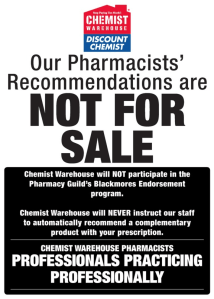
Chemist Warehouse had publically and loudly protested, promising to not participate in the deal. “Our pharmacists recommendations are not for sale” and “Professionals Practicing Professionally” stated their defiant flyer. Ouch!

Many individual pharmacists were, to put it mildly, infuriated and appalled at the Guild’s total stuff up which effected the integrity of all pharmacists.

Stuart Baker, a pharmacist from Western Victoria quit the Guild in protest. In view of the decision to drop the Gold Cross endorsement he still won’t be returning. Damage done there it seems. In light of the Guild’s inability to accept responsibility for such poor decision making the damage could be both more widespread and persistent.

Jane McCredie recently wrote in MJA Insight:

PHARMACISTS have long felt like the poor relations in the broader family of health professionals when it comes to status and respect, if not monetary reward.

In recent years, their representative bodies have lobbied for expanded prescribing rights, for recognition of their role as front-line “clinicians” and against allowing pharmacies in supermarkets for fear this would undermine the quality of health care provided.

It’s going to be a lot harder to make those arguments convincingly in the wake of the spectacularly ill advised deal between the Pharmacy Guild and Blackmores that created such a media furore last week.

October 5th saw the Pharmacist Coalition call on the Guild to dump the scheme. AusPharm News reported in part:

The Pharmacist Coalition for Health Reform (PCHR) has called on the Pharmacy Guild of Australia to axe their deal with Blackmores, following the Guild’s admission that the computer prompts to upsell dietary supplements were a pilot only and would be reviewed.

PCHR spokesperson and Chief Executive Officer of the Association of Professional Engineers, Scientists and Managers, Australia (APESMA), Chris Walton, said that pharmacists had rejected the deal and it was now time for the Pharmacy Guild to scrap the pilot. “A Pharmacist Coalition poll of over 460 people has shown that 94 per cent of community members, including pharmacists and pharmacists-in-training, disagree with the Blackmores’ deal and believe ‘it undermines the professionalism of pharmacists’.

“This has been further supported by The Age online poll which revealed that of over 2,000 voters, 94 per cent do not approve of the ‘Pharmacy Guild of Australia’s deal with Blackmores to recommend Blackmore’s supplements’. [….] PCHR spokesperson and Chief Executive Officer of The Society of Hospital Pharmacists of Australia (SHPA), Yvonne Allinson said The Pharmacy Guild has lost credibility and a failure to scrap the pilot would damage their reputation further.

Gold Cross is a fully owned subsidiary of the Guild. Now that the Gold Cross endorsement has been cancelled their logo, if you like, won’t appear on Blackmores companion range. Nor will the pilot project of software prompts at point of sale go ahead. The decision was “made in conjunction with Blackmores”.

The mutual decision has been taken in view of the strong level of public concern about the proposal, based on some media reporting of the endorsement which was ill-informed and inflammatory.

The last thing the Guild would ever want to do is deplete the credibility of community pharmacists, or damage the trust in which they are held by Australians. That trust and confidence is of paramount importance to the Guild and to our Members. The Gold Cross endorsement arrangement with Blackmores was entered in good faith, with absolutely no intention of undermining the professionalism and integrity of participating pharmacists. [….]

Additionally, an optional prompt containing clinical information for the patient to consider in relation to one product of the Companions range was to be available through the dispensary IT programs, on a pilot basis. The software pilot was not intended to commence until at least November, and will now not proceed.

Chris Walton CEO of APESMA Pharmacist division said in response:

This is a pathetic back down by an out of touch organization. The Guild has been dragged kicking and screaming to the decision and still will not take responsibility. They describe their decision to enter the deal as one made in good faith. Good faith must now be code for a bag of coin.

The profession should never forget that the Guild was willing to trade on the good reputation of pharmacists for commercial gain. While the same people are in charge why would we ever trust them again. Any pretence that they represent the pharmacy profession is over.

Still insisting that the “need for these natural health supplements for some consumers is underpinned by a body of scientific evidence”, Blackmores released a statement also with soothing noises about having listened. But they go one further and point out the “considerable confusion” in waking up to their scam. Hmmm. Perhaps they have a supplement for that? Either way, also from October 5th:

We have listened to the feedback on the Companions range and it is apparent that there is considerable confusion regarding the positioning of this range which we believe is detracting from the potential underlying benefit of these products to consumers.

As a result, and following discussions with Gold Cross, Blackmores will remove the Gold Cross endorsement from the four products, we will not feature these products on the proposed IT dispensary software and we will update the product names to reflect the key ingredients, under the Companions brand.

Blackmores have published research on their professional page for “health professionals” which is well summarised here. I suspect in response to the NPS review of evidence to sustain (cough) claims made in defence of the “companion range”. Christine Holgate opens her heart here about “misconstrued” information and accurate representation of “integrity”. Basically, it’s all good and they’re doing Aussies a favour. No, really.

All up, it’s rather shameful. The Guild haven’t in effect admitted being at fault. At most they seem to grudgingly admit to a type of PR blunder. Blackmores is sticking to it’s guns pleading misunderstanding on the part of the public and a raft of health professionals. Marcus Blackmore bemoaned that a full scale assault on complementary medicines had grown out of the same misunderstanding. ABC have a comprehensive write up with audio and video.

Jane McCredie finished her MJA Insight article in style:

The Pharmaceutical Society of Australia is due to release a new code of ethics for its members — along with a vision for the profession’s future — at its annual conference later this week. It would be nice to think that code might require pharmacists to disclose the level of evidence for any non-prescription medication they sell — hardly an unreasonable demand of people who want to be recognised as clinicians.

I’m imagining the conversations now if this code is implemented. Pharmacists selling homoeopathic remedies will be required to tell each and every customer: “There’s not a skerrick of evidence this works, but if you want to throw your money away…”

Therein lies the very source of the problem. Blackmores’ deal stood out because it officiated upselling and would have included entirely unwarranted prompts. Both the Guild and Blackmores knew it to be a grab for money. So did everybody else. Yet pharmacists do recommend and sell junk to consumers. Assistants do little if anything to dissuade from spontaneous buying.

Doctors will testify to patients at times admitting to taking large amounts of useless supplements. It’s documented that patients are reticent to admit to doctors they use alternative products. In the main doctors are missing out on vital information they need to properly treat their patients.

The only durable solution is for the TGA to move forward with sharp teeth and legislation to call CAM what it really, in the main is.

Unproven and unnecessary.

Pediatric Chiropractic integrity faces new challenges

Yesterday the BBC reported that the University of Wales is to cease validating “other degrees”.

Accrediting degrees from private colleges has no doubt been lucrative for the Uni of Wales. But it’s also proven to be a slur on expected standards. Early last November the BBC reported on the Uni. of Wales suspending accreditation of degrees from a controversial Malaysian business college. Overseas accreditation was always a risky venture and this debacle led to Leighton Andrews, Minister for Education in Wales to claim that Wales itself had been brought into disrepute. The university he said, had let down Higher Education. The Quality Assurance Agency for Higher Education ultimately requested that the Uni. of Wales review the entire caper.

The decision places doubt upon McTimoney Chiropractic College, having its degrees approved. This is nothing less than tremendous news for thinking Australians and anyone concerned about a discipline that runs “seminars” designed to lure paying customers into entrusting their child’s health to unproven guesswork. Such as, How to create the ‘It’s normal for children to be adjusted’ mindset with your clinic and your community, or How to have the majority of your patients as children. These are just a couple of the gigs run by RMIT graduate Glenn Maginness of the Mt. Eliza Family Chiropractic Clinic.

All this comes together if we consider that McTimoney College offer degrees in the McTimoney Chiropractic Method, named after the late John McTimoney. These guys are famous for ordering all members to remove their entire websites at the beginning of the Singh libel case because they were veritable cornucopias of bogus claims. McTimoney always knew they were in the business of scamming when it came to claims about children and feared justified complaints. They also hold claims to fame for having atrocious academic standards in “make believe degrees” as espoused by David Colquhoun.

One of the “special” degrees from McTimoney College happens to be in Pediatric Chiropractic. Indeed, to my knowledge the only degree worldwide in Pediatric Chiropractic comes from McTimoney, and is validated by The University of Wales. From this hub radiates the dangerous and unproven practices and claims from the RMIT pediatric clinic – subject to a highly supported request to close it down reported in the BMJ – the greed of people like Glenn Maginness, potentially lethal antivaccination misinformation from Warren Sipser and Nimrod Weiner and the overarching mystical philosophy of Simon Floreani’s Chiropractors’ Association of Australia.

One hopes this abuse of Higher Education will be challenged, given the lack of evidence for chiropractic in general and the total absence of evidence for pediatric hanky panky. You may have heard of the KiroKids franchise chain in Victoria. In which case you’ll be delighted to know that the “course leader” for the Masters Degree at McTimoney is none other than the brains behind the unconscionable KiroKids scam. Not-a-real-doctor Neil J Davies himself. He boasts:

The MSc degree course now offered to the chiropractic profession by McTimoney College of Chiropractic was designed and written by the Course Leader, Dr Neil J Davies in conjunction with a group of leading paediatricians and other medical specialists and chiropractic advisors.

The course was in development for a period of 4 years and in August 2003 it was duly validated by the University of Wales. The course has been so well accepted by the chiropractic profession that enrolment applications have been received from 14 different countries including the United Kingdom.

Davies waffles about Intelligent Neurological Chiropractic. He has not one research paper published. He does have a text book however, and has won the auspicious Fishslapper of the week prize. Given that UK criticism of chiropractic has been scathing of the “new breed” of outright cons if you will, it may be that validation of McTimoney chiropractic degree ceases. This will put a welcome abrupt halt to the growth of one of the most unfortunate exploitations of vulnerable parents ever witnessed. But it goes further than just scamming a gullible public. They not only cause harm to children’s musculo-skeletal integrity and inflict stroke and death through cervical manipulation. By peddling misinformation and indirectly sustaining falsehoods about conventional medicine their status as a one stop shop for quackery is firm.

Consider this from the abstract of Pediatric vaccination and vaccine-preventable disease acquisition: associations with care by complementary and alternative medicine providers:

Children who saw chiropractors were significantly less likely to receive each of three of the recommended vaccinations. Children aged 1-17 years were significantly more likely to be diagnosed with a vaccine-preventable disease if they received naturopathic care. Use of provider-based complementary/alternative medicine by other family members was not independently associated with early childhood vaccination status or disease acquisition.

Pediatric use of complementary/alternative medicine in Washington State was significantly associated with reduced adherence to recommended pediatric vaccination schedules and with acquisition of vaccine-preventable disease. Interventions enlisting the participation of complementary/alternative medicine providers in immunization awareness and promotional activities could improve adherence rates and assist in efforts to improve public health.

Still, we must remember whilst the claims of chiropractic are primarily nonsense, John Reggars, past president of the Chiropractors Registration Board of Victoria and present vice president of the Chiropractic and Osteopathic College of Australasia, is a voice of sanity. Reggars has been scathing toward tactics (presently backed and encouraged by the CAA), used to increase income for chiropractors and. His article Chiropractic at a crossroads or are we just going around in circles, [Archived copy] published in Chiropractic and Manual Therapies, May 2011, is a compelling read.

Reggars claims the “all-encompassing alternative system of healthcare is both misguided and irrational”. And;

“Chiropractic trade publications and so-called educational seminar promotion material often abound with advertisements of how practitioners can effectively sell the vertebral subluxation complex to an ignorant public,” Mr Reggars said.

“Phrases such as ‘double your income’, ‘attract new patients’ and ‘keep your patients longer in care’, are common enticements for chiropractors to attend technique and practice management seminars.” Mr Reggars, who stressed his support for the “mainstream majority” in the profession, also condemned the use of care contracts, where patients signed up to a fixed number of treatment sessions.

“Selling such concepts as lifetime chiropractic care, the use of contracts of care, the misuse of diagnostic equipment such as thermography and surface electromyography and the X-raying of every new patient, all contribute to our poor reputation, public distrust and official complaints.”

“For the true believer, the naive practitioner or undergraduate chiropractic student who accepts in good faith the propaganda and pseudoscience peddled by the VSC teachers, mentors and professional organisations, the result is the same, a sense of belonging and an unshakable and unwavering faith in their ideology.”

Integrity like that of Reggars reminds us that the option of subjecting students to proper education will always come up in this debate. Many will argue that a change at the institutional level will result in professionalism at the clinical level. Yet chiropractic has always had difficulty selling its song as much more than a jingle. It hasn’t just recently gone awry with brats the like of Floreani, Weiner and Davies, all of whom should be vigorously prosecuted for false claims and fraud under the appropriate health act and advertising codes. There have always been crooks and there probably always will be.

It’s not a discipline. It’s a belief system and it peddles subjective faith on so many levels. Many like Reggars have done an admirable job and we can remain thankful for the attempts of the Chiropractic Boards to address complaints. Yet today chiropractors are expected to provide for the new age worried well. In the eyes of so many real disciplines they are not health practitioners. They practice rituals. The superstitious “result” is achieved by so-called “patients” who think themselves into a state of wellnesss – whatever that is.

The very last demographic we need pushed into this anything-goes nonsense are impressionable children. Let’s hope the decision by the University of Wales has far reaching consequences.

Time for Blackmores to pull that evidence out of a hat

Where are all the people dying in the street from complementary medicines?

Marcus Blackmore – September 2011

Although a seemingly innocuous if not arrogant turn of a logical fallacy called Begging The Question (and a few others as well) I was surprised at how gullible Blackmore may actually take Australians for. Four deaths in two years and 40 serious adverse reactions reported. But, not in the street to my knowledge. Forget the lead, mercury and arsenic poisoning from imported Chinese herbs.

In this case he’s trying to dismiss the vast vacuum of evidence for efficacy of Blackmores hanky panky, by confusing no medicine (or placebo) with a bad medicine. Confusing no effect with malignant effect. It’s also an inconsistent non-sequitur in that he’s applying the logic we would apply to real drugs (or consumer products under fire) to propose the absence of an outcome that by definition, cannot follow. Regardless of how you see this nonsense, it’s a pearler. It encapsulates so much of what’s wrong with regulation of alternative medicine today, in just a dozen words.

Fortunately for consumers it makes Blackmore look quite the villain. It has zero to do with the problem at hand. Namely the current Pharmacy Guild deal done during an evolving awareness of unsustainable claims and corresponding outrage. Although he hasn’t said this in response to recent criticism, he has been scathing of sound criticism, using this phrase before. More to the point it’s a taunting, if rather melodramatic version of What’s the harm? which to skeptics is a huge clanger. Professor Alastair MacLennan head of obstetrics and gynaecology at Adelaide University, cites “four harms of ‘harmless’ therapy”.

In the recent Trick or Treat article by Gary Tippet, MacLennan is summed up:

Probably most important is delay in seeking effective therapy, if there is one; increasing evidence of side effects and drug interactions, which are under-reported; a placebo effect that wears off within months and sees people ”becoming disappointed, disillusioned and depressed as they move along the health food shop counter seeking placebo after placebo”; and a multibillion-dollar industry that is a waste of the scarce health dollar, if they’re not doing any real good.

Interestingly, Marcus Blackmore’s Dirty Dozen words resonates more or less with each of those points. But back to the fallacy. Just because something isn’t doing harm doesn’t mean it’s doing good. Nor can potential benefits (such as supplements suitable for malnutrition) justify wide scale use or the – quite frankly – astonishing prices of Blackmores’ concoctions. Had he asked the question, “Where are all the people wasting money on complementary medicines?”, one could just steer him toward customer exit of any large store.

Fairfax Poll Today

Chemist Warehouse have made their position plain. But don’t abandon your trusted pharmacy/pharmacist. These guys are about slicing trade from competitors. Including (in my suburb) with the 30 plus metre aisle of junk potions bulging with Blackmores’ goods.

Their grab for the “integrity dollar” was written up today in The Age. The Life and Style section included a poll. Of note, the article continued:

However, in a sign the guild is backing away from the deal, it wrote in its latest newsletter that the Blackmores’ prompts in its computer system were a pilot only, which would be reviewed.
”Contrary to some media reports, there is no compulsion whatsoever on pharmacists to sell these products, nor is there any direct incentive to any pharmacist to sell them,” the guild’s newsletter said.

Fortunately the lack of evidence is now evident. In a great interview recently on ABC is Professor Paul Glaziou of Bond University from the Centre for Research in Evidence based practice. He went looking for and couldn’t find the evidence one would expect from Blackmores. He’s asked for them to make it available. He shouldn’t have to – nobody should be left looking for evidence here.

Or download here.

The clash of reality catching up with an industry that survives on social psychological trends such as the need to take control of ones health, distrust of pharmaceutical companies and a prevailing zeitgeist of choosing something – anything – natural in an environment we are erroneously told is highly toxic is getting louder. Marketers of this junk know this and they’ve been fighting a semantic battle against the growing doubts of efficacy, trying to head off reality at the pass.

We’ve gone from “natural”, to “alternative”, to “complementary” and now we’re getting scammed with Integrative. As though this cockypop mix of potion and ritual actually has a place waiting for it within the current model of evidence based medicine. Purveyors of naturopathy, vitamin therapy, supplemental, acupuncture, reiki, massage, kinesiology, meditation, homeopathy, chiropractic (the one stop shop for self-health sabotage) have delighted in maligning “allopathy” for years.

The paucity of evidence to defend the need for unproven products is summed up well by Dr Wendy Morrow, chief executive of the Complementary Healthcare Council:

Quite frankly, if complementary medicines didn’t work it would have been a fad that was here and gone in the blink of an eye. Their increasing use shows they’re not a fad, they do work if used appropriately, and I don’t see that people are going to stop using them.

Which could also be said about any of the useless rituals above which also come bundled with attacks on vaccination, antibiotic therapy, medication in general and ample conspiracies about “allopathy”. However, late on Friday Blackmores did publish a research summary. Bear in mind however that claims made in advertising are subject to the Therapeutic Goods Advertising Code which is something I wish to look into shortly.

Pharmacy news items reported on Monday October 3rd:

Blackmores reports that while there is evidence to suggest that some medications can affect how the body uses nutrients, this is ‘unrecognised or overlooked by many healthcare practitioners’. Blackmores says that the evidence was compiled in line with the TGA’s Levels of Evidence Guidelines for Listed products and demonstrates that ‘some prescription medicines diminish nutrients and that supplementation can improve nutritional status’, adding that the evidence for its Companion range was reviewed in consultation with ‘leading [unnamed] pharmacists’.

NPS have published Examining The Evidence and looked into each of the four “companion medicines”. They find evidence was “absent” except for the probiotic option, which was “limited”. To summarise each area:

  • Supporting evidence for using Co-enzyme Q10 with statins (none)

Evidence does not support the use of Co-enzyme Q10 to prevent myalgia (muscle pain) during treatment with a statin. No trials have shown that taking a Co-enzyme Q10 supplement with a statin prevents myalgia.

Randomised controlled trials of Co-enzyme Q10 to manage statin-associated myalgia have conflicting results and do not support routine use with statin therapy.

  • Supporting evidence for using magnesium supplements with PPI therapy (none)

Magnesium deficiency or ‘hypomagnesaemia’ has been associated with long-term use of proton pump inhibitors (PPIs). Case reports indicate that stopping the PPI is the best way to normalise magnesium levels. Taking a magnesium supplement with the PPI may not be enough to correct the magnesium deficiency.

No studies have investigated the use of a magnesium supplement to prevent magnesium deficiency during PPI therapy. A magnesium supplement should only be considered if a PPI has caused a deficiency in magnesium that requires treatment. Evidence for using a supplement with a PPI to treat magnesium deficiency is based on case reports.

  • Supporting evidence for using zinc supplements with antihypertensives (none)

Routine use of zinc supplements is unnecessary for people taking blood pressure lowering medicines (or ‘antihypertensives’). There is evidence that long-term treatment with certain types of antihypertensives may reduce zinc levels, but it is unclear how often this causes zinc deficiency.

  • Supporting evidence for using probiotics to alleviate antibiotic-associated diarrhoea (some)

There is some evidence from trials that probiotics may prevent antibiotic-associated diarrhoea in some adults and children. But limitations with the trials mean that the true effect of probiotics is uncertain, as is the most effective product or dose.

58 million prescriptions per year. Coke and fries. 90% non-compliance with regulation. No regulatory enforcement because it’s not “cost effective”. A recent audit finding the TGA has failed for decades to counter deceptive, false and misleading advertisements. If compound X is today found to be unable to make claim Y proper policing applies only to new products coming onto the market. Products already on the Australian Register of Therapeutic Goods cannot be edited.

Given what’s been leaking out about the industry and the paper tiger apathy of the TGA, it shouldn’t be surprising Blackmores’ “Coke and Fries” is geared for consumers money, not health benefits.