A critical summary on the (s)CAM industry from the Tonic TV programme, looking at regulatory problems and the role of the TGA.
More posts and reports on how regulation impacts on just what you’re buying here. Access the Auditor Generals report and a few standout epic failures here.
Where are all the people dying in the street from complementary medicines?
Marcus Blackmore – September 2011
Although a seemingly innocuous if not arrogant turn of a logical fallacy called Begging The Question (and a few others as well) I was surprised at how gullible Blackmore may actually take Australians for. Four deaths in two years and 40 serious adverse reactions reported. But, not in the street to my knowledge. Forget the lead, mercury and arsenic poisoning from imported Chinese herbs.
In this case he’s trying to dismiss the vast vacuum of evidence for efficacy of Blackmores hanky panky, by confusing no medicine (or placebo) with a bad medicine. Confusing no effect with malignant effect. It’s also an inconsistent non-sequitur in that he’s applying the logic we would apply to real drugs (or consumer products under fire) to propose the absence of an outcome that by definition, cannot follow. Regardless of how you see this nonsense, it’s a pearler. It encapsulates so much of what’s wrong with regulation of alternative medicine today, in just a dozen words.
Fortunately for consumers it makes Blackmore look quite the villain. It has zero to do with the problem at hand. Namely the current Pharmacy Guild deal done during an evolving awareness of unsustainable claims and corresponding outrage. Although he hasn’t said this in response to recent criticism, he has been scathing of sound criticism, using this phrase before. More to the point it’s a taunting, if rather melodramatic version of What’s the harm? which to skeptics is a huge clanger. Professor Alastair MacLennan head of obstetrics and gynaecology at Adelaide University, cites “four harms of ‘harmless’ therapy”.
Probably most important is delay in seeking effective therapy, if there is one; increasing evidence of side effects and drug interactions, which are under-reported; a placebo effect that wears off within months and sees people ”becoming disappointed, disillusioned and depressed as they move along the health food shop counter seeking placebo after placebo”; and a multibillion-dollar industry that is a waste of the scarce health dollar, if they’re not doing any real good.
Interestingly, Marcus Blackmore’s Dirty Dozen words resonates more or less with each of those points. But back to the fallacy. Just because something isn’t doing harm doesn’t mean it’s doing good. Nor can potential benefits (such as supplements suitable for malnutrition) justify wide scale use or the – quite frankly – astonishing prices of Blackmores’ concoctions. Had he asked the question, “Where are all the people wasting money on complementary medicines?”, one could just steer him toward customer exit of any large store.
Fairfax Poll Today
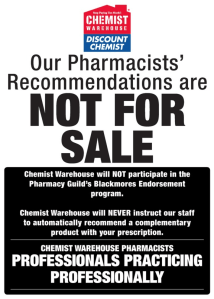
Chemist Warehouse have made their position plain. But don’t abandon your trusted pharmacy/pharmacist. These guys are about slicing trade from competitors. Including (in my suburb) with the 30 plus metre aisle of junk potions bulging with Blackmores’ goods.
Their grab for the “integrity dollar” was written up today in The Age. The Life and Style section included a poll. Of note, the article continued:
However, in a sign the guild is backing away from the deal, it wrote in its latest newsletter that the Blackmores’ prompts in its computer system were a pilot only, which would be reviewed.
”Contrary to some media reports, there is no compulsion whatsoever on pharmacists to sell these products, nor is there any direct incentive to any pharmacist to sell them,” the guild’s newsletter said.
Fortunately the lack of evidence is now evident. In a great interview recently on ABC is Professor Paul Glaziou of Bond University from the Centre for Research in Evidence based practice. He went looking for and couldn’t find the evidence one would expect from Blackmores. He’s asked for them to make it available. He shouldn’t have to – nobody should be left looking for evidence here.
The clash of reality catching up with an industry that survives on social psychological trends such as the need to take control of ones health, distrust of pharmaceutical companies and a prevailing zeitgeist of choosing something – anything – natural in an environment we are erroneously told is highly toxic is getting louder. Marketers of this junk know this and they’ve been fighting a semantic battle against the growing doubts of efficacy, trying to head off reality at the pass.
We’ve gone from “natural”, to “alternative”, to “complementary” and now we’re getting scammed with Integrative. As though this cockypop mix of potion and ritual actually has a place waiting for it within the current model of evidence based medicine. Purveyors of naturopathy, vitamin therapy, supplemental, acupuncture, reiki, massage, kinesiology, meditation, homeopathy, chiropractic (the one stop shop for self-health sabotage) have delighted in maligning “allopathy” for years.
The paucity of evidence to defend the need for unproven products is summed up well by Dr Wendy Morrow, chief executive of the Complementary Healthcare Council:
Quite frankly, if complementary medicines didn’t work it would have been a fad that was here and gone in the blink of an eye. Their increasing use shows they’re not a fad, they do work if used appropriately, and I don’t see that people are going to stop using them.
Which could also be said about any of the useless rituals above which also come bundled with attacks on vaccination, antibiotic therapy, medication in general and ample conspiracies about “allopathy”. However, late on Friday Blackmores did publish a research summary. Bear in mind however that claims made in advertising are subject to the Therapeutic Goods Advertising Code which is something I wish to look into shortly.
Pharmacy news items reported on Monday October 3rd:
Blackmores reports that while there is evidence to suggest that some medications can affect how the body uses nutrients, this is ‘unrecognised or overlooked by many healthcare practitioners’. Blackmores says that the evidence was compiled in line with the TGA’s Levels of Evidence Guidelines for Listed products and demonstrates that ‘some prescription medicines diminish nutrients and that supplementation can improve nutritional status’, adding that the evidence for its Companion range was reviewed in consultation with ‘leading [unnamed] pharmacists’.
NPS have published Examining The Evidence and looked into each of the four “companion medicines”. They find evidence was “absent” except for the probiotic option, which was “limited”. To summarise each area:
Supporting evidence for using Co-enzyme Q10 with statins (none)
Evidence does not support the use of Co-enzyme Q10 to prevent myalgia (muscle pain) during treatment with a statin. No trials have shown that taking a Co-enzyme Q10 supplement with a statin prevents myalgia.
Randomised controlled trials of Co-enzyme Q10 to manage statin-associated myalgia have conflicting results and do not support routine use with statin therapy.
Supporting evidence for using magnesium supplements with PPI therapy (none)
Magnesium deficiency or ‘hypomagnesaemia’ has been associated with long-term use of proton pump inhibitors (PPIs). Case reports indicate that stopping the PPI is the best way to normalise magnesium levels. Taking a magnesium supplement with the PPI may not be enough to correct the magnesium deficiency.
No studies have investigated the use of a magnesium supplement to prevent magnesium deficiency during PPI therapy. A magnesium supplement should only be considered if a PPI has caused a deficiency in magnesium that requires treatment. Evidence for using a supplement with a PPI to treat magnesium deficiency is based on case reports.
Supporting evidence for using zinc supplements with antihypertensives (none)
Routine use of zinc supplements is unnecessary for people taking blood pressure lowering medicines (or ‘antihypertensives’). There is evidence that long-term treatment with certain types of antihypertensives may reduce zinc levels, but it is unclear how often this causes zinc deficiency.
Supporting evidence for using probiotics to alleviate antibiotic-associated diarrhoea (some)
There is some evidence from trials that probiotics may prevent antibiotic-associated diarrhoea in some adults and children. But limitations with the trials mean that the true effect of probiotics is uncertain, as is the most effective product or dose.
58 million prescriptions per year. Coke and fries. 90% non-compliance with regulation. No regulatory enforcement because it’s not “cost effective”. A recent audit finding the TGA has failed for decades to counter deceptive, false and misleading advertisements. If compound X is today found to be unable to make claim Y proper policing applies only to new products coming onto the market. Products already on the Australian Register of Therapeutic Goods cannot be edited.
Given what’s been leaking out about the industry and the paper tiger apathy of the TGA, it shouldn’t be surprising Blackmores’ “Coke and Fries” is geared for consumers money, not health benefits.
Already the myth that the AMA is critical of Blackmores scam to push woo woo at point of sale because of profit jealousy has emerged.
Whilst there are justified criticisms of medical and pharmaceutical industry cooperation, it is frequently blown up to conspiratorial levels. Or misunderstood as being a negative influence on doctors in total. There’s no evidence doctors are immune to incentives – none of us are – but regulations and guidelines exist for a reason. Also, the strongest push to place ethics before the benefits of pharmacy marketing comes from doctors themselves.
Quite frankly though, it also has zip to do with this new problem lapping around the ankles of patients visiting pharmacies to have scripts filled. Drugs work. In the vast majority of cases the consumer can choose a cheaper brand at point of purchase. Alternative products may loosely be said to not so much work, as to carry almost no risk. And this lack of risk, if you pause and think, by definition in the vast majority of cases brings a lack of efficacy. That is, after all, the basis by which they make it onto shelves. That is what differentiates a listed product from a regulated product.
You may have noticed there’s no black market in echinacea. “Naturopath shopping” due to a high tolerance of spirulina or glucosamine isn’t a problem. Clandestine labs aren’t employing criminals to smurf homeopathic tablets so the latest ATS can continue to be supplied. Pharmacies aren’t ram raided in the dead of night so the probiotic fridge or magnesium supplements can be carried off. No cries in emergency departments of “Quick nurse… two teaspoons of Ethical Nutrients fish oil… No – make that Cod Liver Oil. And no fruity flavour Godammit!”.
Alternative medicines have been shown to not work reliably over and again. Those with demonstrable effect suffer from unpredictable results, varying concentration and drug interaction. If Blackmores’ hanky panky does anything well, it’s interferring with the expected effect of real medication. Being not customised per patient needs, it’s impossible to claim one size fits all immediately after claiming it is for something so difficult to quantify as “nutritional deficiency”. A deficiency that may or may not exist at all and if so, demands individual follow up and perhaps a pathology test.
Yet side stepping this final step in patient specificity is exactly what Blackmores seeks to do in mass managing highly specific, and very rare, potential eventualities.
Which brings us back to the grandiose sell being pushed in Blackmores promotion. Claims made in advertising are frequently not backed by evidence. 80 of 82 complaints pertaining to the relevant Advertising Code this year were upheld by the TGA. The two failed complaints were specific to competing companies.
Yet presently there’s no way to follow through and prosecute for non compliance with TGA demands to address false advertising claims. Readers may remember crook and homeopath Fran Sheffield smirking at TGA demands to publish a retraction of outrageous claims on her website. It is simply not cost effective to prosecute, according to the TGA. Indeed it is so cost ineffective, it is not judged to be in the public interest. Pages 130-131 of The Auditor Generals Report into the TGA and Complimentary Medicines, includes;
The TGA’s Advertising Unit is not aware of having successfully used the full range of sanctions, such as seeking a prosecution for breaches:
Due to the very low financial penalties currently available (a maximum of $6600 for individuals and $33 000 for corporations) for advertising offences in the Act and other investigative priorities for the TGA, it is not cost‐effective for the TGA to initiate a formal investigation of an advertising breach with a view to preparing a brief of evidence for consideration of prosecution by the Director of Prosecutions …
It has never been cost‐ effective for the TGA to initiate a formal investigation of an advertising breach with a view to preparing a brief of evidence.
The size of penalties attached to criminal offences may also mean that it is seen as not in the public interest to proceed. This view is consistent with legal advice provided to the Advertising Unit about specific breaches.
The TGA has also observed that “prosecution is currently the only available option where administrative requests fail to achieve compliance”. There have never been any cases that have been referred for prosecution action and accepted.
In 2010 a DoHA review found 90% of products reviewed were found to be non-compliant with regulatory requirements. The infamous 31 products selected at random yielded 68 breaches;
20 medicines had labelling issues such as non‐compliance with labelling requirements and/or breaches which may mislead consumers.
12 included incomplete and/or inappropriate information on the Australian Register of Therapeutic Goods (ARTG).
22 were found to have manufacturing and/or quality issues.
14 did not have adequate evidence to substantiate claims made about the medicines.
It is into this highly unsatisfactory environment the Blackmores Beast is born. Ken Harvey has written an excellent summary in addition to his Fairfax piece noted in the last post. Pharmacies to push supplements as fries and Coke to prescriptions is hosted on The Conversation.
In a change from Pharmacy Guild president Kos Sciavos being “personally thrilled” to announce the deal, it now also emerges;
The National President of the Pharmaceutical Society of Australia, Grant Kardachi, is meeting Blackmores this week and will seek an apology for the damaging and denigrating comments made about the profession of pharmacy.
Mr Kardachi said the “coke and fries‟ comment by Blackmores‟ Chief Executive was more than unfortunate and ill-considered.
One can only await further developments with interest.
One can be forgiven for wondering exactly how pharmacist members of The Pharmacy Guild of Australia, will keep a straight face when giving advice about medication.
Not that they don’t have the training to do so. Far from it. Which is what makes the money spinning deal to push Blackmores’ “companion products” to certain medications particularly galling. By it’s very nature this “Coke and fries” (to use Blackmores term) deal is predicated on pharmacists pre-empting doctors and making on the run diagnoses. Diagnoses that they aren’t equipped to make and that may also prove deleterious.
The scam works like this. Blackmores have identified key prescription medicines and isolated potential “nutritional consequences”. They’ve proposed a “companion product” to the prescription with scant regard to the fact that no standing recommendations exist. More so, research into this approach to supplements is both ambiguous and has revealed negative effects.
The four areas you should be terrified about are:
Proton pump inhibitors and magnesium deficiency with muscle cramps, vertigo, hyper-irritability, excitability and the inevitable poor concentration. But if you can remember where you’re going for long enough you can limp to the chemist, stagger from wall to wall and unleash your hyper-rage upon stock to ensure a swift diagnosis.
Antibiotic treatment, upset GI microflora and the need for probiotics helped along by icky stories of bloating, farting and diarrhoea. Fear not you gaseous, smelly, splattering assault upon polite society, for they have just the probiotic for you.
Anti-hypertensives and zinc deficiency along with poor immunity, poor appetite, impaired sense of taste and smell. Topped off with poor skin health (delayed wound healing), GI tract issues with the inevitable diarrhoea which compounds zinc deficiency. Can’t eat, can’t heal, can’t taste, can’t smell and you’re stuck in the toilet. There’s a plus in there somewhere but no doubt you need a zinc supplement.
Statins (cholesterol lowering drugs) and myalgia plus (get this) “muscle soreness”. Along with cramping, weakness and fatigue, you clearly need Coenzyme Q 10 and vitamin D3. What a pity you’re already too shattered to get out of bed.
Of course dealing with the nutritional consequences, may have… er, consequences. For example Blackmores go on to tell consumers, CoQ10 may:
• Have hypotensive effects in patients with hypertension and may have additive effects on antihypertensive medications
• Interfere with some types of chemotherapeutic agents. Use with caution
• Decrease the anticoagulant effect of warfarin
• Decrease blood glucose levels in people on hypoglycaemic therapy
Vitamin D3 may theoretically cause hypercalcaemia if taken with thiazide diuretics. Caution is advised in those with hyperparathyroidism, malignancies that increase serum calcium levels or other risk factors for hypercalcaemia. Zinc may decrease absorption and blood levels of tetracycline and quinolone antibiotics unless doses are separated by at least 2 hours.
Magnesium may decrease the absorption and efficacy of tetracycline and quinolone antibiotics, bisphosphonates and chlorpromazine unless doses are separated by at least 2 hours. If using [Blackmores’ probiotic] with antibiotics to which [Blackmores’ probiotic] is sensitive, separate doses by at least two hours.
This is enough to make you pause and think about chatting at length with your doctor. There’s a few other useless spooky observations that the (s)CAM industry simply rock at pulling off. Such as vitamin D deficiency being widespread and associated with poor CV health. Magnesium contributes to healthy teeth, bones, muscle/nerve function, electrolyte balance and normal energy metabolism. Myalgia is one of the most common reported adverse effect of statin use.
Many patients – particularly older ones – may already have poor nutrient intake… 1/3 of Aussies over 18 don’t get the RDI of magnesium. My favourite is the veiled suggestion GP’s aren’t capable of doing their job: “…the TGA have advised prescribers to be alert to hypomagnesaemia in people taking PPIs”. To which I can easily imagine Professor Farnsworth from Futurama saying, “Why yes… which is exactly why cowboy’s like you should stay the hell away from grown up science”.
With the help of Dr. Ken Harvey, who we know here from the SensaSlim saga, we can pin down the extent of frivolity being advanced by this joint venture. The statin claims are particularly bold, given side effects. Also, noting Wyman et al;
Some small clinical trials seem to show that coenzyme Q10 supplements can be used to lower blood pressure and to treat or prevent myalgia caused by hydroxymethylglutaryl coenzyme A reductase inhibitors (statins). However, larger trials are needed to determine if they are truly effective for these purposes.
There is some evidence that prophylactic probiotics reduce the incidence of antibiotic-associated diarrhoea but the appropriate combination of agents has not been established, so probiotics cannot be recommended for routine use. In immune-compromised patients, occasional cases of probiotic-associated bacteraemia have occurred
Regarding zinc and magnesium supplementation there is no standing recommendation for use with anti-hypertensive therapy and PPI use respectively. As Farnsworth just reminded us, being on the lookout for symptoms is for trained health professionals. Blackmores’ hijacking of professional guidelines is just another trick for selling for the sake of it.
Consumers Health Forum of Australia chief Carol Bennett claims in Fairfax that the entire caper is unethical and urges consumers to demand evidence and report pharmacists who lean on fears. Geraldine Moses, who is a drug safety researcher reminds us of the folic acid related seizures epileptics sustained after taking a supplement to combat the reduction in folate specific to epilepsy medication.
PHARMACISTS have been accused of putting money ahead of patients’ interests after striking a controversial deal to market dietary supplements with prescription medicines.
The Pharmacy Guild of Australia, which represents 94 per cent of Australia’s 5200 pharmacies, has agreed to start recommending a range of Blackmores products to patients when they pick up prescriptions for anti-biotics, blood pressure drugs, cholesterol medicine and proton pump inhibitors.
Last week, Blackmores chief executive Christine Holgate told Pharmacy News the deal meant they could provide ”the Coke and fries” with prescription drugs while providing pharmacies with ”a new and important revenue stream”.
Her comments prompted sharp criticism from doctors and consumer advocates who said it risked turning pharmacies into McDonald’s-like businesses that push products onto patients who do not need them. Under the deal, when a prescription is filled, a prompt in the pharmacist’s computer system will remind them to discuss a particular Blackmores product that has been designed to offset possible side-effects of their prescription drug.
[……]
Australian Medical Association president Steve Hambleton said the move was outrageous and smacked of commercial interest rather than clinical need.
He said he did not know of any solid evidence backing the combination of dietary supplements with the prescriptions included in the deal. ”I think the evidence for Coke and fries is about the same as the evidence for these products,” he said. Dr Hambleton said the recommendations had the potential to confuse patients, who should trust their doctors to prescribe them what they need without any conflicts of interest.
Geraldine Moses, a drug safety researcher and pharmacist based at Brisbane’s Mater Hospital, said she was concerned about the deal because of good evidence that the more drugs a person took, the more likely they were to have adverse reactions and interactions. She said while Blackmores may have evidence showing that prescription drugs reduce particular nutrient levels and that their supplements increase those nutrient levels, it was incorrect to presume that replenishing those levels was the right thing to do.
Outrageous, unethical and potentially dangerous according to experts. This is undoubtedly a grab for money targetting a demographic that is unable to afford trumped up scams with potential risks. Given the appalling performance of the alternative product industry in the recent Auditor General’s Report and concerns raised about regulation of same in the TGA Transparency Review in July, the Pharmacy Guild should be ashamed of itself.
I wish Professor Farnsworth could get a piece of them.
The recent report (2011-12) on the Auditor Generals performance audit into Therapeutic Goods Regulation of complementary “medicines”, is disturbing reading. It confirms that the CAM “industry” if you will may breach the Therapeutic Goods Act with little concern.
Under the authority contained in the Auditor-General Act 1997 the Australian National Audit Office (ANAO) undertook an independent performance audit in the Department of Health and Ageing (DoHA). The Therapeutic Goods Administration – part of the DoHA – has the role of regulating the Therapeutic Goods Act 1989. The Minister for Health and Ageing holds responsibility for the Act.
Back in June this year a Transparency Review of the TGA was published, which you can find in a separate post here. I also outlined the essential gateway that permits the wide scale manufacturing of bogus products, with bogus claims, sold for very real percentages of your hard earned money;
To register a product, sponsors use an electronic listing facility – ELF – by simply going online. Much like filling out a Facebook profile. Ingredients are selected from a drop down list. Near enough is good enough. These ingredients are already deemed riskish free by the TGA. Sponsors “self certify” under GMP requirements. Basically claiming that the goods are produced under Good Marketing Practice. Finally they tick a box indicating that they hold good evidence. Hand on heart no doubt. No checks are ever run. They pay the $600 fee and receive an AUST L number. These goods are then able to be listed on the Australian Register of Therapeutic Goods.
The Electronic Listing Facility software (now version 3) has the power to allow products for sale. It’s no surprise dear reader, to find that our friend the ELF features heavily in the independent audit. The Act was given extra zing in 2001 to allow easy market access of products deemed low risk because they, well, in the main don’t really do anything. It favours “sponsors” (producers) hiding true information from the public. Thus it is open to wide abuse and it seems this opening is a crowded one indeed.
The ELF also provides a free text field for sponsors to wax lyrical about the astonishing qualities and safety of products. Again, like a Facebook profile you may enter whatever you like. Or omit entering what you don’t like. Although introduced in 2003 it can have no impact on products already on the ARTG prior to it’s introduction. True to it’s sleepy nature the TGA have done nothing to check if existing (pre-2003) products comply with present standards. Which may well tell us more about what the TGA think of it’s own so-called standards than the egregious risk to public health it otherwise appears to be.
In respect of “pre-market assessment” on page 77 under 3.44, the ANAO noted four matters “whose consideration could improve their integrity”:
(1) indications and claims in older products have not been checked;
(2) arrangements for scanning free‐text indications are not robust or comprehensive and require manual backup;
(3) the coded indications project—which could address both these issues by eliminating the free‐text field—has been proceeding very slowly; and
(4) some sponsors may, on occasions, be entering incorrect information into the ARTG intentionally.
If a product variation or grouping of products occurs ELF 3 will scan the records from pre-2003. Yet, this is widely known and sponsors avoid updating their records despite new research condemning effects or dismissing efficacy. Thus (for example), St. John’s Wort remains marketed as an effective depression treatment despite having no effect on endogenous depression and a poor effect on clinical depression. Fish oil sponsors continue to boast of success with osteoarthritis (OA) despite the anti-inflammatory effects only showing promise in rheumatoid arthritis. The promised “cartilage regeneration” occurs at a glacial pace compared to loss via OA, rendering it almost meaningless.
The list of “hangers on”, if you like, debunked in any manner of exercise is extensive. “Anti-oxidant” products incapable of meeting claims, detoxification kits that have negative effects actually resulting in jaundice and poor LFT’s, all homeopathic products, echinacea, dedicated preparations containing vitamins or minerals, crystal therapies, energy bands, sexual performance/libido enhancers, cognitive enhancement products, immune stimulants, herbal weight loss products and teas, etc, etc.
The TGA does no manual checking and the software cannot scan existing records for restricted or prohibited terms aiding this pseudoscientific white elephant. This is despite the fact the TGA is regularly adding new terms. So effectively;
Any product listed on the ARTG prior to 2003 escapes scrutiny for all restricted or prohibitive terms. Any such product escapes even the dubious self-certification standards by which new products are listed;
When the TGA adds a term or word to it’s list of restricted or prohibited words and terms, every single item listed prior to this is not checked for these same words or terms;
The TGA’s assessment system is incapable of scanning existing products and thus cannot correct for the impact of emerging research;
In the 8 years since implementation of the ELF the TGA has made no attempt to manually check pre 2003 listings;
Sponsors intentionally avoid updating information via the ELF, effectively misleading the public to continue to believe a product succeeds where it has been shown to fail;
Sponsors may enter incorrect information about a product intentionally and the product may still be approved for listing on the ARTG;
Nonetheless the TGA is working to address these shortfalls via a “coded indications” project, which the ANOA has identified at progressing too slowly.
Not surprisingly then when ANAO searched for “TGA Approved” and “safe” – the use of which is unlawful in advertising alternative products – thousands of examples were found. Of these thousands the ANAO provided “three egregious examples to the TGA” (p. 128). The TGA identified other breaches “such as ‘cancer‘”. As of June 20th, 2011 two of these three “egregious breaches” were not rectified.
Okay, so why? Well on page 130-131 we read that prosecution is the only option left to the TGA in these cases. Yet;
The TGA’s Advertising Unit is not aware of having successfully used the full range of sanctions, such as seeking a prosecution for breaches:
Due to the very low financial penalties currently available (a maximum of $6600 for individuals and $33 000 for corporations) for advertising offences in the Act and other investigative priorities for the TGA, it is not cost‐effective for the TGA to initiate a formal investigation of an advertising breach with a view to preparing a brief of evidence for consideration of prosecution by the Director of Prosecutions …
It has never been cost‐ effective for the TGA to initiate a formal investigation of an advertising breach with a view to preparing a brief of evidence.
The size of penalties attached to criminal offences may also mean that it is seen as not in the public interest to proceed. This view is consistent with legal advice provided to the Advertising Unit about specific breaches.
The TGA has also observed that “prosecution is currently the only available option where administrative requests fail to achieve compliance”. There have never been any cases that have been referred for prosecution action and accepted. As a consequence, the prospect of using prosecution action against non‐compliant behaviour, and as a deterrent, seems limited.
Alrighty then. So it’s not cost effective or “in the public interest” to enforce regulations. Sponsors and manufacturers would know of this stunning record of no successful prosecution. They must be trembling in their Whitsunday banana lounges, dear reader. 80 of 82 complaints pertaining to the Advertising Code this year were upheld by the TGA. The two failed complaints were “between” competing companies. Yet there’s no way to follow through and prosecute for non compliance. That’s quite absurd in anybody’s reasoning.
In 2010 a DoHA review found 90% of products reviewed were found to be non-compliant with regulatory requirements. The infamous 31 products selected at random yielded 68 breaches;
20 medicines had labelling issues such as non‐compliance with labelling requirements and/or breaches which may mislead consumers.
12 included incomplete and/or inappropriate information on the Australian Register of Therapeutic Goods (ARTG).
22 were found to have manufacturing and/or quality issues.
14 did not have adequate evidence to substantiate claims made about the medicines.
This comes on top of the 2003 recall of 1600 Pan Pharmaceutical products. In 2006 the TGA found 75% non-compliance with regulations. However, the TGA doesn’t use information gathered from post market reviews to sharpen up the prodding stick for frequent offenders or even the most frequently occurring characteristic of regulatory breaches. This is a major issue in presenting transparency and setting in train practices that would better inform the public.
Since 2005 it’s been government policy for the TGA to collect from sponsors a summary of evidence, for the purpose of informing the public. Sponsors are required to have this summary. The TGA inexplicably assumed this process of collection would be legislated for under the Australia New Zealand Therapeutic Products Agency. The ANZTPA process initially faltered and as the TGA is wont to do it consequently did… nothing.
But by golly, in May this year it “took steps” – yes “steps” dear reader – “to restart implementation of this policy”. Yes! To “restart” the policy. Which to me sounds like bureaucratic blubber indicating a pre-emptive attempt at damage control, if we scrutinise the dates of the auditing process.
So here we are still waiting to know what comes out of those magical places that use our little ELF. On top of the Transparency Review we may conclude there is little transparency for the public. If you’re not in the habit of reading research or taking an intellectual interest in alternative product dynamics (which indicates you’re almost certainly immune to hanky panky), you’d make a perfect customer. Ignorant, misled and unable to access proper information. All in all it’s pretty tragic.
Do be my guest and have a read.
Auditor Generals Report: Therapeutic Regulation of Complementary Medicines



 Losing In The Lucky Country