On July 2nd Greg Beattie and Meryl Dorey released a rambling attack on the pneumococcal vaccine.
Bizarrely it was headed “Media Release” and despite listing the contact details of both Greg and Meryl, the Aussie media know anti-health warriors when they see them. It sank without a trace almost immediately.
Still, a look at the context and contents reveal much about the tactics used by both Beattie and Dorey. It proclaimed;
A media release being issued by a self-proclaimed group of ‘experts’, including many with financial links to vaccine manufacturers, is calling for increased use of vaccines against pneumococcal bacteria as a way of preventing pneumonia.
Without letting on, it was actually in reference to this Australian Lung Foundation media release. They were falsely suggesting a campaign targetting “young Australians” for pneumococcal vaccination was under way. In fact, it is Pneumonia Awareness Week and little wonder they did not link to the many facts related to pneumococcal disease.
On July 3rd, Sky News quoted Professor Booy from the National Centre for Immunisation Research and Surveillance. He had elaborated on implications from a survey completed by GP patients. The survey reached a sample of 2,500 and looked closely at risk factors. Sky News reported:
A survey of 2,500 GP patients found about a quarter of those aged 15 to 64 had at least one risk factor for contracting pneumococcal diseases such as pneumonia and meningitis.
About two in three of those had not been vaccinated, according to research by the University of Sydney’s Family Medicine Research Centre. But most patients – nearly 80 per cent – aged 65 and over had a pneumococcal vaccination.
Risk factors included smoking, diabetes and chronic lung disease.
Okay. So, first off we have our most damning variable to be obfuscated by… (let’s call them Gregyl in the Hollywood fashion). What Gregyl had done was to report on these dynamics as if concerns related to low pnemococcal vaccination rates applied only to the mainstream population. In fact it was specifically related to risk factors which also include diabetes, heart disease, kidney disease and impaired immunity. Infants and the elderly are also deemed at higher risk.
The populations are referred to as “at-risk”. Reflecting this, the Sky News article was headed Vaccine rates low for at-risk pneumonia. To mock this Gregyl headed theirs Australians “at risk” from vaccination campaign (inverted comma’s theirs). In classic foot bullet style this indicates they knew very well there was no campaign targetting Aussies.
Having set the scene Gregyl can control the attack on the vaccine. They ask:
Will increased use of pneumococcal vaccines lead to declines in either the notification or mortality (death rates) from pneumococcal pneumonia?
This is certainly Beattie’s work as he favours irrelevant sources. He includes a 2008 letter from the WHO Bulletin, to answer his own question in the negative. Except he fails.
The letter is not looking at infection from pneumococcal bacteria or death rates from pneumococcal pneumonia following pneumococcal vaccination. It is arguing that the incidence of “clinical pneumonia” is not reduced by this vaccine. Pneumonia can arise from at least 8 strains of bacteria, 7 viruses and various fungi.
Worse, the letter deals with dynamics in developing nations. It is utterly and irrevocably deceptive to cite the dynamics of infectious disease in low income nations and apply them to a developed nation such as Australia. 50% of all cases of bacterial pneumonia globally, test positive for Streptococcus pneumoniae. It is the leading cause of CAP – Community-acquired pneumonia – in Australia.
To answer the question above – Yes most certainly.
As shameful as that was, Gregyl continue with:
Are those aged between 15 and 64 truly at greater risk of contracting or dying from pneumonia caused by pneumococcus as these ‘experts’ have stated?
The question is misleading as the issue at hand is at-risk, chronically ill patients. Beattie supplies an Australian Institute of Health and Welfare graph of pneumonia mortality per 100,000 citing age groups 0 – 14, 14 to 64 and 65 plus.
His aim is again to answer the question in the negative.
Predictably it shows a drop in pneumonia for the lower age groups from 1907 to 2006. It also shows a rise and fall for 65 plus from 1907 to 1967. It then tapers off reflecting the increased life expectancy and better health of older Aussies.
Of course, I should dismiss this graph out of hand as it covers all pneumonia cases. Yet it’s worth noting that a common misconception about pneumonia is that it’s a “really bad” cold or flu. In truth pneumonia strikes after infection with influenza or another disease that leaves one chronically ill or at-risk.
As more and more vaccines have been introduced, particularly pertussis, influenza, pneumovax, hepatitis B and follow up with boosters became common place, the health of Aussies has increased markedly. Thus the causes of pneumonia of all types have been less likely to exploit weakened immunity or chronic disease problems.
So in effect, Beattie’s graph actually reinforces the essential need for pneumococcal vaccination because it shows the power of vaccines in protecting at-risk Aussies from pneumonia.
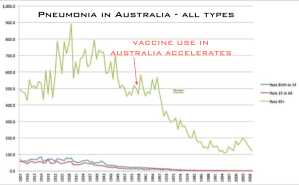
Thanks to Beattie’s graph we have an answer backed by The Australian Institute of Health and Welfare. Yes, most certainly.
Next is:
What percentage of all cases of pneumonia are caused by pneumococcal bacteria?
Now it’s time to leave Kansas entirely Dorothy. Beattie links to the American Lung Association Pneumonia Fact Sheet, claiming that 14% of all cases of pneumonia are attributed by the ALA to pneumococcal bacteria. What Beattie has done is taken the male discharges (589,000) and female (643,000) from 2006. This total = 1,232,000 pneumonia discharges for 2006.
He then gets an August 2009 annual estimation of 175,000 cases to get his 14%. It goes without saying that his claim, “according to the ALA, blah, blah…” is a lie. There’s nothing wrong with making rough conclusions from different sources but Beattie had no reason to a.) falsely attest to an annual figure and b.) falsely attribute it to the American Lung Foundation.
Let’s check that paragraph:
Streptococcus pneumoniae or pneumococcal pneumonia is the most common cause of bacterial pneumonia acquired outside of hospitals. The bacteria can multiply and cause serious damage to healthy individual lungs, bloodstream (bacteremia), brain (meningitis) and other parts of the body, especially when the body’s defenses are weakened. It is estimated that 175,000 cases of pneumococcal pneumonia occur each year, with a fatality rate of 5-7%, or even much higher among the elderly
Now it’s time to address Gregyl’s focus on pneumonia. Remember, Gregyl is attacking pneumococcal vaccination. The trick so far has been has been to focus on pneumonia and ignore meningitis and septicaemia. This enabled Beattie to invent or ask the wrong questions.
The notion of streptoccocus pneumonia cases being minor compared to other types is nonsensical. As noted way above, of all bacterial pneumonia cases, Streptococcus pneumoniae bacterium is isolated 50% of the time. It is the leading cause of pneumonia acquired in the community. So for Joe Bloggs, it may as well be 100% of cases. We can see by the graph above that the greatest variable is age – not type.
So to answer this question – It makes no difference.
Beattie is almost cornered by his lies. Next up is:
Will use of the pneumococcal vaccine reduce the incidence of illness?
Astonishingly he then blurts out, with no references:
- Most adults and children carry the bacteria without symptoms
- The vaccine won’t stop us coming into contact with the bacteria
- Levels of meningitis, septacaemia and pneumonia have not gone down
- Death rates are increasing in the elderly since introduction
The disease is spread by droplets from person to person. The Department of Health and Ageing note:
Pneumococci can be isolated from the upper respiratory tract in children and, less frequently, adults, and can spread directly from the nasopharynx to the respiratory tract which may cause otitis media, sinusitis or pneumonia. Pneumococci are also able to enter the bloodstream to cause invasive disease which may manifest as meningitis, pneumonia, septicaemia…
What then about notifications and hospitalisations from pneumococcal disease? Are they rising?
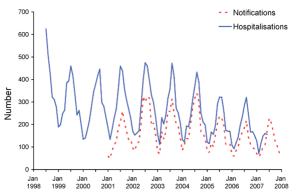
Pneumococcal disease notifications and hospitalisations, Australia, 1998 to 2007
Absolutely not. No idea where these guys get data from but it certainly won’t back what they claim.
How are the most vulnerable, the young and old faring? What of Gregyl’s increased disease and death in the elderly?
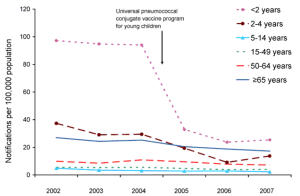
Pneumococcal disease notification rates, Australia, 2002 to 2007, by age group and year of diagnosis
No. Not here. Even remembering that the elderly show reduced immune responses to vaccination.
So the answer is – Yes, it will control the illness.
Next we get:
Will vaccinating against 23 strains of pneumococcal bacteria provide true protection against pneumococcal pneumonia?
After telling us it lives in the upper respiratory tract Gregyl now admits there are 91 different strains, and the vaccine targets 23. This is a genuine query and results suggest the vaccine will protect against the strains, compared to notification.
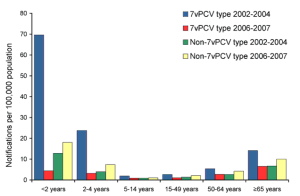
Notification rates of IPD cases with serotypes contained in the 7-valent pneumococcal conjugate vaccine (7vPCV), versus notification rates for other non-7-valent serotypes, Australia, 2006–2007 compared with 2002–2004, by age group
The Immunization Action Coalition offer:
What causes pneumococcal disease?
Pneumococcal disease is caused by Streptococcus pneumoniae, a bacterium. There are more than 90 subtypes. Most subtypes can cause disease, but only a few produce the majority of invasive pneumococcal infections. The 10 most common subtypes cause 62% of invasive disease worldwide.
In a concerted effort to mislead, Gregyl claims that, “studies in multiple locations around the world” have shown bacterial vaccines to lead to serogroup replacement. They fail to cite one study. Then again use the WHO Bulletin letter on developing nations to argue the point. Finally they claim this has happened with pertussis leading to “potentially more dangerous strains of bacteria”.
As has been explained here countless times no “more dangerous” strain of pertussis has evolved. In fact the opposite is supported by data. Fatalities are less than 1997 and 2000, whilst hospitalisations are about the same. This is parallel to far more notifications. More so, Tom Sidwell has demolished the notion of pertussis bacteria evolving around the vaccine.
Lastly we get:
Is there any evidence at all that use of this vaccine has led to a decline in either incidence of or deaths from invasive pneumococcal disease?
It’s followed by the use of NNDSS total notification figures of invasive pneumococcal disease in Australia to argue that there has been no change. Whilst the graphs above show a definite change USA research also backs significant reduction in infant infection and a reduction in mortality for all other age groups.
Yet most offensive is that NNDSS notifications tell us nothing about vaccination status. Every notification might be unvaccinated or every one may be vaccinated. Yet you’re tricked as if 100% of Aussies actually have been vaccinated. Nothing suggests infection even originated in Australia? This is one of Dorey’s old tricks. The fact is that it is an unrelated data set dealing only with notifications.
So our final answer? Yes, there is an abundance of evidence.
All up this was an appalling and scurrilous attempt to both scare the public into believing a vaccination “campaign” was under way and use this to fallaciously attack a very successful vaccine. Along with rotavirus, pneumococccal vaccination is on rapid roll out in developing nations. A major reason for this is it’s outstanding success here.
Dorey and Beattie, or Gregyl if you prefer, have been caught out at every single turn in this so-called “media release”. Not only does other evidence refute these absurd claims, even the evidence they provided upholds the importance of this vaccine’s success.
To be fair there was another question about making an informed choice. Which is code for will parents be provided with more codswallop of this type. As it had all just vanished in a puff of smoke I could see no point in answering.
In conclusion, to Gregyl and particularly Greg Beattie I am grateful for the chance to answer Yes to all those questions.
No matter how distorted they were.




 Losing In The Lucky Country