
So, should it be a collection? A theorem? A grab bag? A heap? A garble? Perhaps an annoyance? That may do for the purposes of this post. An annoyance of conspiracy theories (CTs).

Running through the collated knowledge of CTs, we know they’ve been around for a very long time, and reflect our awfully human ability to distrust.
Throw in some imagination that suits our own bias of how people and society function and it’s a small step to theorise about how others conspire to achieve their goals. Particularly at ones expense.
There’s been a copious amount of research into conspiracy theories and contemporary accounts tend to reference the assassination of President Kennedy, the moon landing, vaccines causing autism and more recently a host of annoyance surrounding COVID-19 the disease and the COVID-19 vaccine. Indeed, the spread and flexibility of CT rhetoric has been marvellously enhanced by the Internet and Social Media. The pandemic was of course a “plandemic”, whilst around the same time the delightfully helpful 5G technology cranking up download speeds was apparently actually spreading a man-made coronavirus.
There was no doubt such conspiracies caused harm. Whether from sabotaging individual confidence in public health, to destroying 5G towers, to nurturing dingbat thought processes, the sheer evaporation of critical thinking in relation to these topics was revealed to be stupendous. As research continued into conspiracy theories, came a fascinating piece in The Conversation just over 4 months ago. The notion that psychological distress leaves people more likely to develop or adopt conspiracy theory thinking, as a means to make sense of the cold indifference of reality, appears to benefit from further examination.
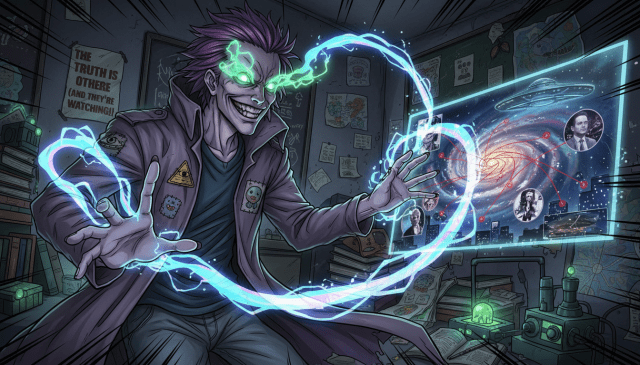
The existential threat model of conspiracy theories, as this notion is called, may not be as certain as previously elucidated. Fortunately the authors concluded that interventions involving critical thinking skills have a welcome role in combating the tendency to accept the flawed reasoning that conspiracy theories offer genuine understanding of our world.

Nonetheless, if we have discovered one alarming piece of information it is both the number of people who certain accept conspiracy theories, and the number of conspiracy theories migrating across cyberspace for the taking. As this month came to a close AOL published 50 Totally Insane Conspiracies People Actually Believe And Can’t Stop Talking About, which also links to this piece by BoredPanda with some truly silly notions about what and why a conspiracy theory is.
I myself could come up with a few conspiracies about either article. “America’s turning into 1940s Germany”, is perhaps on equal par with making the country “great again”. “AI is being made to look so real so that we can’t trust anything we see in the future”, may not be a conspiracy theory at all for cat-video lovers. Of course the BoredPanda chuckle-conspiracy theories may actually be an attempt by Big Psychology to plunge us all into depression at the thought this is what passes as humour.
Still, one thing is for sure. Once Epstein moves aside we will have more of that mere 10% of the brain that we actually use (ahem), to waste terabytes of social media and A.I. on new-found conspiracy theories.
 Losing In The Lucky Country