Respect your elderberries?

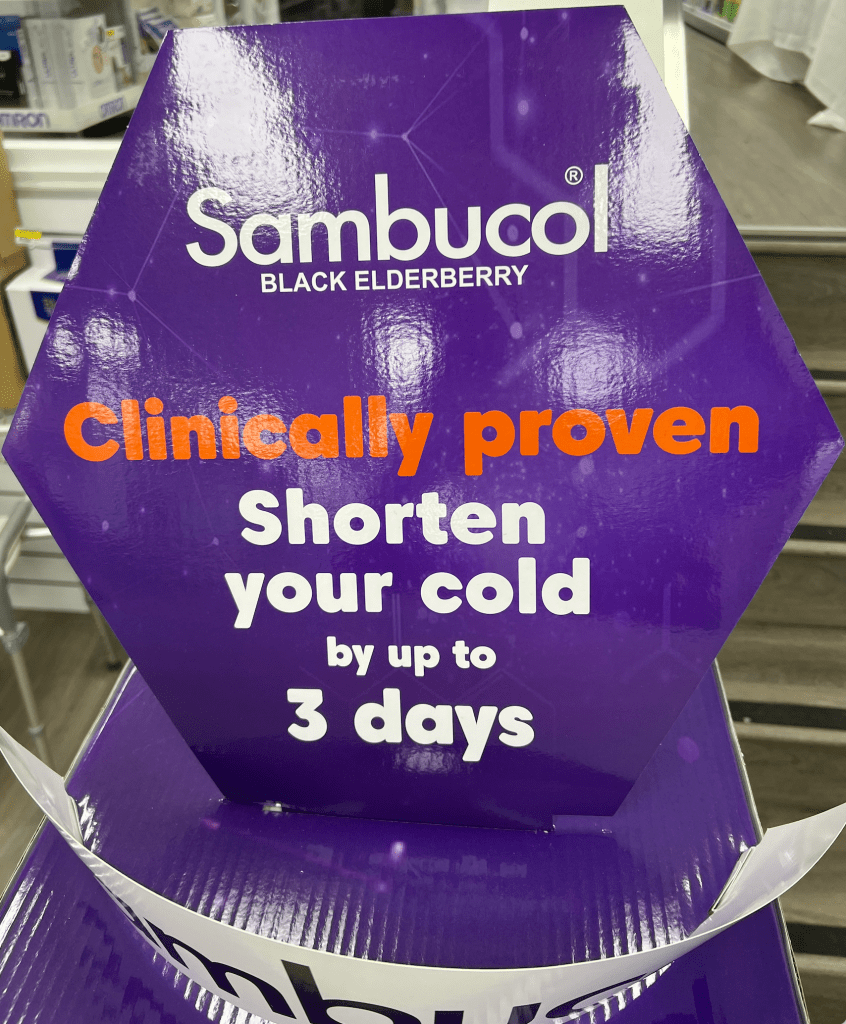
A couple of weeks before the start of winter, I wandered past a garish product display in my local pharmacy. A glossy purple hexagon boasted orange font across its middle; Clinically proven. Underneath that in white font: Shorten your cold by up to 3 days.

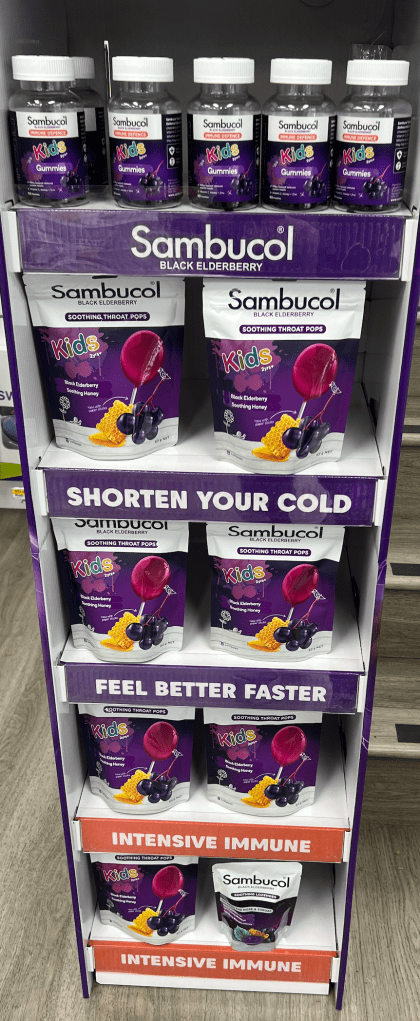
Taking in the entire sign, I spotted a familiar brand name. Sambucol® – Black Elderberry, a product of PharmaCare. The hexagon sat atop five cardboard shelves each labelled with more claims: Feel Better Faster, Intensive Immune, Shorten Your Cold, all packed with something for “kids”. Immune Defence Gummies, Soothing Throat Pops and Soothing Lozenges to “refresh the nose and throat”. It all sounded wonderful. I mean, who doesn’t want to feel better faster? Or puff up immunity with gummies? And knock 3 days off a cold? Surely it wasn’t just for kids. Then I wondered, could such claims really be “clinically proven”?

The elderberry grows on the elder plant (Sambucus nigra). Nataly Martini of the School of Pharmacy at the University of Auckland has written about elderberry in the Journal of Primary Healthcare, 31 March 2021 (2021;13(1):91–92. doi:10.1071/HC15960). It is reproduced by the Royal NZ College of General Practitioners, as a Potion or Poison article accessible here. The author notes “Dried or fresh berries have been used to treat constipation, neuropathic pain, headache, tooth-ache, sinus congestion, sore throat, influenza and the common cold, among others”. A meta-analysis of four randomised placebo-controlled studies, often cited by Pharmacare in promoting Sambucol, is also referenced. Martini reports that supplementation with elderberry, “reduced the duration of upper respiratory symptoms in verified cases of influenza, or symptoms consistent with either influenza or the common cold, when administered at the onset of symptoms”.

Martini continues:

Other studies have reported that elderberry supplementation significantly reduced symptoms and the duration of influenza A by 3–4 days, or the common cold by ~2 days in long-haul travellers. However, in the latter study half of the participants also used co-medication to relieve symptoms, limiting the application of these findings.

Writing in The Conversation Monash immunology researcher Kim Murphy referred to the latter study noting the collective duration of colds, rather than the average length, was compared in unequal group sizes, and concluded, “this isn’t a reliable finding”. What stands out in Martini’s article is the Summary Message. It highlights a recurring theme with the efficacy of elderberry preparations and symptom duration. Namely, that more research is needed to substantiate claims and high quality trials are currently lacking:

Although findings suggest that elderberry may be effective in reducing symptoms and duration of viral infections, more high-quality human trials are needed to substantiate these claims. Currently no studies support the use of elderberry in coronaviruses. Generally regarded as safe, toxicity may result from ingestion of raw or uncooked fruit, and allergies may occur in susceptible people. Use is not recommended in pregnancy and lactation due to insufficient evidence. Elderberry products may exacerbate symptoms in patients with autoimmune diseases. Caution is advised with immunosuppressants as elderberry may reduce effectiveness of these drugs. No major drug interactions are known.


Pharmacare is an alternative medicine manufacturer, and as such its primary concern is brand promotion and brand protection. In essence, Pharmacare is about sales. There’s nothing wrong with this, but as a skeptic I’m more concerned with the transparency of the claim that Sambucol® is “clinically proven” to reduce cold symptoms by up to three days. Can such a claim be trusted? Let’s review a 2018 article by Liam Mannix, science reporter for The Age and Sydney Morning Herald; University of Sydney pulls claims elderberries can fight flu, to get our bearings. The article opens:

One of the country’s leading universities has been forced to retract a claim its study showed eating elderberries could help beat the flu after admitting it was overhyping its own science.

The University of Sydney also concealed the research was part-funded by company Pharmacare – which sells elderberry-based flu remedies – at the company’s request. Although it was declared in the study itself, the university also failed to publicise that a Pharmacare employee was involved in the research.

The flu-busting claim, made in a press release and published on the university’s website, attracted national and international media attention, most of which did not mention the Pharmacare funding.

The article reveals that the study simply focused on in-vitro dosing of human cells in a laboratory environment. No mice or human subjects were involved. As stressed in the article such research is fine, but how it is represented is vital. Professor Ken Harvey, then-president of Friends of Science in Medicine observed:

“This is an appalling misrepresentation of this Pharmacare-funded in-vitro study. It was inappropriate and misleading to imply from this study that an extract was ‘proven to fight flu’.”

The article reveals that Pharmacare were aware of the press release but requested not to be named, for reasons study authors did not understand. Ray Moynihan, an assistant professor at Bond University’s Centre for Research in Evidence-Based Practice, who studies science reporting in the media stressed it raised “serious concerns” about transparency. “It is vital information for us to know who sponsored the study“, he said at the time.

The Sydney Uni episode said much about Pharmacare transparency and even more about claims relying on Pharmacare-funded studies. The company presently has a collection of articles gathered to back its many assertions. Some cite Pharmacare studies, whilst others present generalised health-related information, citing other studies, articles and reports. Following Sambucol® “shortening colds by up to 3 days” brings us to a page that opens with:

Sambucol® Black Elderberry Cold & Flu is the only Black Elderberry Cold & Flu product clinically proven to shorten your cold by up to 3 days.

The page refers to a study by Rao A, et al, and informs the reader it is an, “Unpublished study by RDC Global on behalf of Pharmacare Laboratories. Available on request.” More about this study, can be gleaned from a Pharmacare internal catalogue on their Clinically Proven Formula, which is marked on each page, “For Professional and Internals Staff use only. Not to be distributed”. The catalogue includes a number of Pharmacare-funded studies, and lists the Rao et al, study title in full: Rao A, Sethi M, Dick C, A double-blind, randomized, placebo-controlled study to evaluate the safety and efficacy Sambucol® liquid formulation to reduce the duration and severity of the common cold symptoms in adults. PHA-Sam15. 2016.

The catalogue summary of the study, offers graphs and a report on p.6. It professes a 31.8% reduction in symptom severity and a reduction in sick days from 8.9 to 5.9 (33.7%) days between placebo and Sambucol® recipients. The public summary includes:

The efficacy of Sambucol Black Elderberry Cold & Flu to reduce the duration and severity of common cold symptoms was researched in a double-blind, randomised and placebo-controlled study sponsored by Pharmacare Laboratories.

The study included 461 healthy, adult participants and found that participants who took Sambucol® Black Elderberry Cold & Flu daily from the onset of cold symptoms were sick for a significantly shorter period of time.

The median duration of illness for the placebo group was eight days, whereas the median duration of illness for the group taking Sambucol® Black Elderberry Cold & Flu was five days – a median three-day reduction in duration of illness.

According to the study, “The results show that supplementation with Sambucol® Black Elderberry Cold & Flu at the onset of cold symptoms significantly reduced the duration of a cold episode as well as significantly reduced the severity and impact of cold and flu symptoms.

Being unpublished, the Rao et al, study lacks the authority attributed to peer reviewed research. Nor has it been reproduced independently. Yet Pharmacare-funded studies are of paramount importance to their business model. It allows the company to produce and distribute positive material related to Pharmacare brands. As the FAQ page informs us under, What is the difference between Sambucol Black Elderberry products and other black elderberry products?

Not all black elderberry extracts are the same. Only Sambucol Black Elderberry, the original black elderberry extract introduced more than 20 years ago, contains the same proprietary, naturally balanced elderberry extract used in the published scientific studies. Other products use a concentrated, standardized elderberry extract. They are fundamentally different ingredients.

Pharmacare Brands

Nonetheless, the internal Pharmacare catalogue cites a number of studies where generic elderberry extract is used, to assert its effect on the duration and impact of cold and flu symptoms. There have been no comparative studies of extract efficacy, and as such there is no evidence that Sambucol® Black Elderberry is more or less effective than any other black elderberry extract. Generic extracts have been used in “the published scientific studies”, such as the Hawkins et al meta-analysis, which found an association with reduced influenza A symptoms and duration.

Speaking of influenza, Pharmacare cite two studies in their internal catalogue that conclude Sambucol® has an effect against influenza. On page 6 they refer to in-vitro and in-vivo efficacy against influenza A and B. On page 7 they refer to in-vitro efficacy in reducing H5N1 by 99%. The catch for Pharmacare here, is that Australia’s Therapeutic Goods Administration (TGA) limit the seriousness of diseases and symptoms that they can claim Sambucol® relieves. Influenza is not accepted (see below). On another note, one must be aware that Pharmacare’s Sambucol® benefits from generic use of the term Sambucol. Consider this entry for Sambucol at drugs.com.

Sambucol is a berry from a European or Black elder tree. The berries are used to make medicine. Sambucol is also known as Arbre de Judas, Baccae, Baises de Sureau, Black-Berried Alder, Black Elder, Boor Tree, Bountry, Elderberries, Ellanwood, Ellhorn, European Alder, Fruit de Sureau, Grand Sureau, Hautbois, Holunderbeeren, Sabugeuiro-negro, Sambequier, Sambu, Sambuc, Sambuci Sambucus, Sambugo, Sauco, Saúco Europeo, Schwarzer Holunder, Seuillet, Seuillon, Sureau, Sureau Noir, Sus, Suseau, or Sussier.

The emerging claim that Sambucol® improves immunity also deserves comment. The internal catalogue summarises a 2002 study by Barak et al, on page 8, with the conclusion:

Sambucol® activate the healthy immune system by increasing inflammatory cytokine production more effectively compared to other herbal remedies.

The study, The effect of herbal remedies on the production of human inflammatory and anti-inflammatory cytokines compared Sambucol® to propolis and Echinacea. These are used as herbal treatments and preventatives of upper respiratory tract infections in adults and children. The cytokine-modulating effect of echinacea has been demonstrated in-vitro and in animal studies. However, a 2021 systemic review concludes firm evidence linking elderberry to inflammatory cytokine production is lacking. However, accounts of elderberry syrup linked to Drug Induced Liver Injury and Autoimmune Hepatitis have become evident. In the latter case the overproduction of inflammatory cytokines has been considered. Depending on future incidence, proper management at the point of sale may thus require an understanding of patient history. Whilst this is possible in the pharmacy setting it is not so elsewhere.

The claimed reliability of elderberry lends itself to the appeal to antiquity as it has reportedly been used for centuries, for a host of purported reasons, as mentioned above, in addition to heart disease, gum disease, high cholesterol and obesity. The drugs.com entry for Elderberry and Sambucol are identical and include (bold mine):

It is not certain whether [Sambucol/Elderberry] is effective in treating any medical condition. Medicinal use of this product has not been approved by the FDA. This medicine should not be used in place of medication prescribed for you by your doctor.

The US Food and Drug Administration (FDA) have warned promoters of elderberry syrup, as evidenced by (for example) a September 2000 warning letter and another in August 2022, written to highlight breaches of the Federal Food, Drug and Cosmetic Act because the products advertised were “intended for use in the cure, mitigation, treatment, or prevention of disease”. The FDA does not regulate herbal supplements. In Australia the TGA accepts Sambucol Black Elderberry Cold & Flu and Sambucol Black Elderberry Cold & Flu + Pain as Listed medicines as opposed to Registered medicines.

Read more about TGA classifications here, and please remember a September 2022 TGA review of Sambucol® states, “The efficacy of the medicine was not assessed as part of this review”. Thus the term “TGA Assessed” cannot be used in relation to this product or on its label. Read more about TGA regulation of Listed medicines here. The TGA does not approve Listed medicine labels before marketing. The TGA state:

This is because we take a risk-based approach to regulation, which means higher risk medicines have more rigorous controls than lower risk medicines. However, we do require sponsors to certify that the medicine complies with all relevant regulation, and that they hold evidence that their medicine does what it says it will. Source: TGA – How we regulate medicines.

The public summary on the TGA Australian Register of Therapeutic Goods for Sambucol Black Elderberry Cold & Flu permits the following indications.

  • Relieve weariness/tiredness/fatigue/feeling of weakness.
  • Maintain/support general health and wellbeing.
  • Decrease/reduce/relieve common cold duration.
  • Helps decrease/reduce/relieve the severity of symptoms of common colds and flu.
  • Decrease/reduce/relieve symptoms of common colds and flu.
  • Decrease/reduce/relieve mild upper respiratory tract congestion.
  • Decrease/reduce/relieve cough.
  • Relieve symptoms of sore throat/pharyngitis.

Indication requirements are as follows:

  • Label statement: If symptoms persist, talk to your health professional.
  • Product presentation must not imply or refer to serious forms of respiratory disorders/diseases, such as: asthma, pneumonia, COAD, COPD, influenza.
  • Label statement: Adults only, OR Not to be used in children under 2 years of age without medical advice (or words to that effect).
  • Respiratory tract infections must be qualified by ‘mild’.
  • Product presentation must not imply or refer to chronic fatigue syndrome.

Looking at the above it is clear the TGA have been more than generous with the allowed claims in the ARTG indications for this product. Particularly given the lack of published evidence and the absence of TGA assessment for efficacy. I don’t accept that Sambucol is clinically proven to shorten colds or boost immunity or any other claims made in sales promotion. The evidence simply isn’t there and relying on unpublished work organised and funded by Pharmacare is misleading. Whilst an impact of elderberry syrup on cold and flu symptoms is acknowledged in literature, the most common conclusion is that more research is needed. Quality human trials are still lacking.

So what might Pharmacare have planned to improve evidence in their favour? The Australian New Zealand Clinical Trials Registry, presently has the registered trial ACTRN12623000299606, last updated 7 April 2024. The title is, Determining the effectiveness of Sambucol in reducing the duration and symptoms of the common cold in children and teens. The age group is 2-17 and the aim is to use Sambucol and report on symptoms via, “a purpose-built study app ‘Sambucol Research’.” The methodology is likely to favour Pharmacare, particularly given that there is no control group. Rather, “a comparison will be made to two existing data sets”.

The first data set is reported as:

Data describing the incidence, severity and duration of different cold symptoms in children over a six-week period. (Troullos E, Baird L, Jayawardena S. Common Cold Symptoms in Children: Results of an Internet-Based Surveillance Program. J Med Internet Res. 2014 Jun 19;16(6):e144.) This study was not a randomised controlled trial or an intervention. The study observed duration and severity of colds and as such was not registered.

The second data set is “a confidential report to Pharmacare”, and is none other than the initial unpublished study that found Sambucol® “shortened colds by up to 3 days”; Rao A, Sethi M, Dick C. A double-blind, randomised, placebo-controlled study to evaluate the safety and efficacy of Sambucol liquid formulation to reduce the duration and severity of the common cold and flu symptoms in adults.

The more things change…

Kambo: The promised cure linked to injury and death

An inquest into a Kambo related fatality in Northern NSW has been suspended by NSW State Coroner Teresa O’Sullivan, who referred the matter to the Director of Public Prosecutions (DPP). This is the second inquest into a death linked to the frog poison touted as an alternative medicine, to be heard at Lismore Court House since May 2023.

Jarrad Antonovich

Evidence in this case described how Jarrad Antonovich attended the Dreaming Arts Festival in Arcoora Northern NSW, on 16 October 2021. He died of a perforated oesophagus that night. His day included a Kambo ritual at around 10am. Kambo ceremonies at the festival were being run by Cameron Kite. After the Kambo, Antonovich displayed symptoms of being very unwell, including a markedly swollen neck – an adverse reaction known to be caused by Kambo. Despite being unable to stand without support by 5pm, Mr. Antonovich was later given the psychoactive brew, ayahuasca. He died during the ayahuasca ceremony after being helped into a hall where it was to take place. Both Kambo and ayahuasca are illegal in Australia. The inquest heard from different witnesses that they believed Mr. Antonovich was in need of professional help, but they had been instructed not to interfere with anyone’s “journey”, and to trust the medicine, the shamans and the organisers. The offer to call an ambulance was made by other festival attendees, but Antonovich refused and elders “reassured” concerned onlookers.

An ambulance was not called until 11:30pm and took an hour to reach the remote location. As Jarrad Antonovich’s life ended, organiser Soulore (“Lore”) Solaris was strumming his guitar at the front of the gathering, as others in another location were being guided in CPR over radio, as they attempted to save Mr. Antonovich. When paramedics arrived Mr. Antonovich was blue in the face and dead. Ten or twenty people in the immediate area were engrossed in the ceremony and one asked paramedics to “move away from Jarred because they were interfering with his aura”. Both Kambo and ayahuasca are associated with vomiting or “purging”, as adherents refer to it. Ayahuasca induces violent and sometimes prolonged vomiting. The coroner was investigating the likelihood that vomiting caused Mr. Antonovich’s perforated oesophagus. The exact reasons behind the coroner’s decision to refer the case to the DPP cannot currently be revealed.

Lore Solaris and Cameron Kite

Dreaming Arts Festival organiser Lore Solaris, a counsellor who facilitates ayahuasca ceremonies, is presently subject to a NSW Health Care Complaints Commission interim prohibition order under the Health Care Complaints Act 1993, Section 41AA. The order reads in part:

Mr Soulore Solaris must not under any circumstances provide, or cause to be provided, any health services, either in paid employment or voluntary, to any member of the public.

Interim orders may apply “during any investigation of a complaint against a non-registered health practitioner”. The HCCC may make an interim order if:

a) it has a reasonable belief that the health practitioner has breached a code of conduct for non-registered health practitioners, and 

(b) it is of the opinion that– 

(i) the health practitioner poses a serious risk to the health or safety of members of the public, and 

(ii) the making of an interim prohibition order is necessary to protect the health or safety of members of the public. 

Jarrad Antonovich’s former partner, Patrick Santucci, gave evidence in May 2023 that Lore Solaris had called to reassure him Jarrad’s death was a “beautiful occasion”. Solaris told him that kinesiologists couldn’t find anything wrong with him. Kinesiologists utilise acupressure on points of the imaginary “meridian system” and wrongly believe the body can heal itself. They focus on “imbalances” which may be caused by a forgotten memory or even an attitude. They may use flower essence or homeopathy. There is no evidence kinesiology works. Mr. Santucci testified that Solaris told him an Aboriginal elder chanted sacred songs, “calling the spirit out of his body” and that:

[T]he koalas were making a special sound that is known to the elders when the land accepts a spirit.

Protecting Ayahuasca

Both Kite and Solaris were due to give evidence on 24 May; the day the inquest was suspended. Had they given evidence, it was expected the men would have responded to alarming statements given by other witnesses, describing attempts to cover up events and mislead police. For example Mr. Antonovich had difficulty breathing, was moaning in pain and his neck was swollen to the jaw line. Kambo practitioner Laara Cooper suggested giving him ayahuasca as this could “help shift” the Kambo induced discomfort. Consequently Antonovich was given what was described as a “not small” cup of the brew by Cameron Kite at the instruction of Solaris.

Cooper and Solaris had told ceremonial “guardians” to drive to Antonovich’s home and tell his flatmate not to mention to police the use of ayahuasca, in an attempt to “protect the medicines”. The inquest heard Cameron Kite was deeply distressed by events at the festival and told his partner at the time that Solaris and Cooper “just took over” the account given to police. Festival attendees were also told not to speak to police or paramedics about what actually happened as it may “damage the good work” being done with Kambo and ayahuasca. Antonovich was found to have ingested toxic levels of N,N-Dimethyltryptamine (DMT); ayahuasca’s most powerful psychedelic.

Both ayahuasca and Kambo are favoured as alternative medicines by neo-shamanic devotees, convinced purging “detox” experiences lead to personal growth and discovery. Logical fallacies such as appeal to antiquity, appeal to nature and an unguarded tendency toward xenocentrism, leave them vulnerable to experimentation and/or regular use of both substances. Traditional use of both can be traced back to indigenous tribes of the Amazon. Ayahuasca has a well established profile of around 70 years, as a promised cure for Western ailments, particularly those with a psychological component. It has also attracted research attention in offering an overhyped role in opiate addiction recovery. Despite some evidence suggesting it may have been used as early as 2000BC, widespread use across the Amazon was reliably established in the mid-19th century. Ayahuasca religions emerged very late in the 19th century. The Antonovich inquest heard that a Brazilian blend of Christianity and Amazonian shamanism (including drinking ayahuasca) had gained influence over The Australian Church of Ayahuasca, which had been active in the Northern Rivers region.

Kambo

Kambo has a much shorter history as a choice of alternative therapy in Western society. It gradually attracted interest after the International Association of Kambo Practitioners (IAKP) was established in 2014. Despite the flowery, earthy tones on their site, Kambo is emerging as a substance with a much higher risk profile than ayahuasca. IAKP claim:

IAKP teachers guide students to cultivate a profound comprehension and reverence for this potent natural modality. By enriching and forging connections with the intelligence and spirit of Kambo, our training courses enable practitioners to embrace personal growth, embark on a voyage of self-discovery, and engage in selfless service to others through the safe application of Kambo.

Kambo is collected from secretions of the Amazonian giant leaf frog, after “agitating” the innocent amphibian. Images suggest more than a little agitation is needed as they depict a frog tied by each leg and stretched asunder. The secretions are dried and packaged. Kambo is illegal in certain South American countries unless used in traditional indigenous practice, including Brazil. For Western ceremonies, the poison is reconstituted with water or saliva and applied to burn sites made with a smouldering stick on the arms, legs, chest or shoulder. Lucky recipients may get a dash of “dragons blood” tree sap as an antiseptic. The poison quickly makes its way into the lymphatic system then the bloodstream, and the effects begin.

Kambo lacks the psychedelic and hallucinogenic experience that ayahuasca brings. Writing for The Conversation Martin Williams notes:

Typically, the first symptoms reported are an initial rush of heat and redness of the face. Nausea and vomiting are often experienced within several minutes, accompanied by general malaise, racing heart, dizziness and swelling of the face, and sometimes an urge to defecate. Further effects include the feeling of a lump in the throat or difficulty swallowing, abdominal pain, nausea, vomiting, diarrhoea, runny nose and tears, swollen lips, eyelids or face, and occasionally a swollen tongue or throat.

Adherents claim this process rids the body of toxins, although there is no evidence supporting the claim. In 2021 the Therapeutic Goods Administration (TGA) classified Kambo as a Schedule 10 poison (page 9). They are defined as, “substances of such danger to health as to warrant prohibition of sale, supply and use”. Kambo does not have any medicinal benefit and can damage the liver, stomach and cause cardiac arrest. Visiting the IAKP website page on contraindications yields nothing but arguably useless advice; “For the latest updates and safety information relating to contraindications and cautions, please seek guidance from an IAKP trained Kambo practitioner.”

In the Natasha Lechner inquest findings, Coroner Teresa O’Sullivan referenced medical contraindications “according to the IAKP” (page 9) and observed it was unclear if these are supported by peer reviewed research. She also criticised the paucity of the IAKP information relating to “risks” and particularly IAKP training material on the risk of death. One thus wonders if the present absence of contraindications is a policy recently adopted by the IAKP. More so the IAKP Code of Ethics and Professional Practice omits any reference to the dangers of Kambo itself.

Natasha Lechner

Natasha Lechner died on 8th March 2019, following a Kambo ceremony at her home in Mullumbimby. The inquest into her death was held at Lismore in May 2023. NSW State Coroner Teresa O’Sullivan handed down her findings in February 2024. The coronial findings (PDF) provide valuable insight into the insouciance with which self proclaimed shamanic healers prepare for what is known to be a high risk “ceremony”, and the potential for tragedy that awaits vulnerable individuals drawn into this culture. This was an unnecessary death stemming from a failure to call for help.

Natasha lived with a number of chronic health issues and was unable to work. Two months before her death she had undergone a two week basic Kambo course run by the IAKP. The coroner found that the IAKP was founded by Karen Darke who has no medical qualifications. IAKP has no input from toxicologists or medical practitioners in development of their training materials. Natasha took her role as a Kambo practitioner seriously.

In 2014 Natasha met Victoria Sinclair who, as a senior Kambo practitioner used the name Maestra Victoria. Her website mentioned in the coronial finding is still available. She advertises herself extensively, including:

Victoria is a transpersonal (eco)psychologist, trauma and postcolonial theorist and plant medicine practitioner, working on a High Priestess Level of initiation, ordained through several lineages and acknowledgments and in terms of shamanic initiation and training she worked prolifically in the Free Party Scene in Europe since 1990s and has been journeying and working extensively in Central and South America and Australia since 2006.

Indeed. Ranging a little further than the inquest findings, one discovers this woman has more qualifications I’m not familiar with. Such as these “therapeutic qualifications”:

Victoria has been a Reiki practitioner since 1999 and is a Master of both Tibetan Usui Reiki and Sekhem – Seichim – Reiki.  She has been teaching people globally since 2012 and has dedicated herself deeply to upgrading Sekhem teachings to help to create a Higher Pathway to Metaphysical Ethical Practitionership as part of her Dharma.

Her training background includes;  Transpersonal Psychology, Non-Dual Astrology, Epigenetics, Trauma work, Pranayama, Kundalini Yoga, Plant medicines, De-colonisation and Quantum, sound and ancestral practices… She is also a plant communicator.

If you’re not convinced you’d want to be alone with Victoria when you take a frog’s defensive secretion that the TGA later classified as a schedule 10 poison, be aware that Victoria also works with indigenous groups, “around spiritual sovereignty and healing of self and eliminating planetary dis-ease to nurture higher vibrational being for the new age and evolution of homo luminus.”

Ranging a little further allows us to meet her latest incarnation, Victoria Padma Khandro, who is offering over this year and next:

  • High Level Multidimensional Mentoring
  • Non-Dual Astrology readings and Time-line work
  • Soul-plan work involving fusion clearing, psychotherapy, Quantum Transfiguration, Ancestral Work, Gene Keys and Astrology zero-pointing
  • Therapeutic packages including ancestral work, IFS, Quantum Transfiguration, Quantum Art Therapy and sometimes in-house referrals to deepen the scope of the work.

Returning to the inquest findings, we find that before 2019 Victoria had performed Kambo ceremonies on Natasha who either paid her or provided accomodation. In March 2019 Victoria Sinclair was visiting from Ireland and was staying with Natasha at Mullumbimby. Before Sinclair arrived Natasha had reported feeling “really off”. It should be stressed that the “ceremony” was Natasha’s idea. They began the ritual by using Sananga eye drops. Sananga is another psychoactive plant extract associated with a host of unproven health benefits. Natasha administered Kambo to Sinclair who vomited, as expected, without incident.

Sinclair administered the burn wounds onto Natasha with an incense stick, then applied the Kambo. Immediately Natasha became faint and lay down. Two minutes later she sat up, grabbed Sinclair’s hand and said “this isn’t good” or “something’s not right” before passing out. Sinclair thought she might be “processing something” and held her upright for about 10 minutes as Natasha made moaning noises. Only then did she lay Natasha down in the recovery position and remove the poison from the wounds. She attempted to revive her by pouring water over her head. Then noticing goose bumps, assumed she was cold and began to massage her limbs.

Sinclair began CPR after noticing Natasha’s lips were blue. She attempted to use a mobile phone to call an ambulance. This failed as “she did not normally use mobile phones” and didn’t know the Australian emergency number. I find this deeply troubling as mobile phones allow access to dial emergency services without needing to be unlocked, or input of the specific number. As the more experienced Kambo practitioner, with a promoted reputation of travelling the global party scene, Sinclair should have known this. Natasha’s house-mate arrived home around 90 minutes after the ceremony had begun. She immediately began CPR and called an ambulance which arrived within 5 minutes. Natasha was already dead. Despite testifying she had ceased Kambo administration after Natasha’s death, Victoria Sinclair still advertises the service. The coroner specifically addressed the legalities of Sinclair’s involvement on pp. 12, 13 & 15.

As I touched on above, the coroner was critical of the IAKP training material on the risk of death. Evidence given by Sarah Morrison (aka Aisha Priya) cited the various risks discussed (page 10). On death, information for Kambo practitioners was:

Death is discussed as a risk if the water guidelines or first aid are not adhered to or if a client is contraindicated and does not disclose this or does not know they have a medical condition.

The coroner observed the incompleteness of this information and noted it does not advise even healthy people of the true risk of Kambo. Available literature and the two cases brought to the coroner’s attention led her to observe “that death can occur even where there is no pre-existing condition, or at least not one that could be possibly identified beforehand.” It is likely Natasha experienced an acute cardiac event caused by Kambo, such as cardiac arrhythmia leading to cardiac arrest or hypotension leading to cerebral hypoxia followed by respiratory arrest, as causes of her death.

Conclusion

Kambo is emerging as a significantly dangerous substance favoured by individuals interested in extreme so-called alternative medicines. It has been rapidly adopted by communities already familiar with ayahuasca, yet has a demonstrably higher risk profile. There is no scientific evidence to support the efficacy of Kambo in alleviating health problems as claimed by proponents. Nonetheless, the presence in Kambo of peptides and polypeptides with analgesic properties and affinity for opiate receptors may explain “feelings of well being and improvement of motor skills”, that users describe, and offer insight into repeated use.

Still, it is the very complex nature of active substances in the secretion that cause arterial hypotension, palpitations, cardiac arrhythmia, facial swelling (see Maestra Victoria above) and uncontrolled smooth muscle changes in the gut. To hope that shamans and self-styled practitioners of Kambo, who offer it as a means to spiritual awakening, are all capable of managing a genuine adverse reaction to the poison is futile. Use of Kambo in Western rituals is entwined with new age scam “therapies” so clearly divorced from reality as to almost beggar belief. This is not the case in the indigenous Amazon populations using Kambo.

Vulnerable individuals interested in exploring non evidence-based treatments for chronic health problems are at high risk of harm if not death from Kambo and its eager promotion. Use is likely to further increase and the self-appointed arbiters of Kambo sourcing and education, the IAKP, are manifestly ill prepared to manage present risks or to protect users.

Community education and adaptation of Harm Reduction strategies may likely prove beneficial in negating risk.

The Secret Santa

Very late on Christmas Eve 2023, Santa had just dropped me a rather special present.

I more or less knew what it was by feeling the packaging, but still fumbled hastily until it sat gleaming in my hand. There it was. A brand new COVID-19 infection.

I could hear him jingling happily into the distance, with the words “naughty” and “nice” echoing on the breeze. Then, “falsifiable hypotheses” wafted back.

Of course! I suddenly remembered a discussion years ago, soaking our blistered feet in cured reindeer urine, when he told me anything that could be falsified was inherently “naughty”. Wrongly, I thought I had properly explained things to him.

This time, I’d sort him out. “Santa, Santa. I just KNOW we’ve had this conversation before”, I yelled in his direction.

I continued.

🎼 Making a list, 🎶 and checking it twice 🎵, gonna find out 🎶 who’s naughty and nice… does not a falsifiable hypothesis make. I just… I mean, I can’t even….”.

He answered with a vague reference to falsifying anti-vaxxer claims and something even more vague about my feet needing another urine soak. Next thing an apparition-like, misty glob of reindeer, a sleigh, a fat, smelly-chap, sacks of presents and boxes of Rapid Antigen Tests was in front of me. Santa folded his arms and confidently started his defence.

I responded,

“Wait! What?! Say that again. I’ve been ‘naughty’, because I revealed falsification, and therefore I can’t enjoy Christmas this year? No, no dude, you’re attributing subjective emotional qualities to the entire notion of the falsibility hypothesis. Yeah I get it – you’re saying if I hadn’t showed things were totally false that I’d have been ‘nice’, particularly because you were 🎶 checking it twice🎵. But if I may, with respect old chap, it simply doesn’t work that way.”

He laughed, pointing at me, and asked, “Why the fud not?”

I was feeling far from well but managed.

“Well because, my long-bearded, voluminous-bellied friend. The very notion that the hypothesis can be falsified, is what lends it such robust integrity in the first place. Suggesting falsifiability is ‘naughty’ and anything not shown to be false is ‘nice’, is likely a position arrived at via a sequence of logical fallacies.

He said I was making some sense but sounding very lah-de-dah. So, I went on.

“Okay, let’s agree your position is that honesty or not ‘being false’, can be labelled very simply as ‘nice’. Cool? Righto then. And that dishonesty, or being deliberately false can be labelled as ‘naughty’. So, deliberate falsehoods coming from, ooh let’s say anti-vaxxers, are ‘naughty’. In fact they are known for providing so-called data based on fabrication, and fraud. So, let’s say ‘very naughty’.

Now, that all sounds okay, but it can’t really be tested beyond the scope of opinion. It also takes unnecessary work and lends credence to fraudsters. Better then, that the theory or hypothesis is one that can be tested and logically refute the idea being questioned, particularly if the falsification can be based on empiricism (what we see or experience).”

Santa asked if empiricism was like the Black Runes-of-Empiricism that Senator Malcolm Roberts used, to make a mockery of climate change.

“Why yes, you’ve heard of him then? A total… whoa, okay… sorry, yes, yes I did see the pontoons strapped to the sleigh. Bit sloshy up North… I can grasp that. Reality and Roberts don’t get on, Santa. Not a fan are we? No Ho, eh? Ah, well… er, no we can’t do the sword thing anymore. No, no the Blood Eagle never did take on down South. Sorry. Free speech and such. Oh? Well, um, I’d prefer to say we’ve become, “civilised” but “as sturdy as walrus diarrhoea” will do for any justified criticism in this case, old chap.”

Santa mumbled on about colourful torment to Roberts for a while, many involving objects I had never heard of, then he then gradually worked his way back to chatting about falsifying arguments and hypotheses.

I jumped in.

“So, see it’s simple really. If you can devise a method to falsify an argument that someone is proposing, then it is held to a greater standard of proof because it is possible to falsify it. Even if it has never been falsified. It just means it is possible to imagine or construct an argument to falsify it.”

I was by now feeling pretty crook and thought I might try my luck at swapping my present.

“Now Santa. Maaate, buddy, bloke. I realise we’re a long way from naughty and nice but I hope this clears things up, and clafifies the obvious error of this rather unique present you’ve dropped off. I guess this is one test I’d like to have seen falsified as it were… Nudge, nudge. Any chance you can wave the magic stocking..?

What’s that? Yes, yes, I did expose a bunch of anti-vaxxer arguments as false. They were false – fabricated in fact. In fact they were all bad. Thanks for noticing – it’s quite a long way for news to travel up North. What do you mean I’m still naughty? Er, yeah, okay… sure… But dude, I don’t CARE how many times you’re 🎼 making a list, 🎶 and checking it twice 🎵. Didn’t you understand a single thing we just discussed?

So, I’m what now? I’m too Skeptical? So I’m naughty because I’m too Skeptical? Oh, righty-Ho-Ho! What? Well, yes I’ve had a few COVID vaccines. Oh, I see that’s what this is. But I never said they were 100% protective; that’s an anti-vax logical fallacy. Gawd, Santa! Vaccines do reduce symptoms though. What? Well, er pretty sh*t actually. I’m running a temp of 39 C. But tomorrow I won’t be.”

Incredible! Santa seemed to be warming up to Gish gallop. Time to wrap this up.

“Anyway bloke. It’s getting late. Shouldn’t you be flying toward the West by now? Time zones and all that. You’re what?! You’re not flying!? Oh?

You’re Travelling!?”

Oh my.

Conspiracy Of One – Nate Eggins – will entertain Skepticon diners

Entertainment for Skepticon’s Saturday night dinner, will be courtesy of Brisbane-based songwriter, musician and science communicator, Nate Eggins. In addition, Nate will also be one of the Skepticon MCs. With thought-provoking lyrics, Nate aims:

To encourage interest in science, promote critical thinking and with his quirky sense of humour, playfully nudge us to second-guess pseudoscience, modern advertising and conspiracy theories through fun catchy clever music.

Nate, a multi-instrumentalist, has used his talent and interest to create the solo project, Conspiracy of One. Described as A bit sciency, A bit funny,Conspiracy of One sold out two live performances at the Brisbane Planetarium, for the release of Nate’s debut album, Road To Reason.

Skeptics and fans of the Australian Skeptics podcast The Skeptic Zone are likely familiar with Nate’s 2021 hit, The Sound a Duck Makes. Indeed your “Quack!” vocal may well be on it. Road To Reason reflects Nate’s journey, “from the darkness of ignorance toward the light of scientific and critical thinking”.

Hit songs from the album include Can You Guess My Star Sign? which features Dr Karl Kruszelnicki, The Song THEY Don’t Want You To Hear and It’s Not You, It’s Corona. Great music and good humour with dinner, in the company of skeptics? Sounds like a great night.

You can learn more about Nate Eggins on his Facebook page, Instagram or check out some of his music on YouTube.

The Saturday night dinner is at the St. Andrews Conservatory in Nicholson St. Fitzroy. If you’d like a ticket, please visit Try Booking.

Clinical psychologist required for Skepticon audience

Gary Bakker is a clinical psychologist with over 40 years experience. His talk at the upcoming Australian Skeptics national convention is titled, Sex, gender and identity: The politics and the science.

It can be a controversial area of which Gary notes:

Gary notes:

It has been very hard to get past the politics of issues around sex, gender, and identity while trying to apply the science to our legal and social policy decision-making. For example, it took several submissions to journals before my two articles on the topic – ‘Sex, gender, and identity: It’s complicated’ and ‘Sex, gender, and identity: Science or politics?’ – were published, both eventually in Rationale, the journal of the Rationalist Society of Australia.

Even Skeptical Inquirer “didn’t want to go there” because any moderate contribution is attacked (cancelled) by both of the vocal extremes on the issue.

Visit Skepticon 2023 for more information or look for tickets here.