Over on the Skepticon 2023 website is a link to all convention speakers.
Melanie Trecek-King, the creator of the online critical thinking resource, Thinking Is Power will be speaking at Skepticon 2023. Melanie is an Associate Professor of Biology at Massasoit Community College and has a “teach skills, not facts” approach to science education.
You can check out Melanie’s Facebook page, the Thinking is Power X profile or read Melanie’s full profile on the Skepticon 2023 website.
Details and a range of tickets to Skepticon 2023 are available via Try Booking.
It’s commonly said that seeing is believing, but it’s often the other way around: Believing is seeing.
In June this year we briefly met suspended GP registrar, William Bay, thanks to his attempt to intervene in the Australian Babies Case. He has summarised his reasons for doing so here. Suffice it to say the Australian Vaccination-risks Network were not happy, making me very happy.
Fast forward to the present, and former AVN president Meryl Dorey, who has taken to feverish promotion of cooker-conspiracy theories on Substack, revealed Saturday that the same William Bay had sent her a formal Letter of Concern. It lists numerous comments about him on her Substack site, that he believes are defamatory. Billy wants the article and every comment removed, topped off with a public apology. This is the latest event since Billy, who proudly refers to himself as the Suspended Dr. William Bay, falsely declared his High Court challenge to have the Voice referendum declared unconstitutional, was a success.
This was not the first time Billy, who often proclaims he’s doing God’s work, declared victory in stark dissonance to the facts. He is soundly refuted by AAP FactCheck here. AAP provide insight into how quickly disinformation spreads between cookers. Billy’s proclamation of victory is a great example of how the uncritical acceptance of a claim can influence belief. It also underscores the power of social media, in this regard. Billy gave a performance of confidence and credibility in a Cafe Locked Out interview, citing as proof documents that actually confirmed his failure.
During the interview he referred to a document on his website’s legal docs page headed “Application For A Constitutional Or Other Writ”. Billy directs viewers to his site then says:
I’m looking at it on my computer right now. It’s a miracle, it’s gorgeous, it’s great. It is a stamped document by Justice Jagot of the High Court itself who has declined to rule on the constitutionality of the referendum. So with this case being dismissed from further need for analysis, in legal circles as my lawyer friends will know… if jurisdiction is not proven it is invalid.
The gorgeous and great miracle was the exact document Billy had submitted for filing. The stamp added by Justice Margaret Jagot references High Court Rule 6.07.2, which deals with the management of frivolous or vexatious applications, and includes:
I direct the Registrar to refuse to issue or file this document without the leave of a Justice first had and obtained by the party seeking to issue or file it.
The upper part of the stamped application is below.
Screenshot – Billy Bay’s rejected application
Of course I am not a lawyer, and neither is Billy for that matter, but he has filed documents with the High Court before this. The Notice Of Filing cover page is part of previous documents he has lodged, displayed on his website. This includes file number, title, registry, type of document; in this case Application for constitutional or other writ, filing party and date. Think of it as confirmation that legal proceedings will take place. Plainly absent from his gorgeous miracle, it also clearly states:
Notice of filing page: Important Information
Staying in theme dear reader, I submit that the evidence before you supports the contention that the Suspended Dr. William Bay did know or should have known that his application was unsuccessful, and did know or should have known that the 2023 referendum is not unconstitutional. This conduct is not unusual for Billy who frequently offers baseless beliefs as fact.
Nonetheless, what followed was an old fashioned pile-on by various “freedom fighters” who took three days and more to decide Billy was wrong. Which interestingly, although they’d never admit it, was how long it took for AAP FactCheck to publish their rebuttal. More so, the stamped rejection of Billy’s application was available on 5 September receiving comment on social media by critics of the so-called freedom movement.
Then on 8 September, long time anti-vaxxer, AVN member, self-proclaimed “journalist” and founder of The People’s Revolution, Tristan Van Rye, better known as Triccy Triddy took to Facebook. Triccy lives in that alternate universe where nefarious global conspiracies of momentous proportion are accepted as fact. His tactics deserve proper deconstruction, but for now bear in mind he is driven by base neoconservatism. There is the ever-changing enemy to fear and there is “us”, constantly threatened by the enemy. Triccy’s a true believer and whilst he’s sowing fear, disinformation and social harm, appears genuinely convinced he is doing good.
In this video Triccy does a sound job of pointing out why Billy’s claim that the referendum is unconstitutional, can only be bogus. Chatter in the cookerverse following Billy’s announcement was reinforcing his other claim, that voting is unnecessary. Triccy had spent months sewing disinformation and anxiety about voting “Yes” and understandably couldn’t allow the chance of lost votes to go unchallenged. Other seasoned curators of disinformation felt the same way and rushed to their live streams. Senator Malcolm Roberts (who himself alleged in parliament that the ballot was unconstitutional), AVN president Aneeta Hafemeister, SovCit grifter Mike Palmer, former MMA fighter and Peacemaker founder Nick Patterson and pseudolaw obsessive Derek Balogh, all had a sudden concern for the spread of misinformation.
In the wake of Triccy’s video, Billy sent him a text message. It was reposted on Telegram:
Triccy, I hearby request and direct you to take down that FB live that you just did about me because I consider it defamatory. We have WON in the High Court. I will continue to show and explain that to the people of Australia; until it’s crystal clear for everyone I encourage you to keep an open mind to things, and in the meantime, I would appreciate it to save us all the trouble if you would remove that video please. Dr William Bay
Billy also sent a Letter of Concern to Triccy in response to said defamatory video. Triccy, in a rare moment of near jocularity, burnt it in his favourite faux lounge fire-pit. Billy however, kept up his booming confidence and applied for leave to issue or file the original application. This matter was heard on 15 September and ruled the original application an abuse of process. See p. 5, para 8:
It is not necessary to consider the question of standing, here in the context of a referendum. By r 6.07.1 leave to issue or file should be refused where the document would amount to an abuse of process. The latter term encompasses proceedings which are foredoomed to fail, as the proposed proceedings are.
Ah, foredoomed to failure, dear reader. A weighty yoke for our suspended doctor to bear. By 19 September, Billy had apologised to Triccy and withdrawn “proceedings”. Triccy was not amused, and announced an end to any further cooperation with Billy. He also took issue with a claim Billy made about employment restrictions imposed by AHPRA. We’ll get to that. First, we don’t want to forget that when Billy was gearing up to sue Triccy for defamation, someone else got their bad ass boots on. In fact there was bad assin’ and chin juttin’ aplenty from our Meryl, all with the hope of provoking Billy.
He was easy to provoke and Meryl went in hard. In a piece titled Distinguishing truth from bullsh*t 101, Meryl hit him where it hurt. It began with humour, as Australia’s most pernicious antivax liar laid out the section heading; Unity is vital – but truth is paramount. Oh, how we laughed! But next came mockery with; Billy Bay’s High Court “Victory”. Ah, the sting of those quotation marks. Then Not the first time Billy has done this, opened the way to a recounting of the failure of the Australian Babies Case. But ultimately came the totally bad ass; Will Billy Bay now come after me for telling the truth about his actions?
Having got the desired reaction, Meryl posted an article, referring to him only as “Bully” as she outlined the specifics of Billy’s letter of concern. The subheading; I don’t take well to threats, can only be described as (need I say it?) totally bad ass, and the article swiftly dispenses with any notion that Meryl is concerned. Within, she refers to a comment reply she wrote in response to Billy’s comment requesting her to “stop attacking” him. She raises the same issue Triccy Triddy had done regarding Billy’s claim on Voice of Freedom that AHPRA had prevented him from working in “any job at all”.
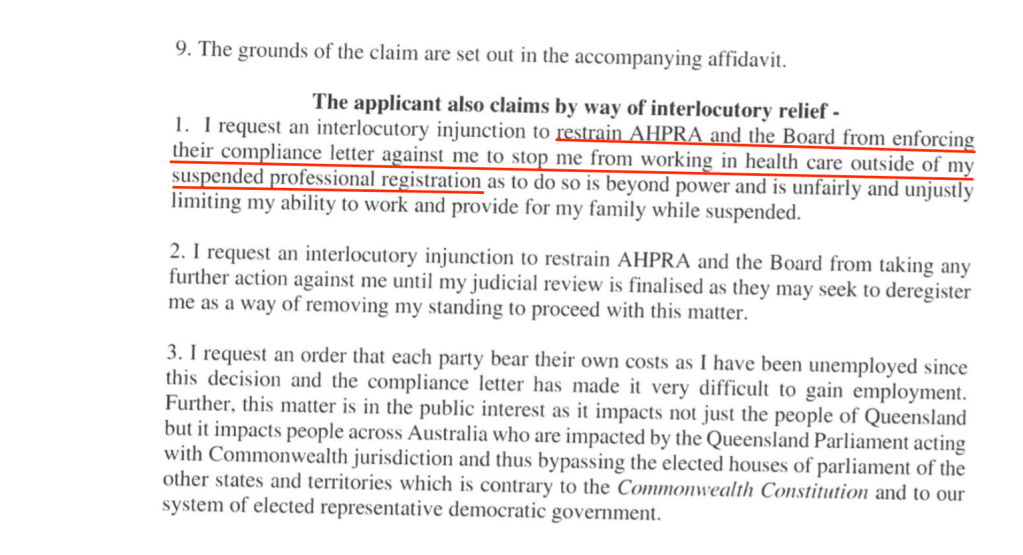
This is another jolly example of that area between remote possibility and reality that Billy exploits. Just as he continued to claim victory in the High Court because he had filed for leave to have his (already rejected) application accepted, there is a submission Billy refers to in the hope of convincing his followers. Simply put it is material submitted in reply from Billy to AHPRA, The Medical Board of Australia and QLD State, in the wake of his suspension. It happens to include:
So, he sought an injunction to prevent AHPRA and the Board from further enforcement of their “compliance letter” so that he can work in positions that don’t “require current registration with AHPRA as a condition of employment”. Neither AHPRA nor the Board have the power to enforce conditions outside their purview. Billy has always been free to work in areas where registration with AHPRA is not required.
Prior to this Billy had submitted an Application for Review of the findings of AHPRA and the Board. On page 7 is a request for an injunction to limit enforcement of the “compliance letter”, so that Billy could work in health care roles seperate from those of a GP Registrar.
The “compliance letter” is clear in that Billy is prohibited from working in health care. All health care, and only health care. In fact, the same document includes a November 2022 affidavit from Billy Bay which presents a clear summary of that letter on page 4, item 15:
The evidence that AHPRA ever sought to prevent Billy working “at all” doesn’t exist. Yet Billy chose to zero in on one part of a much larger, failed application to the Supreme Court. From 27:20 to 28:45 in the interview with Carl Lieberman, Billy talks about what he then thought were defamatory comments from Triccy Triddy. It was “a matter of life and death” for him because if his followers don’t trust him, donations would dry up and this was his only income. You can grab the mp3 file here or listen below. The important part is:
Billy: I even filed an application in the Supreme Court to let me work in any job at all and I lost that one…
Carl: Is that any job in health or any job at all?
Billy: At all, at all Sir… at all! It’s an outrage. It’s a disgrace and a disgust and the people of Australia need to know that, to see how unlawful this AHPRA agency is that they think they can regulate me that much. If they can do that to me they can do that to you.
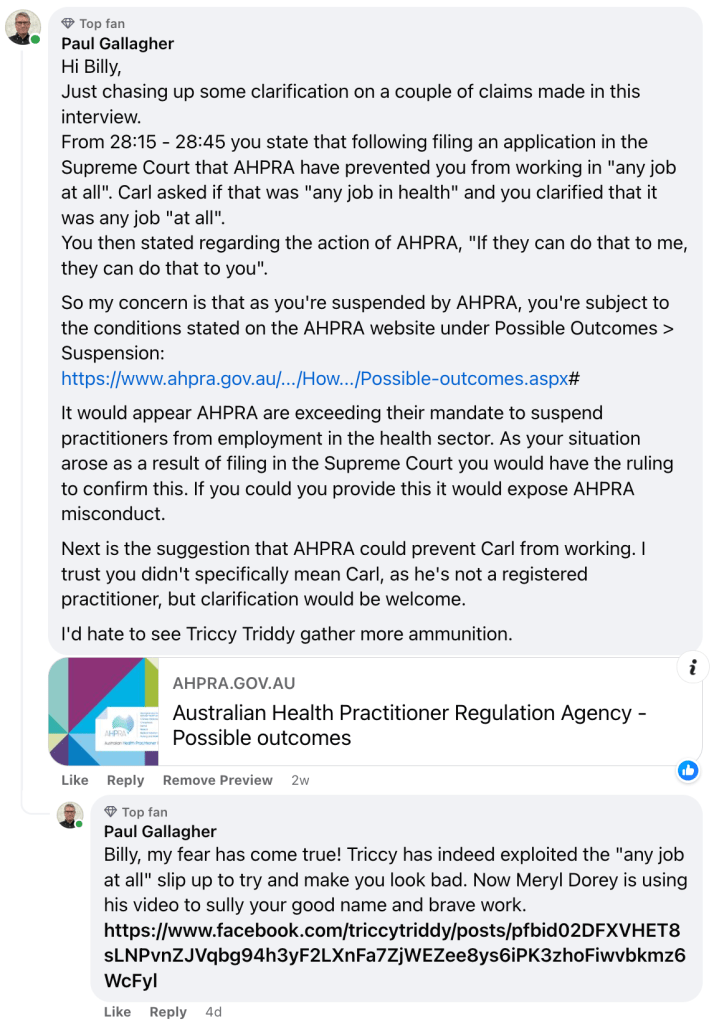
Carl’s face is priceless as he can’t hide his incredulity. He asks Billy about responding to AHPRA under basic trade-law rights, but Billy had already tried “the international covenant on political and civil rights”. And so it came to pass that Triccy and Meryl called foul on this claim of Billy’s. But they were ten and fourteen days late respectively. Where did they get such bad ass information? Could it be that badder asses had earlier sought to hold Billy to account? A quick visit to Billy’s Facebook page gave me an answer of sorts. Some devious character with an obviously fake name had commented under the video, a day after it was posted:
The plot thickens! There’s also some lucky losing cast iron flying pig standing on an old copy of The Skeptic magazine and snooping around X.
@DrBillyBay Can you support your claim of being prevented by AHPRA to work in “any job at all” please? You’re suspended, and AHPRA suspension outcomes are clearly stated on their website. I’m worried you might inadvertently reinforce Triccy’s claim you “spruik misinformation”.
Humour aside, there are serious elements to consider in the wake of Billy’s ultimately harmless threats against seasoned con-artists. It’s breath-taking to witness Meryl Dorey, architect of the 2016 No Jab No Pay High Court scam, levelling accusations of donation fraud against him. NSW Fair Trading found the AVN guilty of breaching the Charitable Fundraising Act 1991, yet decided not to press charges. As for the money Dorey admitted to hoarding, furious AVN donors had to swallow the loss of their $160,000. Yet she recently wrote about Billy:
So Bully is gaining money from our suffering community under false pretences and I exposed that along with several other long-time supporters of health freedom and informed choice.
Meryl exposed nothing others hadn’t revealed two weeks before. Her own false pretences ensured a career sabotaging public health initiatives and scamming donors. Prior to the formation of the unfunded volunteer group, Stop The AVN, her unceasing schemes ran unchecked. COVID was a double-edged sword; bringing more followers to anti-vaccine conspiracies, but ensuring the increasing irrelevance of the Cult of Meryl. Even the AVN court cases failed. The frustration seeps through in this stand-over advice she offered Billy.
Better than you have tried to censor me for nearly 3 decades and they have not been successful. Perhaps it’s time for you to do some deep soul searching Bully and try to work out why you are actually involved with this issue. Because as far as I can see, it doesn’t appear that caring for our community and the lives of the children and adults therein is your main motivator.
Triccy was far more diplomatic in his criticism, stressing that he meant Billy “no harm”. Unlike Dorey, Triccy appears genuinely focused on change rather than profit and ego. That said, his belief that “we are experiencing World War III, which will be known in the future as The War Against the People”, is based on harmful conspiracy theories of shadow governments. Whilst a key aspect of his rhetoric is that “people will forget their differences”, he is quite skilled at ensuring division between what he wants and what most of us identify as progressive thought.
Billy himself has spent over a year filing for court cases, circling social media and attending protests, after he publicly sabotaged his medical career at an AMA conference in July 2022. Like these other two judging him, he spends a great deal of time spreading disinformation to suit his own bizarre ideology. He also scoops up donations from gullible supporters drawn to conspiracies.
Ultimately, trouble in cooker paradise is nothing short of great news. Belief in conspiracy theories and suspicion of vaccines have both increased post COVID. Researchers are refining their understanding of the factors behind distrust of health authorities. Yet the role social media played in warping uncritical minds during lockdown, has today been replaced by quick-changing narratives adapted to suit. Attacking the Voice referendum is a case in point.
For a long time yet, anything that reflects positive social change will be seen by these players as the latest phase of dark conspiracies. I for one wish them all the infighting and trouble they can muster, and may they tear their angry little worlds asunder.
The COVID-19 pandemic created, embellished and gave impetus to a range of movements that have at their core a belief in one concept. Namely, that the pandemic itself revealed or confirmed that global conspiracies are in play, as governments and authorities ultimately seek to harm the populace.
Enter “My Place”. One of the many anti-vaccine groups to percolate from the barrage of disinformation during COVID, it was formed by Darren Bergwerf to oppose COVID vaccinations. It began to attract attention after disrupting council meetings earlier this year. Brandishing all the attributes of the freedom movement, My Place urges adherents to form council action groups with the aim of “controlling council decisions”.
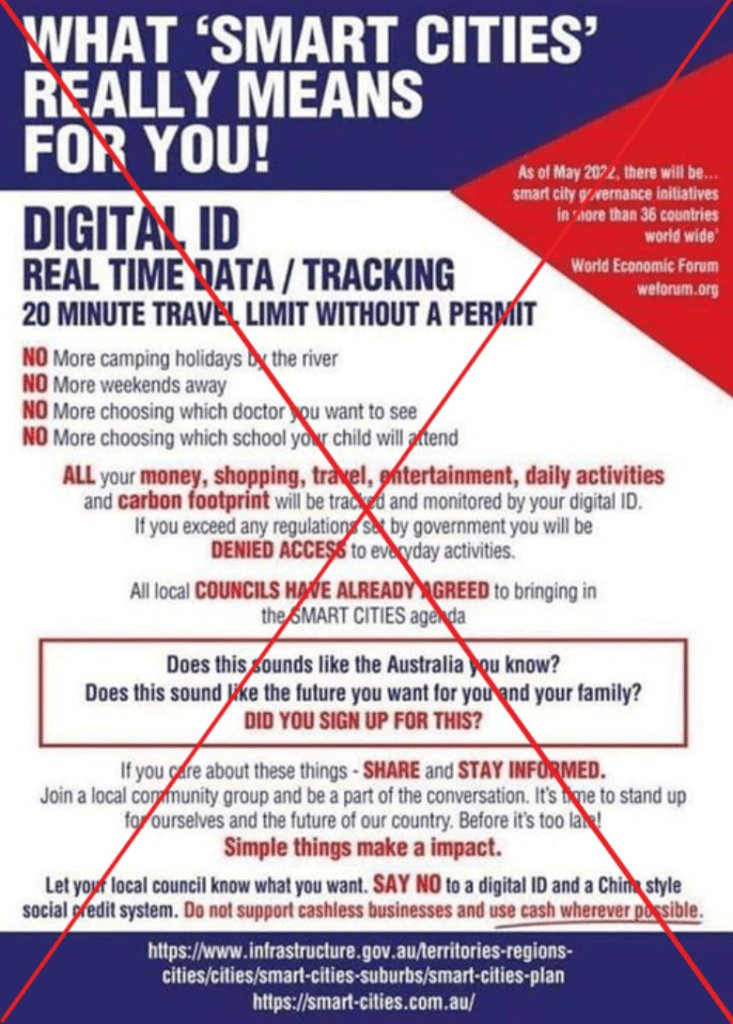
Amongst councils targeted this way was Yarra Ranges Council which, in response to abusive and intimidatory behaviour from the public gallery, took council meetings online in April this year, temporarily closing the gallery. Foremost amongst My Place obsessions is the concept of 20 Minute Neighbourhoods or Smart Cities, which conspiracy theorists believe are covert plans to restrict movement, monitor activity, remove freedom of choice and launch an all-seeing digital ID. With textbook conspiracy theory thinking, My Place wrongly assumed the Monbulk Urban Design Framework (UDF) draft plans, accommodated such a nefarious scheme.
Yarra Ranges had openly encouraged community consultation on the UDF, from 16 December 2022. My Place action group members attended the 31 January 2023 council meeting causing enough disruption to temporarily stop proceedings. Council members were yelled at, called a range of names, accused of hidden motives and had their professional integrity questioned. Council then published Statement regarding misinformation on social media on its website, in which it clarified the purpose behind 20 Minute Neighbourhoods and the manner in which technology may be used. This included:
The intent is for people to be able to move about easily and freely without being burdened by excessive travel or costly transport options. It improves movement and access, rather than preventing it.
Sometimes technology can be used to understand where there is congestion on a path or road network or an intersection… [or] when a bin is full or when a drain is blocked, helping to stop litter entering waterways and flooding.
The decision to move council meetings online is permitted under security provisions in the Local Government Act 2020 [see 66 (2)(b)(c)]. Online meetings were available to the public, and at the time, Yarra Ranges mayor Cr. Jim Child stressed he would review the situation in June. In-person council meetings with registration requirements resumed on 11 July. However in a June media release, My Place contended they had been “locked out” of meetings and more so, Council had done this merely due to “perceived” threats to safety. It was a breach of the human rights of residents by Council, and “deeply insulted” by comments that the mayor had made, My Place submitted an application to the Supreme Court. Their orders are laid out below.
And so it came to pass. On 4 July 2023 the matter came before Supreme Court Justice Melissa Richards. The sole plaintiff seeking an interlocutory injunction to prevent Council from adopting the proposed UDF was Darren Dickson, who represented himself and had submitted affidavits from 18 members of the Yarra Ranges community. Dickson has been described on social media as a “pseudo-law guru”, although I cannot attest to the import of this particular honorary. Justice Richards set a trial date for 3 August 2023.
Dickson sought the injunction based on a lack of community engagement, and further:
An extended 12 month consultation period.
Council to reopen the public gallery for meetings.
Clarification on filming from the public gallery.
Contended Council did not meet Local Government Act 2020 (Vic) requirements.
Contended Council was in breach of the Charter of Human Rights and Responsibilities Act (Vic) 2006, namely right to privacy, to freedom of expression and participation in public life.
Mr. Dickson also sought answers to two questions specific to the manner in which he perceived the implementation of 20 Minute Neighbourhoods (20MN). Namely:
Whether Council’s role includes power to develop three storey accommodation for local areas.
Whether Council can engage with and adopt United Nations policies.
Whilst not living in the municipality Dickson identifies as a member of the community. He works and socialises there and cares for his mother who is a Yarra Ranges resident. Dickson had attended the disruptive 11 April council meeting that led to temporary closure of the public gallery.
Lilydale resident Martin Dieleman was concerned that the UDF proposed by Council would permit 20 Minute Neighbourhoods and in turn, this would ensure increased surveillance and housing density along with restricted choice and freedom of movement. He started a petition in March this year, promoting the well debunked conspiracy theory view of 20MN and by June had over 2,000 signatures from across Victoria. Absurd claims about smart cities had by then become an increasing feature of social media, resonating with those convinced by the “freedom movement”. Dickson had bought the narrative and learned of growing attention to the Monbulk UDF from Dieleman in April this year.
Throughout the consultation period Council had made themselves available to discuss and clarify aspects of the UDF. Specific community engagement programmes organised by Council were provided, along with multiple interactions with individual community members. The draft UDF is discussed in the below video published on 11 February 2023.
Nathan Islip, Manager Design and Place talks about the Monbulk UDF
Edward Gisonda, counsel for Yarra Ranges Council, submitted that being part of the community does not give Darren Dickson standing to seek public law remedies regarding approval of the UDF, conduct of Council meetings and the two questions regarding 20MN. In her judgement of 199 paragraphs over 62 pages, Justice Richards found Darren Dickson did not have standing to pursue legal action. More specifically Dickson did not demonstrate that he had special interest in the UDF, or that if approved by Council, it would have a legal or practical effect on him. His interest is no different to that of any member of the public.
I accept that he is concerned about aspects of the UDF, although these concerns seem to be based on misunderstandings of the UDF’s content and effect. An intellectual or emotional concern, however strongly held, is not enough to give Mr Dickson standing to obtain public law remedies in relation to the Council’s consideration of the UDF.
Nor could Dickson demonstrate a special interest in how Council held its meetings, and he did not submit that he had difficulty accessing or viewing council meetings when held online. Dickson did submit affidavits for 11 local residents who had privacy concerns about the registration process for attending in-person meetings but Dickson himself was not one of them. Nor had he sought consent to record any council meeting.
At its highest, Mr Dickson’s interest is a strongly held belief that the Council should conduct its meetings in a particular way. On its own, that is not enough to establish standing to obtain orders compelling the Council to conduct meetings in that way.
Justice Richards went further and considered if someone with standing would secure the legal remedies that Mr. Dickson sought. This involved examining evidence and testimony presented at trial and viewing Council performance through the lenses of the Local Government Act, the Planning Act, Charter of Human Rights and Responsibilities Act 2006 [Vic] (the Charter) and Plan Melbourne 2017-2050: Metropolitan Planning Strategy. There are some interesting aspects to the judgement.
One contention raised by the plaintiff and revisited during questioning was that the council had failed to “meaningfully engage” over the UDF, with particular emphasis on the temporary closure of public meetings. Council is bound by the Charter to ensure the right to engage with public affairs is observed. Yet this doesn’t give an individual the right to dictate terms of their involvement. Council’s community engagement with respect to the UDF, and the involvement of Nathan Islip in attempting to assuage concerns of some residents, covered 10 pages of the ruling.
Mr. Islip’s patience is evident, in that he was clearly repeating answers to the same questions from the same resident/s via email, over the phone, in person and during council meetings. He fielded questions over freedom of movement, privacy and “tracking of movements” in 20MN. At one meeting he was asked if there would be “consequences for travelling outside of our 20MN”. Addressing whether or not Council met community engagement obligations specific to the UDF, Justice Richards ruled overwhelmingly that they did [para. 70 – 125].
Justice Richards rejected six complaints raised by Mr. Dickson highlighting different means by which Council purportedly failed to provide adequate community engagement. Addressing each in turn Her Honour ultimately wrote:
Mr Dickson has not established that the Engagement Plan adopted by the Council for the UDF limited his or anyone else’s Charter right to participate in public affairs. The right does not enable any member of the public, regardless of their interest in the UDF, to dictate the terms of the Council’s engagement with the community about the UDF, or to demand immediate answers to questions about matters not contained in the UDF.
As had been clear from the My Place media release and questions raised by David Dickson during the hearing, the fact that online council meetings had been held from 26 April to 27 June 2023 was considered a breach of the Local Government Act by the plaintiff, because these meetings were not “open to the public”. However the Local Government Act is clear in this regard. Justice Richards wrote:
Mr Dickson’s complaint that the Council had closed its meetings to the public between 26 April and 27 June 2023 was misconceived. […] A council meeting is ‘open to the public’, as that term is defined in s 66(6) of the Local Government Act, if the meeting is broadcast live on the internet site of the council.
Let’s recall, dear reader, that meetings moved online in response to repeated abuse and aggressive behaviour from the public gallery. Justice Richards recounts in detail, evidence from witnesses concerning the intimidation [para. 157 – 169]. During the trial David Dickson cross examined witnesses, seemingly intent on dismissing what they had already reported as intimidating or threatening experiences. Nathan Islip had given evidence that “threatening comments” were made at the 31 January council meeting, to which police were called. Dickson asked Mr. Islip if he knew what “the definition of a threat is”. Here, Dickson is focusing on the threat of harm, seemingly unaware that intimidation in pursuit of coercion is also a threat.
There was a group of people among the large public gallery who were intent on disrupting the meeting, and who did so. They interjected frequently and loudly and did not recognise the authority of the Mayor as Chair of the meeting. Their behaviour was contrary to r 73.3 of the Governance Rules, in that they did not extend due courtesy and respect to the Council and its processes, and they did not take direction from the Chair.
With respect to filming council meetings, attendees wanting to do so must seek consent of the Chair. Pre-registration with photo ID for those who want to attend in-person meetings has not been shown by Mr. Dickson to be unlawful. It is permitted under the Local Government Act and the Occupational Health and Safety Act 2004. Evidence was given by Andrew Hilson, Yarra Ranges Director of Corporate Services, that information collected is in accordance with the Privacy and Data Protection Act 2014. Justice Richards ruled that given prior disruption to council meetings, registration is proportionate and not an unlawful interference with the right to privacy.
This brings us to the two additional questions Dickson wanted answered regarding three storey accomodation and the adoption of UN policies. In fact they arise from a misunderstanding of the origin and scope of the UDF. There is no evidence that Council is seeking to develop three storey accomodation for local areas. Nor is there evidence that the UDF heralds adoption of UN policies. Rather, the UDF does not actually refer to 20 Minute Neighbourhoods. In the event that it did, it would in fact be Victorian Government policy and an existing part of the Yarra Ranges Planning Scheme.
More importantly however, is that David Dickson does not have standing to seek answers to these questions. Again, his interest is no different to any other member of public. Justice Richards wrote:
In short, the additional questions should not be answered because they do not relate to any legal controversy between the Council and Mr Dickson, or the Council and anyone else identified in the evidence.
Ultimately, there were no democratic principles or legislation breached by Yarra Ranges Council during UDF consultation, or as a result of temporarily changing meetings to online. Online meetings are not only available to the public but are the preferred option for many. Yarra Ranges Council posted a response to the ruling on their website here.
Darren Dickson was ordered to pay Council’s costs. If in disagreement, he has until 1 September 2023 to submit his reasons as to why a different order should be made.
One cannot ignore that as sovereign citizens, My Place supporters reject the notion that Australian courts, laws and institutions hold any valid power. Exactly how this ruling will be accepted remains to be seen. Might it be rejected outright, or woven into the complex tapestry of the parallel society My Place founder Darren Bergwerf aims to create? Sov Cits are skilled at rationalising dissonant outcomes as victory. It may be that taking a Council to the Supreme Court can be accepted as a win. Of sorts.
Either way, the theme of corrupt public authorities was also evident in the many unsuccessful cases involving anti-vaccination groups and vaccine mandate opponents, recently making their way to court. They too had “woken up” to a new reality. Many were exploited or left in debt. Established anti-vaccine pressure groups had retooled for COVID. They continue to promote themselves, and financially profit to this day.
Not one has been, or will be, denied an opportunity to access the court system and bring their evidence, no matter how disjointed and deceptive, before a judge. Ultimately, this particular case has, like the others, reinforced the strong democracy Australia has.
Evidence for a corrupt global cartel however, remains elusive.
The Australian Skeptics National Convention is being held in Melbourne this year, at the University of Melbourne Parkville campus. Tickets are now on sale.
Early bird discount of 5% applies to convention tickets until 31 July 2023.
The convention will be held over Saturday 2nd and Sunday 3rd December at the Ian Potter auditorium, in the Kenneth Myer building (Google maps reference). Online access is also an option. To date, international speakers include critical thinker Melanie Trecek-King and well known skeptic activist Susan Gerbic. Keep an eye on the Skepticon 2023 website or check back here for updates, as the full speaker’s schedule continues to take shape.
Skepticon is known for presenting great speakers and stimulating topics. Recent conventions have included presentations on pseudo-archaeology, research into vaping, responding to the COVID pandemic, superstition in elite sporting performance, adaptation to climate change, the Ivermectin scandal, discerning trustworthy scientific studies and escaping cults. Speakers have included Dr. Ken Harvey, Dr. Rachael Dunlop, members of the European Skeptics podcast, Brian Dunning of Skeptoid, Steven Novella, Bruce Baer Arnold and great panel discussions, to offer just a hint of what this convention brings.
The annual Skepticon dinner will be held on the Saturday night at St. Andrews Hotel, Nicholson Street Fitzroy. It’s a popular night of entertainment, dining, great conversation and the presentation of awards from Australian Skeptics Inc. One is a unique prize that inevitably draws some media comment. Namely, The Bent Spoon Award.
This exclusive title is an annual award presented to the perpetrator of the most preposterous piece of paranormal or pseudo-scientific piffle. Nominations are underway for this year’s winner. Or should that be “lucky loser”? They include, but are not limited to favourites of this author, such as Dave Oneegs, Senator Gerard Rennick and (suspended) Dr. William Bay. If you have somebody in mind or want to add your support to an existing nomination, submit your vote by email.
Last years winner was bogus-medico Maria Carmela Pau who was caught out selling fake COVID vaccination exemption certificates. Other winners include Craig Kelly, 2021, for spreading his waffle on COVID, the vaccine, alternative “cures” and various conspiracy theories. Pete Evans, 2015 for dietary nonsense, anti-fluoride and anti-vaccination piffle. Pete also won in 2020, for his colourful but useless BioCharger, and yet more prolonged anti-vaccination rhetoric. What’s that? No, no. A haircut, no matter how preposterous, is neither paranormal nor pseudoscientific.
2016 was a great year, producing the winning trifecta of Judy Wilyman, Brian Martin and the University of Wollongong. This came in the wake of a doctorate being awarded for Wilyman’s anti-vaccine thesis, void of any research design or novel data. SBS-TV, ABC programmes and producers have also won for presenting pseudoscience and alternatives to medicine in a supportive framework. Of course dear reader I cannot omit that the 2009 Bent Spoon went to Meryl Wynn Dorey and the AVN for being themselves.
Justifiably, there are merit awards given for great talent and hard work. At a time when we are surrounded by conspiracy theories, scams, pseudoscientific claims, discrimination and bigotry, the skeptic movement is motivated to recognise and reward individuals who contribute to critical thinking, scientific reasoning and who value diversity and inclusivity. This is particularly clear in the Goals of Australian Skeptics Inc.
To this end, the following awards are also presented at the Skepticon Saturday dinner. The Fred Thornett Award – known as The Fred – is given for the promotion of, and educating the public about, issues of Science and Reason. The Barry Williams Award for Skeptical Journalism, also known as The Wallaby, acknowledges journalistic work that critically analyses or exposes issues related to pseudoscience or the paranormal. Depending on the topic, individuals chosen for these awards may have faced abuse and/or intimidation as they work toward these valuable goals. This is not lost on skeptics in Australia.
Finally, Skeptic of The Year is awarded to a skeptic or someone with links to the skeptical community in recognition of effective activism or an exceptional contribution to the skeptic movement. This is not awarded annually or biannually, but rather in response to an individual’s unique contribution.
Throughout the weekend there is opportunity for stimulating discussion with like-minded individuals on topical issues relevant to Skepticism. It’s also a great time to broaden your interest in, or involvement with, the skeptical community.
In a previous post we looked at the unsuccessful attempt of the Australian Vaccination-risks Network to convince the Federal Court of Australia it had legal standing to challenge the COVID-19 vaccine rollout.
They sought a writ of Mandamus to overturn provisional registration of mRNA and AstraZeneca COVID-19 vaccines, and a Judicial Review to overturn provisional approval of Pfizer’s vaccine for 5 to 11 year olds.
The evidence was intended to demonstrate lack of safety and efficacy of the vaccines. The plaintiffs contended the vaccines should not have been provisionally approved or registered. Indeed, that they should have been cancelled or suspended because of an imminent risk of death or serious injury. Thus, the Secretary of the Department of Health had erred in his duty to “cause to be maintained” the Australian Register of Therapeutic Goods.
However the evidence and legal arguments were never heard in court. The AVN had no “special interest”, and thus standing. On 8 August 2022 their appeal against this finding was found to be incompetent. A couple of months later, lengthy correspondence went out to all “donors and potential donors”. Headed AVN Legal Actions and Strategiesthe document opined on the issue of standing:
The way that the current case law is being applied by the Federal Court is essentially to say that nobody has sufficient standing to challenge these therapeutic ‘goods’, nor indeed the Secretary of Health.
The Babies Case
The AVN had decided to take “an alternative course of action”. One that had been researched and prepared by retired barrister Julian Gillespie and solicitors Peter Fam of Maat’s Method and Katie Ashby-Koppens of PJ O’Brien and Associates. In view of the AVN’s recent outcome it was deemed wiser to approach the High Court with “The Australian Babies Case” (AuBC), and seek to “halt the provisional approval of the Moderna jab from being injected into our precious 6 month old to 5 year old infants”. The AVN would “change course” and become a co-applicant with five others.
The other applicants were:
Associate Professor Peter Parry
Dr. Julian Fidge
Dr. Shoba Iyer
Dr. Astria Lefringhausen
Mark Neugebauer
The first three applicants above are active members of the Australian Medical Professionals’ Society (AMPS), a Red Union group that formed with the specific aim of challenging the rollout of COVID-19 vaccines, fighting COVID-19 mandates and promoting controversial treatments such as Ivermectin and hydroxychloroquine. Parry is also the lead applicant challenging the State of QLD over health professional’s vaccine requirements and a key member of Doctors Against Mandates. Three months before the AuBC strategy was outlined in this document, the AVN published the full AMPS Medico-Legal Summit on its website.
The breakdown of speakers at the summit includes AVN legal consultant and primary researcher behind the AuBC Julian Gillespie, primary plaintiff Prof. Peter Parry, Senator Malcolm Roberts and Senator Gerard Rennick. We will meet Senator Rennick again, later in this post. In lobbying the SA Minister for Child Protection, plaintiff Mark Neugebauer cites AMPS correspondence from Dr. Christopher Neil, another speaker at the summit. Gillespie and Ashby-Koppens appear on AMPS Discussions From The Frontlineupdating legal activity |2|.
The document went on to outline the strategy behind this new approach:
In The Australian Babies Case, the legal strategy is to present five applicants before the High Court of Australia, and show the Court how each applicant is affected by the actions and inactions of the Secretary of Health, with respect to the Covid-19 drugs made available to babies and young children, and the rest of the Australian community in circumstances where, prima facie, preventable deaths, illnesses, and injuries in extraordinary numbers are associated with their use; and where most of the population does not need them; however despite the expertise and evidence possessed by the various five applicants, the current law on standing in Australia is deficient, and will not recognise any of the applicants as proper parties for suing the Secretary of Health.
Australian Babies Case legal research team
Julian GillespiePeter FamKatie Ashby-Koppens
It further outlined that the Babies Case would be seeking to have the High Court “fix the law on standing” such that the applicants would be accepted as having “special interest”. Namely, “the preservation of human life from preventable death, illness or injury”. It was claimed, albeit without evidence, these preventable outcomes were being seen now, due to “COVID-19 drugs” and that this constituted an “iatrogenic catastrophe”. That is to say, a catastrophe caused by the diagnosis and treatment of a condition.
Mark Robinson SC who represented the AVN in the initial failed case, confirmed this new approach was viable and advised that the High Court “has indicated that it wishes to revisit the law of standing in Australia”. They would be seeking:
A new Special Interest regarding the preservation of human life.
If successful, a court-granted injunction to halt the provisional approval of COVID-19 vaccines to babies 6 months to 5 years and children 6 to 11 years of age.
If the High court recognises this new special interest for standing, that the High or Federal Court immediately hear the Judicial Review cases for both childhood age groups and the original Mandamus case for mRNA and AstraZeneca vaccines.
If successful, the AVN expected to be able to proceed with their initial cases. As “a matter of convenience” the AVN would seek to take over the running of the Judicial Review case that involved children 6 months to 5 years (the AuBC). The AVN note that they feel joining the case “operates as a de facto appeal” from the 8 August 2022 Federal Court appeal decision.
The application was filed with the High Court on 20 December 2022. The day before, a media release was published by AVN president Meryl Dorey. It provided some initial insight into the legal tactics to be employed in this quest for a new category of standing. Resurrected anti-vaccine themes from the initial Federal Court case peppered a quote attributed to Julian Gillespie (bold mine):
The High Court of Australia is now being called upon to protect our youngest from participating in an acknowledged and ongoing Phase III clinical trial, to receive experimental drugs involving unprecedented levels of reported adverse events, including deaths… for a virus also acknowledged to pose no threat to our Babies and Toddlers…
At this point it’s worth noting that, in public discourse, the Australian Babies Case legal team studiously avoid discussing the 3 August 2022 ATAGI recommendations for this age group. Namely:
ATAGI recommends COVID-19 vaccination for children aged 6 months to <5 years with severe immunocompromise, disability, and those who have complex and/or multiple health conditions which increase the risk of severe COVID-19.
More so, the legal team make much of the fact severe cases of COVID-19 are not common in this age group, and thus provisional approval of Spikevax suggests nefarious, and not clinical, motivation. Yet ATAGI clearly state:
ATAGI’s guidance takes into account:
The very low risk of severe COVID-19 (e.g. hospitalisation due to COVID-19) in healthy children aged 6 months to <5 years. This age group is one of the least likely age groups to require hospitalisation due to COVID-19. Among the small number who are hospitalised or who die due to COVID-19, underlying medical conditions or immunocompromise are frequently present. […]
The plaintiffs alleged Spikevax is a “genetically modified organism”. As such, Brendan Murphy, Secretary of the Department of Health had failed to comply with yet another section of the Therapeutic Goods Act 1989 (TG Act). As expected a writ of certiorari would be sought to quash provisional approval of Moderna’s Spikevax vaccine for children 6 months to 5 years. A writ of mandamus (where the court orders an official) was originally sought to have the application to approve Spikevax, reviewed under law. It was ultimately abandoned. For more specific insight we must turn to the application.
Legal Arguments
The plaintiff’s argument had two grounds, and a section headed Reasons Why Remittal Not Appropriate. Those reasons argued that the case should be heard by the High Court because that court had the power to accept the need for, and then admit for hearing, a new category of standing. Thus the High Court should not remit (send back) the case to the Federal Court. They contended that the principles for standing should be more liberal when a person can establish the subject matter involves life threatening or debilitating medical conditions and they seek to preserve human life. In short:
Where the fabric of human life might be compromised or adversely impacted, interested and involved members of the public should have a right of standing in such circumstances.
Whilst I don’t accept the argument for a new category of standing in this manner, I do agree that the law is frequently lacking. In fact, it’s about here I suspect a number of Australian vaccine proponents, Skeptics and opponents of the anti-vaccination lobby may feel a dash of Deja Vu.
In 2010, following complaints from the public about misleading AVN advice, the NSW Health Care Complaints Commission published a “damning report”. The AVN successfully appealed the ruling because whilst the HCCC had jurisdiction, the complaints lacked evidence that anyone had acted on AVN advice. The appeal outcome led to the Health Legislation Amendment Bill 2013 in NSW Parliament, allowing the HCCC to act on the likelihood of harm. A follow up inquiry was launched and a second, more in depth Public Warning against the AVN was published in 2014.
Let’s return to the present. The plaintiffs also argue that there are “important questions about the lawfulness of Commonwealth officials to make provisional determinations” that impact wellbeing. They allege there is no real jurisprudence about this in the context of the TG Act. Yet in reality, the standard of evidence required to make these determinations is high and the TG Act is comprehensively designed to minimise risk. Indeed failure to make provisional determinations may risk the wellbeing of the nation.
Ground One of the plaintiff’s argument again takes us to the TG Act. Specifically Section 22D(1), which provides that the Secretary must decide to make or refuse to make a determination, when a valid application has been made. In this case the application was for Spikevax (elasomeran), which the Secretary provisionally approved for children 6 months to 5 years, on 19 July 2022. The plaintiffs argue that s 22D(1) “is subject to an implied restraint”, that the decision will be legally reasonable. They submitted:
Legal reasonableness, or an absence of legal unreasonableness, is an essential element in the lawfulness of decision-making.
Referring to “the decision” to provisionally approve Spikevax for the ages under discussion, the application is dismissive of evidence used. It cites the TGA document Australian Public Assessment Report for Spikevax, 19 July 2022. Yet the Submission overview and risk/benefit assessment, accommodates no less than half of the 31 pages. This was updated on 8 November 2022; 42 days prior to filing of the plaintiff’s application, and contains 8 subsections covering 55 of the document’s 69 pages. Subsections include, but are not limited to, Quality, Risk management plan, Risk-benefit analysis, Additional clinical data and Second risk-benefit analysis.
The plaintiffs further argued that the Secretary’s decision that Regulation 10L(1)(a) of the Therapeutic Goods Regulations 1990 (TG Regs) was met, is legally unreasonable. That particular regulation states under Provisional Determinations:
(1) For the purposes of subsection 22D(2) of the Act, the criteria are all of the following:
(a) an indication of the medicine is the treatment, prevention or diagnosis of a life-threatening or seriously debilitating condition;
In other words it was legally unreasonable to accept that the vaccine ever contributed to the prevention of serious illness brought on by COVID-19 in children 6 months to 5 years. This argument is a repeat of the AVN tactic seeking Judicial Review in the initial Federal Court Children Decision case, where they also targeted s 22D of the Act.
This was cited because the AVN also sought an order quashing any determination made by the Secretary pursuant to section 22D, that an indication of the vaccine:
“[W]as the treatment, prevention or diagnosis of a life-threatening or seriously debilitating condition for children aged 5 to 11 years of age.”
The plaintiffs continue to argue their case for “legal unreasonable decision-making” by again turning to the TG Act. They argue the Secretary has failed to satisfy requirements in s 25(1)(d)(i). Section 25 deals with evaluation of therapeutic goods, and the cited subsection provides:
(d) for an application for provisional registration of a medicine:
(i) whether, based on preliminary clinical data, the safety and efficacy of the medicine for the purposes for which it is to be used have been satisfactorily established.
Put more simply, the plaintiffs contend that when the Secretary was evaluating Spikevax, the data he used did not “satisfactorily establish” its safety and efficacy. This, they allege, amounts to legal unreasonable decision-making.
Genetically Modified Organism
Ground two of the plaintiff’s argument stated that the Secretary failed to comply with s 30C(2) of the TG Act. Section 30C provides for Consultation with the Gene Technology Regulator (OGTR). The cited subsection reads:
It appears that there has been non-compliance with a statutory condition in the TG Act. […] The plaintiffs contend that non-compliance with the statutory obligation mandated by s 30C(2) leads to the invalidity of the registration decision that followed.
Could it be that the Secretary did not have to notify the OGTR? As fate would have it we are assisted here by questions from Senator Gerard Rennick. On 16 February 2023 during a Community Affairs Legislation Committee Estimates hearing, Rennick questioned our current gene technology regulator, Dr. Raj Bhula, about s 30C of the TG Act, asking if the Secretary had written to the OGTR in regards to mRNA vaccines.
You can read the full exchange on Rennick’s website, or watch the video of it below. However, I’ll cut to the responses that matter with respect to the AuBC. Does the Secretary have to notify the OGTR?
Dr Bhula : No, because the mRNA vaccines are not required to be regulated through the OGTR.
Senator RENNICK: Did they write to you and actually ask you that question?
Dr Bhula : No, because they’re not required to be regulated through the OGTR.
Senator RENNICK: But how would they know, because you’re the expert? And, by the way, gene technology involves both replication and transcription.
Dr Bhula : Yes.
Senator RENNICK: Which is what the mRNA vaccine does.
Dr Bhula : But the mRNA COVID-19 vaccines did not involve any step of genetic modification—
Senator RENNICK: They produce proteins.
Dr Bhula : or a GMO—
CHAIR: Senator Rennick, would you allow Dr Bhula to finish her answers.
Dr Bhula : which meant that that didn’t require regulatory oversight by the OGTR.
An unambiguous answer. Interestingly, this wasn’t published on Rennick’s website at the time of the exchange. It was published 20 March 2023, which was four days after the High Court decided not to hear the AuBC. A coincidence? Unlikely, dear reader. As mentioned above, Senator Rennick, the AuBC plaintiffs, key legal researcher for the case and the AMPS are linked by their COVID-19 ideology and related lobbyist activity.
Gerard Rennick questions Dr. Raj Bhula, Office of Gene Technology Regulator
For the purposes of the AuBC affidavit, I acknowledge the confusion surrounding mRNA vaccines and GM technology. The AstraZeneca COVID-19 vaccine using a genetically modified chimpanzee adenovirus, is a clear example of GM technology. The OGTR Risk Assessment and Risk Management Plan for that vaccine is here. Years earlier the OGTR published a similar plan for a GM Live Attenuated Influenza Vaccine. The TGA acknowledges both examples as GMO medicines.
Technology applied to extract, multiply and distill the mRNA used in vaccines to instruct our cells to produce the spike protein of SARS-CoV-2 is different to the genetic modification of an adenovirus or a live influenza virus. Dr. Bhula describes it as not involving “any step of genetic modification or a GMO”.
Nonetheless, the Australian National Gene Technology Scheme lists mRNA COVID-19 vaccines, including Spikevax, as GMOs used as medicines. An Open Access Government article states, “mRNA and viral vector vaccines are derived using techniques of genetic modification (GM)”. The Alliance For Science distinguishes between the two. “This one really is genetically engineered”, it says of the adenovirus vaccine, after discussing mRNA vaccines.
We must accept Dr. Bhula’s position that mRNA vaccines are not required to be regulated through the OGTR. For the sake of the AuBC affidavit, s 30C(2) of the TG Act does not then apply, and the provisional registration of the mRNA vaccine Spikevax, is valid.
Case Remitted to Federal Court
The plaintiffs did not appear before the High Court. On 16 March 2023, Justice Stephen Gageler remitted the case to the Federal Court of NSW, as per the following order. A summary page is below.
No weight was given to the legal arguments raised, although it was noted there were “supporting affidavits totalling more than 2,000 pages”. What’s important is Justice Gageler’s observation that the Secretary had submitted that the proceedings should be remitted to the Federal Court which would have jurisdiction, under Section 39B(1) or (1A)(c) of the Judiciary Act. That section follows parliamentary action in 1997, to transform the Federal Court into one with more general jurisdiction (see p.9), including jurisdiction over any matter, “arising under any laws made by the Parliament [excluding criminal implications]”.
Justice Gageler observed:
I am satisfied that this matter is one “arising under” the TG Act for purposes of s 39B(1A)(c) of the Judiciary Act, and that the Federal Court has jurisdiction over its subject-matter and the parties on that basis.
Justice Gageler reflected on the plaintiff’s claim that the High Court was the only appropriate Court to decide on a new category of standing due to “special interest” arising when “the fabric of human life might be compromised or adversely impacted”. He stressed that the power to remit is discretionary “to be exercised after due consideration of all the circumstances of the case”. Justice Gageler cited another case as instructive, in that the power of the remitter is designed to ensure the High Court is not diverted from its principle functions by matters that “could properly be brought in an Australian trial court”. After offering his assessment of the significant scale of the case, Gageler concludes:
Having regard to these considerations, significant case management and fact finding are likely to be required to conduct a hearing of the kind contemplated by the application. Undertaking that task would unduly divert the Court from its principal functions.
“We are Discontinuing the Australian Babies Case”
The plaintiffs did not return to the Federal Court. On 12 April 2023, instructing solicitor Peter Fam of Maat’s Method published an article, and a longer explanatory video, in which he labels the vaccines “a poison”. In view of their 2022 failures with the Federal Court, further chances were poor. Even if successful, there may be repeated appeals lasting over a year. They did not have the money or time. “People are being injured and dying every day”, from COVID-19 vaccines, Fam said without evidence.
Fam added; “Too much money has been usedon facetious exploits and actions… things that haven’t been thought out in terms of strategy… people aren’t working together… doing things that are contradictory to each other… I have to take some responsibility… we lost the AVN case… a lot of money had been donated to that case”.
However:
All is not lost. This is a pivot; not a retreat, and there are other matters we have been working on simultaneously with this one, with better prospects of success than this case would have in the Federal Court. Those efforts will be formally launched within weeks, and you will hear more about them soon.
Dr. William Bay
A final mention must go to suspended GP registrar, William Bay. Bay has become a favourite amongst “cooker” watchers since he chose an AMA conference to film himself yelling anti-vaccine conspiracies, and call Chief Medical Officer, Paul Kelly “a liar”. A client of Peter Fam, Bay was asked to join the AuBC as a plaintiff. Shortly after he wanted to swap his position as plaintiff with the parent of a vaccine-injured child, believing this gave the team a greater chance at success. Fam and Gillespie disagreed. Nor could such a client be found.
Later, he filed for leave to intervene in the case as he objected to the nature of the special interest standing. He argued that if granted, the existence of standing granted via special interest in “the preservation of human life from preventable death, illness or injury”, could be used to justify COVID-19 vaccination for children. You can read Julian Gillespie’s “urgent” letter to supporters on this matter here.
Understandably, Bay further argues that such special interest standing may then be used to interfere in the application of medicine and the doctor-patient relationship in areas unrelated to COVID-19 vaccination (see video 56:45). Gillespie argues, quite rightly, that the request for standing applies to administrative and not private law. What Gillespie omits though, is any appreciation of how administrative changes impact private citizens.
Conclusion
The Australian Babies Case sought to convince the High Court to accept that medically qualified applicants had “special interest” preventing “death, illness or injury”, in babies and small children. Success would lead to a new category of standing, and this would permit the AVN to return to the Federal Court to pursue this case and its original 2022 Federal Court case, AVN v Secretary, Dept. Health.
Case evidence involved a revamping of prior legal tactics. The Therapeutic Goods Act was exploited by the plaintiffs to demonstrate regulatory failures on the part of the Secretary of the Department of Health. These failures, they again argue, justify overturning the registration or approval of COVID-19 vaccines. Driving this action was a suite of fallacious claims and misrepresented statistics.
The plaintiffs are members of and/or closely associated with the AMPS, a well organised union of medical and allied health professionals, working actively to undermine confidence in COVID-19 vaccines. Members of the legal team in this case are strident anti-vaccine activists, closely associated with AMPS, and outspoken anti-vaccine politicians.
Despite the label of “Babies Case”, this was all about giving the AVN a second chance for legal standing to have their case demanding an end to all COVID vaccines, heard in the Federal Court. Had standing been granted via a special interest as described above, it could be used to target all vaccines and help Meryl Dorey advance her life-long claim that “no vaccine is safe”.
According to the instructing solicitor of the AVN, further action should be expected soon.






 Losing In The Lucky Country