Vaxxed III: Unmitigated disinformation

On 23 August this year, Robert F. Kennedy Jr. suspended his independent US presidential campaign in ten battleground states, choosing to endorse Donald Trump. He cited the same causes, “that persuaded me to leave the Democratic Party and run as an independent”, according to AP News. Namely, free speech the war in Ukraine and “a war on our children”.

Kennedy: Anti-vaccine activist

There is, of course, no war on American children. Nor a war on any children in developed nations, in the sense Kennedy is alluding to. In fact as the chairman of Children’s Health Defense (CHD), Kennedy has himself waged a long battle against one of public health’s most important pillars; childhood immunisation. As with every anti-vaccine activist, COVID-19 presented Kennedy with an opportunity to manipulate and exploit a growing pool of misguided and misinformed individuals. Those who blame COVID-19 vaccines for virtually every illness or cause of death. Let me stress, I’m not referring to the known side effects but rather, those pushed by COVID conspiracy theorists and tireless anti-vaxxers. Ultimately, Kennedy’s profile expanded markedly, as did CHD revenue.

So comfortable with deceit, when he began his independent trot toward the White House, Kennedy insisted he was not anti-vaccine. This, despite telling a supportive crowd in December 2021, “It is criminal medical malpractice to give a child one of these vaccines”. Despite his influence in bringing about the measles tragedy in Samoa. He worked hard at the presidential pretence, even temporarily stepping down from his position as CHD Chair. Still today, the “chairman on leave” video message on every CHD website page lacks any reference to vaccines. Yet Kennedy mentions “unnecessary injuries” suffered by children, includes studies of autism and developmental disorder rates and packs in 16 snippets of autistic individuals – mostly with pronounced symptoms. Children are chronically sicker than ever before, “wandering around in a toxic soup”, Kennedy tells viewers. In search of the cause he will die with his boots on, fighting for them. Kennedy originally wrongly linked vaccines to autism in a, now removed, 2005 Rolling Stones article. This fact check piece offers an excellent deconstruction of the misconceptions used to make that link.

Vaxxed

Kennedy’s Children’s Health Defense has been hard at work targeting vaccine evidence during the COVID pandemic. This includes the making of the third Vaxxed film, Vaxxed III: Authorised to Kill, by CHD Films. True to the Vaxxed brand, it is a slick cornucopia of fear-mongering and falsehood. A key figure in this ghastly enterprise is interviewer and co-producer Polly Tommey, who has been involved with the first two Vaxxed films. Readers may remember Tommey was banned from Australia for three years following her antics in promoting the original Vaxxed film here in 2017. Trundling about with the (then) Australian Vaccination-skeptics Network, Tommey, who wrongly believes the MMR vaccine caused her son, Billy, to develop autism, told Australian audiences “doctors were murderers”. The Tommey named as producer of Vaxxed III and Vaxxed II: The people’s truth, is her other son, Tobias. The second and third Vaxxed films have been directed by Brian Burrowes. The first Vaxxed was directed by Andrew Wakefield and produced by Del Bigtree.

In doing some basic research for this post, I noted that Polly Tommey has changed not at all. On 6 September she used CHD’s X account to peddle the falsehood that “an experimental” oral polio vaccine is being used in Gaza. She added the sweeping claim that “the oral polio vaccine” is responsible for the poliovirus infecting “hundreds each year”. Like most persistent anti-vaccine lies there is a kernel of truth here. A prior oral polio vaccine caused disease in ~1 in 2.9 million. However, the new oral vaccine in Gaza does not contain the vaccine-derived strain responsible for past infections. More so, it is the lack of vaccination and the presence of poliovirus in human waste causing the problem. In addition, removal of the problematic weakened virus in 2016, in an attempt to prevent vaccine-derived outbreaks, resulted in greater infection rates. Citing a draft report for the World Health Organisation, AP News explain:

The polio strain in question evolved from a weakened virus that was originally part of an oral vaccine credited with preventing millions of children worldwide from being paralyzed. But that virus was removed from the vaccine in 2016 in hopes of preventing vaccine-derived outbreaks.

Public health authorities knew that decision would leave people unprotected against that particular strain, but they thought they had a plan to ward off and quickly contain any outbreaks. Instead, the move resulted in a surge of thousands of cases.

Suffice it to say, facts are anathema to CHD and Tommey. Which brings us to the quality of Vaxxed III: Authorised to Kill. As with the prior two films the main content is of people interviewed about so-called “vaccine injuries”, deaths and negative health system experiences, filmed in a Vaxxed bus driving across the USA. Like all Vaxxed buses this one was wrapped in Vaxxed brand colour and font. This time the message was Vax – UnVax: The People’s Study. The journey took nine months. All the COVID-19 anti-vaccine tropes are there. Countless testimonies of “life-altering injuries and deaths”, frightening symptoms, scans of brain tumours and pulmonary bleeds, suicidal tendencies and futile hospitalisations. Whistleblowers, medical professionals and lawyers apparently serve to legitimise what is unmitigated disinformation. Viewers are primed to accept that any response to COVID was a “fundamental violation of human rights”.

Vaxxed films are slick productions. Well edited to give the impression of government and health-authority deception, feeding viewers a misleading narrative that casts vaccines as harmful toxins pushed onto an unsuspecting public for nefarious reasons. A conspiracy to hide the truth is always present. As with all Vaxxed buses the names of the “vaccine injured” and dead are written on the outside of the bus. The dedication page for these most recent names contains over 1,350 entries, many of which list autism from MMR or “childhood vaccinations”. Apart from harm done to perception of vaccine safety and public health, individuals exploited and coaxed into a victim mindset, experience genuine pain and distress. Nothing good comes from these films.
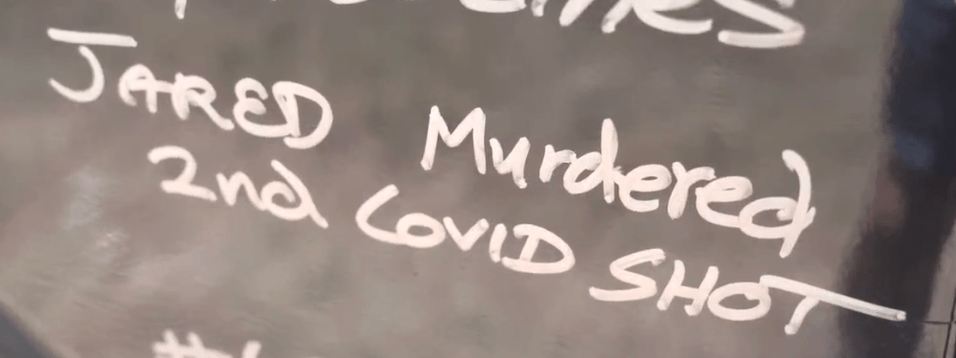
Message on the CHD Vaxxed bus

This latest Vaxxed chapter raises a few questions for those of us in Australia who followed the antics of The Australian Vaccination-risks Network (AVN) and their much troubled journeys in their own Vaxxed II: The People’s Truth, bus. The AVN hit the road in July 2020 in their bus, sticking closely to the Vaxxed script. They clocked up seven seperate tours in two buses, as the first was irreversibly damaged in NSW flood waters. On 8 July 2020, AVN founder Meryl Dorey revealed parents “will be filmed for an up-coming Australian documentary”. Five weeks earlier president Anita Hafemeister had boldly claimed, “This will be the Australian version of Vaxxed II, I assume”. All that excitement led this humble author to speculate that the Vaxxed II bus tour would yield material for Vaxxed III. In fact the AVN was still advertising the bus, with sponsorship requests, in February this year. One can only assume that the reality of CHD dollars, Kennedy’s backing and the ambition of Polly Tommey has for now, kept content from Down Under off the big screen.

Polly Tommey and CHD are pushing to fill theatres in the US for an 18 September screening. A host of graphics are offered to assist fans to spread the word on social media. All contain the image of a driverless bus emerging from the mist in the dead of night. The film is being advertised with an unabashed call for donations. Or if you’d like to be an associate, co-‘ or executive producer with a minimum donation of $10,000, that privilege is a mere phone call away. No doubt Vaxxed III will make a profit for Kennedy’s CHD.

Of more concern, is that acceptance of COVID vaccine misinformation has grown in developed nations under the labour of anti-vaccine activists. The USA is currently experiencing a growth in the belief of COVID vaccine falsehoods and this film, along with the discussion that follows, may well worsen that trend in the US and elsewhere. Australian anti-vaxxers will have to wait for an online release.


Polly Tommey and Co discuss pre-release debunking of Vaxxed III
Vale Jane Hansen

Last week Jane Hansen passed away from glioblastoma, an aggressive form of brain cancer. Jane was a deeply committed and focused journalist who utilised evidence to challenge pseudoscience, scams and disinformation. Jane regularly used truth to expose those who profited from exploitation of the vulnerable. She had journalistic skills equal to multiple tasks. Her presentation style and writing made that abundantly clear.

Consequently, Jane’s colleagues have recently offered other adjectives to describe her as a journalist. Esteemed, celebrated, legendary, star, courageous, compassionate, revered, renowned, tireless, passionate, crusader, genuinely funny, a giant, a hero, a pioneering female, a warrior for truth. Social media reflected the extent of the respect Jane had engendered over the years. Amazing, awesome, tireless warrior, dedicated, excellent, great… and more. A quick search for Jane’s name yields a veritable stampede of honorific headlines, all jostling to make individual statements, yet all condensing around one notion: Praise.

Respected Australian journalist, Ray Martin offered this summary:

“Jane Hansen gave journalism a good name. She was formidable, energetic and ethical.

“She fought relentlessly for the underdog and the disadvantaged – especially women and Indigenous Australians.

“Jane was smart, funny and a reliable friend. We’ll miss her pursuit of excellence, as she tried to keep the bastards honest.”

Jane was also a loving and loved mother, sister and an adored friend of many. I knew Jane only through the occasional email exchange or direct messaging on social media, yet often enjoyed her well known talent for making people laugh. I’ve lost count of the number of times I consulted an article Jane had written to orient myself regarding a specific anti-vaccine insult, or from whom a certain deceit had arisen. One highlight for me was Jane’s work in the making, production and promotion of Big Shots: Anti-Vaxxers Exposed. Made in the early, pre-vaccine days of the COVID-19 pandemic, Jane capably bridged the harm that anti-vaccine lobbying had already caused in Australia, and the foreseeable damage COVID conspiracy theories would inevitably bring.

Readers familiar with the tactics of vaccine conspiracy theorists can certainly guess, or may well be aware, of how they have reacted to this news. Fortunately, Jane made a lasting schism in their fragile credibility, leaving in her wake a surging wash of evidence-based reasoning, powerful enough to smother both their deceit and vulgarity. Jane always focused on presenting the facts. Her critics focused on attacking the person. On the day Big Shots aired in 2021, Jane was interviewed on Sky News, and shared this observation, which in my mind reflects both her sense of fairness and respect for sound public health.

I don’t have a problem with questioning a vaccine. This is a new vaccine, we want to know if it’s safe. There’s no point in having an unsafe vaccine; we all want a safe vaccine. But some of the misinformation that’s being spread is just ludicrous.

Jane’s career was extensive, including her role as a war correspondent for Network 10 in both Iraq and Bosnia, later working on the current affairs programme Hard Copy. She worked at Channel Nine for fourteen years. Jane co-authored Boned, the eye-opening book on boys-club mentality in TV media, and also authored the deeply personal and emotional Three Seasons. Her own experiences aided her unbiased assessment of Kathleen Folbigg, culminating in Jane writing and presenting the popular podcast Mother’s Guilt. Of course, Jane also managed her extensive and impressive career at The Sunday Telegraph.

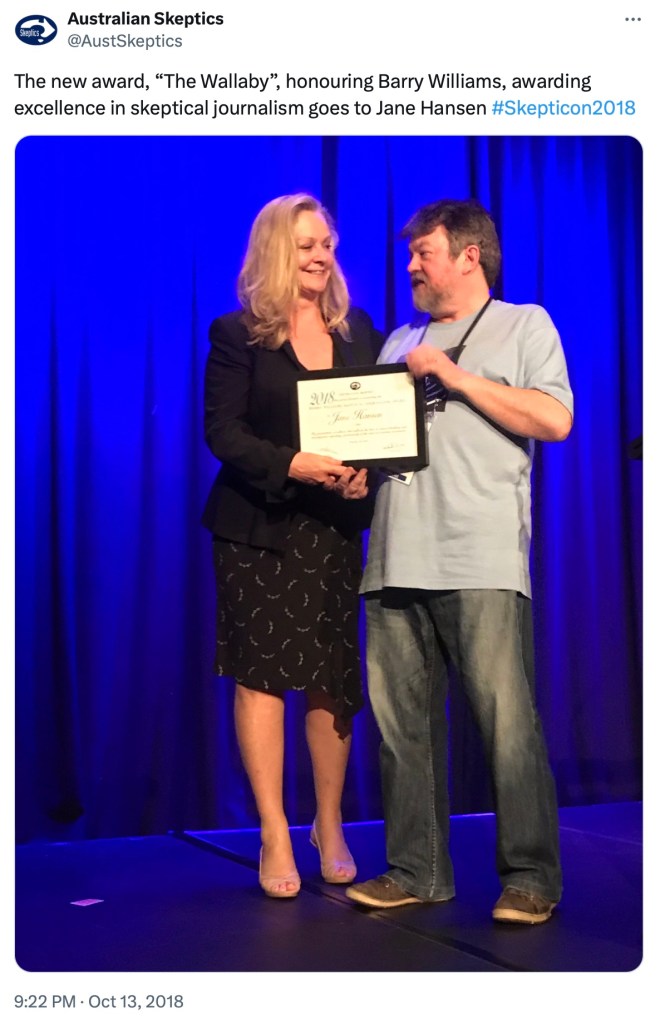
Jane’s tireless campaigning was instrumental to the introduction of the Abbott/Turnbull government’s No Jab, No Pay/Play policies. Introduced in 2016, this public health initiative has seen an ongoing increase in life-saving childhood vaccination and is regarded as an overwhelming success. Jane’s reporting on anti-vaccine responses to it continue to educate the community. The same can be said for her criticism of anti-fluoridation conspiracies. In 2018 Jane was the inaugural winner of The Barry Williams Award for Skeptical Journalism. Australian Skeptics Inc. explain:

The Barry Williams Award for Skeptical Journalism is awarded for journalistic work that critically analyses or exposes issues related to pseudoscience or the paranormal. The award is dubbed “The Wallaby” after Barry’s alter ego of Sir Jim R Wallaby, which he used for some of his more whimsical pieces published in The Skeptic magazine. In addition to a commemorative certificate, $2000 is awarded to the recipient or to a charity or cause of their choice.

Jane Hansen awarded the “Wallaby” 2018

Jane’s respect for evidence-based public health policies was linked to her desire for a more just world. In addition to her work exposing pseudoscience, Jane also reported on childhood muscular dystrophy, childhood medication, childhood cancer, cardiac health, teen vaping, IVF clinics, endangered animals, diabetes, organ donation and much more. Claire Harvey described Jane as “the most passionate journalistic crusader” she’d ever known. Jane’s work will remain and continue to positively influence others.

As a final note I’d like to stress there is no such thing as turbo cancer and no evidence COVID-19 vaccines cause cancer. Jane passed away late on 6th August after being diagnosed less than two years ago with glioblastoma, a particularly aggressive form of brain cancer. Outside of inherited syndromes or exposure to radiation, the cause of glioblastomas is not known. More common in older adults, they may occur at any age. Research has not identified anything that can prevent development of glioblastoma.

Fidge v Pfizer: High Court writ targets Chief Justice Debra Mortimer

Last we visited developments related to the Fidge v Pfizer case, we had a long look at ambitious arguments arranged to convince Federal Court Chief Justice Debra Mortimer to uphold a constitutional complaint against Justice Helen Rofe. Rofe had summarily dismissed Dr. Julian Fidge’s application for injunctive relief under the Gene Technology Act on 1 March 2024. The judgement is here and my post summarising the case is here.

Fidge was found to lack standing and the case did not proceed. As I mentioned at the time, this was the latest failure of case design by solicitors Katie Ashby-Koppens and Peter Fam, and retired barrister Julian Gillespie. By 22 March Ashby-Koppens and PJ O’Brien and Associates had filed the constitutional complaint with the Chief Justice, alleging Justice Rofe had concealed “her connections to Pfizer and the pharmaceutical industry, before dismissing a case to Pfizer’s advantage”. Reading the complaint, one is struck by both the tenuous nature and the sheer range of the arguments put forward to establish motive, as alleged by the complainants.

Justice Rofe omitted to disclose her role as a barrister acting for Pfizer in patent law cases around 20 years before; hence the “connections to Pfizer”. Yet her connections to “the pharmaceutical industry” rely on one following a convoluted web of associations, that are presented by the complainants as potentially nefarious only through the lens of conspiracy theory thinking. In fact the reader must also accept there are inherent flaws and a predisposition to deception associated with scientific and medical research per se, and indeed any acceptance of COVID-19 vaccines and/or COVID public health initiatives.

On 27 June a writ of mandamus was lodged on behalf of Dr. Julian Fidge at the Brisbane registry of the High Court of Australia. The defendant named was Chief Justice Debra Mortimer. As we’ve observed before, such a writ commands or dictates that an individual or government department carry out a duty that falls within their remit. We saw this in the AVN case targeting the Secretary of the Department of Health to use his powers under the Therapeutic Goods Act to cancel or suspend the provisional registration of three Covid-19 vaccines, including the Pfizer and Moderna vaccines (Australian Vaccination-Risks Network Incorporated v Secretary, Department of Health [2022] FCA 320). They too were found to lack standing.

Clearly Julian Gillespie and Katie Ashby-Koppens feel that three months is long enough to wait. Justice Mortimer has not commented and Gillespie writes that they have argued in “countless correspondence with her office ever since the Complaint was lodged with her”, pointing out their argument. It basically runs as follows:

Helen Rofe did not disclose her prior relationship with Pfizer and thus cancelled out her own judicial authority. This invalidated her 1 March ruling. Justice Mortimer should have informed her of this, Gillespie reasons. He has also peddled ad nauseam his “not a judge” theory. So, let’s look at this. Gillespie cites the High Court ruling QYFM v Minister for Immigration, Citizenship, Migrant Services and Multicultural Affairs (May 2023), paragraph 26. He quotes:

The question arising in the circumstances of the present case falls to be resolved at the level of principle within the framework established in Ebner v Official Trustee in Bankruptcy. Foundational to that framework are two propositions. One is that impartiality is an indispensable aspect of the exercise of judicial power. The other is that “[b]ias, whether actual or apprehended, connotes the absence of impartiality” … an actuality or apprehension of bias is accordingly inherently jurisdictional in that it negates judicial power.

With the negation of judicial power Justice Rofe is apparently “not a judge”. But let’s read that paragraph again, with all the text and a minor change in emphasis:

The question arising in the circumstances of the present case falls to be resolved at the level of principle within the framework established in Ebner v Official Trustee in Bankruptcy. Foundational to that framework are two propositions. One is that impartiality is an indispensable aspect of the exercise of judicial power. The other is that “[b]ias, whether actual or apprehended, connotes the absence of impartiality”. Leaving to one side exceptional circumstances of waiver or necessity, an actuality or apprehension of bias is accordingly inherently jurisdictional in that it negates judicial power.

Exceptional circumstances of waiver or necessity. Could there be circumstances of necessity? I’ve no idea at this point, but it seems relevant. Gillespie assumes he and others so inclined deserve the attention of one of Australia’s most senior judges. Despite being wrong five times in two years, they now seek to force the hand of the Chief Justice of the Federal Court of Australia. He accuses Chief Justice Mortimer of not “properly investigating Helen Rofe, her workmate”.

Another key reason to take this position is the belief that the ruling by Justice Rofe on 1 March is “unappealable”, yet Chief Justice Mortimer “wants to see us appeal the 1 March decision despite Dr Fidge’s legal team telling her that decision is unappealable”. The logic for this also stems from the “not a judge” mantra. The Federal Court of Appeal has jurisdiction to hear a judicial decision from a single judge. As Gillespie alleges Justice Rofe negated her judicial authority, the case did not have a single judge and they “have no decision vested with judicial authority”. Thus, the Gillespie contention is that it follows that the case is “unappealable”.

Finally, this entire manufactured affair provides an opportunity for chasing donations and to promote Australia’s anti-science senators in attacking COVID-19 vaccines. An initiative of Children’s Health Defense Australia Chapter is Section 72. The website seeks to direct devotees to lobby MPs to act in response to the constitutional complaint against Justice Rofe, and to date claims almost 9,000 have “taken action”. It also claims without any evidence that, “there is also the possibility other members of the same court are implicated in this misconduct of Justice Rofe”. Also:

Senators Malcolm Roberts, Gerard Rennick, Ralph Babet, Alex Antic and Russell Broadbent all intend to support the Complaint being dealt with properly by Parliament under Section 72(ii) of the Constitution…

Section 72(ii) of The Australian Constitution states:

The Justices of the High Court and of the other courts created by the Parliament–

  (ii.)   Shall not be removed except by the Governor-General in Council, on an address from both Houses of the Parliament in the same session, praying for such removal on the ground of proved misbehaviour or incapacity: 

The proposed aim of this constitutional complaint has been to push for Justice Rofe’s removal from the Federal Court. Allegations of corruption and COVID conspiracy theories shape the thinking of those involved. It will be interesting to see what response if any the complaint elicits and how the recent High Court filing targeting Chief Justice Mortimer for “not doing her job” plays out.

This particular anti-vax legal saga is likely far from over.

Fidge v Pfizer: The constitutional complaint

In the last post I ran through the finding by Justice Helen Rofe in the case of Fidge v Pfizer. This was the third case brought by individuals and legal representatives with strong anti-vaccination links; both ideological and active. The applicant, Dr. Julian Fidge was found to lack standing. The case was dismissed.

As I previously began to discuss, within a day of the ruling, a follower of Julian Gillespie prompted him to do some digging into Justice Helen Rofe’s career as a barrister. You see, dear reader, as a barrister Helen Rofe had represented Pfizer in cases of intellectual property and patent law between 2003 and 2006. To the antivax mindset, this was proof of corruption because she did not reveal this prior to hearing the case. As a perceived “conflict of interest” existed, Rofe should have recused herself or allowed parties to request her recusal, they argued.

Now again, I am not a lawyer and I cannot qualify the importance of the duty of disclosure in this instance. But my thoughts on this development are straightforward. Is there any evidence Justice Rofe could not have acted impartially, or did not act impartially? Or rather, did her experience make her an ideal choice to hear the case. In 1988 Helen Rofe completed a Bachelor of Science with a major in genetics. Justice Rofe states on LinkedIn:

Prior to being appointed to the Federal Court I was a commercial barrister and Queen’s Counsel specialising in science and technology related matters.

Constitutional Complaint

On 22 March 2024, PJ O’Brien and Associates filed a constitutional complaint against Justice Rofe citing not only her prior work as a barrister but also “affiliations and extended family”. According to the media release (below) Justice Rofe “concealed her connections to Pfizer and the pharmaceutical industry”.

Constitutional Complaint Media Release

I should point out that contact for the complaint, Katie Ashby-Koppens, is on the steering committee for the World Council for Health (WCH). The WCH is renowned for promoting misinformation linking COVID-19 vaccines with death. Wikipedia describes the group:

The World Council for Health is a pseudo-medical organisation dedicated to spreading misinformation to discourage COVID-19 vaccination, and promoting fake COVID-19 treatments.

The organization’s online appearance is that of a mainstream health organization. It appears to have been formed in September 2021 and its published leadership contains people which an Australian Associated Press fact check described as “figures who have promoted unfounded conspiracy theories”.

Now, better equiped to understand motivation, let us examine the complaint.

The accusations in the complaint are impressive to say the least. They require substantial “reasonable assumptions”, both numerous and convoluted. This reasoning begins by pointing out that Justice Rofe has majored in genetics, and the Fidge case involved genetics, genetically modified organisms and allegations that mRNA vaccines are GMOs. Also, we’re reminded that Justice Rofe held prior membership of the Bolton Clarke Human Research and Ethics Committee. Her cousin Sir Andrew Grimwade supported research there with grant monies from the Felton Trust. He was a member of the Felton Bequest for 50 years, and served 19 years as chairman of the bequests committee. He was a guest at the ceremony to welcome Justice Rofe to the federal court. Rofe “enjoyed a good relationship with Sir Andrew” sharing his “interest in science and scientific research”.

Sir Andrew was the great-grandson of Frederick Shepherd Grimwade who, “founded the Grimwade family pharmaceutical industry fortune in Australia”. The complaint goes on to state, Sir Andrew also “served as the honorary President of the Walter and Eliza Hall Institute (WEHI) for 14 years before retiring in 1992″ and had been on the Board since 1963. He “appears” to “have maintained a close relationship with WEHI right up until his death”, purportedly evidenced by a public guestbook obituary from WEHI.

As Australia’s leading biomedical research institute, the WEHI “may have” received billions of dollars from Australian governments. The WEHI have received $30 million from The Bill & Melinda Gates Foundation. Pfizer, BioNTech and Moderna have received six times that from the same Foundation, which has also promoted COVID-19 products. It’s “also reasonable to assume the WEHI supports all of the efforts of Mr Gates and the Bill & Melinda Gates Foundation in respect of their support of the COVID-19 products of Pfizer and Moderna.” WEHI received $13.5 million in Australian government funding for “COVID related projects”.

In mere paragraphs we’ve leapt from the failure of Justice Rofe to reveal that she had represented Pfizer some 18 to 21 years ago, to the apparent significance of her cousin’s commitment to scientific research and the involvement of the premier anti-vax enemy, Bill Gates. The complaint continues, targeting the Australian and Victorian governments’ partnership with Moderna. “It is reasonable to assume that the WEHI stands to possibly receive significant monies” from this partnership. The Victorian government has given $600,000 to WEHI as part of mRNA Victoria. “It is entirely reasonable, in light of enduring family ties and her Honour’s own scientific background and interests”, that Justice Rofe has “long been aware of the sources of funding… and the public statements in support of mRNA technologies” made by state and Commonwealth ministers and the Prime Minister.

The complaint rolls on in alleging that affiliations “reaching back four decades for her Honour personally, and over a century when extended family interests of great significance are factored in”, in fact mean a reasonable observer would accept J Rofe holds “Big Pharmaceutical interests, both domestic and international”. More so, Justice Rofe has “meaningfully and significantly assisted to protect, grow, and further establish in Australia [the interests of Pfizer]”. It is further alleged extended family ties nefariously influenced Justice Rofe’s decision-making to favour funding for WEHI, mRNA technology and “further significant sums of research monies” for both, as they’re supported by The Australian PM. Finally we reach paragraphs 42 and 43:

A reasonable observer can conclude from the above that it was more likely than not her Honour would seek to see the science and technology promoted by Pfizer and Moderna, and Australian governments, that stand to significantly benefit medical research institutes like the WEHI, survive and flourish in Australia.

Judicial proceedings of the type brought by Dr Fidge would, if successful, strike a damning blow against all the above interests, and much more.

The complaint continues with Case Implications, outlining what they believe would happen if Fidge had won the case. It not only reads like an anti-vaxxer day dream, yet reveals in black and white, the unabashed sabotage of vaccine public health initiatives and related vendettas, that this group deems justified. Australia would see injunctions and “serious criminal charges” for Pfizer and Moderna. Initiation of investigations into the “operations, processes and personnel of the OGTR, Department of Health and Aged Care” and (of course), “In particular the former Secretary of Health, Brendan Murphy due to his being responsible for provisional approval [of COVID-19 vaccines]”. In addition would be initiation of an examination to determine if the absence of GMO licences led to failure to provide proper informed consent, and medical negligence implications.

There would also be potential civil liability in the Commonwealth government for failing to enforce GMO licensing, and civil liability for Pfizer and Moderna for failing to undertake GMO licensing. The complaint also refers to “possible confirmation” of injuries and deaths caused by genetically modified properties of mRNA vaccines. Yet there is no body of work identifying such adverse outcomes. It is a misinformed notion linked to the same suite of decades old research, mRNA-critical pre-print papers, animal studies, SARS-CoV-2 infection studies and related articles that buoy this anti-vaccine belief. I’m not criticising the research, but strenuously reject the invented link to “injuries and deaths” fabricated by the anti-vaccine lobby.

Another implication of a Fidge victory, is vaccine hesitancy due to a loss of trust in Australian health authorities. Yes, they’re serious. However, vaccine hesitancy is in fact due to constant misinformation spread about vaccines, by groups such as this. Then on p. 13 we read the implication under 44 J:

The necessity to initiate many forms of clinical studies to assess the real world damage, disease, or fatal outcomes associated with the GMO products of Pfizer and Moderna, and any observed medium-to-long term disease and adverse reproductive health outcomes associated with the GMO products of Pfizer and Moderna, for those Australian citizens who were not informed they were receiving GMOs.

Astonishing. The complainants apparently believe an entire body of clinical research would evolve following a Fidge victory. One may ask, quite rightly, as to why such research into this vaccine induced disaster is not already underway. The answer being of course, that the “damage, disease and fatal outcomes” do not exist.

We then read that the complaints provided list is not exhaustive and that the implications suggested, pose severe and long lasting reputational damage and financial consequences “for all Australian political parties and their lead members in power throughout the COVID period”. Particularly for those introducing Pfizer and Moderna vaccines.

They finalise the implications by contending that these, or other implications not even listed, may have served to motivate Justice Helen Rofe to dismiss the case brought by Julian Fidge. The complaint then moves onto Judicial Conduct, and examines the Guide To Judicial Conduct with respect to J Rofe’s “failure to discharge her duty of disclosure concerning her prior dealings with Pfizer.” The complaint submits in paragraph 48:

As detailed under the section above…, her Honour Justice Rofe had significant prior dealings with Pfizer when a barrister, and through her science learnings and the interests of her extended family, significant professional and personal interest in seeing the continued success of those institutions her extended family and science colleagues had been involved with, and perhaps continue to be involved with.

The remainder of the complaint utilises the Guide to Judicial Conduct and the various summations of active bias that the complainants allege motivated J Rofe’s decision-making, in an attempt to argue she is in breach of sections of the Guide. Focusing on the principle of Impartiality and sections such as Personal Relationships, the complaint references seven “slightly different positions [reinforcing] the same common-sense view”:

Where there is a prior relationship with a party, the judicial duty is to disqualify oneself or disclose the relationship before all the parties. If in doubt about disqualification, disclose the relationship before all the parties and invite submissions.

Again, impartiality should be determined by “a fair-minded lay observer who might reasonably apprehend that the judge might not [be impartial]”. Whilst perception of bias and conflict of interest sufficient for disqualification from a case “is to be judged by the perception of a reasonable well-informed observer”. Parties should be informed by the judge of facts which might give rise to perceptions of bias, but the judge must decide on the appropriateness to sit on a case.

Conclusion

For this author, looking through the complaint is like reading any text peppered with the red flags of anti-vaccine beliefs combined with an entrenched distrust of medical, legal and government authority. I can see nothing wrong with the legal team of Julian Fidge raising concerns over Justice Rofe’s failure to disclose her past history representing Pfizer. I don’t believe there’s much substance to it but respect their right to raise concerns. However, the constitutional complaint itself relies on typical anti-vax tropes such as distrusting J Rofe’s respect for science and research, and her affiliations with individuals or organisations linked to vaccine technology and/or its funding. Indeed the complaint made a number of connections that whilst exhaustive, are difficult to respect, much less accept. To argue that J Rofe acted with corrupt intent, primarily to avoid the dawn of the post Fidge-victory era as the complaint described it, is simply fantastic.

I can only conclude by wishing Justice Helen Rofe all the very best.

Professional Conduct Rules for Lawyers

As a footnote, it’s worth pausing to consider that lawyers and solicitors are also subject to professional conduct rules. Katie Ashby-Koppens and Peter O’Brien & Associates must keep in mind their duty to the court and the administration of justice.

Lacking professional distance from your client (or their cause) risks distracting you from this duty, which is paramount and prevails to the extent of inconsistency with any other duty. Your objectivity, your independence and your forensic judgement – on which the court relies – may be reduced.

The duty to avoid any compromise to integrity and professional independence:

Your integrity and trustworthiness are fundamental to your reputation as a lawyer and to your relationships with clients and other parties in the justice system. When a lawyer fails to act with integrity because their professional boundaries are compromised, the integrity of the justice system as a whole is undermined.

Wise words.

Fidge v Pfizer: Federal court ruling

The title of “Fidge v Pfizer” given to the Federal court case file number VID 510 of 2023, tells us little about those behind the case and what motivates them. Dr. Julian Fidge stepped up to be the applicant in a case “designed”, we’re told on the Maat’s Method website (archive), by retired barrister Julian Gillespie and solicitor Katie Ashby-Koppens of P. J. O’Brien and Associates.

Those names should sound familiar to anyone with an interest in cases brought to the Federal and High courts of Australia by anti-vaccination activists represented by Peter Fam of Maat’s Method. The case was the third brought by this group, in an extended campaign to discredit COVID-19 vaccines. It alleged mRNA COVID-19 vaccines are unregistered GMOs, and their manufacturers guilty of breaching legislation. The initial two cases have been covered on this blog here and here.

Background

Seeking to invalidate the approval of COVID-19 vaccines, the so-called evidence in the first two cases relied heavily on unverified adverse reactions reported to the TGA. Having made these claims, the affidavits advanced various “gotcha” scenarios using the Therapeutic Goods Act (TG Act) in which the Secretary of the Department of Health, was supposedly duty bound to remove approval of COVID-19 vaccines. Neither case was successful in establishing legal standing to prosecute proceedings.

The second case, known as The Australian Babies Case included Dr. Julian Fidge as one of the six applicants. It also advanced a “gotcha” argument against the Secretary for failing to comply with section 30C(2) of the TG Act. This was unique in that section 30C provides for Consultation with the Gene Technology Regulator (OGTR). They argued that the mRNA vaccines were GMOs and the Secretary had failed to give written notice to the Gene Technology Regulator, as specified in section 30C. The affidavit contended:

It appears that there has been non-compliance with a statutory condition in the TG Act. […] The plaintiffs contend that non-compliance with the statutory obligation mandated by s 30C(2) leads to the invalidity of the registration decision that followed.

That case aimed to “fix the law on standing” by arguing the applicants warranted a unique “special interest”. It was filed with the High court in December of 2022 and remitted back to the Federal court in March 2023. Announcing its discontinuation in April 2023, Peter Fam observed that they had been working simultaneously on other more promising cases that would be announced within weeks. And thus, in July 2023 came the announcement We are suing Pfizer and Moderna directly – because their shots are GMOs. They had sent letters of demand to Pfizer, Moderna, the Therapeutic Goods Administration (TGA) and the Office of the Gene Technology Regulator (OGTR).

Julian Fidge was no doubt a willing applicant, ready to take one for the team. His eagerness to reject government mandates and AMA requirements related to COVID-19 is well documented. He has a strong association with the Australian Medical Practitioners Society; a group that has been instrumental in opposing COVID-19 vaccines and related mandates. They also strongly support the claim mRNA vaccines are GMOs. Fidge also had previously challenged the Medical Board of Australia over conditions placed on him following an anti-vaccine post on Facebook and has been reported as the doctor who “reversed Australia’s ban on ivermectin”. Fidge has had regular contact with Julian Gillespie, Katie Ashby-Koppens and Peter Fam. We know this anti-vaccine legal team had been working on this case for months, and no doubt modified the application to suit Dr. Fidge. With that, let us turn to the application and ruling.

Fidge v Pfizer

The case was heard before the Hon Justice Helen Rofe. Justice Rofe delivered her ruling on 1 March 2024. Her reasons for judgement are comprehensive with respect to legislation and case law, and could be reasonably summarised as follows.

On 6 July 2023 Fidge filed an injunction against Pfizer and Moderna pursuant to section 147(1) of the Gene Technology Act 2000 (GTA), on the basis that:

  1. The mRNA vaccines are or contain GMOs as per section 10 of the GTA.
  2. To “deal with” GMOs Pfizer and Moderna (respondents) were required as per section 40 of the GTA to secure licences from the OGTR, but failed or refused to do so;
  3. The respondents knew after vaccine approval that; (i) the vaccines are or contain GMOs, and (ii) the vaccines were not licensed as per s. 40 of the GTA;
  4. The respondents dealt with and continue to deal with the vaccines in Australia by importing, transporting and distributing them. This constituted “vaccine dealings”;
  5. The vaccine dealings without a licence are unlawful as per s. 32 and s. 33 of the GTA. This constituted “breaches” of the GTA;
  6. Fidge is an “aggrieved person” as per s. 147(1) of the GTA because “he wasn’t fully informed that this new class of drugs is capable of transferring genetic material”, which Fidge considers poses significant adverse health risks.

Dr. Fidge asserted he had standing under section 147(1) of the GTA on “a number of grounds” citing his:

  1. “Professional capacity” as a GP who oversaw administration of 10,000 COVID-19 vaccinations, and may be exposed to legal claims from his patients, as he was unable to advise them of the vaccine-GMO status. He has also failed to “do no harm” as he contends the vaccines are or contain GMOs, rendering them unsafe;
  2. “Personal capacity” as the recipient of three Pfizer vaccines;
  3. “Private capacity” due to “severe moral injury, mental harm and suffering”, due to the large number of “deaths, illnesses and injuries reported to the TGA to date”;
  4. “Public capacity” as a doctor subject to a duty to preserve human life and protect the health and safety of the public. He is compelled to speak for all Australians and believes his professional codes of conduct mean he is obliged to inform patients about the vaccine-GMO status to properly provide informed consent.

Before going on it’s worth pausing to note that the first COVID-19 vaccine to arrive in Australia is Astra Zeneca; an adenovirus organism. It was registered with the OGTR in February 2021 as a genetically modified vaccine, with risk assessment approval describing it as a GMO. The AZ vaccine has not attracted attention from this group as a dangerous GMO. That allegation is reserved for mRNA vaccines, following intense focus on reports of plasmid DNA in mRNA vaccines, a number of animal studies into mRNA vaccines and pre-COVID studies of nanoparticles, all frequently cited by opponents of mRNA vaccines.

The respondents, Pfizer and Moderna, sought a summary judgement under s 31 A(2) of the Federal Court Australia Act and rule 26.01(1) of the Federal Court Rules on the basis that the applicant lacks standing to seek relief under s 147(1) of GT Act. Section 31 A(2) of the Federal Court Australia Act, states that, the court may give judgement for one party against another in relation to the proceeding if:

  (a) the first party is defending the proceeding; and

  (b) the court is satisfied that the other party has no reasonable prospect of successfully prosecuting the proceeding.

Rule 26.01(1) of the Federal Court Rules states that a party may apply to a court for an order that judgement be given against another party because:

(a) the applicant has no reasonable prospect of prosecuting the proceeding; or

(b) the proceeding is frivolous or vexatious; or

(c) no reasonable cause of action is disclosed; or

(d) the proceeding is an abuse of the process of the court.

On 10 August 2023 Justice Rofe ordered that the respondents application for summary judgement be heard in October, separately from Julian Fidge’s application for injunctive relief. Rofe did not accept that Fidge had established he had standing to bring his application, and thus, allowed the respondents’ applications for summary judgement. Rofe observed that the respondents denied the vaccines were GMOs or that they had breached the GTA. In addition she observed that the position of the OGTR, “is that the vaccines are not GMOs”.

In paragraph 15 Justice Rofe writes:

The parties agreed that the question of whether Dr Fidge has standing is premised on the assumption (for the purposes of the respondents’ applications) that the vaccines are GMOs and the respondents therefore breached the Act by dealing with the vaccines. Thus, for the purposes of this summary judgment application, I do not need to determine whether the vaccines are GMOs or the resulting question of whether Pfizer and Moderna breached the Act by failing to obtain licences for the Vaccine Dealings. I have therefore disregarded any evidence filed by the parties that address whether the vaccines are GMOs.

Alas, once again the result for the Gillespie group is to be ruled as lacking standing. Dr. Julian Fidge is not a “person aggrieved”, and thus no different from any ordinary member of the public. Also, rather helpfully Justice Rofe applies case law to expand on why summary judgement under the Federal court Rules and Act, is appropriate where standing is absent. If an applicant lacks standing there are no prospects of success. Indeed, citing precedent, Rofe observes that an abuse of process arises if the applicants case is “foredoomed to fail”, as would always be the case without standing. Rofe opens paragraph 22 with:

It is clear that without standing an applicant has no prospect of success, no reasonable cause of action and the proceeding is an abuse of process.

Standing

Justice Rofe also elaborates on the importance of standing in this case by referring to precedent. Standing dictates that a person must be an appropriate party to instigate proceedings. Various terms such as “sufficient interest”, “special interest”, “real interest” or “sufficient material interest” are one consistent test. In fact, if standing was accorded to any citizen, the law may be, “abused by busybodies and cranks and persons actuated by malice“. In addition persons or groups who feel very strongly about an issue will be prepared to put another party, whose actions have not affected them, to great cost and inconvenience in mounting a defence.

Most interestingly, Justice Rofe referred to Australian Vaccination-Risks Network Inc v Secretary, Department of Health (2022) 292 FCR (AVN’s appeal) in reinforcing the lack of standing for Fidge. Justices hearing the appeal agreed that the AVN lacked standing. We can see that Justice Rofe has not missed the similarity between Fidge seeking to enforce performance of a public duty via the GTA, and the AVN seeking to force the Secretary of the Department of Health to execute duties under the TG Act. Rofe cites:

It is quite clear that an ordinary member of the public, who has no interest other than that which any member of the public has in upholding the law, has no standing to sue to prevent the violation of the public right, or to enforce the performance of a public duty.

Over paragraphs 28 to 32 Justice Rofe references the initial AVN case and their failure to demonstrate standing to further demonstrate why Julian Fidge also lacked standing. One does not find it difficult to imagine that this would not have sat well with the brains behind these three cases; Julian Gillespie, Katie Ashby-Koppens and Peter Fam.

Justice Rofe addresses the GTA extensively, and in a manner that is beyond the purpose of this post. In doing so she notes that Fidge has only alleged Pfizer and Moderna contravened the offences in s 32 and s 33 of the Act. Rofe also rejects evidence presented by Fidge claiming Pfizer’s understanding of the Act is so “narrow, myopic and restrictive” it prevents anyone from having standing to challenge breaches of the GTA. Further, the GTA deals with GMOs that present a biosafety risk to people or the environment and not “the quality, efficacy and safety of GMO vaccines for administration to humans”. More so, the applicant failed to establish he is “any other aggrieved person” within the meaning of s 147(1) of the Act. Without standing Fidge, ” ‘has no reasonable prospect of successfully prosecuting the proceeding’ within the meaning of s 31A(2)(b) of the FCA Act and r 26.01(1)(a) of the Rules”.

In her conclusion Rofe writes that instead of making an application under the “relevant statute that regulates vaccines”; the TG Act (as the AVN had done), Fidge “seeks an injunction under an act that only tangentially deals with GMO vaccines”. In what one imagines may well infuriate the legal brains who strategised this case in the wake of AVN, Rofe sensibly observes:

That strategic decision may be understandable in light of the decisions in AVN and AVN FC but was ultimately misguided.

Dr. Julian Fidge’s application for injunctive relief under the GTA was summarily dismissed. On 22 March 2024, Fidge filed with the Federal court for leave to appeal.

Is Justice Rofe corrupt?

Within a day of the ruling came the allegation, courtesy of Julian Gillespie, that Justice Rofe had failed to disclose prior activity as a barrister, representing Pfizer in patent disputes. There are five such instances that occurred between 2003 and 2006. There is no evidence Justice Rofe was unable to act impartially or did not act impartially. Nonetheless, PJ O’Brien & Associates and Ashby-Koppens have not only examined her career, but most of her life, her extended family and affiliates, to allege nefarious intention on her part motivated by “Big Pharmaceutical interests, both domestic and international”. They have filed a constitutional complaint with the Chief Justice of the Federal court and also called on the Australian Parliament to investigate allegations of misbehaviour, which if proven may result in her removal from the bench.

In the next post we will look into the complaint, the scope of its contention and ask not only if the allegation is justified, but even feasible.