Bad politics vs good drug policy and prison health

Australia’s National Drug Strategy consists of the three pillars of Harm Minimisation

To hear major parties speak of Australia’s national drug strategy one may be forgiven for assuming it is a competition of muscle. To be sure, we’ve come a long way since the great stupor of the Howard years, as then federal Health Minister, Tony Abbott taunted Opposition leader, Kim Beasley for being “soft on drugs”. Translation? Taking the evidence based advice of global drug strategists.

Terrified of losing votes, Beasley all too readily took the bait. In this way successive debates and policy changes had a ratcheting effect on absurd non evidence based and wasteful attempts to be seen to be “tough” on drugs. Manfully tearing up cannabis plants and thrashing them against rocky outcrops or cursing at bags of cocaine aside, it follows quite logically that “tough on drugs” is nothing less than tough on people.

Should Abbott become PM we will quickly find that there is more to Aussie politics than just carbon taxes, boat arrivals and the odd NBN slur. It wasn’t just Howard’s homophobia, weapons of mass destruction lies and black and white 1950’s relativism we’d woken up from. Howard’s skill as a politician is rivalled very well by his inability to understand the 21st century. Indeed, perhaps the last third of the one before.

I’m not suggesting drug policy should become a national focus to the exclusion of any other policy. It never will. Yet, the list of human rights abuses ushered in by stealth and without reason under Howard is a long one. It was Tony Abbott himself who funded the extreme right evangelical lobbyists, Drug Free Australia with the explicit aim of destroying Neal Blewett’s 20 year old successful policy of Harm Minimisation. Howard’s sabotage of our role as world leaders in Harm Reduction is legendary.

Even in 1997 going against the advice of then health minister Michael Wooldridge, and taking that of (later) DFA board member, evangelist and disgraced Salvation Army Major, Brian Watters (initial Chair of the ANCD) to dump the heroin on prescription trial. From The Politics Of Heroin – ABC 4 Corners:

KATE CARNELL: The approach that we put, or I put, to that meeting, was that this was a small trial, only 20 people or so in the first instance. That the trial would be a medical trial with appropriate science backup.

ANDREW FOWLER: The vote came as a huge surprise. The Federal Health Minister, four States and the ACT voted for the trials to go ahead.

A 6-3 result. The decision marked a radical shift in policy.

KATE CARNELL: This is not just a heroin trial. It’s an integrated, national approach that brings in the majority of States in this country. I think it shows a huge amount of maturity and it really is a mammoth step forward.

ANDREW FOWLER: The Federal Health Minister, Michael Wooldridge, telephoned the Prime Minister to tell him the news. But a few minutes later, as he made his way back into the meeting, observers say he looked shaken.

Nothing to this day has beaten Bronwyn Bishop’s 2007 Parliamentary Committee Inquiry. A despicable abuse of our parliament and the role of standing committees, the final report was rejected by every D&A body in Australia. All except our installed enemies of humane policy, lobbyists Drug Free Australia. As Chair and at John Howard’s urging she intoned to field experts that, “the PM says he doesn’t want that” (Harm Minimisation), sounding much like an Inquisitor instructed to reject reference to heliocentrism. That this was her governments policy was entirely lost on her. It was a predetermined farce to attack progressive successes, and demonstrably so.

Her attacks upon Alex Wodak‘s internationally respected skill and evidence in favour of biblical stories from fundamentalist zealot Dr. Stuart Reece, left jaws agape. A bastard baptising, bible wielding, Jesus summoning fruit cake who’d knocked off 25 of his patients in 20 months with reckless naltrexone treatment. The investigation into which he described as “a conspiracy”. “They’re only drug addicts anyway”, he informed a grieving parent who later wrote to me.

As reported in Crikey by Ray Moynihan in Naltrexone II: no trials, just the power of prayer:

In lengthy evidence to a current parliamentary committee inquiry into illicit drugs, being run by Bronwyn Bishop, Reece suggested one of the biggest problems at the moment was a disease called “drugs, s-x and rock and roll.” As part of his evidence, Stuart Reece cited Sodom and Gomorrah, the Biblical cities destroyed by God for their immorality.

Reece’s testimony then suggested Australia’s civilisation was under threat of being destroyed by the scourge of injecting rooms, give-away syringes, and methadone. These of course are the well-established strategies of “harm minimisation”, the approach that underpins the way Australia deals with the dangers of illicit drug use. In contrast to his attacks on harm minimisation, Stuart Reece spoke reverentially of the work of Dr George O’Neil, and the immense value of the still unproven naltrexone implant.

Asked during an interview whether he currently prescribed naltrexone implants to heroin addicts, Dr Reece answered cryptically, “Yes and No”.

Suffice it to say, Reece as a member of Drug Free Australia still marches front and centre with the most dangerous and most irrational opponents to Harm Minimisation. Our National Drug Strategy. What they call “the noramlisation of illicit drug taking”.

However, the Public Health Association report below on the proposed Needle, Syringe Program (NSP) trial at the Alexander Maconoche Centre is clear:

The Australian government web page on the National Drug Strategy (NDS) identifies that

“the National Drug Strategy, a cooperative venture between Australian, state and territory governments and the non-government sector, is aimed at improving health, social and economic outcomes for Australians by preventing the uptake of harmful drug use and reducing the harmful effects of licit and illicit drugs in our society”. (Australian Government Department of Health and Ageing-DoHA, 2011)

The NDS is based on three inter-related strategic approaches to dealing with drugs in our community – the NDS refers to them as the “three pillars” of the overall approach of harm minimisation.
Harm minimisation, therefore, is our agreed national approach to drug policy which encompasses the three pillars of:

Demand Reduction

Demand reduction to prevent the uptake and/or delay the onset of use of alcohol, tobacco and other drugs; reduce the misuse of alcohol and the use of tobacco and other drugs in the community; and support people to recover from dependence and reintegrate with the community. To achieve this requires effort to:

  • prevent uptake and delay onset of drug use
  • reduce use of drugs in the community
  • support people to recover from dependence and reconnect with the community
  • support efforts to promote social inclusion and resilient individuals, families and
    communities

Supply Reduction

Supply reduction to prevent, stop, disrupt or otherwise reduce the production and supply of illegal drugs; and control, manage and/or regulate the availability of legal drugs. To achieve this requires effort to:

  • reduce the supply of illegal drugs (both current and emerging)
  • control and manage the supply of alcohol, tobacco and other legal drugs

Harm Reduction

Harm reduction to reduce the adverse health, social and economic consequences of the use of alcohol, tobacco and other drugs. To achieve this requires effort to:

  • reduce harms to community safety and amenity
  • reduce harms to families
  • reduce harms to individuals

Our NDS does not simply limit its scope to the broad community but states categorically:
“The approaches in the three pillars will be applied with sensitivity to age and stage of life, disadvantaged populations, and settings of use and intervention”. (DoHA 2011)

Over the years we’ve had the rants of Alan Jones and John Laws. The rubbish of Piers Akermann and Andrew Bolt. The fear mongering of the anti-science mob. Still many fail to appreciate not just good policy but the responsibility under human rights which (as I’ll get to in time) is exactly what Alexander Maconochie is about. Right down to using the name of the great penal reformer himself.

This Lateline segment from October 2009 gives excellent insight. On October 2nd 2009 they reported, “The Australian drugs conference in Melbourne has today called for a trial of needle and syringe programs in Australian prisons. One in three Australian inmates has hepatitis C, and it is thought that a needle and syringe program could reduce the incidence of blood-borne viruses in jail.

Resistance born of political will, not evidence, continues today. It will be a great shame if ignorance prevails.
Lateline


Public Health Association Report on NSP Trial at the Alexander Maconochie Centre

Needle, Syringe Programs needed in Aussie prisons

Needle Syringe Programs in prisons have proven successful across the globe, including in Iran.
Gains are directly transferred to
individuals, family members, community members, custodial officers, law enforcement officers and health professionals.

Australia once led the world in Harm Reduction initiatives, a number of which pertain to safe injecting of illicit drugs.

Because of the illegality, potential for tragedy and high risk associated with IV drug use it is very easy to be led astray from the evidence base supporting harm reduction initiatives. Primary amongst these is the funding of over 1,000 Needle, Syringe Programs (NSPs) across Australia. Although introduced against considerable opposition, community acceptance is now very high. More to the point, similar misinformation and conservative opposition was raised against another harm reduction initiative when introduced. Condom use amongst men having sex with men (MSM).

Harm Reduction measures were introduced by then federal health minister, Neal Blewett in 1985, ushering in unprecedented acceptance, understanding and management of high risk behaviour leading to the spread of HIV in Australia.

Led by the Minister for Health under the Hawke government, Neal Blewett, Australia undertook several unprecedented and pragmatic steps: it introduced a needle exchange program for intravenous drug users, encouraged open discussion of safe sex, and created the famous Grim Reaper advertising campaign.

There was fierce opposition from the religious right, but 25 years after the initial AIDS outbreak, Australia’s decision to accept human nature in policy making has saved thousands of lives – especially when compared to the USA where ‘morality’ has outweighed practicality in dealing with the illness.

Harm Reduction (HR) is one of the three major prongs of Australia’s illicit drug policy. The policy is called Harm Minimisation. Not “tough on drugs”, not “zero tolerance”. Harm Minimisation includes Supply Reduction, Demand Reduction and Harm Reduction. Over the years the gay lobby and LGBTQ community has forged itself a formidable legal and social identity. I pity the conservative zealot who would insult their ontology. Not so for IV drug users. This is due to many reasons, the more obvious being the transient nature of drug use (experimentation), the social, professional and personal cost of outing oneself as a chronic addict, the complete lack of intention to politically mobilise and the volume of comorbid mental health problems.

To be rather crude whilst it is demonstrably bigoted to discriminate against Australia’s disabled population they are not a force of reckoning. Our communities remain poorly suited to accommodate disabilities. Stigma persists leading to discrimination and inequality.

Similarly whilst we clinically accept the disease model of addiction, many community members still remain blinded to this very real health problem in favour of pop culture “bad guy” stereotypes. This is sheer manna for those with political interests to be seen to be “tough on drugs” or who seek to exploit individuals with a range of disabilities, including drug dependence.

Most Aussie addicts are alcoholics and cigarette smokers. The bulk of public health money dealing with drug induced harm is spent here. Illicit drug addiction consumes under 5% of the total expense. Writing in, Redefining Addiction in MJA Insight Paul Haber noted:

The American Society of Addiction Medicine (ASAM) grappled with this problem for 5 years before releasing its new definition of addiction, which has stimulated interest from around the world with commentaries in The Lancet, Time and elsewhere. ASAM proposes that addiction is a primary, chronic disease of brain reward, motivation, memory and related circuitry. It is a chronic relapsing and remitting disorder that manifests in continuing use of substances or alcohol despite accumulating harm to the individual and to others. [….]

This addiction disease concept facilitates a medical approach to management, including the need for quality evidence to support clinical interventions and it encourages engagement of medical professionals in this field. Acceptance of the disease model can also reduce the stigma of the disorders. Specific neurobiological abnormalities have been identified such as certain dopamine receptors in the reward system and these are targets for therapeutic intervention.

The funding pittance that is dealt to illicit drug harm reduction in part reflects the dwarfing of this demographic alongside drinkers, smokers and gamblers. The rest is explained in that the lions share is consumed by futile supply reduction efforts in the endless cycle of importation, distribution, dealing and administration. Demand reduction – fighting the demand for drugs through education, rehabilitation and disincentives also receives more money than harm reduction. It remains far, far too easy to raise a voice of ignorance and accuse HR initiatives of “allowing” or “encouraging” drug use.

The ABC news items below discuss the need for needle exchange programs in Australian prisons and the potential for a trial beginning in Canberra’s Alaxander Maconochie prison. It’s probable an HIV epidemic beginning in injecting drug users, and placing the wider Australian community at risk, would begin in Australian prisons. Questions are also raised as to the “shameful” state of Australia’s Harm Reduction initiatives that have fallen behind what is considered effective evidence based practice for prison population health. This is further evidenced by successful programs in other countries around the world. Needle Syringe Programs are strongly supported by a large global evidence base. Significantly, one public health success story is Australia.

Indeed return on investment research in 2009 [PDF] show that “investments in needle and syringe programs were yielding a twenty seven fold return in health, productivity and other gains.” Gino Vumbaca, Executive Director of the Australian National Council on Drugs wrote at the time:

What is striking is the level of public support for the program. The largest regular survey on drug use issues we have, the National Household Survey on Drugs, now records public opposition to the program at less than 20%. The Hawke, Keating, Howard and now Rudd Governments, as well as a myriad of state and territory governments of varying hues over the past 20 years have all lent their support to the program. For some this was in the face of strident opposition. A truly admirable achievement based on evidence, common sense and humanitarian grounds

Discussing the 2009 report findings Anex wrote:

The World Health Organization commissioned a review of evidence of the effectiveness of Needle and Syringe Programs to reduce HIV which concluded:

There is compelling evidence that increasing the availability and utilisation of sterile injecting equipment for both out-of-treatment and in-treatment injecting drug users contributes substantially to reductions in the rate of HIV transmission. Research from around the world clearly indicates that NSPs make a significant contribution to preventing the spread of HIV/AIDS and hepatitis C.

Between 2000 and 2009, the Australian Government invested $243 million in Needle and Syringe Programs. This resulted in the prevention of an estimated 32,050 new HIV infections and 96,667 cases of hepatitis C. $1.28 billion dollars were saved in direct healthcare costs. [….] The report states: “If NSPs were to decrease in size and number, then relatively large increases in both HIV and hepatitis C could be expected with associated losses of health and life and reduced returns on investment. Significant public health benefits can be attained with further expansion of sterile injecting equipment distribution.”

Countries, like Australia, that have implemented NSPs have averted HIV epidemics among injecting drug users and, therefore, the community at large.  Those countries that have not implemented these measures have often experienced uncontrolled HIV epidemics. There is strong evidence to suggest that when HIV becomes endemic among the injecting drug user community it can then spread to their sexual partners and children, resulting in high mortality rates and large social and economic costs to the entire community.

Conservative ideologues and those with vested interests in punitive measures, have attempted to discredit NSP efficacy. Nations without proper NSPs, such as Sweden are deemed in breach of the UN International Right to Health. See page 3, item D. Religious fundamentalists & other totalitarian belief systems frequently reference Sweden’s “war on people” mentality, obfuscating the human rights abuse. As revealed by WIKILEAKS, the USA work actively to sabotage Harm Reduction initiatives as part of their War On Drugs policy, citing Stockholm as a reliable ally. An excellent discussion of this matter is to be found at Neurobonkers. The Global Commission on Drug Policy has demonstrated the failure of the Drug War. [CNN News]

With respect to needle exchange, rather than advance challenges to NSP efficacy with new research the tactic of a small minority is to attack existing methodology in an out of context, subjective fashion creating the illusion of an argument. An analogue today might be “pertussis diagnoses have increased, therefore the vaccine is ineffective” – a claim advanced by comparison of unrelated data sets.

In May 2010 Norah Palmateer et al. produced a meta-analysis using what they called “Critical appraisal criteria” to challenge the methodology of NSP research. However, even whilst selecting particular modes of distribution and leaving out others, a conclusion that “New studies are required to identify the intervention coverage necessary to achieve sustained changes in blood-borne virus transmission”, was delivered. This is scarcely revolutionary, yet is falsely cited as discrediting NSP efficacy by fundamentalist conservative groups. In truth Palmateer et al actually argue for a shift in analytical focus to biological rather than behavioural data. More so, they write:

The findings of this review should not be used as a justification to close NSPs or hinder their introduction, given that the evidence remains strong regarding self-reported IRB and given that there is no evidence of negative consequences from the reviews examined here. [….] We recommend a step change in evaluations of harm reduction interventions so that future evaluations: (i) focus on biological outcomes rather than behavioural outcomes and are powered to detect changes in HCV incidence; (ii) consider complete packages of harm reduction interventions rather than single interventions; (iii) are randomized where possible (preferably at the community level); and (iv) compare additional interventions or increased coverage/intensity of interventions with current availability.

“The findings of this review should not be used as a justification to close NSPs or hinder their introduction”. Yet this is exactly what the enemies of reason have done, misquoting Palmateer at every turn. The “AVN” of Blood Borne Virus control is a group of far right evangelical lobbyists known as Drug Free Australia. Their “Meryl Dorey”, as it were is their “secretary”, young earth creationist and climate change denialist, Gary Christian. The similarities between Dorey and Christian are striking. No medical or health qualifications, citing of global conspiracies, “social experiments” – not evidence based public health, saving Australians, provision of “truth”, attacking certain research identities, cherry picking of data and outright lies.

When a 27 fold return on investment for NSPs was claculated after years of research, Mr. Christian promptly dismissed this claiming NSPs actually serve to promote drug use and spread viruses. WHO data would prove this if properly adjusted he cried, mimicking Dorey’s claims to “properly read research”. Thus he was able to immediately dismiss what is absolute proof opposition to NSPs is baseless. Indeed, Christian went further.

Harm Reduction is the “normalisation of illicit drug use” not just correlating to, but causing a rise in drug use. Hands up if knowing about NSPs motivates you to experiment with IV drugs. This new take on “condoms cause AIDS” is demonstrably flawed. Just as abstinence, not condoms will prevent STD’s, Christian claims “free HIV testing” not NSPs or harm reduction will control HIV, citing discredited non peer reviewed sources.

Thus arguments raised against the value of exchange program efficacy in cutting blood borne virus spread are emotive, supposedly backed by misrepresented, spurious and/or biased “research” and driven by discredited, conservative fringe lobby groups.

Unsurprisingly the opposition to NSPs in Aussie prisons is based on misinformation and a lack of evidence.

ABC TV News October 15th

ABC AM Program October 15th

NSP Information, Q&A. Australian Government

End War On Drugs, Try Legalisation: Global Commission On Drug Policy

The Global Commission on Drug Policy aims;

To bring to the international level an informed, science-based discussion about humane and effective ways to reduce the harm caused by drugs to people and societies.

Their goals are to;

  • review the basic assumption, effectiveness and consequences of the ‘war on drugs’ approach
  • evaluate the risks and benefits of different national responses to the drug problem
  • develop actionable, evidence-based recommendations for constructive legal and drug policy reform

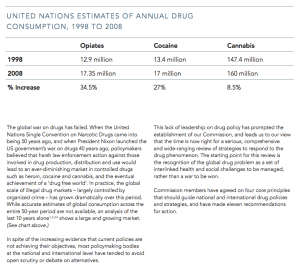
At the beginning of June they released a comprehensive report [below] arguing that the War on Drugs had failed and that it was time to look at options such as regulation and legalisation. With opiate use up 34.5%, cocaine use up 27%, cannabis use up 8.5% in a decade, the GCDP recommends an end to the criminalisation, stigmatisation and marginalisation of drug users who do no harm to others. Portugal successfully decriminalised drugs a decade ago.

   Report of The Global Commission on Drug Policy – June 2011

Banning synthetic cannabinoids – a “kronic” overraction?

During Questions Without Notice in the Australian Senate on June 22nd [Page 50], Senator Steve Fielding challenged federal Attorney-General Representative, Senator Joe Ludwig over his government’s intentions toward previously legal synthetic cannabinoid products, known quaintly as “synthetic cannabis”.

One particularly common brand is named “Kronic”. Fielding’s ignorance is telling. He refers to such products as being “sprayed with a synthetic chemical” and as such are “designed to manipulate people’s minds”. He further relays concerns about anecdotal reports, which whilst serious are not conclusive. No documentation or conclusive study is presently available leaving quantification and qualification impossible. No correction has been made for the use of other substances in conjunction with Kronic or pre-existing psychiatric conditions or symptoms. It is for the very reason we must take these reports seriously that they deserve proper scientific inquiry.

Ludwig admirably fills his time relaying the excessive reaction of W.A. in banning such preparations under the Misuse of Drugs Act (which provides for a 25 year sentence in certain cases). QLD will move to ban 15 of these products under the QLD Drugs Misuse Act. He omits that NSW is seeking to regulate “synthetic pot” at the level of heroin. One wonders at the logic of this rash action given the well documented failure of prohibition and the recent report from the Global Commission on Drug Policy, damning prohibition and urging implementation of legalisation models [CNN].

More prohibition opens the way for criminals to move from growing, harvesting, preparing and packaging cannabis for transport and sale, to switch to small vials of synthetic cannabinoids. These could be added to any legal vegetable matter or herb, in unknown concentrations and mixes further compounding already known problems arising from an imbalance in cannabinoids due to hydroponic growing techniques.


ABC Lateline gave a balanced report on these developments. When NSW health minister, Kevin Humphries, describes psychotropic synthetic cannabinoid preparations as a “synthetic psychotic drug”, one can be sure he’s not speaking from a position of evidence. Still, “synthetic pot” that’s been with us for four years, will now be as illegal as heroin, in NSW. As already noted anti-drug zealot and W.A. Premier, Colin Barnett was true to form in announcing 25 year prison terms for some offences.

The fact is we don’t know the full side effects of synthetic cannabinoids ingested without supervision beyond the certainty that inhalation of any combustible material is a dire challenge to pulmonary health. We may assume confidently that psychotropic effects are similar to cannabis. And we may ask genuine questions about the effect of significantly greater concentrations of THC in synthetic concoctions both as acute and long term (or chronic – no pun) effects. Paul Dillon raises good points about the rapid rise of availability, of varieties of synthetic drugs. Paul does raise a false analogy citing a synthetic THC cannabinoid – no doubt HU-210 – referring to it being 100 times more potent that natural THC. Had he taken the time to express the need for health responses here it would have been welcome.

Indeed, we don’t know the the effects of 22% of Complimentary and Alternative Medicines in Australian pharmacies that, lacking any trial data, were fraudulently submitted as “evidence backed” and rashly added to the Australian Register of Therapeutic Goods by the TGA. But there’s no rush to ban these products or to wage a War on Placebo, despite fears of adverse drug interactions or contamination with heavy metals and poisons. Regrettably, this clip has the standard file footage of unnamed researchers looking at brain scans as the voice over notes doctors concerns – despite only anecdotal stories of nasty side effects. Both good and bad effects are the same as cannabis. Sanity is provided by Alex Wodak and Robbie Swann.

Prohibition has failed splendidly, leading only to the creation of vast underworld markets. Here, we may watch it in action. I support warnings that smoking a loosely controlled herb dosed with cannabinoids is cause for caution. But removing the product from legal tax paying outlets and placing it in the hands of criminals who will now sell it as genuine cannabis – without the risks of handling genuine cannabis – is appallingly short sighted.

Ultimately, synthetic illicit drugs are here only because the certain profit provided by prohibition of already popular drugs, has empowered criminal enterprise to produce them. Perhaps it’s time we began to learn from history. I reject argument from antiquity – that humans have always used drugs and thus always will. But it’s irrefutable that without the lucrative market provided by prohibition many of todays problematic illicit drugs would not exist.


The Global War on Drugs has failed. Synopsis from The Global Commission on Drug Policy

Progressive policy and fundamentalist resistence

A close look at the rejection of evidence and application of religious belief as guiding principles for members of the Negative team, in debating if drugs should be legalised. Jade Lewis, Greg Pike and Paul Sheehan.
Last post we looked at the debate All drugs should be legalised held by Intelligence Squared. One of the greatest moral, social and human rights based questions today is: Should illicit drugs be legalised?
We ask this question because the harm caused at the community and personal level by prohibition is irrefutable. To this we can add the devastating effects of The War On Drugs – crafted initially by Nixon on the back of the Vietnam war. Few realise the first head of the US Drug Enforcement Administration had his office in Saigon. Returning veterans had to produce clean urine to show they were not using heroin.
Once begun, this foreign policy bonanza worked much like Dr. Whoʼs “psychic paper” pass. Flash it at a sentry and they read whatever convinces them of ones legitimacy. But more so was the USAʼs powerful control over the UNODCP and hence, UN drug policy. Most in the Western world have knowledge of Harm Reduction. The acceptance that punitive measures for drug users ultimately inflicts personal, monetary and social cost on the wider community, and accepting use whilst minimising harm reaps benefits for all.
For this reason nations who focus on evidence and the international right to health provide clean needles through NSPʼs – needle and syringe programmeʼs. Safe injecting facilities are provided increasingly in Europe and elsewhere. Australia has over 1,000 NSPʼs and one Medically Supervised Injecting Facility – MSIC – in Kings Cross, Sydney.
These programmeʼs and facilities serve to manage high risk behaviour, control the spread of blood borne viruses, motivate/provide for users to seek treatment, and they meet community discontent arising from obvious illicit drug use. Most users can return to work, pay taxes, raise a family and remain healthy. But what of intractable addiction? More recently several heroin on prescription schemes in Europe have shown dramatic results in reducing crime, death/illness, uptake of heroin use and length of heroin addiction. Portugal has full decriminalisation and demonstrates a resounding success to date.
Once world leaders in harm reduction, Australia was ready to be the first nation since the War On Drugs began to introduce a heroin on prescription trial in 1997. Despite State government sanction of 6-3, John Howard personally intervened to stop this, and weʼve been backsliding ever since. The rise of Christian Evangelical lobbyists has caused bemusement, angst and disgust.
Australiaʼs full policy is Harm Minimisation – HM. Supply reduction, demand reduction and harm reduction. Zero Tolerance has only ever been rhetoric. Harm reduction is the least funded, with the struggle to repel supply and the education and (usually failed) advertisements thrust at young Australianʼs taking the two highest shares respectively.
Those who resist drug legalisation seek to distort the argument by misrepresenting the success of harm minimisation. Indeed despite overall reduction in drug use they fraudulently and falsely argue that HM encourages, condones, increases or has no positive effect on use. Attacks on successful initiatives with peacock terminology and weasel worded opinion pieces are common. Published as “research” these are brought up time and again.
In the case of Drug Free Australiaʼs Case For Closure [PDF] against the MSIC, written during itʼs trial status, it is simply rehashed, republished and recirculated. One speaker, Greg Pike is co-author and “statistical analyst”. Greg is best known from his role as Director of the Southern Cross Bioethics Institute, which presently promotes his part in the upcoming debate. Another co-author is the infamous “naltrexone fatality” doctor, Stuart Reece. Embattled DFA secretary Gary Christian is another.
You may wonder why, if supply and demand reduction are funded more than harm reduction, that such groups attack harm reduction – HR. My psychological profiling days may be behind me, but this is clear. HR already attracts right wing condemnation and is easy to misrepresent. The evil druggie and his/her filthy lifestyle is a false pop culture phenomenon. However, conservative Christians cast HR in pop culture format usually in the context of blaming HM. Enter the suggestion of why we need demand reduction. Young Aussies take drugs. Kids from all walks of life. From all faith backgrounds.
For the religiously conservative mind this is an affront. An insult to parenting skills, the instillation of Christian values and indeed, Godʼs work. God “cures” addiction. He does not leave vacuums of vulnerability, in the mind of the fundamentalist. Thus HM in totality is an affront to conservative Christians. Overlaying this is the fear of the success of HR education. An analogue of sex education and condom availability, no proper child would fail to just say no to sex and drugs – or rock n roll for that matter. With two down, supply reduction must be increased along with punitive measures for users. And DFA are adamant they speak for “all Australians”, promoting behaviour control: Harm Prevention.
Another speaker and DFA identity – whose intentions I kind of understand – Jade Lewis wants a drug free Australia, [surprise!] through application of biblical values and the never ending sale of her “story” on DVD. Not your story, or the story of drug policy, or evidence based material – her amazing religious conversion. Jade is ruthlessly exploited by DFA. The excessively priced, only-seen-if-you-buy-it DVD, “Golden Haze” earned Jade the title “The goose that laid the golden haze” – (more on Jade later).

Greg Pike
Greg is co-author of the Case for Closure and a crusader against humane or progressive policy and free choice. His “bioethics institute” gig is a misleading peacock in some of today’s most pressing health issues. Abortion to him is of course, murder and at one time he claimed – as a research outcome – most women do not want choice. His argument against euthanasia once included the appalling claim that a patient travelled to Switzerland – with others – to die with dignity, as “… a case of someone wanting to pursue death under activist like circumstances.” [ABC 7:30 Report Feb. 2007].

Greg Pike

The right to die for the terminally ill is supported by as many as 85% of Aussies according to some polls. The reluctance of politicians shows the grip of the Australian Christian Lobby on vote wary parties. Prior to the above debacle, Pike wrote “Once the killing starts, there’s no stopping it” in January 2007. It included;

Continue reading