Ross Cameron’s tantrum over changes to school chaplaincy on The Drum

Jesus said to them, “Render to Caesar the things that are Caesar’s, and to God the things that are God’s.” And they marveled at him.

Mark 12:17

So anyway… getting back to school chaplaincy, there’s been some sensible rendering of funding of late. Perhaps Garrett stumbled upon this verse and saw the light.

As we know secular welfare workers or “counsellors” if you will are now on board as an option in spending your school’s $20,000 diluting that magical omnipotent lifeline to God. As reported in The Age today;

The change will open up the program to schools that have chosen not to take up chaplains, such as Essendon Keilor College in Melbourne’s north-west. Principal David Adamson said he would be applying for a secular chaplain ”as soon as the forms arrive”.

”We decided as a secular school we didn’t want to have a religious person come into the school because we have a very multicultural background in our students, so I think this is an excellent idea,” he said.

Previously schools were able to hire a secular welfare worker under the program only if they showed efforts to find an ordained chaplain had failed. Mr Garrett said the decision to add secular ”student welfare” workers was a reflection of community concerns over the religious nature of the existing system.

”It was an issue that had been raised in the consultation process … and it’s an issue which we’ve always known is one which some parents and some school groups and organisations have raised previously,” he said.

Other changes include mandated minimum qualifications, stricter guidelines for conduct and a better system for complaints. Existing school chaplains operating under the program will now have to ensure they meet a minimum skills requirement of the mental health and making referrals units of a Certificate IV in Youth Work.

New chaplains and student welfare officers appointed from 2012 will need to have completed a Certificate IV in Youth Work, Pastoral Care or an equivalent qualification.

As we noted previously the Australian Christian Lobby whose leader fought and killed foreigners for a non gay, non Islamic Australia is mighty upset. He resorted to Twitter. His calling card is the “-:”. And no subliminal suggestions please ❖. The Age continued;

The Australian Christian Lobby said widening the program broke a promise made by Prime Minister Julia Gillard in the lead-up to the 2010 election.

”The government’s commitment before the election was that the chaplaincy program would retain its unique faith-based pastoral care emphasis,” managing director Jim Wallace said. He said secular workers should be funded separately.

I’m not surprised Wallace is having a sob. That’s what your taxes pay this rather vile, bigoted, moralistic thug to do. When Howard introduced the program he (Howard) made much of the word “chaplain” as providing Christian pastoral values in times of need as opposed to secular workers. Described by many experienced teachers as “a cynical ploy”, things got worse with Rudd and Gillard. As Rupert Macgregor, Executive Director of the Australian Council of State School Organisations (ACSSO), noted just over a year ago;

What is further disturbing is the extent to which we have seen established open process overtaken by the interests of political expediency. With the promised neutral national review under way and well advanced, PM Rudd essentially pre-empted the outcome by announcing an extension of the existing arrangements beyond the determined “end date” Even more recently, during the election campaign, PM Gillard subverted the whole review process by announcing a further extension to 2014. At the same time, the Opposition basically dismissed any need for review, reverting to their original conviction that this program should continue in perpetuity.

No wonder then visitors to the ACL media page will read;

It actually speaks volumes. Volumes as to the true political favour seeking function of the ACL. That which, in their own minds, places them above and beyond not just other Australians – all too often seen as besieging them via some immoral ontological attack – but above the welfare of their fellow country men and women. Students no less.

Allow me to translate. If you are not willing to accept the narrow minded Christian option lurching at the end of a leash which we always hold, then off you go and find your own money. You should be angry. Damn angry that Über-phobes who are only too happy to mess up our children’s minds and futures just to see their own castrated view of reality seeping across the land can rail as such.

Some “broken promise”. NSW never took part in the NSCA’s NSCP charade. The method by which Australian’s were scammed into thinking 25% of schools – which were half of a carefully chosen 50% of total schools to return surveys – was actually a “97% request rate for the NSCP nationally”, is outrageous.

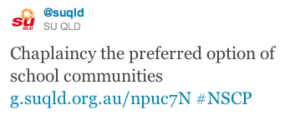
Scripture Union QLD are keeping the faith as we’ve already noted. As unscientific as polls are one does chuckle at these two images – the second from the above Age article;

Scripture Union QLD Tweet

Fairfax Poll

Yet to me surely the most telling tantrum was from former Liberal MP Ross Cameron, on ABC’s The Drum, last night (September 7th). Ross blamed the need to balance chaplains with secular welfare workers on student dynamics brought on by “.. one of the single most negative, corrosive, destructive forces in our community”.

Shite! Drug Lords? Terrorists? Collingwood fans? No. The Education Unions.  It’s them wot dunnit. “They are a disgrace and have systematically worked to destroy cultures of excellence within public schools”. Wow! Who’da thunk it?

Students shouldn’t be running for help as implied by the need for counsellors and he reckons the money would be better spent on preventing why they can’t just play with chaplains instead. Oh, yes – again this is such a small petty issue he’s amazed it gets coverage.

Last time he told us it was “the smallest of small beer” and that as chaplains are going in to war zones with troops they can “handle a playground full of students”.

Shut up Ross.

Secular welfare changes to school chaplaincy on The Drum

❖ Update: Speaking of subliminal… Some hours later I was on Twitter only to read:

Sunrise hype mandatory vaccination

Firstly, there is no “push” for mandatory vaccination. Anti-vaxxers like the Australian Vaccination Network market this to garner support against Big Government.

Scheibner uses the same tune again

Yet if ever there’s an argument for mandatory vaccination it’s people like Viera Schiebner – or rather, the potential harm they cause. On this Sunrise segment, Scheibner (who keeps documents in a parsnip box) is given far too much time to sound convincing using the old “driving licence tests cause road fatalities” non-logic of correlation.

She also fails to distinguish between disease trend moving from correlating issues with polio to outbreak epidemiology with pertussis. All the while Scheibner suggests this is of course, an argument against vaccines.
Professor Robert Booy gets only a brief chance to slay her with facts. Facts that prove her to be lying.

It is not the vaccinated who die from vaccine preventable disease and he delivers the goods. The facts are clear. Risk/benefit is in favour of vaccination. Schiebner’s correlation myth and claims that disease is best for immunity are ignorant of facts and grossly irresponsible.

Channel 7 gave air time to an eccentric micro-palaeontologist intent on sabotaging vaccination regimes in pursuit of ratings. For shame, 7, for shame!

Sunrise Thu. September 8th, 2011

Peter Garrett welcomes changes to school chaplaincy program

Catch up on other NSCP posts here.

After scamming Aussies, Scripture Union QLD continues to maintain the fallacy;

Following changes announced today to the National School Chaplaincy Program. The Australian writes;

SCHOOLS will be able to choose whether to employ chaplains or secular welfare officers under changes to the federal government’s controversial chaplaincy program.

All new chaplains or youth workers employed under the program will also have to have a minimum qualification of a Certificate IV in youth work. Existing chaplains must have at least completed the mental health and making referrals units of the course.

The changes announced by Schools Minister Peter Garrett today include renaming the scheme the national school chaplaincy and student welfare program. Previously schools were able to use the funds to hire a youth worker only if they showed efforts to find an ordained chaplain had failed. […]

The school chaplaincy program is the subject of a High Court challenge, with Queensland father Ron Williams arguing the requirement for chaplains to be ordained is unconstitutional. [….]

The program also came under fire from the commonwealth ombudsman in July.

The Australian Christian Lobby of course, wants no part of independently contributing to sound “secular” care of student welfare. The tax payer can foot the bill just as for all things biblical;

HOBART 7 September 2011. Garrett announcement welcome

The Minister for Education and Skills, Nick McKim, has welcomed today’s announcement to extend the National School Chaplaincy Program to include secular student welfare services.

Mr McKim commended the decision by Federal Minister Peter Garrett which will allow school communities to employ either a chaplain or a secular student welfare worker.
“I commend Mr Garret for his decision because these changes address much of the feedback I’ve received from school communities,” Mr McKim said.
“I am pleased the program is to be extended to ensure principals and school communities are able to choose the right person to fit the needs of their students and local communities.
“This will give schools much greater choice in deciding whether they want to employ a chaplain or secular student welfare worker.
“Growing up in today’s world has its challenges for our young people and today’s announcement will provide them with the support they need.
“There are 95 chaplains currently working in Tasmanian schools and colleges.”
“I have asked my department to ensure that all schools are made aware of these changes to ensure they are fully informed of the options now available.”

PETER GARRETT: This morning I wanted to make an announcement about some changes that the Government will be making to the National Chaplaincy Program. I want to highlight some of those changes to you but to begin by saying this has been a very popular program. It’s one that the Government fully supports, and we’ve been through an extensive consultation process to determine what changes might be applied to the program in order to strengthen it and improve it. So today I can announce that we will broaden the scope of the chaplains program to include student welfare workers or secular workers in the schools as a part of that program.

We will strengthen the requirements for qualifications for those who work as chaplains in the schools under the program. We’ll also make additional requirements for the chaplaincy service providers, that they have strengthened requirements for the delivery of the program, and we’ll make available an extra $4000 to increase the amount for chaplains or the student welfare workers in remote, regional or disadvantaged communities from $20 000 to $24 000, to take account of the additional costs that can apply in remote areas.

What today’s announcement is about is taking a popular and positive program and making it better, with stronger qualifications and more choice for parents and school communities. And I’m really pleased that we’ve had the opportunity to take a program which is both popular and successful and improve and strengthen it. Now, I should add that in relation to those chaplains who are already working under the program and who don’t have minimum qualifications, the Government recognises that there is a need for them to have some minimum qualifications in the areas of mental health and referral qualifications that already exist under equivalent Cert IV qualifications. That will be a requirement for those chaplains already in the program, but the Government will provide them with the assistance to get those qualifications.

This is a program which is all about giving schools the choice about having a chaplain or a student welfare worker in their school. Schools are in the driving seat in this program.  It is a popular program and it is one that the Government fullysupports and, additionally, has provided funding for another 1000 schools to take the opportunity to have these services in their schools. I’m extremely confident that the changes we’ve made will deliver a program which suits the school communities right around Australia. I know this is a very popular program. It’s one that the Government fully supports and I commend these changes.

QUESTION: Minister, there was a High Court challenge in which the judgement’s due by the end of the year. Did the Ron Williams challenge play a part in making the Government expand its secular welfare movements?

PETER GARRETT: The consideration as to whether or not the program should be expanded for secular workers was one which was made prior to the High Court challenge that considered the chaplains program. It was an issue that had been raised in the consultation process that the Government had undertaken, and it’s an issue which we’ve always known is one which some parents and some school groups and organisations have raised previously.

QUESTION: With these student welfare workers, what do you mean?

PETER GARRETT: We’re providing the opportunity for schools to choose somebody who has an equivalent Cert IV qualification, someone who’s in a position to provide support and advice in the school community, as chaplains do, but effectively is a secular worker.

QUESTION: When you say student though, are they still at uni? Or is it do you mean that as in counselling a student? A youth worker or something?

PETER GARRETT: What I’m saying here is that schools can either choose to have a chaplain delivering the services under the program or a welfare worker delivering those services under the program, and there’ll be minimum requirements for both of those capacities, whether chaplain or a welfare worker.

QUESTION: Minister, there was a concern earlier that some of these chaplains were pushing religious views and trying to convert people to Christianity. Do you have concerns about the particular conduct of some chaplains under the program previously?

PETER GARRETT: I can’t stress strongly enough that the guidelines in the program are absolutely crystal clear that chaplains are not there to provide religious instruction or to proselytise, and that definitely remains the case. It is not appropriate that this is delivering religious instruction – and the guidelines and the code of conduct expressly forbid that. In those small number of cases where charges of proselytisation have been made, they’ve been investigated. I’m very confident that this is a program that is delivering into school communities the kind of services they think benefits students.

Remember, this is a voluntary program. Schools choose whether they want to have a chaplain or, now, a student welfare worker and I’m very confident that schools will make that choice, taking into account the views of their school community.

QUESTION: When will that come in?

PETER GARRETT: We will process the opportunities for those schools that want to continue the chaplain program over the coming week. We’ll also then start to process the additional applications for the thousand schools that additionally the Government is committed to. I do want to place on record my thanks for all of those groups that participated in the consultation process, the chaplaincy service providers, the principals and parents associations, and other interested parties. The fact is that we are fully committed to making sure that we put schools in the driving seat to determine whether they want to have a chaplain working in the school to help students or whether they want to have a welfare worker working at the school.

QUESTION: Minister, Labor power brokers say that Julia Gillard has until the end of the year to turn things around for Labor or there will be a change of Prime Minister. Should Julia be dumped as leader if she doesn’t turn things around by Christmas?

PETER GARRETT: The Prime Minister has my full support and the support of the caucus. We’ll continue to prosecute what I think are the important issues that Australians do care about. That includes the announcement that I’m making today. That includes the reforms that we have underway with delivery of the National Broadband Network, the big education reforms that we’re rolling out, improving schools, making sure that kids get the best education they can. That’s what Australians are interested in us doing and that’s what I’m interested in talking about.

QUESTION: Why shouldn’t Kevin Rudd be given another chance as Prime Minister?

PETER GARRETT: Well, again, I’m not going to provide a whole heap of commentary around these issues. I think that everybody wants to see the Government continue to deliver the reforms that we think are in the national interest and that’s what we’re going to do.

QUESTION: So will you be hoping she gets elected for another [term]?

PETER GARRETT: There’s no question about that.

QUESTION: And how long can the party afford to wait before action needs to be taken?

PETER GARRETT: Well, again, the most important thing for us to do as a government is what we are doing – making announcements such as the announcement that I’m making today, committing ourselves to improving the educational opportunities for young Australians and making sure that we continue with the significant health reforms that are out there, ensuring that we have a focus on those Australians – say, for example, in the disability area, who have not been given the level of attention that they deserve by our coalition opposition in the past and are now getting the level of attention they deserve from this government.  These are the things that count and these are the things that we’ll focus on.

QUESTION: Minister, will you be a Labor candidate for Kingsford Smith at the next election?

PETER GARRETT: I’ve always said that I intend to stand again and, at the moment, I’m absolutely relishing the opportunity not only to serve the people of Kingsford Smith, but also to bring forward policies which I think are better for the people of Australia. If Australians care about the quality of political leadership, then the Opposition Leader today should distance himself from the actions of the Parliamentary Secretary, Cory Bernardi, who is providing a great succour to an extremist politician who has dangerous views which are completely at odds with Australian culture and Australian values.

And I am extremely concerned to see that Senator Bernardi, who has consistently put a hardline view on a range of issues, has now offered support to a Dutch politician, Geert Wilders, whose views are extreme and dangerous. And Mr Abbott should show some leadership, discipline this Senator, remove him from his portfolio responsibilities, and ensure that he makes it absolutely clear that there is no place in a country like Australia, where our values are values of fairness and tolerance, for the kind of actions that Senator Bernardi has embarked upon in offering to support this extremist overseas politician.

QUESTION: Well, John Howard had Pauline Hanson disendorsed from the Liberal Party in 1996. Are you saying Tony Abbott should have Cory Bernardi kicked out of the Liberal Party in 2011?

PETER GARRETT: It’s up to Mr Abbott to make clear what action he’s going to take in relation to Senator Bernardi’s dangerous and completely unacceptable offer of assistance to an extremist politician. The ball is in Mr Abbott’s court if he understands the significance of the actions that Senator Bernardi has taken, and I would like to think that he does understand the significance of them, then he ought to take the appropriate action – it’s in his hands.

QUESTION: Just a – do you support a return to offshore processing of refugees?

PETER GARRETT: I’ve already made my comments clear in relation to what I think the Government has in front of us following the High Court decision. You’ve seen the subsequent comments made by the Prime Minister and we’ll continue to deal with this issue in the most appropriate way, given the decision that the court has made. Thanks everybody.

QUESTION: I’ve just got one more question, sorry.

UNKNOWN: Just when you thought you were –

QUESTION: It’s about the chaplains or the secular workers actually.

PETER GARRETT: Yeah.

QUESTION: Where are the secular workers going to come from?

PETER GARRETT: Look, they’ll come from the community and from those areas of expertise of people who have those qualifications.

QUESTION: But the chaplains don’t get paid very much so you’re asking non chaplain workers who are supported by their churches to come and do the work with them for the same amount of money?

PETER GARRETT: Yeah. It’s the same figure for the chaplains or the welfare workers, other than that we’re providing the additional amount up to $24 000 for the remote and disadvantaged areas.  Look, I’m confident that there will be a source of people that want to come in and do this work. I know that we have people who are coming through the TAFE system, through the university system, through non government organisations and others, who have these equivalent qualifications who would relish the opportunity of working in schools, and providing assistance and support to kids in those schools.

QUESTION: For $20 000 a year?

PETER GARRETT: Well, I don’t have any doubt at all that in the same way as we’ve seen chaplains come into the schools for two days during the week normally, that the same opportunities will arise for the welfare workers.

QUESTION: Is the expansion of this to the secular workers a recognition that not everyone was happy with the religious nature of the program?

PETER GARRETT: The broadening of the program is a recognition that we want to provide schools with every opportunity to exercise a range of choice as to who they want to have operating in their school community. The fact is that the chaplains program has been a popular and positive program. It’s well supported by schools and given that it’s a voluntary program, I have every expectation that we’ll continue to see large numbers of chaplains in schools, but we’re also providing the opportunity for schools to make a choice about the kind of person they want working in their school. And if they do desire a secular worker in the school, then that opportunity is there for them.

QUESTION: Just to clarify, the $24 000 a year, that’s for ones in regional or remote areas – so is that outside capital cities? How would that criteria work?

PETER GARRETT: Look, there’s a series of definitions that the Department applies to those criteria and that will be made clear to the applicants.

QUESTION: So would the Central Coast of New South Wales be part of – considered regional or would that be part of the Sydney metropolitan for chaplains?

PETER GARRETT: Well, in terms of the Department’s definition, that’s something for them to determine but the point of the additional investment that we’re providing to the program is to enable schools that are in remote and regional areas and in disadvantaged communities as well to take advantage of this program. So the Department will have a set of indices that apply to that and the guidelines will make clear what they are and schools will have the opportunity of applying.

Thanks, everybody.

Leo Igwe talks witchcraft, Christianity & superstition in Nigeria

Interviewed on ABC Melbourne by Lindy Burns, Leo Igwe, West and Southern African Director for the International Humanist and Ethical Union, discusses the struggle faced by skeptics and humanists on the African continent.

A regular contributor to The Skeptic magazine and The Humanist in Australia, Leo’s work is well known amongst humanists and skeptics. Facing superstitious beliefs, clever scams, exploitation and violent retribution for exercising free thought – including attacks on his family – Leo has a difficult role. Having recently spoken to Victorian Skeptics and Victorian Humanists Leo also spoke at Trades Hall in Melbourne.

One issue that stuck in my mind after hearing Leo speak is that whilst one child dies from malaria every 30 seconds in Africa frequently the cause is assumed to be witchcraft. In view of this, parents do not take the ill children to hospital but to evangelical churches where exorcisms and prayers are offered as a “cure” instead. These children die long painful deaths, although some do make it to hospital… eventually.

Yes, What’s The Harm? indeed.

[audio http://traffic.libsyn.com/firesnake/leo-igwe-interview-for-web.mp3|righticon=0xff0000|righticonhover=0xFFFFFF|loader=0xff0000]

Or download audio

Beware the ELF in the cupboard

The recent report (2011-12) on the Auditor Generals performance audit into Therapeutic Goods Regulation of complementary “medicines”, is disturbing reading. It confirms that the CAM “industry” if you will may breach the Therapeutic Goods Act with little concern.

Under the authority contained in the Auditor-General Act 1997 the Australian National Audit Office (ANAO) undertook an independent performance audit in the Department of Health and Ageing (DoHA). The Therapeutic Goods Administration – part of the DoHA – has the role of regulating the Therapeutic Goods Act 1989. The Minister for Health and Ageing holds responsibility for the Act.

Back in June this year a Transparency Review of the TGA was published, which you can find in a separate post here. I also outlined the essential gateway that permits the wide scale manufacturing of bogus products, with bogus claims, sold for very real percentages of your hard earned money;

To register a product, sponsors use an electronic listing facility – ELF – by simply going online. Much like filling out a Facebook profile. Ingredients are selected from a drop down list. Near enough is good enough. These ingredients are already deemed riskish free by the TGA. Sponsors “self certify” under GMP requirements. Basically claiming that the goods are produced under Good Marketing Practice. Finally they tick a box indicating that they hold good evidence. Hand on heart no doubt. No checks are ever run. They pay the $600 fee and receive an AUST L number. These goods are then able to be listed on the Australian Register of Therapeutic Goods.

The Electronic Listing Facility software (now version 3) has the power to allow products for sale. It’s no surprise dear reader, to find that our friend the ELF features heavily in the independent audit. The Act was given extra zing in 2001 to allow easy market access of products deemed low risk because they, well, in the main don’t really do anything. It favours “sponsors” (producers) hiding true information from the public. Thus it is open to wide abuse and it seems this opening is a crowded one indeed.

The ELF also provides a free text field for sponsors to wax lyrical about the astonishing qualities and safety of products. Again, like a Facebook profile you may enter whatever you like. Or omit entering what you don’t like. Although introduced in 2003 it can have no impact on products already on the ARTG prior to it’s introduction. True to it’s sleepy nature the TGA have done nothing to check if existing (pre-2003) products comply with present standards. Which may well tell us more about what the TGA think of it’s own so-called standards than the egregious risk to public health it otherwise appears to be.

In respect of “pre-market assessment” on page 77 under 3.44, the ANAO noted four matters “whose consideration could improve their integrity”:

(1) indications and claims in older products have not been checked;

(2) arrangements for scanning free‐text indications are not robust or comprehensive and require manual backup;

(3) the coded indications project—which could address both these issues by eliminating the free‐text field—has been proceeding very slowly; and

(4) some sponsors may, on occasions, be entering incorrect information into the ARTG intentionally.

If a product variation or grouping of products occurs ELF 3 will scan the records from pre-2003. Yet, this is widely known and sponsors avoid updating their records despite new research condemning effects or dismissing efficacy. Thus (for example), St. John’s Wort remains marketed as an effective depression treatment despite having no effect on endogenous depression and a poor effect on clinical depression. Fish oil sponsors continue to boast of success with osteoarthritis (OA) despite the anti-inflammatory effects only showing promise in rheumatoid arthritis. The promised “cartilage regeneration” occurs at a glacial pace compared to loss via OA, rendering it almost meaningless.

The list of “hangers on”, if you like, debunked in any manner of exercise is extensive. “Anti-oxidant” products incapable of meeting claims, detoxification kits that have negative effects actually resulting in jaundice and poor LFT’s, all homeopathic products, echinacea, dedicated preparations containing vitamins or minerals, crystal therapies, energy bands, sexual performance/libido enhancers, cognitive enhancement products, immune stimulants, herbal weight loss products and teas, etc, etc.

The TGA does no manual checking and the software cannot scan existing records for restricted or prohibited terms aiding this pseudoscientific white elephant. This is despite the fact the TGA is regularly adding new terms. So effectively;

  • Any product listed on the ARTG prior to 2003 escapes scrutiny for all restricted or prohibitive terms. Any such product escapes even the dubious self-certification standards by which new products are listed;
  • When the TGA adds a term or word to it’s list of restricted or prohibited words and terms, every single item listed prior to this is not checked for these same words or terms;
  • The TGA’s assessment system is incapable of scanning existing products and thus cannot correct for the impact of emerging research;
  • In the 8 years since implementation of the ELF the TGA has made no attempt to manually check pre 2003 listings;
  • Sponsors intentionally avoid updating information via the ELF, effectively misleading the public to continue to believe a product succeeds where it has been shown to fail;
  • Sponsors may enter incorrect information about a product intentionally and the product may still be approved for listing on the ARTG;
  • Nonetheless the TGA is working to address these shortfalls via a “coded indications” project, which the ANOA has identified at progressing too slowly.

Not surprisingly then when ANAO searched for “TGA Approved” and “safe” – the use of which is unlawful in advertising alternative products – thousands of examples were found. Of these thousands the ANAO provided “three egregious examples to the TGA” (p. 128). The TGA identified other breaches “such as ‘cancer‘”. As of June 20th, 2011 two of these three “egregious breaches” were not rectified.

Okay, so why? Well on page 130-131 we read that prosecution is the only option left to the TGA in these cases. Yet;

The TGA’s Advertising Unit is not aware of having successfully used the full range of sanctions, such as seeking a prosecution for breaches:

Due to the very low financial penalties currently available (a maximum of $6600 for individuals and $33 000 for corporations) for advertising offences in the Act and other investigative priorities for the TGA, it is not cost‐effective for the TGA to initiate a formal investigation of an advertising breach with a view to preparing a brief of evidence for consideration of prosecution by the Director of Prosecutions …

It has never been cost‐ effective for the TGA to initiate a formal investigation of an advertising breach with a view to preparing a brief of evidence.

The size of penalties attached to criminal offences may also mean that it is seen as not in the public interest to proceed. This view is consistent with legal advice provided to the Advertising Unit about specific breaches.

The TGA has also observed that “prosecution is currently the only available option where administrative requests fail to achieve compliance”. There have never been any cases that have been referred for prosecution action and accepted. As a consequence, the prospect of using prosecution action against non‐compliant behaviour, and as a deterrent, seems limited.

Alrighty then. So it’s not cost effective or “in the public interest” to enforce regulations. Sponsors and manufacturers would know of this stunning record of no successful prosecution. They must be trembling in their Whitsunday banana lounges, dear reader. 80 of 82 complaints pertaining to the Advertising Code this year were upheld by the TGA. The two failed complaints were “between” competing companies. Yet there’s no way to follow through and prosecute for non compliance. That’s quite absurd in anybody’s reasoning.

In 2010 a DoHA review found 90% of products reviewed were found to be non-compliant with regulatory requirements. The infamous 31 products selected at random yielded 68 breaches;

  • 20 medicines had labelling issues such as non‐compliance with labelling requirements and/or breaches which may mislead consumers.
  • 12 included incomplete and/or inappropriate information on the Australian Register of Therapeutic Goods (ARTG).
  • 22 were found to have manufacturing and/or quality issues.
  • 14 did not have adequate evidence to substantiate claims made about the medicines.

This comes on top of the 2003 recall of 1600 Pan Pharmaceutical products. In 2006 the TGA found 75% non-compliance with regulations. However, the TGA doesn’t use information gathered from post market reviews to sharpen up the prodding stick for frequent offenders or even the most frequently occurring characteristic of regulatory breaches. This is a major issue in presenting transparency and setting in train practices that would better inform the public.

Since 2005 it’s been government policy for the TGA to collect from sponsors a summary of evidence, for the purpose of informing the public. Sponsors are required to have this summary. The TGA inexplicably assumed this process of collection would be legislated for under the Australia New Zealand Therapeutic Products Agency. The ANZTPA process initially faltered and as the TGA is wont to do it consequently did… nothing.

But by golly, in May this year it “took steps” – yes “steps” dear reader – “to restart implementation of this policy”. Yes! To “restart” the policy. Which to me sounds like bureaucratic blubber indicating a pre-emptive attempt at damage control, if we scrutinise the dates of the auditing process.

So here we are still waiting to know what comes out of those magical places that use our little ELF. On top of the Transparency Review we may conclude there is little transparency for the public. If you’re not in the habit of reading research or taking an intellectual interest in alternative product dynamics (which indicates you’re almost certainly immune to hanky panky), you’d make a perfect customer. Ignorant, misled and unable to access proper information. All in all it’s pretty tragic.

Do be my guest and have a read.

Auditor Generals Report: Therapeutic Regulation of Complementary Medicines