Banning synthetic cannabinoids – a “kronic” overraction?

During Questions Without Notice in the Australian Senate on June 22nd [Page 50], Senator Steve Fielding challenged federal Attorney-General Representative, Senator Joe Ludwig over his government’s intentions toward previously legal synthetic cannabinoid products, known quaintly as “synthetic cannabis”.

One particularly common brand is named “Kronic”. Fielding’s ignorance is telling. He refers to such products as being “sprayed with a synthetic chemical” and as such are “designed to manipulate people’s minds”. He further relays concerns about anecdotal reports, which whilst serious are not conclusive. No documentation or conclusive study is presently available leaving quantification and qualification impossible. No correction has been made for the use of other substances in conjunction with Kronic or pre-existing psychiatric conditions or symptoms. It is for the very reason we must take these reports seriously that they deserve proper scientific inquiry.

Ludwig admirably fills his time relaying the excessive reaction of W.A. in banning such preparations under the Misuse of Drugs Act (which provides for a 25 year sentence in certain cases). QLD will move to ban 15 of these products under the QLD Drugs Misuse Act. He omits that NSW is seeking to regulate “synthetic pot” at the level of heroin. One wonders at the logic of this rash action given the well documented failure of prohibition and the recent report from the Global Commission on Drug Policy, damning prohibition and urging implementation of legalisation models [CNN].

More prohibition opens the way for criminals to move from growing, harvesting, preparing and packaging cannabis for transport and sale, to switch to small vials of synthetic cannabinoids. These could be added to any legal vegetable matter or herb, in unknown concentrations and mixes further compounding already known problems arising from an imbalance in cannabinoids due to hydroponic growing techniques.


ABC Lateline gave a balanced report on these developments. When NSW health minister, Kevin Humphries, describes psychotropic synthetic cannabinoid preparations as a “synthetic psychotic drug”, one can be sure he’s not speaking from a position of evidence. Still, “synthetic pot” that’s been with us for four years, will now be as illegal as heroin, in NSW. As already noted anti-drug zealot and W.A. Premier, Colin Barnett was true to form in announcing 25 year prison terms for some offences.

The fact is we don’t know the full side effects of synthetic cannabinoids ingested without supervision beyond the certainty that inhalation of any combustible material is a dire challenge to pulmonary health. We may assume confidently that psychotropic effects are similar to cannabis. And we may ask genuine questions about the effect of significantly greater concentrations of THC in synthetic concoctions both as acute and long term (or chronic – no pun) effects. Paul Dillon raises good points about the rapid rise of availability, of varieties of synthetic drugs. Paul does raise a false analogy citing a synthetic THC cannabinoid – no doubt HU-210 – referring to it being 100 times more potent that natural THC. Had he taken the time to express the need for health responses here it would have been welcome.

Indeed, we don’t know the the effects of 22% of Complimentary and Alternative Medicines in Australian pharmacies that, lacking any trial data, were fraudulently submitted as “evidence backed” and rashly added to the Australian Register of Therapeutic Goods by the TGA. But there’s no rush to ban these products or to wage a War on Placebo, despite fears of adverse drug interactions or contamination with heavy metals and poisons. Regrettably, this clip has the standard file footage of unnamed researchers looking at brain scans as the voice over notes doctors concerns – despite only anecdotal stories of nasty side effects. Both good and bad effects are the same as cannabis. Sanity is provided by Alex Wodak and Robbie Swann.

Prohibition has failed splendidly, leading only to the creation of vast underworld markets. Here, we may watch it in action. I support warnings that smoking a loosely controlled herb dosed with cannabinoids is cause for caution. But removing the product from legal tax paying outlets and placing it in the hands of criminals who will now sell it as genuine cannabis – without the risks of handling genuine cannabis – is appallingly short sighted.

Ultimately, synthetic illicit drugs are here only because the certain profit provided by prohibition of already popular drugs, has empowered criminal enterprise to produce them. Perhaps it’s time we began to learn from history. I reject argument from antiquity – that humans have always used drugs and thus always will. But it’s irrefutable that without the lucrative market provided by prohibition many of todays problematic illicit drugs would not exist.


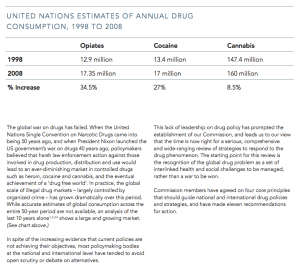
The Global War on Drugs has failed. Synopsis from The Global Commission on Drug Policy
Progressive policy and fundamentalist resistence

A close look at the rejection of evidence and application of religious belief as guiding principles for members of the Negative team, in debating if drugs should be legalised. Jade Lewis, Greg Pike and Paul Sheehan.
Last post we looked at the debate All drugs should be legalised held by Intelligence Squared. One of the greatest moral, social and human rights based questions today is: Should illicit drugs be legalised?
We ask this question because the harm caused at the community and personal level by prohibition is irrefutable. To this we can add the devastating effects of The War On Drugs – crafted initially by Nixon on the back of the Vietnam war. Few realise the first head of the US Drug Enforcement Administration had his office in Saigon. Returning veterans had to produce clean urine to show they were not using heroin.
Once begun, this foreign policy bonanza worked much like Dr. Whoʼs “psychic paper” pass. Flash it at a sentry and they read whatever convinces them of ones legitimacy. But more so was the USAʼs powerful control over the UNODCP and hence, UN drug policy. Most in the Western world have knowledge of Harm Reduction. The acceptance that punitive measures for drug users ultimately inflicts personal, monetary and social cost on the wider community, and accepting use whilst minimising harm reaps benefits for all.
For this reason nations who focus on evidence and the international right to health provide clean needles through NSPʼs – needle and syringe programmeʼs. Safe injecting facilities are provided increasingly in Europe and elsewhere. Australia has over 1,000 NSPʼs and one Medically Supervised Injecting Facility – MSIC – in Kings Cross, Sydney.
These programmeʼs and facilities serve to manage high risk behaviour, control the spread of blood borne viruses, motivate/provide for users to seek treatment, and they meet community discontent arising from obvious illicit drug use. Most users can return to work, pay taxes, raise a family and remain healthy. But what of intractable addiction? More recently several heroin on prescription schemes in Europe have shown dramatic results in reducing crime, death/illness, uptake of heroin use and length of heroin addiction. Portugal has full decriminalisation and demonstrates a resounding success to date.
Once world leaders in harm reduction, Australia was ready to be the first nation since the War On Drugs began to introduce a heroin on prescription trial in 1997. Despite State government sanction of 6-3, John Howard personally intervened to stop this, and weʼve been backsliding ever since. The rise of Christian Evangelical lobbyists has caused bemusement, angst and disgust.
Australiaʼs full policy is Harm Minimisation – HM. Supply reduction, demand reduction and harm reduction. Zero Tolerance has only ever been rhetoric. Harm reduction is the least funded, with the struggle to repel supply and the education and (usually failed) advertisements thrust at young Australianʼs taking the two highest shares respectively.
Those who resist drug legalisation seek to distort the argument by misrepresenting the success of harm minimisation. Indeed despite overall reduction in drug use they fraudulently and falsely argue that HM encourages, condones, increases or has no positive effect on use. Attacks on successful initiatives with peacock terminology and weasel worded opinion pieces are common. Published as “research” these are brought up time and again.
In the case of Drug Free Australiaʼs Case For Closure [PDF] against the MSIC, written during itʼs trial status, it is simply rehashed, republished and recirculated. One speaker, Greg Pike is co-author and “statistical analyst”. Greg is best known from his role as Director of the Southern Cross Bioethics Institute, which presently promotes his part in the upcoming debate. Another co-author is the infamous “naltrexone fatality” doctor, Stuart Reece. Embattled DFA secretary Gary Christian is another.
You may wonder why, if supply and demand reduction are funded more than harm reduction, that such groups attack harm reduction – HR. My psychological profiling days may be behind me, but this is clear. HR already attracts right wing condemnation and is easy to misrepresent. The evil druggie and his/her filthy lifestyle is a false pop culture phenomenon. However, conservative Christians cast HR in pop culture format usually in the context of blaming HM. Enter the suggestion of why we need demand reduction. Young Aussies take drugs. Kids from all walks of life. From all faith backgrounds.
For the religiously conservative mind this is an affront. An insult to parenting skills, the instillation of Christian values and indeed, Godʼs work. God “cures” addiction. He does not leave vacuums of vulnerability, in the mind of the fundamentalist. Thus HM in totality is an affront to conservative Christians. Overlaying this is the fear of the success of HR education. An analogue of sex education and condom availability, no proper child would fail to just say no to sex and drugs – or rock n roll for that matter. With two down, supply reduction must be increased along with punitive measures for users. And DFA are adamant they speak for “all Australians”, promoting behaviour control: Harm Prevention.
Another speaker and DFA identity – whose intentions I kind of understand – Jade Lewis wants a drug free Australia, [surprise!] through application of biblical values and the never ending sale of her “story” on DVD. Not your story, or the story of drug policy, or evidence based material – her amazing religious conversion. Jade is ruthlessly exploited by DFA. The excessively priced, only-seen-if-you-buy-it DVD, “Golden Haze” earned Jade the title “The goose that laid the golden haze” – (more on Jade later).

Greg Pike
Greg is co-author of the Case for Closure and a crusader against humane or progressive policy and free choice. His “bioethics institute” gig is a misleading peacock in some of today’s most pressing health issues. Abortion to him is of course, murder and at one time he claimed – as a research outcome – most women do not want choice. His argument against euthanasia once included the appalling claim that a patient travelled to Switzerland – with others – to die with dignity, as “… a case of someone wanting to pursue death under activist like circumstances.” [ABC 7:30 Report Feb. 2007].

Greg Pike

The right to die for the terminally ill is supported by as many as 85% of Aussies according to some polls. The reluctance of politicians shows the grip of the Australian Christian Lobby on vote wary parties. Prior to the above debacle, Pike wrote “Once the killing starts, there’s no stopping it” in January 2007. It included;

Continue reading