Yesterday I hinted at the cost to the AVN of Justice Christine Adamson’s ruling in favour of their appeal against the HCCC.
Whilst I postulated on what the HCCC could have done to ensure that the appeal was tossed out, the fact remains that Meryl Dorey – “Australia’s foremost expert on vaccination” – has to accept that she has (Ed: in respect of this ruling, arguably) been found to influence no-one. I’m sure being legally insignificant is not the pivotal aspect of the ruling Dorey will recount to members, unless she is grasping to deny the “anti-vaccine” label.
… I am just so pleased that the Supreme Court agreed with our original contention that the HCCC had no jurisdiction to investigate us based on the complaints which were not valid complaints according to the HCC Act. Justice DOES work sometimes.
Not strictly true. A major part of the original contention was that the HCCC acted outside jurisdiction because the AVN was not a Health Service Provider.
By Saturday the deception was tangible. Meryl Dorey posted:
For those who have been asking about our chariity (sic) status, hopefully, I will have more information on that early next week. The HCCC decision did not automatically give us back the authority, but I am hopeful that we will get it back since the OLGR relied completely on the HCCC warning to revoke the authority. Therefore, since the warning was invalid, the revocation may be too. Anyway, I will let you know as soon as I have the information myself.
MD
I’m not sure what game Dorey is playing here. She initially made this claim 16 months ago. There’s no doubt that she has constantly manipulated the flow of information to create the illusion that the OLGR revocation followed directly from, and was based upon the HCCC ruling. Initially in October 2010, Dorey emailed members citing only sections A, C and F of the notice she received from the OLGR and claimed:
As you can see, the OLGR based their entire decision on the HCCC’s demand for us to declare ourselves as being anti-vaccine and putting their disclaimer on our website…
Strange, because as far I can see the HCCC cannot possibly have had anything to do with OLGR findings of :
Fundraising without an authority
Unauthorised expenditure
Failure to keep proper records of income
23 breaches of the Charitable Fundraising Act 1991
On Saturday reasonablehank was quick to look for any substance and I recommend reading what is a complete demolition of this myth that the OLGR “relied completely on the HCCC”.
The holy grail of this HCCC appeal can be gleaned from Dorey’s erroneous claim. She wanted the OLGR decision overturned. But how? Certiorari is the legal term for an order given to set aside a decision. The decision is quashed and expunged from the record. Originally Dorey had named the Minister for Gaming and Racing as a second defendant. On July 5th, 2011 she discontinued proceedings against the Minister.
Dorey then sought to have the HCCC Investigation, Recommendation and Public Warning not only ruled as outside jurisdiction as per the HCC Act – ultra vires – but also sought certiorari to quash the HCCC determination to issue the warning. This would mean the decision was made unlawfully and not just outside jurisdiction as granted under the Act as it pertains to complaints. So what did the AVN put to Justice Adamson as unlawful? What rights had the HCCC abused? Adamson wrote:
When asked to identify the discernible legal right which was affected, counsel for the plaintiff said:
“The damage to its reputation by being labelled a public risk to health and safety.”
I realise it’s looking rather obvious but in plain speech this is where Dorey got to say, I’m not a risk to public safety and I deserve to retain my right to be a health charity. Adamson continued:
The plaintiff submitted that its rights were not only directly affected, but also altered, by the HCCC’s decision to issue the Public Warning and that certiorari is accordingly available… It argued that the decision directly exposed it to a new hazard of an adverse exercise of public power (having its fundraising capacity revoked).
However, the plaintiff could not point to any provision in the Charitable Fundraising Act 1991 that made the Public Warning a mandatory relevant consideration in the Minister’s decision whether to revoke the authority. Accordingly there is no basis on which I could find that the Minister for Gaming is legally obliged to take into account the Public Warning. For these reasons, certiorari does not lie.
The implications of this are huge. With denial of certiorari the linking of the AVN’s fundraising capacity revocation to the HCCC ruling has no basis. The court did not find that the AVN is not a risk to public health and safety because it also did not find that the HCCC erred in its conclusions or that the complaints are unfounded. The significance of Dorey’s clinically impotent insignificance is worth noting.
The AVN is left with the reality that the HCCC acted outside of jurisdiction in its Investigation, Recommendation and Public Warning. Because in this instance, the AVN in effect influences nobody in any significant way.
Also a lot of attention has now been drawn to this “anti-vaccination” group. This led Dorey to complain which led Fran Sheffield of Homeopathy Plus to comment on Dorey’s dishonesty, confirming that the AVN were anti-vaccine.
Fran then backed it up 45 minutes later with something that echoes point one of the HCCC’s pre-warning request, which read: The Australian Vaccination Network’s purpose is to provide information against vaccination in order to balance what it believes is the substantial amount of pro-vaccination information availableelsewhere. The other two points were (2) The information provided should not be read as medical advice and (3) The decision about whether or not to vaccinate should be made in consultation with a health care provider.
Sheffield wrote:
I think if the AVN placed a statement clearly on its website that people saw on first visiting – that it is providing the ‘missing’ information, or the information government and health departments should provide but don’t, then it would explain why weight of information the AVN carries makes it appear to be anti-vaccine.
In what must be one of the most hypocritical replies Dorey has ever managed, she then argued that the “AVN code of ethics” forbade judging anyone on their decisions. It might be harmful to their cause to openly say they were anti-vaccine. She “could not care less what others do” once the AVN have given them information doctors and the government withhold. Then amazingly Dorey herself echoes point one of the HCCC’s pre-warning request:
We provide information on the negative aspects of vaccination in order to balance the purely one-sided information given by the government and the medical community. We provide balance – we don’t tell people they should not vaccinate and we never will.
On Friday the NSW Supreme Court ruled in favour of the Australian Vaccination Network’s appeal against the HCCC’s public health warning.
Based on Justice Christine Adamson’s interpretation of the HCC Act, the HCCC did not act within jurisdiction. This means the HCCC warning is no longer valid. The outcome also means that the HCCC recommendation for the AVN to post warnings as to it’s antivaccination, non-medical and non-governmental stance are void. Complaints upheld by the HCCC can no longer stand.
Whilst congratulations rightly apply to the AVN their “victory” has come at the price of conceding any real community impact and the denial of certiorari (crucial to Dorey’s promised OLGR appeal). Confirmation of being a Health Care Provider may bring complications for the usually free falling AVN.
Initially Dorey’s argument was that the HCCC investigation was “illegal”. That they did not fall under HCCC jurisdiction because the AVN is not a health care provider. Dorey conceded in the Supreme Court on July 28th 2011 that the AVN did fall under the HCCC jurisdiction as a health care provider.
Because the HCCC jurisdiction to investigate requires a complaint, the court ruling then focused on interpreting the HCC Act under section 7(1) – What can a complaint be made about? The HCCC had upheld two complaints against the AVN. The judge deemed that section 80 of the Act provided specific functions of the HCCC that ruled out dealing with complaints “per se”.
The judge rejected the HCCC submission that section 7(1)(b): a health service which affects the clinical management or care of an individual client, was an alternate source of jurisdiction to that provided under 7(1)(a): the professional conduct of a health practitioner. The HCCC submission that the word “affects” should be read broadly, was not accepted. The judge ruled that the HCCC did not have jurisdiction to investigate complaints not concerning subject matter encompassed in section 7(1) entire. The ruling included:
In my view, the use of the words “the clinical management or care of an individual client” evince an intention that only a complaint concerning a health service that has a concrete (even if indirect) effect on a particular person or persons is within jurisdiction. Complaints about health services that have a tendency to affect a person or group, but which cannot be shown to have had an effect, would appear to be excluded.
I’m sure many of you have wrapped your thinking lobes around this outcome by now. Not being a lawyer my opinions are varied. Given that the Act was written in 1993 I think the HCCC inferred somewhat reasonably where Justice Christine Adamson wrote:
The HCCC submitted that I ought infer that the information the plaintiff has published on its website about vaccination has affected the decisions of people to vaccinate themselves or their children.
However the reality of legislation lagging behind lives deeply influenced by online access and communities is axiomatic. In this light perhaps the HCCC could have sought to cover all bases. This question becomes more relevant when we note that with a good deal of legal help Dorey wrote to the HCCC in December 2009 “again asking for information on jurisdiction”. Page 1 and 2 deal explicitly (and strikingly) with interpretation of the Act just as we saw it eventually impact upon the final judgement. Page 2 includes:
It seems however that the HCCC is seeking to interpret section 7 of the Act in a way that extends its jurisdiction beyond the reasonable (and legislatively established) limits set out in section 7(1)
The HCCC had earlier argued (14 December 2009) via correspondence that a complaint may be made under 7(2) “unrestricted in any way”. Regrettably, and with the help of hindsight over two years later, one can now see that section 7(1)(a) and (b) must be taken together. In fact if no tendency to have a direct affect upon the clinical management or care of a person or persons can be shown then jurisdiction does not apply. Adamson again:
In my view, the use of the words “the clinical management or care of an individual client” evince an intention that only a complaint concerning a health service that has a concrete (even if indirect) effect on a particular person or persons is within jurisdiction.
Should the HCCC have ensured this aspect was covered? Arguably yes. The very problem it would face in court had been laid out before them by the AVN well in advance. The Act dictates how the HCCC function and this entire matter had grown from complaints – the subject of section 7.
So yes, the HCCC should have been prepared. Could “direct affect” upon clients have been established?
There are many written examples of individuals attesting to the AVN having a direct affect upon clinical management or care. A small few include the first letter here republished by Meryl a year ago. A proud dad not vaccinating his daughter last month. An extended admission in support of Dorey speaking at Woodford, last December. This one even popped up just yesterday:
I’d not give these absolute credence in court, but a certain volume would be hard to ignore. However there are also doctors, paediatricians, neonatal nurses and many more who may well have confirmed this in a legal declaration. Justice Adamson herself noted the ease with which the HCCC could have accessed proof of direct affect from one of the complainants. She then wrote:
However, the ease with which it might have done so is not the test. It did not do so. As I have found, the evidence adduced before me is not sufficient to bring the complaints within s 7(1)(b) of the Act.
Yes. It appears that direct affect upon clinical management or care could have been established by the HCCC. I wonder if Adamson’s original draft has “head desk”, scribbled in the margin?
Let’s not forget who we’re talking about here. Dorey isn’t just anti-vaccine but pro-disease.
While this became news locally, how many West Australians were killed by medical error, adverse reactions to properly prescribed medications and hospital-borne infections. (sic) Why isn’t that written up in the newspapers? […]
But no – a mother who exposes her child to chicken pox – a disease that has never been considered deadly… an action that all our mothers and grandmothers would have taken – is threatened with police action or child protection because a man who considers vaccination to be a sacrament of medicine, reported her to the authorities and they didn’t laugh him down.
Keep in mind that giving someone a live virus vaccine (chicken pox, measles, mumps, rubella) is already deliberately infecting them with the virus.
Now that the AVN is a Health Service Provider under the HCCC’s jurisdiction one wonders just how much more feral ranting can go unnoticed. There can be no doubt what influence on care is intended by that article.
To this we can add the sum of the rubbish Dorey sells online as alternative health choices and natural cures. The very purpose of such material is to influence clinical care. It is reasonable to suggest the HCCC missed an opportunity which cost it a case.
Yet exactly how much of a “victory” it has been for the AVN has not yet been decided.
Interviewer: Are you proud that this area has one of the lowest vaccination rates in the country?
Meryl Dorey: I don’t think there’s anything to be proud or ashamed of. I think I am proud that our organisation is assisting parents to get information that they would not otherwise be able to access.
Sunday Night – April 2009
Unfortunately when you’re out to derail vaccination regimes the consequences of singular pursuits can be ignored this way.
I’ve little doubt Meryl would be proud, having labelled vaccines, “instruments of death”. Apart from the standard antivaccination fare, Dorey has a unique approach to reality:
Now, we have a medical community that’s saying if you get measles, if you get whooping cough you’re going to die from it. Well where is the information from that? You didn’t die from it thirty years ago and you’re not going to die from it today. [Audio]
Well that’s certainly misinformation one would not “otherwise be able to access”. Over that same year three tiny babies died from pertussis. From 1993 – 2008, 16 babies under 12 months lost their lives to pertussis. Fatalities continue right up to the present day. In addition survivors are left with hypoxic brain damage, scarred lungs, burst blood vessels in conjunctiva and broken ribs. Adults can seriously injure themselves. Dr. Penny Adams recounts how she prolapsed a cervical disc onto her spinal cord requiring surgery to correct.
As this information is easily accessible we can appreciate why those who monitor Ms. Dorey raise serious concerns about the ethics of allowing her to speak unhindered in public. Seeking to impede someone who claims pride in intentionally spreading falsehoods that can injure and kill Australians is not an attack on free speech.
One of the earliest observations that Meryl Dorey’s antivaccination lobbying could have an effect on local herd immunity was published in early 2003. MAPPING IMMUNISATION COVERAGE AND CONSCIENTIOUS OBJECTORS TO IMMUNISATION IN NSW was written in the NSW Public Health Bulletin, Volume 14, Numbers 1–2 January–February 2003. Authors Brynley Hull and Peter McIntyre note in the discussion (page 12) [Bold mine]:
Although immunisation coverage has greatly improved over the past five years in NSW, and many areas have reached coverage targets, there are areas in NSW where the level of registered conscientious objection to immunisation isgreat enough to affect immunisation coverage, as measured by the ACIR. One such area is northern NSW, and the Byron Bay SLA in particular, where the rate of conscientious objection is one of the highest in the country.
Presently Australia is in the fifth year of strikingly elevated pertussis notifications. Whilst it seemingly began in Meryl Dorey’s backyard on the north coast, we can easily trace its spread across the nation from media reports. Although not the first report, an article by Amy Corderoy on October 30th, 2010 brings the concerns of Hull and McIntyre to life, over 6 1/2 years later. From Vaccination rates spark epidemic fear. [Bold mine]:
And health authorities warn that NSW could be facing another outbreak as more cases than usual have been seen recently in the areas where the epidemic started. The highest rates of so-called “conscientious objectors” to immunisation are in parts of the north coast – such as Byron Bay – where 12 per cent of children born between 2001 and 2007 were never immunised for any condition. […]
An epidemic of whooping cough in 2008 and 2009 began on the north coast. It quickly swept across the state driven by low vaccination rates in some wealthy parts of Sydney. […]
Dr McAnulty said areas with lower vaccination rates were more at risk. “If you are a parent it is so important for your child to be protected, but also for the other children in your community,” he said.
In 2007 Australia recorded 4,863 cases. In 2008, 14,290. In 2009, 29,786. In 2010, 34,793. Last year, 38,514 and already this year 3,645. For the entire time Ms. Dorey has urged against vaccination, attacking those who choose to vaccinate, mocking health authorities and distorting statistics. A request to answer a thorough deconstruction of her widespread trick to malign vaccine efficacy remains unanswered – which is answer enough for me.
However as unwelcome as antivaccine lobbyists may be, there is more to this epidemic than just irresponsible, if not unconscionable, conduct. Nation wide access to PCR testing has led to a higher number of confirmed diagnoses and this in turn is being “fed” by doctors and health staff with better diagnostic skills – especially during the early stages. It seems that added to an epidemic we’re testing more often and more accurately.
Despite the louder volume of antivaccination arguments, if they were really taking hold and driving the full epidemic we’d expect to see consonant rises in fatalities and hospitalisations. In fact despite the huge numbers of notifications since 2008 below, we’re seeing less fatalities than the epidemic in 1997. Hospitalisations have not increased in pace with notifications.
Frustratingly, increased notifications are exploited by antivaxxers as so-called proof the vaccine is ineffective. Yet if this is the case then a representative increase in fatalities and admission to hospitals should be apparent. It isn’t. This also makes claims by Dorey of “a more virulent virus” hard to sustain. She’d do better to argue a less virulent virus explains the disparity between notifications and serious cases.
Either way, it’s important to respond to abuse of certain nuances related to increased pertussis notification. For example we can dispense with nonsense such as this stunner from July 2011, which was Dorey’s partial conclusion from revelations of better testing revealing more notifications:
So not only is the pertussis shot not preventing vaccinated people from getting pertussis – it could also be responsible for the increased death rate.
Pertussis Notifications To Date
A range of factors accompany low immunisation as a factor in pertussis outbreaks and increased notifications. Nonetheless since an “epidemic of whooping cough in 2008 and 2009 began on the north coast” it’s been reported in every state in epidemic proportions. The advice is unanimous. Vaccination Saves Lives.
In January 2009 ABC’s The Pulse reported with A bad year for whooping cough. We may have found Dorey’s reason as to why “you didn’t die from it 30 years ago”. Mass vaccination:
Whooping cough used to be a disease that everyone got as kids, says Dr Frank Beard, acting senior director of Queensland Health’s Communicable Diseases Branch.
However, numbers plummeted following the introduction of mass vaccination in the 1950s. Cases fell to an all time low in the 1970s and 1980s…
By March 13th, 2009 Tasmania issued its first pertussis alert urging parents to seek vaccination for newborns at 6 weeks rather than 8 weeks of age. Vaccination Alert Following Steep Rise in Whooping Cough Cases. This followed an increase to 99 infections compared to just 4.
Low immunisation behind South Australian whooping cough outbreak, wrote Tory Shepherd on November 5th, 2009:
SOUTH Australia is experiencing its worst whooping cough outbreak on record – and babies are the main victims of the potentially fatal and highly infectious disease. […]
A four-week-old NSW baby who died in March was the first fatality from the disease in a decade. Since then it is understood two other children have died.
By August 31st, 2010 the epidemic was hurting QLD. Whooping cough epidemic gains pace, wrote Amelia Bentley:
Health authorities have warned a whooping cough epidemic is spreading throughout Queensland.
The Sunshine State has the most people in Australia falling ill with the infectious disease, prompting a state-wide call for children and adults to be immunised.
Seventeen days later the Danny Rose reported in Victoria’s Herald Sun. Fourth baby dies of whooping cough:
THE death of another baby in Australia’s slow-moving whooping cough epidemic underscores the importance of broad immunisation coverage, an expert says.
The five-week-old boy died in the intensive care ward of an Adelaide hospital earlier this week, and Professor Peter McIntyre said this was the fourth child death in a pertussis outbreak which started in 2008.
The infant contracted the bacterial lung infection when he was too young to receive the whooping cough vaccine, which can be administered after a child is six weeks old.
Adults represent most notifications and are a common source of infection for children and infants. Presently adult booster rates are around 11.3%, which is too little to be effective. Whilst adults aren’t as vulnerable to harm as babies are, the longer the epidemic has gone on the more the percentage of adults contributing to notifications has become. Comparison of age groups shows a significant increase in adults particularly from 2010 – 2011.
More than 220 people were diagnosed with whooping cough in Central Australia during the past twelve months, according to Coordinator of the Centre for Disease Control for Alice Springs and Barkly regions, Dr Teem-Wing Yip.
“The majority of cases occurred in older children and adults,” Dr Yip said.
“Adults with whooping cough may feel unwell from an annoying cough, but the highly infectious disease can be much more serious in young children,” she said.
“Symptoms of whooping cough in adults may be as minor as an annoying cough, but can cause significant illness. In very young children, the disease can be very serious,” she said.
Fear over whooping cough epidemic, wrote Julia Medew in Victoria on October 21st, 2010:
Jenny Royle, a paediatrician with the hospital’s immunisation service, said Victoria had experienced an unusually sustained epidemic since 2008, with the disease affecting thousands of people, young and old.
This prevalence was now putting newborn babies’ lives at risk.
She said the hospital had seen 19 babies with the disease since August, including three aged six to 12 weeks who ended up in intensive care.
”This is really unprecedented … A baby died in Adelaide a couple of weeks ago with whooping cough, so we’re very concerned about the number of cases we’re seeing here,” Dr Royle said. ”We are worried that we’ll see deaths here too.”
In late January 2011 Victoria’s Chief Medical Officer published an Advisory for health professionals. But the fear felt and prediction of death only weeks earlier was all too real. On February 17th, 2011 Fairfax reported on an infant death in Melbourne. Death Sparks Vaccine Appeal wrote Julia Medew:
THE death of a newborn baby from whooping cough in Melbourne this week has triggered a call for Victorians to vaccinate against the highly contagious disease. […]
Dr Jenny Royle, a paediatrician with the immunisation service at the Royal Children’s Hospital, urged Victorians, young and old, to check they were up to date with their whooping cough vaccinations because the epidemic was putting babies’ lives at serious risk. […]
Whooping cough, also known as pertussis, can cause minor cold-like symptoms for adults but is fatal for about one in 200 babies infected. In infants, it can cause coughing fits that deprive the brain of oxygen, leading to brain damage and death.
On the same day, ACT Health published a Health Alert on pertussis. In order to protect your baby you could:
Ensure your baby is vaccinated on time, this can be done from 6 weeks of age.
Keep your baby away from anyone with a coughing illness.
Ensure everyone in your household is up to date with their vaccinations.
Be on the lookout for symptoms of pertussis and consult your GP if concerned
Back near ground zero, four years on, pertussis was still effecting the community. Meryl herself was not happy that grassroots volunteers had slowed her pace, revealing perhaps more legal irregularities than intellectual ones. Vaccination was now likened to “rape with full penetration”. Those with questions were members of “hate groups” seeking to suppress her democratic freedom as an expression of “health fascism”.
Despite her “martyr for the cause” act, the true intent and impact of the likes of Dorey was not lost on Australians. Both online and regular media had taken interest in this person now the subject of a public health warning. On May 15th 2011 Jane Hansen reported in The Sunday Telegraph, Doctors warn parents to keep newborns at home as whooping cough epidemic escalates:
DOCTORS have warned parents to keep newborn babies at home to protect them from a whooping cough epidemic triggered by the “chardonnay set and alternatives”. […]
“With vaccination rates so low in this area we say to the mothers of newborns, do not take them out in the community,” local paediatrician Dr Chris Ingall said.
“We’re appalled at how many kids are getting whooping cough because the chardonnay set and the alternatives don’t vaccinate their children.”
Areas with low vaccination rates had 300 per cent more cases of whooping cough between 2008 and 2010, according to figures from NSW Health.
On September 16th, 2011 the importance of vaccination in preventing pertussis was reinforced by Dr. Julie Leask in Clear and present danger: how best to fight the latest whooping cough outbreak.
Tasmania’s Public Health Alert was last updated on November 9th, 2011. Again it reinforced the importance of vaccination and proper conventional care.
By January 4th, 2012 ABC Online reported, WA facing whooping cough epidemic:
Health authorities in Western Australia are warning that the state is on the brink of a whooping cough epidemic.
A record number of more than 3,500 cases were reported last year, more than double the 2010 total. Four babies have died from the infection in as many years and the Health Department is urging parents to be prepared for more cases. […]
“Measles kills, whooping cough kills. All of those diseases that you can now get a vaccination to stop, can kill children.
“So please make sure your children get vaccinated.” [said Paul Armstrong of W.A. Health]
So it isn’t hard to find this epidemic mentioned over and again in every state of Australia, with a repeat of the necessary advice for the community.
The pertussis epidemic that probably began due to low immunisation rates in Byron Bay in 2008/2009 and again in October 2010, likely wreaked havoc and heartbreak across NSW and parts of QLD. Exactly how much can be attributed directly to Meryl Dorey, is impossible to tell but low herd immunity in Lismore and surrounds has been devastating for some. I’m sure people have never heard of Meryl Dorey nor care to, yet still refuse to vaccinate. Sadly, she glows with delight when asked the question that assumes she is responsible for local immunisation denial.
Ranging out across Australia there are far too many factors to consider and many pockets of low immunisation for a number of reasons. Outbreaks chronologically followed the initial Byron Bay outbreak and that’s all that can be said using a rough media guide. A virus of thought can spread faster and further than a viral or bacterial infection.
It is this that makes the likes of Meryl and other enemies of reason the danger that they are, and that requires concerted efforts to address.
Across the globe it is known how important the pertussis (whooping cough) vaccine is in preventing both infection and severity of infection with Bordetella pertussis.
Along with vaccines for diphtheria and tetanus, then polio (1950’s), measles, mumps, rubella (1960’s) the Australian pertussis vaccine has contributed to an astonishing 99% reduction in deaths from vaccine preventable disease. Just after the turn of the century pertussis, diphtheria and tetanus vaccines alone had saved over 70,000 lives whilst the population had almost tripled since their inception. Since then pertussis vaccination alone has saved around another 10,000 Australian lives.
From the World Health Organisation, to national or state health authorities across developed nations to your local doctor, the evidence is compelling. Although anyone can catch pertussis it is babies under 12 months who are most vulnerable to infection. The disease can cause disability and death in the unvaccinated. Whilst immunisation provides antibodies to fight pertussis, it does not provide “magical protection”. For that you need chiropractors or other practitioners of alternatives to medicine.
Immunisation against pertussis does mean:
A significantly reduced chance of being infected
A significantly reduced severity of infection if infected
Protection of unvaccinated individuals that one may come into contact with
Low levels of community infection with high levels of immunisation
Pertussis epidemics follow on from reduction in immunisation across the community, leading to a drop in herd immunity. The present epidemic Australia is experiencing began in Byron Bay, an area with very low immunisation rates, and then spread to other areas of low immunisation. From the backyard of Meryl Dorey’s anti-vaccination lobby group the seeds for this epidemic were sown a decade ago. Brynley Hull and Peter McIntyre wrote in January 2003 [page 12]:
Although immunisation coverage has greatly improved over the past five years in NSW, and many areas have reached coverage targets, there are areas in NSW where the level of registered conscientious objection to immunisation is great enough to affect immunisation coverage, as measured by the ACIR. One such area is northern NSW, and the Byron Bay SLA in particular, where the rate of conscientious objection is one of the highest in the country.
Despite the crystal clear science and undoubted success of immunisation, movements against all vaccines have grown. They have kept pace with internet driven conspiracy theories, imaginary diseases, imaginary cures and new age beliefs. The most successful currency used by those opposed to scientific success is ignorance and misinformation.
An excellent example regarding pertussis vaccination is that many people incorrectly believe all vaccines, with the exception of influenza, provide lifelong immunity. With pertussis, vaccine induced immunity wanes over time and as noted above whilst it reduces the chance of infection, it is not an impervious shield. Antivaccination lobbyists have taken advantage of this to infer that the pertussis vaccination schedule itself has failed. First, we have ignorance – the expectation that immunity is lifelong. Then follows misinformation.
For example as debunked here more than a few times, figures describing vaccination levels and notification of infection are frequently misused by the Australian Vaccination Network to falsely refute the efficacy of immunisation. Yet these clumsy attempts are piecemeal and misleading. Time and again infection notification and vaccination status is highlighted and infused with qualities that serve to misinform. Placing figures in context yields a very different picture which, given that they seek to deny international trends that have existed for decades, is not surprising.
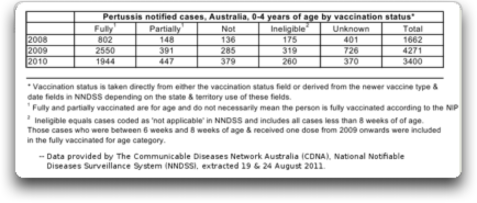
The question, or challenge if you will, is about the veracity of the pertussis vaccination schedule. Thus we must take care to ensure we elucidate notifications related to full immunisation as per the schedule. Take the following table of children between 0 – 4 years old, diagnosed with pertussis:
Pertussis notification by vaccination status 0-4 years, Australia August 2011
We see that a total of 9,333 notifications have been tabulated. 5,296 or 56.7% are fully vaccinated.
986 are partially vaccinated. 800 are not vaccinated. 754 are ineligible for vaccination. This gives us a total of 2,540 or 27.2% who are not fully vaccinated.
1,497 or 16% are unknown.
Do these figures reflect infection in the community? No, they reflect the vaccine status of children diagnosed.
Firstly as the table informs us “fully vaccinated” does not necessarily conform with fully vaccinated under the National Immunisation Program. Ineligible cases between 6-8 weeks of age that had received one dose in 2009 are included in “fully vaccinated”. Both these facts artificially inflate the “fully vaccinated” category.
Next we must accept that this table underestimates the actual number of infections in the community. The National Notifiable Diseases Surveillance System relies on a passive surveillance system which does not capture every case of pertussis in the community.
Which raises the question. Who is not making notification? Can we infer anything about the vaccination status of those not recorded in the above table? If so, does this help us understand the figures in the table better? As a matter of fact, yes.
Do these figures reflect the efficacy of pertussis vaccination? In other words, is this telling us that there are over twice as many infected children in our community who have been vaccinated (56.7%), than those who have not been fully vaccinated (27.2%) and thus reflect low vaccine efficacy? No.
Far more children are vaccinated against pertussis than those who are not. 95% vs 5% in fact. Even with greatly reduced chance of infection the sheer numbers of vaccinated children mean that “fully vaccinated” will dominate notifications. These figures also reflect the greater likelihood of parents who vaccinate to take their child to a GP and follow through with reporting, and also reflect the likelihood of conscientious objectors to avoid a GP and to not follow through with reporting.
For example a USA study published in Vaccine in December last year showed that parents who do not vaccinate their children are four times more likely to take their child to a chiropractor than a conventional doctor. In Australia we already know that chiropractors are vocal antivaccination proponents with strong links to antivaccination lobby groups such as the Australian Vaccination Network. Many chiropractors in Australia actively mislead consumers on the topic of vaccination making impossible claims, actively deriding vaccination.
But we can do much better than this and begin to build a profile of parents who refuse vaccination and later choose conscientious objection. Five days ago Australian Doctor reflected on the study:
A US survey found parents who refused childhood vaccinations were four times more likely to have sent their youngest, school-aged child to a chiropractor than parents of vaccinated children. Parents who conscientiously objected to school immunisation requirements were also more likely to have strong concerns about vaccines, to distrust local doctors and to have had one or more births in a non-hospital, alternative setting. […]
Are naturopathic and complementary healthcare providers reinforcing parental concerns and ‘anti-vaccine’ opinions or promoting exemptions, or are they providing healthcare without emphasizing vaccinations?
The pattern emerging is one of anti-conventional medicine, reinforced by alternatives to medicine masquerading as “complementary healthcare”. For our purposes we must now accept that unvaccinated children may be up to four times less likely to visit a GP when ill with pertussis. This means they may be up to four times less likely to appear as a notification. Regardless of exactly how many unvaccinated children are missed, we can see with confidence that the total is skewed away from highlighting unvaccinated children.
Thus the 8.6% of unvaccinated children noted in the table above (n=800) is possibly a significant underestimation. As parents who do vaccinate are more likely to visit a GP and report diligently, the total is additionally skewed toward the fully vaccinated. What this actually means regarding community impact is best captured in this post written by a mother whose vaccinated child was infected by an unvaccinated child who had been sent to school.
Now comes the fascinating aspect. “Unknown”. What does this mean? Really? For whatever reason, somewhere along the line the child’s vaccination status is not recorded at all, is recorded and fails to make it to the final notification table or is lost to genuine confusion or poor record keeping.
However if parents are not registered on the ACIR as conscientious objectors or as completing their children’s vaccination schedules they are also listed as “unknown”. Thus the following from Brynley Hull and Peter McIntyre is compelling [bold mine]:
Additionally, the proportion of conscientious objectors on the [Australian Childhood Immunisation Register] ACIR is likely to be an underestimate of the proportion of parents who don’t immunise because they disagree with immunisation, particularly in more economically advantaged areas. There are some non-immunising parents who ‘object to registering’, and they will refuse to complete any government-provided form.
“Refuse to complete any government-provided form”. Such as those that question the immunisation status of one’s child? That also is where a significant number of “unknown” cases have their genesis.
In tandem with our emerging profile of anti-conventional medicine beliefs driving the decision to not vaccinate and combined with the observation that CO’s are likely to contribute to the “unknown” category by not registering on the ACIR, we are able to make a strong inference that unvaccinated out-rate vaccinated in this category.
Whilst it is impossible to make outright factual quantified claims and rewrite that table, we may conclude that placed in the context of community trends it gives a less than reliable indication of infected subjects within the community. What it does give us is a snap shot of the vaccine status of notifications. Placed in context those notifications appear to be skewed away from unvaccinated and toward vaccinated subjects.
The most significant reason is the overwhelming numbers of vaccinated children in the community. Although appearing as a notification they have a far less severe case of pertussis and are unlikely to suffer disability or death. Other reasons for this would appear to be the intentional avoidance or substitution of conventional medicine, diagnosis and reporting of vaccination status by those in denial of vaccine efficacy.
Of course, people will use these figures to attack the overwhelming evidence in support of vaccination. That’s just what eccentric parent Greg Beattie has tried. It’s simply gobsmacking to read his misleading claim that only 11% of pertussis infections aren’t vaccinated. Actually it’s only 8.6%.
But the point to be made is whilst only 5% of 0-4 year olds aren’t “fully vaccinated” they make up a disproportionate 27.2% of infection notifications. Unsurprisingly his novel mathematics have been dealt with unceremoniously by A Drunken Madman.
There is no debate here. Pertussis vaccination saves lives.
Not long ago I suited up for satire and wrote about Package Insert Airlines. The fictitious airline that takes the view passengers must know of every adverse event to flying before making the “informed choice” to fly.
This was in response to Meryl Dorey’s proposal that the AVN will march on Canberra with demands. One of these is that all parents be given vaccine package insert information to discuss with a “health professional” before deciding to vaccinate their child.
Such a distortion of the reality of the risk-benefit of vaccination seeks to promote Meryl’s choice – not a parents choice. So it is with her recent publication of Definition of Adverse Events Following Immunisationon the AVN Facebook page.
It’s appendix 6 from the 9th edition of the Australian Immunisation Handbook. Yes, those same scheming government manipulators Dorey snorts at when facts get in her way. As antivaxxers dispute that immunity is gained from vaccines, Meryl swapped the word “immunisation” with “vaccination”. List of adverse events which can occur following vaccination. In her first comment GP’s were attacked over, “crying which is continuous and unaltered for longer than 3 hours”.
One member claimed this (3 hours of screaming) meant “almost everyone should be taking their screaming child back to the doctor after a vac!”. In the real world, this should have been gently dissuaded with a reminder that abnormal crying occurs in only 4% of cases. This information is actually on the same site as the adverse event list.
Instead Dorey replied:
And when you do, [redacted], most likely, the doctor will say it’s perfectly normal and won’t report it! -MD
It kind of makes bizarre sense. Meryl can’t report the actual incidence of 4%, as that would mean acknowledging that doctors, nurses and more do report adverse reactions. Far better to invent malicious intent and advise members of that, when we’re talking “informed choice”.
You can see where this is going. Context is meaningless. Actual incidence and significance of adverse events or package insert information works against all that the AVN stand for. As I wrote last time, “This particularly immoral intent of Meryl Dorey’s overall scheme to sabotage vaccination in Australia is born of connivance of such intellectual paucity as to demand it be placed in context”.
The intent is to jettison any accurate notion of risk-benefit. It aims to falsely convey that vaccines are worse than the diseases they prevent. To mislead parents and burden them with irrational fear. Dorey would have you believe that if vaccines aren’t 100% perfect then they must be 100% dangerous.
quotes selectively from research to suggest that vaccination may be dangerous
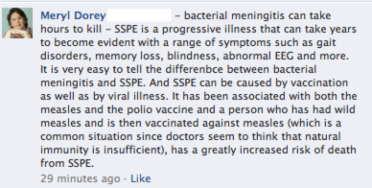
Let’s take yesterday’s attempt to claim that MMR or the measles vaccine can by itself cause Subacute Sclerosing Panencephalitis (SSPE). SSPE occurs following measles infection in which the virus infects neurons and lays dormant. Although erring on the side of exceptional caution, SSPE is listed in Australia as an adverse event following immunisation so confirmation bias will play a part.
The fact that it’s listed does not mean SSPE from MMR or another vaccine is probable or even possible. It means the decision to remove it from listing has not yet been made.
It’s fair to say that incorrect conclusions were previously drawn in some very rare cases – and understandably so. Measles vaccines involve an attenuated live virus. With incomplete investigation, or those limited in scope, errors are made. Ms. Dorey just hasn’t caught up with the facts yet. Science may move forward at a crawl but antivaxxers seem to insist some aspects be frozen in time forever.
On a Facebook page Vaccines Uncensored that has since closed, Dorey wrote:
The polio vaccine reference Dorey later produced from whale.to also included claims of polio definition fraud along with AIDS, GBS, Leukemia and cancer, being certainly due to all vaccines. Where polio vaccination has been instituted globally, “reported polio infections show a 700% increase as a result of compulsory vaccination polio” the trusty reference informs us.
Meryl then copy/pasted a section quoting “Informed Parent” issue 4, 2001 which itself was quoting a 1970’s article on a large New Zealand outbreak of SSPE from 1956 to 1966. It was suggesting live SV40 was involved. There was no confirmation but it was believed the SSPE was related to the Salk vaccine. No such case has been documented again.
Dorey then copy/pasted two more paragraphs from either whale.to or vaccineinjury.info, goading the other member with “You can apologise later”.
One was a paper written by Belgamwar RB et al. 1997. Measles, mumps, rubella vaccine induced subacute sclerosing panencephalitis. It “presumed” an Indian child developed SSPE 15 years after she received MMR at 9 months of age. The reasoning is that the live measles virus in MMR lay dormant. Although incredibly rare at zero – 0.7 cases per million, these events seemed feasible.
Another explanation may be denatured or failed vaccines that, having no efficacy, left the subject vulnerable to consequent measles infection. Or SSPE from a pre-vaccine infection could be involved. This girl apparently had no history of measles infection, but this does not account for the potential of asymptomatic measles infection or incomplete records. Today it is accepted that a natural measles infection is the cause in these cases.
Risk of subacute sclerosing panencephalitis from measles vaccination. Pediatr Infect Dis J. 1990 by Halsey was another similar piece pasted in by Dorey. It posed the existence of “vaccine associated SSPE”, but failed utterly to show causality. Focusing on SSPE in an era when vaccination is preventing wild measles does not eliminate prior infection with measles and resultant latency as the cause of SSPE. Halsey practically admits to this oversight in his text, ignoring dormancy and stating, “we should pay attention to SSPE after inoculation”.
Well before these largely discredited papers, Zilber et al. in 1983 had already posed:
Most of the SSPE cases reported measles at an age significantly younger than that of the general population. This pattern did not change after introduction of antimeasles vaccination. Incidence was significantly lower (p less than 10(-9) in the vaccinated population than in the unvaccinated population. Occurrence of SSPE in some children who were vaccinated against measles could be explained by incomplete vaccine efficacy, or by older age at vaccination, which allows the possibility of prior exposure to measles. There was no indication that measles vaccine can induce SSPE.
The physiopathology of SSPE is not well understood. Yet evidence (October 2010) suggests that factors at play favour humoral over cellular immune response allowing viral dormancy in infected neuronal tissue. Exactly what this atypical immune response helps to explain in cases of SSPE is bound to be further elucidated. It was certainly not known to the authors Dorey has cited. What is clear is that measles vaccination does not trigger SSPE in those already infected by wild measles virus – as suggested by Dorey in the screenshot above.
Available epidemiological data, in line with virus genotyping data, do not suggest that measles vaccine virus can cause SSPE. Furthermore, epidemiological data do not suggest that the administration of measles vaccine can accelerate the course of SSPE or trigger SSPE in an individual who would have developed the disease at a later time without immunization. Neither can the vaccine lead to the development of SSPE where it would not otherwise have occurred in a person who has already a benign persistent wild measles infection at the time of vaccination.
For situations where cases of SSPE occur in vaccinated individuals who have no previous history of natural measles infection, the available evidence points to natural measles infection as the cause of SSPE, not vaccine.
For those who wish to err on the side of extreme caution, it pays to remember that the Australian Immunisation Handbook is regularly updated. We should keep in mind that proposed incidence has always been of extremely small numbers. Maintaining the claim SSPE can be due to measles vaccination must now include the academic argument of what significance the phrase, “the available evidence”, as advanced by the WHO should be given.
Zero – 0.7 unlikely cases per million vaccines vs a certain 8.5 per million measles cases, was the older accepted risk-benefit. Following a late 2005 Journal of Infectious Diseases paper the measles induced rate of SSPE has been estimated at 6.5 – 11 cases per 100,000 infections. An increase of 7 to 13 times. This “disease vs vaccine” notion is akin to MMR induced encephalitis. Except the always dodgy evidence blaming vaccination for SSPE is in need of reinstating.
On a final note, it is outrageous for Dorey to be feigning concern over SSPE. There is only one answer to tackle SSPE: the elimination of measles via vaccination. Even then it’s estimated that a lag of up to 20 years or more will follow in which latent SSPE from wild measles will continue to emerge.
For about 6 years the new accepted risk-benefit of SSPE has been zero cases from vaccination and up to 11 cases per 100,000 measles infections.



 Losing In The Lucky Country