Thanks to The Online Criminal Justice Degree Project.


Thanks to The Online Criminal Justice Degree Project.
Skepgoating: Skepgoating (adj) is derived from the notion of scapegoating. It refers to the practice of falsely accusing (scientific) skepticism, skeptics or other individuals of pursuing predetermined agendas derived from distortions of (scientific) skepticism. Used as both defence and attack it aims to cast the other party as inferior, negative and wrong. Particularly found within or in relation to discourse in which truth can demonstrably be derived from evidence. In this way the accuser seeks to drive onlooker or reader attention away from the lack (or presence) of evidence and evoke an irrational and emotional response toward the individual or organisation being skepgoated.
Claims made in skepgoating are false. Rather than address evidence, attempts are made to malign the other party to such an extent that a Faux Victory is claimed. Eg: “Skeptics worship science and are too close minded to understand”. Or, “Skeptics want to suppress your freedom of speech and your right to choose”. Or, “Skeptics want to do bad things to me, that is why they say words that make me appear stupid”.
Skepgoating is also used by certain cult-like groups to imply skepticism by association, by group members who exhibit independent thinking. In such cases skepgoating may have similar power to the belief in witchcraft leading to swift and disproportionate retribution directed at the skepgoat (n). Banishment of the skepgoat and expunging of their visible history follows in an attempt to convey unity to remaining cult members. Dominant or Alpha skepgoaters decide who will be deemed a skepgoat.
As pseudoscience, anti-science, sham disciplines and conspiracy theories have blossomed with high speed information flow, those with a critical eye have kept pace. Some go on to embrace skepticism (scientific skepticism) with an astute and passionate awareness of critical thought and evidence based decision making. Others take great delight – perhaps comfort – in reading skeptic material. Skeptic social events and presentations (often together) are well attended.
Here’s where an observation is needed. There isn’t necessarily a direct correlation between how active a person is skeptically speaking, and how they identify with organised skepticism. In certain areas of interest to skeptics, the most active are not remotely interested in organised skepticism. Alternatively, active skeptics may well spread their interests across many areas. This might prohibit ongoing activism in one area but produces valuable skill sets in skepticism itself.
Some skeptics are deeply involved in areas that demand all ones skeptical faculties, yet find it absent from skeptical topics. In my case drug law reform and a host of human rights issues spring to mind. Having been around these areas a very long time, my advice to skeptics would be to not involve the skeptic movement in major law reform. Being generally apolitical is a valuable feature of skepticism. Exactly when topics enter mainstream skeptical discourse, in part reflects social evolution.
Perhaps it’s best worth noting that some areas involving research, science, critical thought and ample evidence may at once yield unambiguous themes and needs, yet not suit skepticism. Said differently, some areas of scientific consensus receive the attention that reflects political climate more than scientific veracity. Beliefs change in the wake of evidence and the process cannot be rushed. The sacking of Professor David Nutt by the UK Home Office in 2009, is a powerful example of this.
Nutt was of course, absolutely correct. Yet the skeptic in me can spot the evidence he perhaps should have lingered to consider. No matter how you approach it, the facts about drug related harm appear to trivialise the matter. Politically and emotionally Australia, the UK and the USA still blame the inanimate drug and not the policy that denies us control. Unpalatable for many, yes. Slowly changing, indeed. But a fact no less and one that impacts on conclusions.
Rest assured, I’m not diverging onto that topic. Rather, hoping to point out how this fits with the observation above and offers insight into the intellectual paucity that sustains generalised attacks against skeptics in the form of skepgoating. Labelling skeptics as beholden to predetermined agendas is born of the same in-group type thinking that labels science a belief system.
When it comes to skepgoating, your relationship to skepticism may at times be defined for you, by someone with a need to pigeon hole interlocutors or label critics. Note this recent Facebook comment.

As most here know, the AVN is a strident anti-vaccine group, falsely professing to offer “informed choice”. However, as demonstrated by this comment there is a dominant theme emerging peculiar to taking sides rather than discussing vaccination choices. Both the person addressed, and the topic of that address, are very much fans of the AVN. Apparently if one is out of step it’s “outrageous” and one is a friend to a ‘skeptic’. Yes, those inverted commas are intentional and I’ll get to that.
I conclude this comment is quite representative of the AVN. One notes praise and support for the commenter from the AVN president and her own similar combative monochrome approach used to restrict independent expression. Particularly one notes the absence of tolerance for freedom of expression with the AVN.
Of course this is a very silly comment – albeit important to this post. So, what’s going on? Although the subject being attacked here merely thanked another member for posting something “from the pro side” she has been skepgoated. No praise for vaccination took place, and nothing “outrageous” occurred. No rationale is needed. Just point the finger and intone the magic word.
This comment brings up the need for another observation. Whilst passive deconstruction of pseudoscience, scams and paranormal topics of all manner is as old as skepticism itself the internet radically changed communication about these topics. There are no cigars for spotting that skeptics are known for one primary trait. Requesting and examining evidence to substantiate claims. In this light skeptics tend toward a strong appreciation of the scientific method and the role of science.
It follows quite predictably that scientists, those working in or with a background in science, those with an appreciation of science and scientific education to communities and others who understand science, may gravitate toward skepticism. This is by no means absolute but suffice it to say there is overlap. A cursory search would indicate skeptics feel motivated toward activism and use of modern media to publish critiques of pseudoscience and exposure of scam tactics. Ultimately skeptics value scientific inquiry, the scientific method and tend to seek out and conclusively judge scientific consensus.
This helps to grasp the genesis of the irrationalism in the above comment. In an age in which non evidence based claims are pitched toward the health consumer, skepticism is proving a bitter natural pill to swallow. Regarding vaccination the science and pseudoscience are easily identified. “Pro-vax” is quite meaningless, but has been promoted heavily to falsely qualify conclusive evidence and sustain the illusion of a debate.
There is no “pro-vax” and there is no “informed choice”. There’s fact and mistakes. Vaccine science makes vaccination a no brainer. Misinformation leads to fear, confusion and poor or delayed choices – aka mistakes.
For skeptics however, this topic presents examples of evidence denial, cognitive dissonance, confirmation bias, conspiracy theory, flawed reasoning, blind belief, belief in the absurd, exhaustive scams and schemes, in-group thinking, cult like features and so on.
A veritable banquet of non critical thought and destructive behaviour, the antivaccination movement is of enormous interest to skepticism. Of course, the notion that someone deemed to not be a “fan” of an antivax group, are therefore friends to skeptics is utterly ridiculous and paranoid. It helps underscore just why these groups attract so much interest from skeptics.
Forget vaccination for a moment. What if you’re interested in the psychology of quasi-religious bigotry, how leadership dogma drives members to attack, how the need to belong shapes perception of the Self and others, the primal need to identify “enemies” and thus elevate our own importance, and on and on. There’s practically an entire Skepticamp in that one comment.
In this case it goes beyond “If you’re not with us you’re against us”. It’s essentially asserting that if you deviate from arbitrary rules you can be labelled in a manner that defines a great deal about you as a person – including loyalty, belief and motivation. Whether on a micro or macro scale one need not be a skeptic to appreciate how destructive the dictatorial thought process is.
This actual skepgoating comment exists in a thread relating to a major skepgoating article by Mike Adams. In fact the person who published it on Facebook goes to extreme lengths to devalue skepticism almost daily. This is primarily to fill an evidence vacuum and to convince members or observers that skeptics have malignant intentions. Meryl Dorey is that person and first published this article two weeks after it was written – 2, 1/2 years ago.

Then again only days ago.

I’m not convinced Dorey believes very much of this at all. It’s rampant ad hominem generalisation that, presented with no reference to Adams, would appear to be Poe’s Law in action. As noted here before, the pseudo-neoconservative philosophy she peddles flips the argument away from evidence based discussion to a claim of being persecuted. “Thinking” with ones gut yields poor results and this is Dorey’s aim.
As AVN member and coach, University of Wollongong lecturer Dr. Brian Martin argues that this allows one to provoke outrage in onlookers with the hope of causing backfire of critic’s evidence based techniques.
Martin reveals in his writings that his grasp of what separates pseudoscience and actual dissent is remarkably poor. Referring to scientific theories as “dominant paradigms” he seems incapable of grasping scientific consensus, the scientific method, the import of evidence, altruism and moral responsibility. A champion of both pseudo’ and anti-science we see that fierce devaluation of demonstrable facts and scientists themselves, pepper his writings.
Depending on the sophistication of your audience, almost any attack will do. Engender outrage. Force backfire. Justify censorship. Divert from evidence. Inhibit thinking. Which brings us back to Dorey’s second posting of Mike Adams at his most absurd. The fact that it’s bogus is kind of cute given that he did some “research”. It includes;
Skeptics believe that many six-month-old infants need antidepressant drugs. In fact, they believe that people of all ages can be safely given an unlimited number of drugs all at the same time… Skeptics believe that the human body has no ability to defend itself against invading microorganism and that the only things that can save people from viral infections are vaccines. Skeptics believe that pregnancy is a disease and childbirth is a medical crisis. (They are opponents of natural childbirth.) Skeptics believe that ALL vaccines are safe and effective (even if they’ve never been tested), that ALL people should be vaccinated, even against their will, and that there is NO LIMIT to the number of vaccines a person can be safely given. Skeptics believe that the SUN has no role in human health other than to cause skin cancer. Skeptics believe that human beings were born deficient in synthetic chemicals and that the role of pharmaceutical companies is to “restore” those deficiencies in humans by convincing them to swallow patented pills…..
Mike claims to have lifted all this from skeptic sites. However, “I’m not going to list those websites here because they don’t deserve the search engine rankings”. Given that not raising the rankings of sites one links to is quite basic, we may conclude Mike invented this silliness.
Okay, so that’s a patently nonsensical article. It’s false and clearly so. Indeed, round two imploded on Meryl Dorey and set the tone for the above comment. As usual most critical comments have been deleted and the members banned. Only “skeptic trolls” would disagree with Mike. The single remaining critical comment has the most “Likes”. I can’t be sure but it may have remained due to the reply below it. The respondent authored the original comment above.
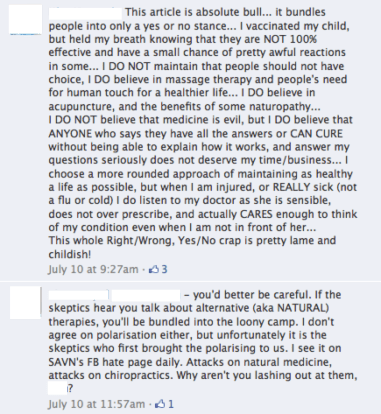
It’s quite unambiguous. Despite attesting to not fancying polarisation it is clear this individual is only there to skepgoat. Now a certain Facebook page is deemed populated by skeptics. It isn’t. Yet evidence based critiques of health scams have become hate speech. Anyway, I think the point is made. This is a decided effort to divert attention from evidence and attack the results of scientific inquiry.
So what then is scientific skepticism? Why attack it so often and so ridiculously? Definitions of scientific skepticism including Wikipedia are worth reading. For our purposes in understanding skepgoating it’s not just skeptical appreciation of evidence and inquiry. Identification of belief and the ease of accepting doubt attracts criticism. Where there is doubt there is… doubt. Pseudoscience is frequently about replacing doubt with fiction or logical fallacies.
In terms of belief consider alternatives to medicine, superstitions, vaccine injury chic, paranormal scams, new age diagnostics and healing, vitamin therapy, wonder foods, etc. The list is practically endless. Appreciating evidence, scientific inquiry and understanding how easily humans are fooled is not what those profitting from cancer cures or removing “vaccine poisons” want widely known.
Mike Adams is a prime example. By attacking modern medicine and modern living he attracts a global demographic that may likely purchase from his multi-million dollar empire selling garbage that purports to repair the damage sustained from modern living. Damage he simply invents. Like Meryl Dorey it’s difficult to be sure where the crafty money making begins and the delusion leaves off.
Then there’s the plain whacky skepgoating characters like Martin Walker. Skeptics are “the global corporate science lobby group”. His Health Fascism in Australia is priceless:

To quote Orac. “‘Health Fascism’ in Australia? The anti-vaccine loons think so”. Walker is one bizarre piece of work. His rambling attack on sinister fascist skeptics includes:
The sinister Skeptics group, agents of what used to be CSICOP now the Committee for Skeptical Inquiry (CSI) organised from the US and linked to the major corporate lobby groups, American Council on Science and Health (ACSH) and American Council Against Health Fraud (ACAHF), which is in turn linked to the Australian CAHF) are making ground in Australia.
Supported by authoritarian ideological influences in government and Big Pharma, the Skeptics are running constant attacks on homeopathy, natural cancer treatments, those who question vaccination and those who support any form of alternative medicine.
With the present world fiscal crisis, all those linked to Big Pharma and Science are fighting a bitter battle to preserve drug company competitiveness. But where fascist influences in government and health with most force come together is in attacking anyone who speaks out about freedom of choice and expression in relation to vaccination.
Over the last year the international corporate lobby Skeptics, have been behind a campaign against the Australian Vaccination Network (AVN). […]
Yes. The “campaign” one retired bloke sent off in a complaint. Nice work it was, but “campaign” by an international corporate lobby? NURSE!
Dorey tried this approach herself blaming skeptics for Friends of Science in Medicine:
There is an organisation in Australia which hates every natural therapy. They hate the healthcare practitioners and they hate the healthcare consumers who ‘turn their backs’ on Western medicine in favour of a range of other modalities which put no money in their pockets and take away their prestige. Worst of all, they hate anyone who chooses not to use vaccines! That is the ultimate heresy, as far as they are concerned.
But it’s OK – because they have a plan and they have the money and media backing, they think, to bring this plan to fruition.
This group, the Australian Skeptics, has been instrumental in setting up the organisation, Stop the AVN.
Now, they are working on a new initiative – and this one is more ambitious then just stopping a small, parent-run community support group. Now, their goal is to stop anyone in Australia (today Australia – tomorrow the world as far as this bunch of ratbags is concerned) from learning about or using natural therapies. Their mad campaign is getting plenty of publicity too!
They have just set up a new front group called Friends of Science in Medicine (FSM) which is behind the new effort to outlaw the teaching of any natural medicine course in University. […]
It’s widely known SAVN is a Facebook page set up by a non-skeptic. It’s a Facebook page, not an organisation. FSM was quite capable of launching themselves. Yet Dorey’s skepgoating is clear. Whilst Australian Skeptics employ a total of one person to ensure a decent magazine appears each quarter the above paints them almost as powerful as a small country.
 My little definition of skepgoating up top includes “other individuals” because, well even skeptics can’t do everything. Just make it seem that way.
I explained how crucial it is for Dorey particularly to tar all critics with one brush. Not with the AVN? Then must be a skeptic actively working against the AVN. This next example speaks for itself.
An article today in The Telegraph notes vaccine conscientious objectors (perhaps having grown under her guidance) continue to secure government immunisation incentives. It also ran in other online publications.
They ran a poll asking “Should anti-vaccine parents get paid?”. The results are quite in line with national vaccine rates. In fact they err toward more fully vaccinated Aussies supporting the payment for vaccine objectors.
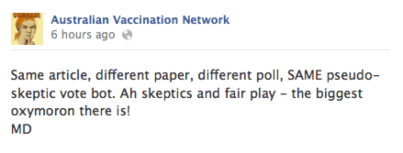
Nonetheless this is Meryl Dorey’s response:
[Note – see update at end]
Despite most skeptics in Australia not bothering with such unscientific nonsense as a dodgy self reporting poll, Dorey still plays that card. It gets sillier when one notes she has asked her own members to visit the poll and vote. Nonetheless it’s a great example of skepgoating and raises my promise to elaborate on those inverted commas within the initial comment.
You see scientific skeptics aren’t skeptics but pseudo-skeptics according to Meryl. No doubt this is intended to provoke the odd skeptic but it’s bizarre given the definition of pseudoskepticism. Marcello Truzini coined the term. He wrote in On Pseudo-Skepticism in 1987:
In science, the burden of proof falls upon the claimant; and the more extraordinary a claim, the heavier is the burden of proof demanded. The true skeptic takes an agnostic position, one that says the claim is not proved rather than disproved. He asserts that the claimant has not borne the burden of proof and that science must continue to build its cognitive map of reality without incorporating the extraordinary claim as a new “fact.” Since the true skeptic does not assert a claim, he has no burden to prove anything. He just goes on using the established theories of “conventional science” as usual. But if a critic asserts that there is evidence for disproof, that he has a negative hypothesis—saying, for instance, that a seeming psi result was actually due to an artifact—he is making a claim and therefore also has to bear a burden of proof.
I’ve dealt with Dorey’s obsession with laying claim to skepticism before, including that appallingly offensive blog abusing the name of Australian Skeptics. She seems to have muddled Hume’s true skepticism (philosophy) with evidence denial. This prompts her to argue that belief is actual skepticism. As in be so skeptical deny reality as well.
Where this fails utterly is that in promoting belief, she unwittingly concludes that is a final contention. You may know this position as “science can’t explain everything”. Dorey, and pseudoscience take it further. “If science is limited this way then anything is possible – especially what I allege”. It’s here where the agnostic (if you like) or acceptance of doubt in science that skeptics are at home with kicks in. Belief does not change. Scientific skepticism accepts that change is always likely but what may eventuate is a matter for inquiry. Certainly not conjecture or at worst, rank conjuring.
Of course science doesn’t “know” everything. But assuming it thus truthfully knows nothing, is a recipe for intellectual disaster. This gives us vaccine denial, AIDS denial, conspiracies, UFO assertion and other false contentions that lead to attacks on modern medicine and the growth of sham industries.
SCEPCOP do exactly the same. Claiming to be the Scientific Committee to Evaluate Pseudo Skeptical Criticism Of the Paranormal, they also lay claim to being actual skeptics. It’s pretty cringe-worthy. Dorey’s use and abuse of both “skepticism” and “pseudoskepticism” is identical to SCEPCOP. There’s also Skeptical Investigations and plenty of others like them. These groups spawn individuals who associate covertly with skeptic groups only to compile negative evaluations about skeptic interests.
Child Health Safety is another antivax site with a long record of attacking skeptics, and presupposing the intent of discourse based on identity. From Dorey’s blog.

Wow. Um is there a point you wanted to make? As you can see dear reader, skepgoating frequently involves attacks with no substance, no context and actually no relevance. All we see over and again is the need to devalue genuine agents of evidence.
Rational Wiki describe pseudoskepticism as if describing these groups and the AVN. By projecting their own pseudoskepticism they seek to devalue critics and label evidence based criticism unfounded. The important point is that it has two common usages at present. 1.) To further devalue scientific skepticism by laying claim to the title (but not process) of skepticism. This is abuse of the term and includes Meryl Dorey’s use.
2.) As a substitute for “denial” it may be used to describe those who pimp and preen as skeptics, make a few convincing noises but hold to a predetermined agenda. They will ignore any evidence that challenges them. Despite holding a PhD in physics and strutting as an academic, our radical sociologist antivaxxer Dr. Brian Martin is a genuine pseudoskeptic. A fraud. I can be no kinder.
I should stress that skeptics themselves must be aware of slipping into pseudoskepticism. Fortunately skeptics are rather good at keeping each other honest. This may sound strange but I’m yet to find a better defender of Dorey than skeptics. Not because they accept her piffle for a moment. But because tolerating generalisations or making assumptions about the AVN without evidence is intolerable.
As I mentioned earlier communication influences present day skepticism. In this way skeptics and those with good critical thinking abilities have made genuine long lasting inroads into debunking scams. People are getting ripped off, made ill and at times dying. Often, they are ripped off while dying and being made more ill by some shonky scam. Skeptic movements have a particular distaste for such “health freedom choices”. They are only too happy to inform governments how poorly existing legislation is. So, if skepticism has changed what can we identify?
Skepticism might be viewed as existing at the centre of four inroads. Evidence, human rights, consumer rights and moral or legal obligation. Each inroad is not exclusive. They may accommodate portions of each other or highlight qualities we value as a society. Such as education, free speech, rationalism, reason, truth, democratic freedom, progressive policy design, equality and so on.
I’ve left out specifying paranormal investigation, enduring themes (like perpetual energy and religious experience) exhaustively examined and respectfully considered by skeptics. I couldn’t possibly do justification to legendary visionaries like Nigerian skeptic Leo Igwe and his struggle to fight superstition and brutal irrationalism with reason and education. No doubt this article could be pages long and include almost every division of pseudoscience and superstition.
One thing I should stress is that skeptics do identify those who have been misled as opposed to those who mislead. The result is an even stronger conviction to prevent charlatans from scheming and scamming the vulnerable. From sabotaging education and indoctrinating with dogma. In turn those who measure profit by victim count, don’t cope terribly well with a skeptic critique.
Presently it’s practically standing room only for the enemies of reason. From creationism to cancer cures they are easy to find. So too is a critical response to these impossible claims. Depending upon ones background, education, experience and social circle individuals pick up fairly quickly on the patterns that resonate with them.
Skepticism is tearing down the walls of illusion and that is why pseudoscience is so keen to attack skeptics and skepticism. Arguments, much less legal or legislative challenges, cannot be won by scam artists on merit. To them it’s imperative that those who seek to hold them to account be devalued, falsely maligned, abused, accused and worse.
If there is one thing this article lacks it is a full representation of the outrageous, scurrilous, blame filled and nauseating attacks on skeptics. Skepgoating.
Ultimately the more skepgoating there is, the better the job skeptics seem to be doing.
July 16th – Update on newspaper poll. Another copy to run a similar piece was the Courier Mail. Providing a shorter piece, they worded their poll differently. “Are vaccinations worth the risk”? I know, I know. Given one is more likely to become a billionaire than experience anaphylactic shock it’s a stupid and loaded question. Still here’s the poll results as of early afternoon the following day.

So with a general vaccination rate of 95% plus, over 20% of us don’t reckon it’s worth the risk! Pseudo-skeptic vote bot, Pseudo-skeptic vote bot. Where for art thou Pseudo-skeptic vote bot? Pathetic effort.
However, gracious in defeat I doff me cap to the anti-vax flying monkeys.
The Global Commission on Drug Policy recently released yet another report condemning illicit drug prohibition and the War on Drugs.
Entitled The War on Drugs and HIV/AIDS – how the criminalisation of drug use fuels the global pandemic the report lists 6 key dynamics behind the trend.
1.) Fear of arrest drives persons who use drugs underground, away from HIV testing and HIV prevention services and into high risk environments. 2.) Restrictions on provision of sterile syringes to drug users result in increased syringe sharing. 3.) Prohibitions or restrictions on opioid substitution therapy or other evidence based treatment result in untreated addiction and avoidable HIV risk behaviour. 4.) Conditions and lack of HIV prevention measures in prison lead to HIV outbreaks in incarcerated drug users. 5.) Disruptions of HIV antiretroviral therapy result in elevated HIV viral load and subsequent HIV transmission and increased antiretroviral resistance. 6.) Limited public funds are wasted on harmful and ineffective drug law enforcement efforts instead of being invested in proven HIV prevention strategies.
Let’s forget “drug war” and call this problem what it is. Treating drug use as a criminal offence. Now, just by raising that image we’re into different waters entirely. Pointing to problems with the criminal model immediately evokes suspicion of compulsory promotion of illicit drug use. We’re conditioned to assume if we don’t punish drug use, it will be everywhere and bring about a host of nasty outcomes.
Mostly, we’re well conditioned to associate drug use with crime and to see it as criminal. Stitched on to this is the pop culture image from which we draw stereotypes. My favourite is one I often refer to as Quinn Martin. Quinn Martin Productions brought us Streets Of San Francisco and a host of other unrealistic 1970’s TV Cop shows. If you wanted a crime – it was drug related. A bad guy or a weak willed loser? Toss in a druggie.
Of course, I’m not suggesting we imagine this. The reality is criminals are made from associating in criminal circles and from being incarcerated, regardless of the reason. How this fits in with the drug-crime punishment model was addressed recently by eminent Australians who authored the Australia 21 Report. They state:
The prohibition of illicit drugs is killing and criminalising our children, and we are all letting it happen
Rather than legalisation alone, that report discussed regulation, decriminalisation and de-penalisation. Far from being an open slather free ride these measures involve control, certain losses of freedom, the need to demonstrate responsibility and a major focus on rehabilitation back to a productive and useful lifestyle. What they don’t involve is the destruction of lives and sustaining criminal enterprise at huge cost to the community.
Yet in Australia we do very well managing HIV/AIDS in injection drug users [IDU]. 16 million use IV drugs globally. Almost 20% live with HIV. Fortunately, Australia managed to keep that level at 3%, and a significant number of that sample were at higher risk statistically from acquiring HIV from another high risk behaviour. This level remained stable for decades.
So the question does arise. Apart from acknowledging shocking human rights abuses, tragedy in many nations and an ongoing source of disease and corruption, what policy aspects need we mull over?
Since the Howard years Tough On Drugs initiative and emergence of groups like Drug Free Australia lobbying against expanded protective measures, the level of HIV in IDU jumped to 4%. It remains an exquisite example of how just a few years of delayed and abandoned Harm Reduction responses, increased punishment and disinformation about Harm Reduction efficacy has an immediately devastating impact on HIV control in Aussie IDU.
The fact that this collective undermining of Harm Minimisation occurred during a period when Harm Reduction services, research and supporting evidence expanded rapidly in Australia is testimony to how effective disinformation and intuitively themed attacks on evidence can actually be.
Still, as of April this year we remain extremely fortunate thanks to Harm Reduction:
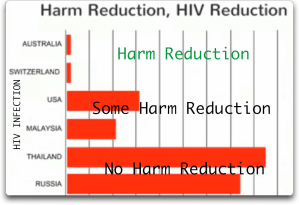
HIV in IV Drug Users matched to Harm Reduction
The single greatest sabotage of Harm Reduction initiatives under the auspices of John Howard, was the suppression of a heroin on prescription trial in 1997. This had strong bipartisan support and the Federal Health Minister, four States and the ACT were excited about the decision to go ahead. Under instructions from then ANCD head Major Brian Watters – later to become a Board member of Drug Free Australia – Howard immediately vetoed the decision.
Exactly how many HIV cases, ruined lives and deaths this led to is impossible to estimate, and I would err toward a minimal estimate. Still, 15 years later we can assume the body pile is now somewhat impressive. In what is unique insight into how Howard in turn manipulated the zealots who tried to manipulate him, he never flinched on needle exchange.
To his credit he continued to fund over a thousand outlets across Australia, with some specialising in bulk dispensing, others in hard core risk management. Abandoning these programmes was insanity, despite conservative lobbyists being convinced he might do so. Yet to Howard, being seen to usher in heroin prescription – “free heroin” – as shock jocks called it was political suicide.
Despite strong support for our official policy of Harm Minimisation, which accommodated extreme spending against smuggling (Supply Reduction), this is how he presented his thoughts in 1998:
The policy of zero tolerance of drug taking in this country is a wholly credible policy and policy that ought to be pursued more vigorously by government and by people who are concerned about the problem.
Of all the lies he told, this remains one of my favourites. There was no such policy beyond words. He seemed to despise everyone equally. Which was essential for the politician he became. All that mattered to Howard was Howard, and securing votes. Manipulating drug workers, users, science advisers, policy experts and voters over what was a social crisis at the time was pure business.
British Columbia did introduce heroin on prescription in 2005. 5 years later the effects of the combined measures on HIV were compelling:
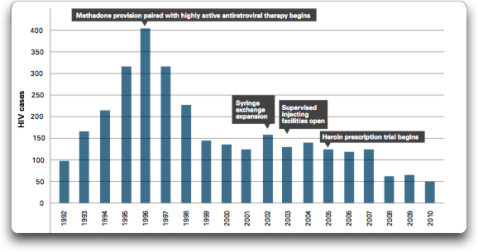 British Columbia: HIV infection matched to Harm Reduction initiatives
Similar success from heroin on prescription is found in every nation to usher in trials and programmes. Sadly, Australia was ready before the Howard years. We were in fact, world leaders. Now it’s a different story. We have one Medically Supervised Injecting Facility that ran as a successful trial for 11 years.
Seven of those 11 years were due to disinformation and sabotage from conservatives. In October 2010 the Kenaelly NSW State government passed a Drug Misuse and Trafficking Amendment bill to ensure the Centre became permanent. 11 years of moral panic was, at least legislatively, silenced.
Whilst actually attacking Harm Reduction initiatives, confusing methadone and buprenorphine with illicit drugs and muddling the lot in with AFL drug policy, Alan Jones delighted us with his wisdom on “Harm Minimisation”, in mid 2007 [MP3 here]. Obnoxious, offensive and completely ignorant of facts it is also somewhat representative of Aussie views today:
So today Australia has a long, long way to go before we do, if ever, fully recover from the rise of anti-drug conservatives under John Howard. They did far more damage than just raise HIV infection by 1% in injection drug users. Our fluency with progressive policy and public maturity has been undermined. Australia waits, on pause.
33 million people live with HIV today. Outside sub-Sahran Africa IV drug use accounts for 1/3 of new infections. For almost 15 years annual HIV infections have been falling on a global scale. Except for seven countries wherein HIV infections increased by about 25% primarily due to IV drug use.
The “drug war” is full on in Eastern Europe and Central Asia and unsurprisingly 5 of these 7 countries are in these boundaries. In the last decade people living with HIV in these areas has close to tripled. Russia has resisted Harm Reduction measures keeping methadone illegal and charging users for needle possession. As this demographic is actively abused by law enforcers the motivation to use needles based on access convenience and minimal time is heightened. The results are clear:

HIV infections – Russian Federation
Thailand has impressively cut HIV infection in workers in the famous tourist attracting sex industry from 40% in the mid 1990’s to around 5% today. This pulled male clientele infection rates down in parallel. At the same time fierce drug war tactics led to 2,500 “death squad” murders in 2003 and HIV is up to 1 in 2 IDU in some regions. A comparison of different demographics for HIV infection is compelling:
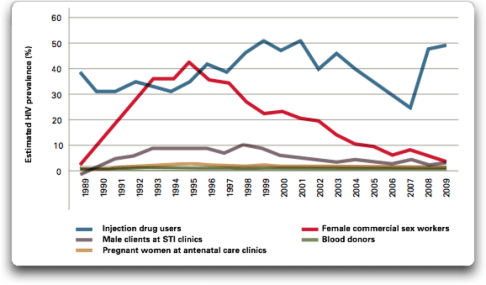 THAILAND: HIV infections per demographic
In a splendid example of stupidity the USA reinstated it’s 21 year ban on federal funding for needle exchange programmes only 2 years after ending it. A stark lesson for Australia, constantly under the assault of disinformation from anti-drug group Drug Free Australia, can be found on page 9 of the GCDP Report.
Recently in reviewing the history of Harm Reduction and HIV, I noted the stark difference between not just nations, but regions within nations favouring HR as a powerful controller of HIV spread. Similarly today it can be seen that in nations with extreme law enforcement, and regions within the USA with the most intense law enforcement that HIV levels are higher than those with low law enforcement.
For instance, a study of the 96 largest US metropolitan areas found that measures of anti-drug “legal repressiveness” were associated with higher HIV prevalence among injectors and concluded: “This may be because fear of arrest and/or punishment leads drug injectors to avoid using syringe exchanges, or to inject hurriedly or to inject in shooting galleries or other multiperson injection settings to escape detection.”
DFA fallaciously – and skillfully – report the exact opposite. Similarly DFA urge for dedicated Harm Prevention measures, described already on this blog as crude behaviour modification. Whether through blind or biblical force the aim is to do just that: force drug users to stop by changing behaviour. Forget the addiction and crush the symptom.
The easiest way to do this is control the environment. Enter compulsory detention. What DFA have called “compassionate detention”. The models they are considering are terrifying. Not only is HIV infection spread through these centres, they fail to offer any addiction treatment. Forced abstinence is associated with high fatality relapse.
Once infected with HIV criminal and punitive approaches act as a disincentive to testing and treatment. Requirements to be drug-free in order to receive treatment (as in Sweden) and denial of certain rights like child custody and employment correlate directly to higher HIV/AIDS fatalities. Confidentiality breaches and stigma impact frequently due to law enforcement regardless of country.
This leads to higher circulation of HIV in the community as treatment has been shown to reduce HIV transmitted via blood and body fluids. As such it is vital all demographics in all communities can be reached through treatment which ultimately leads to prevention.
Incarceration also increases HIV infection and Australia is heading toward a USA type model which has 25% of prisoners listed as HIV positive. Fortunately our initial lower levels in the IDU population will protect us significantly from such a nightmare. Unusually, prison needle exchange is resisted strongly. DFA play the key lobby role nationally and prison guard unions seem intent to deny evidence in favour of their health.
Australian prison guards profit enormously from selling syringes to prisoners. Secondary to money is the control of prison dynamics, control of prisoner behaviour and the essential control of these transactions in corruption entire. A syringe is power in the prison setting. The sooner we remove this tool from guards and protect prisoner health with clean exchanges, the better.
Resources spent on law enforcement are resources not spent on health initiatives generally, on a global scale. With drug crime and infection encouraged by the former and lessened by the latter, it is clear we face a major global challenge. Public health is the first principle of drug control.
Settings where HIV prevention measures have been curtailed as a result of economic concerns have been particularly vulnerable to increases in HIV risk among injection drug users. For instance, a greater than 10-fold increase in newly diagnosed HIV infections among injecting drug users has recently been reported from Greece during the first seven months of 2011.
Australia remains incredibly lucky and indeed most fortunate in this global picture. What cannot be ignored and what must be cautioned against is our slow morphing into a landing pad for USA styled conservative disasters. DFA is an arm of Drug Free America Foundation and act at their bidding. DFAF have their “division”, the Institute on Global Drug Policy who fund the Journal of Global Drug Policy and Practice.
This is no journal but a vehicle for lobbying against progressive drug policy primarily that which targets HIV control. All get together and play at the Swedish based World Federation Against Drugs which similarly is nothing like a “world federation”. What they strive for is patently out of this world.
As today’s most brilliant minds accept the evidence condemning prohibition, the global Drug Free Whomever groups seek to defend the UN Drug Conventions that originated in 1961.
Fortunate we may be, but complacent we cannot afford to become.
In 1985 before the introduction of needle and syringe programmes (NSP) 90% of Australian injection drug users reported sharing injection equipment. By 1994 following introduction of NSPs this figure had fallen to 20%. In 2009 this figure was around 15% possibly reflecting the constant number of distributions from NSP programmes over the previous decade.
One of the most powerful modes of resistance to the spread of HIV/AIDS is Harm Reduction (HR) measures.
In Australia, HR exists as one of three pillars of Harm Minimisation (HM) – our official illicit drug control policy. The other two pillars are Supply Reduction and Demand Reduction. Reduction in supply receiving the lions share of funding directs energy at reducing international and domestic supply. Reduction in demand receiving less funding delivers programmes and initiatives designed to reduce the demand for drugs within communities.
Harm Reduction receiving the least funding from the HM pile targets the harm to individuals that eventuates from behaviour. HR has always drawn condemnation from conservative groups because of the association with drug use and sex. Initially men who have sex with men (MSM). Then later through maximal exploitation of drug using pop culture. Nonetheless, study after study comparing countries and districts within countries to have implemented HR or not done so, show a stunning success in favour of HR.
This post will look almost exclusively at IV drug use. HR for Injection Drug Users (IDU) includes provision of clean needles and sterile water, swabs, sharps containers for disposal and specialised filters capable of removing bacteria. Opioid Substitution Therapy (OST) including methadone and buprenorphine and safe injecting facilities are pivotal aspects of HR. Heroin on prescription is not available in Australia but has shown unprecedented success as a HR measure where it has been implemented.
Despite the evidence supporting HM as an effective policy and the reality that Supply Reduction [law enforcement] is the most highly funded pillar, Aussies are still subject to notions such as “Tough on drugs” and code words such as Drug Free Australia’s Harm Prevention. Intuitively it sounds fine. Why minimise harm if you can prevent it?
Yet on examination “harm prevention” is the abandonment of HM for the reintroduction of Just Say No approaches. Known to have had deleterious effects on self esteem, no effect on lowering drug use and providing the field upon which drug use flourished, Just Say No quite simply failed, and failed Epically. Today of course, skeptics are well aware of how beliefs and behaviours are reinforced through attacking them. Harm Prevention even more so is code for punitive, custodial and forced behaviour control.
It is at times perplexing as to why so much energy is spent on attacking HM entirely. Supply Reduction however is based in part upon the reality that people want, seek, use and enjoy illicit drugs. Education to accompany this is open and honest – not promotion of illicit drug use . Yet to the conservative mind the idea that their children, friends or the community at large is the demographic from which drug demand comes, is morally untenable.
With HR it is aspects of this pillar that equally cannot be accepted. To the conservative mind, just as condoms cause AIDS and promote sexual promiscuity so too do clean needles, safe injecting facilities and safe injecting education encourage drug use. Drug Free Australia write:
We need to re-focus our drug policy and practice on an approach that prioritises primary prevention, if we are to see any real change in the health and wellbeing of our current and future generations of young people. We need to acknowledge that Australia has one of the highest rates of drug use, because of a priority on Harm Minimisation rather than Harm Prevention, and we now need to take a leaf out of the books of the policy makers in the UK and United States. Both these countries have given greater emphasis to prevention initiatives, while still aiming to help people who are drug dependent, to recover.
The towering dishonesty inherent in this nonsense is typical of the tactics used by DFA in what has become over just a few years, one of the most immoral lobbying groups on the illicit drug landscape. Australia has high levels of cannabis use and abuse. This is handy in arguing that we have high drug use generally. A synopsis of the above is simply: Harm Minimisation has caused Australia to have one of the highest drug use levels in the world. We should be doing what America and the UK do.
The UK get a mention because they reclassified cannabis to a Class B (like speed/other amphetamines) from a Class C drug and punish users accordingly. Of 2.3 million USA prisoners in 2010, over 65% or 1.5 million meet DSM IV medical criteria for substance abuse or addiction. On top of this another 458,000 have a history that meets DSM IV criteria for addiction, were under the influence when they committed their crime, committed a crime to finance the purchase of drugs or were incarcerated for a drug law violation.
Between 1960 and 1990 official crime rates in Finland, the USA and Germany were similar. Incarceration in Finland dropped 60%, remained stable in Germany and quadrupled in the USA, driven primarily by drug convictions.
Today around around 80% of USA prisoners are incarcerated due to illicit drugs. 11% are receiving some type of “treatment”. The last thing Aussies need is a dose of the USA nightmare.
What of the impact of changing our strategy on HIV and consequently other types of blood borne virus transmission? The graph below is from a TED talk by Sereen El-Feki, vice-chair of the Global Commission on HIV and the law:
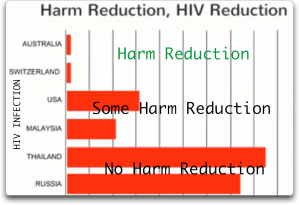 HIV infection in Injection Drug Users
Whilst Thailand and Russia have ignored Harm Reduction and Australia and Switzerland have embraced it the USA and Malaysia employed only some Harm Reduction techniques. Should Australia embrace USA tactics our prison population will explode, HIV infection in IV drug users will increase by about eight times the present rate and treatment – presently some of the best in the world with plunge to 11%. The cost to the public health purse would simply gut present programmes and destroy any hope of improvement for say, dental, mental health, public hospital care, nursing home care etc.
There is a 4 minute out-take from Sereen El-Feki’s TED talk in April this year below. Or download MP3 here.
The first case of AIDS was reported in Australia in 1983. At that time morbidity rates to rival World War II were expected. Following the innovative approach of HR, levels of infection in all demographics fell from 2,500 per year to 500 in the decade following inception of HR. This infection rate has remained stable.
At the time, initiation of clean needle supply contravened the states Drug Offensive which, already highly criticised, had regrettably escalated drug use and criminalisation via the failed “Just Say No” approach. The pilot programme ran from St. Vincents Drug and Alcohol Service on November 13 1986. It was run in the suburb of Darlinghurst. An evaluation recommended they should be adminstered by social workers, drug agencies, pharmacies, medical professionals and urged:
The urgent widespread introduction of needle exchange programmes in all states and territories
There needed to be an amendment to the Drug Misuse and Trafficking Act following which NSW pharmacies sold “anti-AIDS kits”. By mid 1989 there were 40 public outlets run across Sydney. By 1994 there were 250 outlets run by NGOs, government agencies and pharmacists distributing 3.5 million syringes annually. For the year 1993-1994 10.3 million syringes were distributed across Australia. The USA with 15 times the population of Australia distributed 8 million syringes in 1994-1995.
More comprehensive analyses refuted the concerns of increasing drug use. No increase in drug use was seen in any country that had instigated needle exchange and more so, attendance at rehabilitation and abstinence programmes had increased. Australia’s Commonwealth Department of Health (now Dept. of Health and Ageing) estimated that 25,000 cases of HIV were averted in the 12 years from 1988 – 2000 due to needle exchange alone (page 10 – 3.5.3).
The infection rate among Aussie IDU sat at around 3%. Users who were also MSM had an infection rate of 27%. In Russia where HR for drug users was denied, the figure for IDU was between 75 and 90%. One study in 1997 looked at 81 European cities with and without needle exchange programmes. Seroprevalence (measured from the presence of HIV within blood taken from used syringes) increased 5.9% annually in cities without clean needle distribution, and decreased 5.8% in cities with needle exchange.
In an astonishing comparison, Edinburgh with no NSP experienced a 65% HIV infection rate amongst IDU. Glasgow, less than an hours drive away and with NSP experienced a 4.5% increase in HIV infection amongst IDU. The one issue Australia faced was return of used syringes. Users were placing them in sharps bins. Yet to return any syringes to Exchanges meant risking being questioned by police. A used syringe is evidence of illicit drug use and this acted as a disincentive to return items for safe disposal.
Of note however is that fears and front page headlines of beach goers and joggers stepping on syringes and undergoing “agonising waits” for blood tests to be cleared of HIV infection are out of proportion. HIV dies very quickly once outside the body and syringes on beaches have been discarded into drains, washed out to sea and then beached. Nonetheless despite the absence of actual transmission it is an unpleasant experience which can be lessened by removing all offences for possession of a used syringe.
Clearly, Australia’s decision to take the necessary steps and bring together members of drug using demographics, gay rights advocates and prostitutes collectives and allow them to consult upon and shape this programme was one of it’s greatest public health initiatives ever.
Between 2000-2009 NSPs have averted 32,050 new cases of HIV and 96,666 Hepatitis C infections. Needles distributed increased from approximately 27 million to 31 million in that decade. For every one dollar invested, four dollars have been saved. 140,000 Disability Adjusted Life Years were gained over the same decade.
Still, conservative biblical fundamentalist group Drug Free Australia boldly inform us that Return On Investment is quite wrong and should show an expense. In earlier posts you can access from the tag on the right, I highlight how they cherry pick phrases and select data out of context. At other times they simply dismiss WHO findings based solely on the reviews of just one Swedish researcher, Dr Kerstin Käll.
So to be very clear, Dr Kerstin Käll, working for the Swedish government who are dodging UN demands to establish more Needle Exchanges and accelerate HR or remain in breach of the international right to health, conducted no research but criticised methodology that was favourable of NSP success. Her own research argues regular testing for HIV is more of a prevention – yes prevention – than clean needle supply.
It’s easy to get confused because whilst Käll supports NSP programmes as reducing hepatitis C in prisons DFA refute any change in HCV attributable to NSP programmes… anywhere. They also lobby stridently against the establishment of needle exchange in Australian prisons. Of course, despite the evidence above they insist the impact of NSP on HIV is “inconclusive”.
Ultimately it’s irrefutable how successful Harm Reduction has been in controlling the spread of blood borne viruses. Paramount amongst these is HIV, Hepatitis C and Hepatitis B. The most significant and visionary measure to now apply would include steps to decriminalisation and regulation.
Today however, this is where Australia is falling behind.


 Losing In The Lucky Country