As The Australian Vaccination-risks Network celebrate thirty years of spreading anti-vaccine and dangerous health advice to unsuspecting Australians, some satisfying memories of yesteryear have come to mind. Foremost is the delightful own goal scored by AVN founder Meryl Dorey, when promoting Black Salve as she bemoaned the Therapeutic Goods Administration (TGA) for taking action against the AVN for advertising a DVD, which itself promoted Black Salve. Let me explain.
It all began way back in 2012 with increasing interest in a fraudulently marketed so-called skin cancer “cure”. Namely, a corrosive salve known as an escharotic, being marketed as the near-miraculous Black Salve. A DVD sold by the (then) Australian Vaccination Network (AVN) titled One Answer to Cancer, was packed with anecdotal testimonies praising Black Salve and criticising Aldara, the medically approved treatment for keratoses and superficial basal cell carcinomas. I blogged about this at the time, and you can catch up here. It’s indicative of how quickly interest in Black Salve and the dubious DVD was spreading, to see that on 19 March 2012 the TGA published a warning about black and red salves in treating cancer. This included:
The recent use of products marketed as containing ‘Black salve’ in Australia has resulted in serious harm to the skin of three Australian consumers who used the black salves for various skin conditions including the treatment of a skin cancer.
The TGA is not aware of any credible, scientific evidence which shows that any black or red salve preparation is effective in treating cancer. These types of salves have not been formally assessed by the TGA and are not included in the Australian Register of Therapeutic Goods or exempted from inclusion.
All therapeutic goods, including those used for treating cancer, must be included in the Register unless exempted. Penalties of up to $5.5m apply to the illegal importation or supply of therapeutic goods.
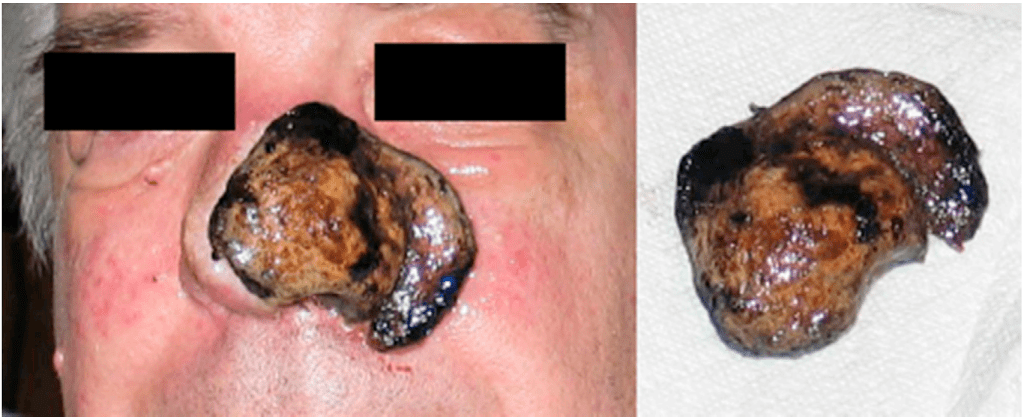
The TGA was investigating importation and a complaint made about supply via the internet. The Australian Pesticides and Veterinary Medicines Authority were also investigating sales purportedly proffered for pets. The TGA stressed that the problem with corrosive salves is that they “essentially burn off layers of the skin and surrounding normal tissue. They can destroy large parts of the skin and underlying tissue, and leave significant scarring.” The corrosive quality is unpredictable and almost impossible to control. Indeed Black Salve is also referred to as a pro-necrotic agent, which I blogged about in 2019. Once the process begins, widespread necrosis follows, leading to the release of enzymes which cause the breakdown of neighbouring cell membranes. A domino effect ensues causing widespread cell death. It brings to mind the “acid for blood” scene in the movie, Alien.
Necrosis of left nostril and surrounding tissue caused by Black Salve (Wikipedia)
Proponents misleadingly call it Nature’s Scalpel. The purpose of One Answer to Cancer was to promote Black Salve and offer instructions on how to prepare your own batch, using zinc chloride and sanguinaria canadensis, also known as bloodroot. This way the DVD producers could side step charges of selling the illegal corrosive. In December 2018, The Royal Australian College of General Practitioners published a comprehensive article on Black Salve, its history and use, noting that the main ingredient is the synthetic corrosive, zinc chloride. Thus claims of a “natural alternative” are inaccurate, and “catastrophic consequences can occur”. The dangers were well documented in 2012 and warnings were abundant. Nonetheless, in the AVN shop Meryl Dorey had included the following blurb with the DVD ad’.
50% of us will face cancer in our own lives at one time or another… we will have to face the choice of how to treat our illness – using toxic drugs or safe, effective, time-tested natural remedies… If you or someone you know is facing this issue or if you just want to be prepared for any future cancer diagnoses, this will be the best $25 you have ever spent!
The advertisement was in breach of the Therapeutic Goods Act 1989 (the Act) and numerous sections of the TGA Advertising Code (the Code). The Code is an effective legislative device for drawing up complaints against the peddling of quack remedies. Once content meets the definition of an advertisement, that content is subject to a number of principles outlined in the Code. More so, persons who publish what meets the definition of an advertisement may be guilty of an offence if other other medications are criticised or if a risk of harm applies. To read the advertisement and understand how the Code and the Act applied in 2012 you can check out the complaint I lodged on 19 April that year.
Prior to 1 July 2018, advertising complaints lodged with the TGA were handled by a Complaints Resolution Panel (CRP). A media release announcing that the TGA would take on the role of complaint management is available here. Way back in 2012 my complaint was handled by the CRP, and their findings from December 2012, can be accessed here. Fifteen sections of the Code and one section of the Act were found to have been breached. The AVN were told to remove the advertisement and publish the notice below.
However long before this, the TGA informed Meryl Dorey that a complaint had been lodged, as is her right. Unsurprisingly, Meryl felt both the complaint and the request of the TGA to remove the offending advertisement was an abuse of her network’s rights. On 5 May 2012, which was about two weeks after being notified, Meryl gave an interview on Fairdinkum Radio, a production of Resistance Media. This was an early freedom fighter production, and host Leon Pittard opened the show announcing the title as, The Australian Government’s Assault on Health Freedom. For me, the highlight of the show was Meryl’s interview which you can access below, or download here.
Meryl waxed lyrical about the benefits of Black Salve and the horror of Aldara, which she falsely claimed was “banned in many parts of the world”. Meryl also managed to call the TGA Cost Recovery model, “a fairly evil policy”. She provided a dubious anecdote of her own apparent use of Black Salve and wrongly claimed it has a “two thousand year history”. She mentioned the DVD and wrongly claimed Black Salve was a combination of herbs and minerals. The interview went on for over five minutes and easily met the definition of an advertisement. An advertisement for Black Salve published in broadcast media, no less. I lodged a second complaint.
The complaint makes clear how both Meryl and host Leon Pittard were liable as advertisers. It also contains a transcript of the interview. Application of appropriate sections of the Code, the Act and the Therapeutic Goods Regulations 1990, justified removal of the interview/advertisement and publication of a retraction (below). By the end of January 2013 the CRP had published their findings which can be accessed here. Thirteen sections of the Code were breached along with two sections of the Act. No sections of the Code raised in the complaint were found not to be breached. More so, over five paragraphs the panel raised additional matters not in the complaint. These included a possible breach of the Act relating to the Register of Therapeutic Goods, and nine possible breaches of the Code relating to criticism of Aldara, promoting a dangerous compound for serious disease, comments about the TGA and more (see pp. 2-3).
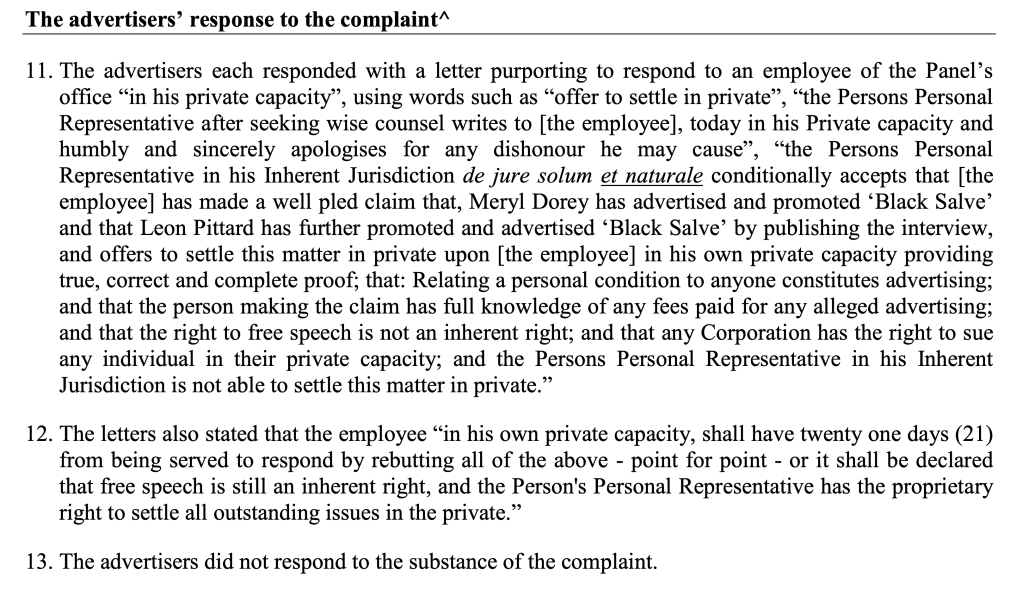
Page 3 of the CRP report includes reference to a somewhat bizarre response to a member of the panel from both Dorey and Pittard. In essence they would cop to the findings of the panel if the member would, in his private capacity, present “true, complete and correct proof” that relating a personal condition to anyone constitutes advertising, that the person making the claim is aware of fees paid for advertising, that free speech is not an inherent right, that any corporation has the right to sue an individual and that the matter couldn’t be settled in private. Leon Pittard had long boasted of monitoring the New World Order, employed a watered-down sovereign citizen logic to his world view and, like Dorey, was a fan of conspiracy theorist, Senator Malcolm Roberts. Pittard no doubt penned the response attributed to both he and Dorey (summarised below).
To my surprise, a short time after lodging the complaint I stumbled across this ridiculous video from the USA which was defending the position of Leon Pittard and Meryl Dorey. I wonder if in the rush to defend free speech the producers did any serious research on Black Salve, or understood the danger their support posed to an unsuspecting public.
Ultimately it was rewarding to have these particular complaints upheld. The second complaint – a veritable own goal – was particularly satisfying. However as is often the case with groups beholden to anti-science ideologies and belief in a fight for “health freedom”, such advertisements aren’t always removed when requested. Non-compliance is met with further warning notices, whilst more serious penalties reflect the nature of the breach and risk to the public. There’s little doubt that Black Salve caused serious injuries at the time and a quick search reveals that it continues to cause harm and generate health authority warnings in developed nations. The TGA seized Black Salve capsules on the Gold Coast in May 2019 and again in Brisbane, in December 2023.
The TGA publish regulatory decisions and announcements and the outcomes of advertising compliance investigations. As members of the public it’s up to us to report harmful products and dodgy advertisements to the TGA. It may involve a bit of reading but not every complaint needs to begin with every potential breach.
You can report perceived breaches or questionable practices here. There’s more information on reporting, what you need to provide and accessing support to complete forms here.
An inquest into a Kambo related fatality in Northern NSW has been suspended by NSW State Coroner Teresa O’Sullivan, who referred the matter to the Director of Public Prosecutions (DPP). This is the second inquest into a death linked to the frog poison touted as an alternative medicine, to be heard at Lismore Court House since May 2023.
Jarrad Antonovich
Evidence in this case described how Jarrad Antonovich attended the Dreaming Arts Festival in Arcoora Northern NSW, on 16 October 2021. He died of a perforated oesophagus that night. His day included a Kambo ritual at around 10am. Kambo ceremonies at the festival were being run by Cameron Kite. After the Kambo, Antonovich displayed symptoms of being very unwell, including a markedly swollen neck – an adverse reaction known to be caused by Kambo. Despite being unable to stand without support by 5pm, Mr. Antonovich was later given the psychoactive brew, ayahuasca. He died during the ayahuasca ceremony after being helped into a hall where it was to take place. Both Kambo and ayahuasca are illegal in Australia. The inquest heard from different witnesses that they believed Mr. Antonovich was in need of professional help, but they had been instructed not to interfere with anyone’s “journey”, and to trust the medicine, the shamans and the organisers. The offer to call an ambulance was made by other festival attendees, but Antonovich refused and elders “reassured” concerned onlookers.
An ambulance was not called until 11:30pm and took an hour to reach the remote location. As Jarrad Antonovich’s life ended, organiser Soulore (“Lore”) Solaris was strumming his guitar at the front of the gathering, as others in another location were being guided in CPR over radio, as they attempted to save Mr. Antonovich. When paramedics arrived Mr. Antonovich was blue in the face and dead. Ten or twenty people in the immediate area were engrossed in the ceremony and one asked paramedics to “move away from Jarred because they were interfering with his aura”. Both Kambo and ayahuasca are associated with vomiting or “purging”, as adherents refer to it. Ayahuasca induces violent and sometimes prolonged vomiting. The coroner was investigating the likelihood that vomiting caused Mr. Antonovich’s perforated oesophagus. The exact reasons behind the coroner’s decision to refer the case to the DPP cannot currently be revealed.
Lore Solaris and Cameron Kite
Dreaming Arts Festival organiser Lore Solaris, a counsellor who facilitates ayahuasca ceremonies, is presently subject to a NSW Health Care Complaints Commission interim prohibition order under the Health Care Complaints Act 1993, Section 41AA. The order reads in part:
Mr Soulore Solaris must not under any circumstances provide, or cause to be provided, any health services, either in paid employment or voluntary, to any member of the public.
Interim orders may apply “during any investigation of a complaint against a non-registered health practitioner”. The HCCC may make an interim order if:
a) it has a reasonable belief that the health practitioner has breached a code of conduct for non-registered health practitioners, and
(b) it is of the opinion that–
(i) the health practitioner poses a serious risk to the health or safety of members of the public, and
(ii) the making of an interim prohibition order is necessary to protect the health or safety of members of the public.
Jarrad Antonovich’s former partner, Patrick Santucci, gave evidence in May 2023 that Lore Solaris had called to reassure him Jarrad’s death was a “beautiful occasion”. Solaris told him that kinesiologists couldn’t find anything wrong with him. Kinesiologists utilise acupressure on points of the imaginary “meridian system” and wrongly believe the body can heal itself. They focus on “imbalances” which may be caused by a forgotten memory or even an attitude. They may use flower essence or homeopathy. There is no evidence kinesiology works. Mr. Santucci testified that Solaris told him an Aboriginal elder chanted sacred songs, “calling the spirit out of his body” and that:
[T]he koalas were making a special sound that is known to the elders when the land accepts a spirit.
Protecting Ayahuasca
Both Kite and Solaris were due to give evidence on 24 May; the day the inquest was suspended. Had they given evidence, it was expected the men would have responded to alarming statements given by other witnesses, describing attempts to cover up events and mislead police. For example Mr. Antonovich had difficulty breathing, was moaning in pain and his neck was swollen to the jaw line. Kambo practitioner Laara Cooper suggested giving him ayahuasca as this could “help shift” the Kambo induced discomfort. Consequently Antonovich was given what was described as a “not small” cup of the brew by Cameron Kite at the instruction of Solaris.
Cooper and Solaris had told ceremonial “guardians” to drive to Antonovich’s home and tell his flatmate not to mention to police the use of ayahuasca, in an attempt to “protect the medicines”. The inquest heard Cameron Kite was deeply distressed by events at the festival and told his partner at the time that Solaris and Cooper “just took over” the account given to police. Festival attendees were also told not to speak to police or paramedics about what actually happened as it may “damage the good work” being done with Kambo and ayahuasca. Antonovich was found to have ingested toxic levels of N,N-Dimethyltryptamine (DMT); ayahuasca’s most powerful psychedelic.
Both ayahuasca and Kambo are favoured as alternative medicines by neo-shamanic devotees, convinced purging “detox” experiences lead to personal growth and discovery. Logical fallacies such as appeal to antiquity, appeal to nature and an unguarded tendency toward xenocentrism, leave them vulnerable to experimentation and/or regular use of both substances. Traditional use of both can be traced back to indigenous tribes of the Amazon. Ayahuasca has a well established profile of around 70 years, as a promised cure for Western ailments, particularly those with a psychological component. It has also attracted research attention in offering an overhyped role in opiate addiction recovery. Despite some evidence suggesting it may have been used as early as 2000BC, widespread use across the Amazon was reliably established in the mid-19th century. Ayahuasca religions emerged very late in the 19th century. The Antonovich inquest heard that a Brazilian blend of Christianity and Amazonian shamanism (including drinking ayahuasca) had gained influence over The Australian Church of Ayahuasca, which had been active in the Northern Rivers region.
Kambo
Kambo has a much shorter history as a choice of alternative therapy in Western society. It gradually attracted interest after the International Association of Kambo Practitioners (IAKP) was established in 2014. Despite the flowery, earthy tones on their site, Kambo is emerging as a substance with a much higher risk profile than ayahuasca. IAKP claim:
IAKP teachers guide students to cultivate a profound comprehension and reverence for this potent natural modality. By enriching and forging connections with the intelligence and spirit of Kambo, our training courses enable practitioners to embrace personal growth, embark on a voyage of self-discovery, and engage in selfless service to others through the safe application of Kambo.
Kambo is collected from secretions of the Amazonian giant leaf frog, after “agitating” the innocent amphibian. Images suggest more than a little agitation is needed as they depict a frog tied by each leg and stretched asunder. The secretions are dried and packaged. Kambo is illegal in certain South American countries unless used in traditional indigenous practice, including Brazil. For Western ceremonies, the poison is reconstituted with water or saliva and applied to burn sites made with a smouldering stick on the arms, legs, chest or shoulder. Lucky recipients may get a dash of “dragons blood” tree sap as an antiseptic. The poison quickly makes its way into the lymphatic system then the bloodstream, and the effects begin.
Kambo lacks the psychedelic and hallucinogenic experience that ayahuasca brings. Writing for The ConversationMartin Williams notes:
Typically, the first symptoms reported are an initial rush of heat and redness of the face. Nausea and vomiting are often experienced within several minutes, accompanied by general malaise, racing heart, dizziness and swelling of the face, and sometimes an urge to defecate. Further effects include the feeling of a lump in the throat or difficulty swallowing, abdominal pain, nausea, vomiting, diarrhoea, runny nose and tears, swollen lips, eyelids or face, and occasionally a swollen tongue or throat.
Adherents claim this process rids the body of toxins, although there is no evidence supporting the claim. In 2021 the Therapeutic Goods Administration (TGA) classified Kambo as a Schedule 10 poison (page 9). They are defined as, “substances of such danger to health as to warrant prohibition of sale, supply and use”. Kambo does not have any medicinal benefit and can damage the liver, stomach and cause cardiac arrest. Visiting the IAKP website page on contraindications yields nothing but arguably useless advice; “For the latest updates and safety information relating to contraindications and cautions, please seek guidance from an IAKP trained Kambo practitioner.”
In the Natasha Lechner inquest findings, Coroner Teresa O’Sullivan referenced medical contraindications “according to the IAKP” (page 9) and observed it was unclear if these are supported by peer reviewed research. She also criticised the paucity of the IAKP information relating to “risks” and particularly IAKP training material on the risk of death. One thus wonders if the present absence of contraindications is a policy recently adopted by the IAKP. More so the IAKP Code of Ethics and Professional Practice omits any reference to the dangers of Kambo itself.
Natasha Lechner
Natasha Lechner died on 8th March 2019, following a Kambo ceremony at her home in Mullumbimby. The inquest into her death was held at Lismore in May 2023. NSW State Coroner Teresa O’Sullivan handed down her findings in February 2024. The coronial findings (PDF) provide valuable insight into the insouciance with which self proclaimed shamanic healers prepare for what is known to be a high risk “ceremony”, and the potential for tragedy that awaits vulnerable individuals drawn into this culture. This was an unnecessary death stemming from a failure to call for help.
Natasha lived with a number of chronic health issues and was unable to work. Two months before her death she had undergone a two week basic Kambo course run by the IAKP. The coroner found that the IAKP was founded by Karen Darke who has no medical qualifications. IAKP has no input from toxicologists or medical practitioners in development of their training materials. Natasha took her role as a Kambo practitioner seriously.
In 2014 Natasha met Victoria Sinclair who, as a senior Kambo practitioner used the name Maestra Victoria. Her website mentioned in the coronial finding is still available. She advertises herself extensively, including:
Victoria is a transpersonal (eco)psychologist, trauma and postcolonial theorist and plant medicine practitioner, working on a High Priestess Level of initiation, ordained through several lineages and acknowledgments and in terms of shamanic initiation and training she worked prolifically in the Free Party Scene in Europe since 1990s and has been journeying and working extensively in Central and South America and Australia since 2006.
Indeed. Ranging a little further than the inquest findings, one discovers this woman has more qualifications I’m not familiar with. Such as these “therapeutic qualifications”:
Victoria has been a Reiki practitioner since 1999 and is a Master of both Tibetan Usui Reiki and Sekhem – Seichim – Reiki. She has been teaching people globally since 2012 and has dedicated herself deeply to upgrading Sekhem teachings to help to create a Higher Pathway to Metaphysical Ethical Practitionership as part of her Dharma.
Her training background includes; Transpersonal Psychology, Non-Dual Astrology, Epigenetics, Trauma work, Pranayama, Kundalini Yoga, Plant medicines, De-colonisation and Quantum, sound and ancestral practices… She is also a plant communicator.
If you’re not convinced you’d want to be alone with Victoria when you take a frog’s defensive secretion that the TGA later classified as a schedule 10 poison, be aware that Victoria also works with indigenous groups, “around spiritual sovereignty and healing of self and eliminating planetary dis-ease to nurture higher vibrational being for the new age and evolution of homo luminus.”
Victoria Sinclair as Maestra VictoriaVictoria Sinclair as Padma Khandro
Ranging a little further allows us to meet her latest incarnation, Victoria Padma Khandro, who is offering over this year and next:
High Level Multidimensional Mentoring
Non-Dual Astrology readings and Time-line work
Soul-plan work involving fusion clearing, psychotherapy, Quantum Transfiguration, Ancestral Work, Gene Keys and Astrology zero-pointing
Therapeutic packages including ancestral work, IFS, Quantum Transfiguration, Quantum Art Therapy and sometimes in-house referrals to deepen the scope of the work.
Returning to the inquest findings, we find that before 2019 Victoria had performed Kambo ceremonies on Natasha who either paid her or provided accomodation. In March 2019 Victoria Sinclair was visiting from Ireland and was staying with Natasha at Mullumbimby. Before Sinclair arrived Natasha had reported feeling “really off”. It should be stressed that the “ceremony” was Natasha’s idea. They began the ritual by using Sananga eye drops. Sananga is another psychoactive plant extract associated with a host of unproven health benefits. Natasha administered Kambo to Sinclair who vomited, as expected, without incident.
Sinclair administered the burn wounds onto Natasha with an incense stick, then applied the Kambo. Immediately Natasha became faint and lay down. Two minutes later she sat up, grabbed Sinclair’s hand and said “this isn’t good” or “something’s not right” before passing out. Sinclair thought she might be “processing something” and held her upright for about 10 minutes as Natasha made moaning noises. Only then did she lay Natasha down in the recovery position and remove the poison from the wounds. She attempted to revive her by pouring water over her head. Then noticing goose bumps, assumed she was cold and began to massage her limbs.
Sinclair began CPR after noticing Natasha’s lips were blue. She attempted to use a mobile phone to call an ambulance. This failed as “she did not normally use mobile phones” and didn’t know the Australian emergency number. I find this deeply troubling as mobile phones allow access to dial emergency services without needing to be unlocked, or input of the specific number. As the more experienced Kambo practitioner, with a promoted reputation of travelling the global party scene, Sinclair should have known this. Natasha’s house-mate arrived home around 90 minutes after the ceremony had begun. She immediately began CPR and called an ambulance which arrived within 5 minutes. Natasha was already dead. Despite testifying she had ceased Kambo administration after Natasha’s death, Victoria Sinclair still advertises the service. The coroner specifically addressed the legalities of Sinclair’s involvement on pp. 12, 13 & 15.
As I touched on above, the coroner was critical of the IAKP training material on the risk of death. Evidence given by Sarah Morrison (aka Aisha Priya) cited the various risks discussed (page 10). On death, information for Kambo practitioners was:
Death is discussed as a risk if the water guidelines or first aid are not adhered to or if a client is contraindicated and does not disclose this or does not know they have a medical condition.
The coroner observed the incompleteness of this information and noted it does not advise even healthy people of the true risk of Kambo. Available literature and the two cases brought to the coroner’s attention led her to observe “that death can occur even where there is no pre-existing condition, or at least not one that could be possibly identified beforehand.” It is likely Natasha experienced an acute cardiac event caused by Kambo, such as cardiac arrhythmia leading to cardiac arrest or hypotension leading to cerebral hypoxia followed by respiratory arrest, as causes of her death.
Conclusion
Kambo is emerging as a significantly dangerous substance favoured by individuals interested in extreme so-called alternative medicines. It has been rapidly adopted by communities already familiar with ayahuasca, yet has a demonstrably higher risk profile. There is no scientific evidence to support the efficacy of Kambo in alleviating health problems as claimed by proponents. Nonetheless, the presence in Kambo of peptides and polypeptides with analgesic properties and affinity for opiate receptors may explain “feelings of well being and improvement of motor skills”, that users describe, and offer insight into repeated use.
Still, it is the very complex nature of active substances in the secretion that cause arterial hypotension, palpitations, cardiac arrhythmia, facial swelling (see Maestra Victoria above) and uncontrolled smooth muscle changes in the gut. To hope that shamans and self-styled practitioners of Kambo, who offer it as a means to spiritual awakening, are all capable of managing a genuine adverse reaction to the poison is futile. Use of Kambo in Western rituals is entwined with new age scam “therapies” so clearly divorced from reality as to almost beggar belief. This is not the case in the indigenous Amazon populations using Kambo.
Vulnerable individuals interested in exploring non evidence-based treatments for chronic health problems are at high risk of harm if not death from Kambo and its eager promotion. Use is likely to further increase and the self-appointed arbiters of Kambo sourcing and education, the IAKP, are manifestly ill prepared to manage present risks or to protect users.
Community education and adaptation of Harm Reduction strategies may likely prove beneficial in negating risk.
Recently there has been some press coverage that potential running mates for Robert F. Kennedy Jr., are themselves well versed in conspiracy theories.
Kennedy, the driving force behind anti-vaccine pressure group Children’s Health Defense, which includes Children’s Health Defense Australia (recently abandoned website), is running as an independent for President of the USA. One possible running mate is Jesse Ventura who was mentioned here when the antics of Rima Laibow were reviewed. The other is Aaron Rodgers who has entertained a number of conspiracy theories including denial of the Sandy Hook shootings. Both are anti-vaxxers.
Kennedy has lobbied for years promoting the debunked link between MMR vaccines and autism. In the early days of the COVID pandemic he emerged as a vocal critic of COVID-19 vaccines. Which for a presidential contender, is understandably proving to be a problem. As measles cases rise across the US it isn’t surprising that Kennedy is not attacking vaccines on the campaign trail. In April last year Kennedy announced he would take leave of his roles as Chairman and Chief Legal Counsel of CHD, although the US site still lists him as both.
Exactly why the CHD Australian chapter URL is parked, just seven months after launching is unclear, although the Instagram page remains. What can’t be denied is Kennedy’s long history of spreading vaccine disinformation. In the early days of his campaign Kennedy talked about plans to tell NIH scientists it is time “to give infectious disease a break for about eight years”. However as his presidential campaign continues he is, according to NBC in the below clip, keeping his usual anti-vaccine message “relatively quiet”.
RFK Jr. relatively quiet on antivax message despite past ties
Critical overdose events at three Australian dance parties in January this year, have led to more calls for Pill Testing (PT) to be introduced as part of our nation’s effective Harm Minimisation drug policy. Harm Minimisation consists of three prongs: Demand Reduction, Supply Reduction and Harm Reduction.
Strong evidence
Pill testing is an evidence-based, harm reduction initiative backed in peer reviewed literature. It reduces drug harms and protects the health of those who access the service. Whilst Australian drug markets are uniquely sourced and specifically affect Australians, Harm Reduction Australia cites Harm Reduction International, in answering the question, What is harm reduction?
Harm reduction refers to policies, programmes and practices that aim to minimise negative health, social and legal impacts associated with drug use, drug policies and drug laws. Harm reduction is grounded in justice and human rights. It focuses on positive change and on working with people without judgement, coercion, discrimination, or requiring that they stop using drugs as a precondition of support.
PT has been demonstrated via live trials at Canberra’s Groovin The Moo festival in 2018 and 2019, to be effective in positively changing behaviour related to drug use. The trials were conducted by Pill Testing Australia, and resulting evidence greatly contributed to the fixed-site testing facility CanTEST, an ongoing trial in Canberra, introduced in July 2022. Indicating the controversy of PT, days before a third dance festival trial was scheduled to begin in 2022, Pill Testing Australia had public liability insurance withdrawn, without explanation.
A 2019 election study found two thirds of Australians support PT at music festivals. Examining deaths, PT initiatives, the success of harm reduction and drug user responses, Andrew Groves wrote in The Harm Reduction Journal in 2018:
Using a theoretical frame of pragmatism and drawing from national and international research evidence, this paper recommends the integration of pill testing into Australia’s harm minimisation strategy.
Australia’s Alcohol and Drug Foundation have published an excellent summary of the evidence supporting PT, and provide data on its successful international uptake. They also point out that public health experts have demonstrated support for PT. These include:
In February 2023, directly citing the success in Canberra, the QLD Palaszczuk government announced plans to develop Drug Checking at fixed and mobile sites. This very shortly followed the state’s plans to reduce penalties for illicit drug possession, including heroin, ice and cocaine. More so, use of the term “drug-checking” is more realistic, inclusive and in line with international practice, as summed up in this opening paragraph from the QLD Network of Alcohol and other Drug Agencies (QNADA):
Drug checking – also sometimes referred to as ‘pill testing’ – involves members of the public voluntarily providing samples of suspected illicit substances they are intending to consume (e.g. tablets, capsules, powders, tabs/blotter paper etc) for chemical analysis.
Test results are provided back to the individual by health professionals as part of a personalised health and harm reduction intervention. The purpose of the intervention is to increase the person’s awareness of the risks associated with the substance with the aim of effecting behaviour changes that result in fewer harms or incidences of drug-related death.
In September last year the QLD government sought private providers to offer plans for two fixed drug-checking sites and mobile services. Of course, great strides like this rarely escape unhelpful politicisation. It was impossible to miss that when announced, the decision was called “soft on drugs” by QLD opposition health spokeswoman, and registered nurse, Ros Bates. It’s been a long time since I’ve heard that phrase used seriously.
Victoria
It is Victoria, to where we must turn our attention to partly examine the recent overdose events. RACGP reported eight people, most in their 20s were intubated and placed in induced comas after MDMA overdose at the Hardmission dance party in early January. Jollyon Attwooll reported:
Chair of RACGP Specific Interests Addiction Medicine Dr Hester Wilson described the introduction of festival pill testing as ‘a no-brainer’. ‘[Pill testing] actually does change people’s behaviour, and therefore it makes it safer,’ she told newsGP. Dr Wilson said that pill testing is ‘not a silver bullet’ but should be used as part of a range of measures to address drug use.
Following the Hardmission OD events, two women were taken to hospital on January 12 after suspected drug use at Juicy Fest. Current Victorian Premier Jacinta Allan initially stated she had no plans to introduce PT. Not long after, Allan advised that she would seek more information from the health department. The Premier sensibly observed:
I think it’s important to examine the evidence and advice and consider that in the policy setting that we have across all of our alcohol and drug policy measures, which is taking a harm minimisation approach, looking at the safety of people going to events.
The ACT
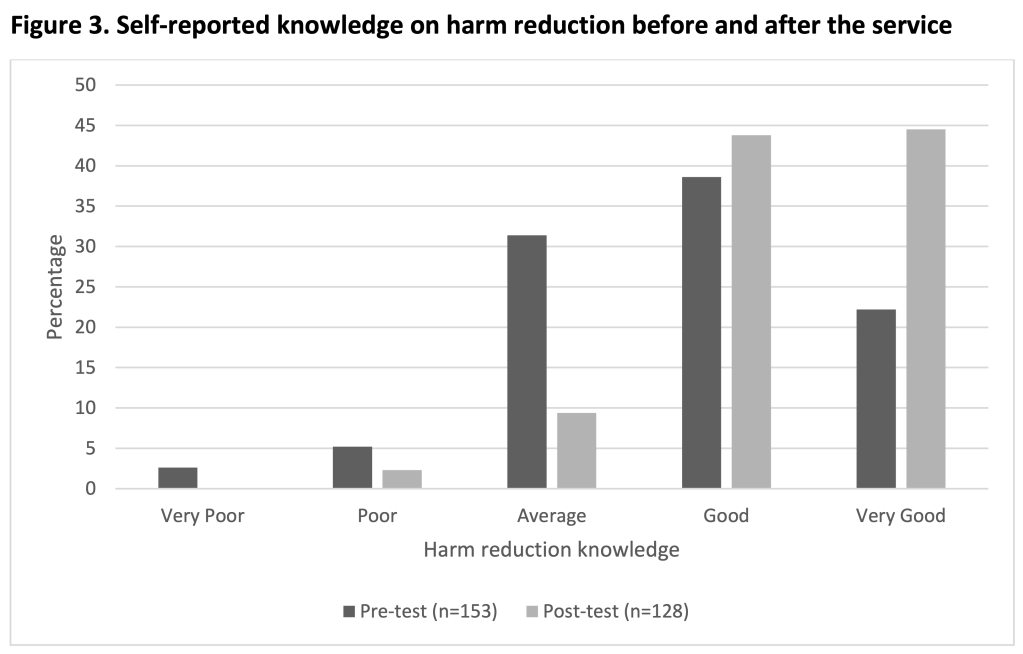
The evaluation document of the 2019 ACT Pill Testing trial is a lengthy read, with confirmation of Dr. Hester Wilson’s words coming through in data and discussion. I won’t copy/paste quotes from patrons who attended the PT facility, but I do recommend skimming through to appreciate that PT, like other harm reduction initiatives, changes drug users behaviour for the better. I did appreciate the graphs on self-reported knowledge of harm reduction before and after having a drug tested. Likewise, when it came to choice of information source, positive changes are evident.
Detailed explanation of the slides below can be found at section/s 6.1 (fig. 1), 6.4.1. (fig. 3) and 6.4.5. (fig.4).
Sydney
At the end of January a challenging scenario unfolded at Sydney’s HTID festival. Having taken what he thought was MDMA, an attendee fell unwell. Ultimately he responded to naloxone, a drug that reverses the effect of opioids. He had taken a tablet cut with nitazene, which is a synthetic opioid reported as “stronger than” fentanyl or heroin. Health workers and members of drug safety volunteers DanceWize, worked to advise the crowd. No doubt they saved lives. It turned out others from around Sydney had been hospitalised that weekend. One pill analysed, contained nitazene and no MDMA. Guardian reported:
Chris Gough, chief executive of the nation’s only pill testing venue in Canberra, said the detection of nitazenes in pills sold as MDMA showed the need for similar services in other states.
“In this case, where a nitazene has been sold as MDMA and therefore people are completely unprepared and potentially opioid naive, the risk of overdose is extreme,” said Gough, who is the executive director of the Canberra Alliance for Harm Minimisation and Advocacy.
“As we have now seen nitazenes in several jurisdictions in Australia it is time to act swiftly to provide drug-checking services throughout Australia so that we can respond to these drug trends as they emerge and thereby save lives and inform the community.”
Canberra
Saving lives is far more about probability than possibility. Indeed that’s been the case with MDMA overdose, MDMA pills cut with N-ethylpentalone or other adulterants. Early last year the Canberra walk-in site CanTEST discovered a pill cut with metonitazene; a synthetic opioid with a potency up to 200 times that of morphine. The owner chose to dispose of the drug on site. In January this year, ANU chemists made an Australia-first discovery of three new recreational drugs. All came from preparations sold as something else. CanTEST staff were able to discern the drugs were not what they were supposed to be, but tests were inconclusive. They were however, able to warn the community. One substance thought to be a derivative of Ritalin was in fact a new variant of cathinone, commonly known as “bath-salts”.
ACT Health have also developed a comprehensive document for festival planners. The Festivals Pill Testing Policy, examines PT options as a service available for festival attendees and how it relates to harm minimisation. Advice on general and specific health and safety measures, the importance of peer support, relaxation areas, emergency services and how PT works with providers and the event itself, is only part of the clear information presented.
Coronial support
A number of fatalities, and the fact that PT promotes positive decision making led to multiple calls to introduce the practice as a policy initiative. Over the last six years, four state coroners have spoken out. A 2020 inquest into five deaths from July 2016 to January 2017, led Victorian coroner Pares Spanos to urge the Victorian government to “urgently” introduce drug checking and a system to warn the community about dangerous substances sold as MDMA. The males aged from 17 to 32 died in a variety of tragic ways after taking what they believed was a modest dose of MDMA. Autopsy revealed the substances 25C-NBOMe and 4-Fluoroamphetamine in their systems. The cluster was discovered after 20 hospitalisations stemming from the Chapel Street nightclub district in January 2017. Victoria Police knew of the dangerous drug’s presence and later defended their decision to not warn the community.
In September last year, Victorian coroner John Cain also called on the government to introduce PT after the death of a man from an MDMA overdose in March 2022. The man had been observed taking a Blue Punisher, a pill with dangerously high levels of MDMA. He was admitted to the Royal Melbourne with brain swelling and multi-organ failure and died four days later. In his findings Cain wrote:
It is impossible to know whether, had a drug checking service existed, [the man] would have submitted a sample of an MDMA pill for testing before taking it at Karnival […] Notwithstanding this, a drug-checking service would have at least created the opportunity for him to do so, and for him to receive tailored harm reduction information from the drug-checking facility.
It is likewise impossible to know whether, had [the man] been provided information of this type, he would have changed his drug consumption behaviour; but likewise, in the absence of a drug checking service, this was not a possible outcome.
Politics
NSW and Victoria have established histories of resisting PT. After the death of a 26 year old at a Sydney music festival in February 2023, Dominic Perrottet mused about his government’s inquiry into methamphetamine and, rejecting any notion of PT offered a most unhelpful contribution:
But my clear message to people right across NSW [is] stay safe, and don’t take drugs and you will be safe.
Associate Professor David Caldicott, one of the driving minds behind CanTEST, suggested Perrottet had engaged in “magical thinking”. In Victoria we have the legacy of Dan Andrews who, citing the demonstrably false [HRJ] claim that PT encouraged pill taking (a belief favoured by Craig Kelly), insisted that under his leadership PT would never be introduced. The state opposition has been steadily opposed to harm reduction measures for conservative political reasons. Ignoring evidence, consecutive opposition leaders have opposed Safe Injecting Facilities and PT alike. I do acknowledge however, that the Victorian opposition has lobbied the state government for more effective emergency drug alert systems.
Recent research
A recent paper Drug-related deaths at Australian music festivals, was published last month in the International Journal of Drug Policy. Examination of the National Coronial Information System (NCIS) yielded the following results about fatalities at music festivals between 2000 and 2019:
There were 64 deaths, of which most involved males (73.4%) aged in their mid-20s (range 15-50 years). Drug toxicity was the most common primary cause of death (46.9%) followed by external injuries (37.5%). The drug most commonly detected or reported as being used was MDMA (65.6%), followed by alcohol (46.9%) and cannabis (17.2%), with most cases reporting the use of two or more drugs (including alcohol) and 36% reporting a history of drug misuse in the coroner’s findings. Most deaths were unintentional, with less than a fifth of cases (17.2%) involving intentional self-harm. Clinical intervention was involved in 64.1% of cases and most festivals occurred in inner city locations (59.4%).
There are complex factors identified in the paper, such as inner city events and multi-day events being more likely to be the site of a fatality. This may reflect policing strategies and the need for harm reduction strategies, respectively. Alcohol is known to be a compounding factor and its use is clearly identified as the second most prevalent substance (see bar graph below). Males are more likely to drink and use MDMA and this is reflected in them making up just under three quarters of deaths. Of 2000 festival goers surveyed, 52% were male. Poor decision making associated with alcohol intake is always a potential factor with illicit drug use.
Total number of drug-related deaths, deaths primarily attributed to MDMA, and deaths primarily attributed to alcohol, at music festivals in Australia by year ranges (n=64)
Harm reduction flexibility
What I took away from this paper was the recommendation that a range of harm reduction measures would each have something to offer in solving this persistent, multifactorial problem. More so, understanding data yielded by such research is vital to establishing the correct harm reduction approach for the Australian population in these instances. In conclusion, the authors write:
Harm reduction strategies such as roving first aid volunteers, mobile medical care, spaces to rest, hydration stations, and drug checking services, may best address some of the risks associated with illicit drug use at festivals, in addition to increased consumer education and awareness. It is important to understand the factors involved in these incidents in order to inform policies around harm reduction and law enforcement at music festivals in future to prevent further deaths.
Just as is the case with injecting facilities, substance checking is a successful, global health policy dynamic. Like all aspects of harm reduction the evidence supporting it is strong, persisting through variations specific to where it is a reality. In Canada, Toronto ran a comprehensive trial from 2019 to 2023. Switzerland has had drug checking available since the 1990’s. Now in a number of cities, the past decade saw a 250% increase in samples tested there. The UK has drug checking services, as does New Zealand.
Despite certain dynamics in NSW and Victoria leaving state governments out of touch with most Australians, there are cabinet ministers and cross-bench teams respectively, raising awareness and pushing for change in each state. When we look at arguments for and against PT, it appears arguments against, lack realistic substance. Indeed these documents recognise the importance of harm minimisation and its place in the National Drug Strategy. The most comprehensive argument “against” is criticism of the limitations of on-site drug checking, compared to laboratory testing. This is well understood and has been directly addressed by Dr. Monica Barratt. Of course the inevitable case that flexible harm reduction measures encourage or create the illusion of safety around illicit drugs is always mentioned. The evidence simply does not support this.
Drug Free Australia
This brings us to the anti-drug lobby. Certain groups contend that law enforcement and zero tolerance are superior in managing drug related harms. Stridently anti Harm Minimisation, they promote the ideology of a drug free world, consistently undermining evidence. In fact my own interest in the anti-vaccination lobby, began in 2009 and I was struck by similarities between their tactics, and those of the more lethal anti-drug lobby, I was long familiar with.
One group, Drug Free Australia (DFA), operate similarly to The Australian Vaccination-risks Network (AVN). DFA aggressively lobby government and an unsuspecting public, frequently using alarming irrelevant information. They attack the media, use meaningless or decontextualised data to dispute published evidence or argue that acknowledging a need for more research, reveals lack of any research. DFA dismiss harm reduction techniques by highlighting the ongoing presence of harm (eg; MDMA has caused deaths, thus no rationale for PT exists) or blame harm reduction for drug user risk-taking, and the familiar contention that PT “green lights” the taking of MDMA.
Such contentions stem from ignoring that high risk behaviour via illicit drug use continues all day, every day in Australia. Harm reduction aims to reduce the harms associated with this behaviour. It provides education, promotes safe choices, saves our health-system money, and yes, saves lives. One way DFA contend PT actually kills, is by misrepresenting the PT card system. A drug found to contain what the owner expected is “white-carded”; as is say, an MDMA pill free of any pollutant. Yet, MDMA causes most overdoses say DFA, so a white-card result must be potentially lethal. Well, no. The drug is what the person expected. Not double or five times the amount. So the patron may take the drug they bought and, remembering the slide show above, will henceforth access reputable information on harm reduction.
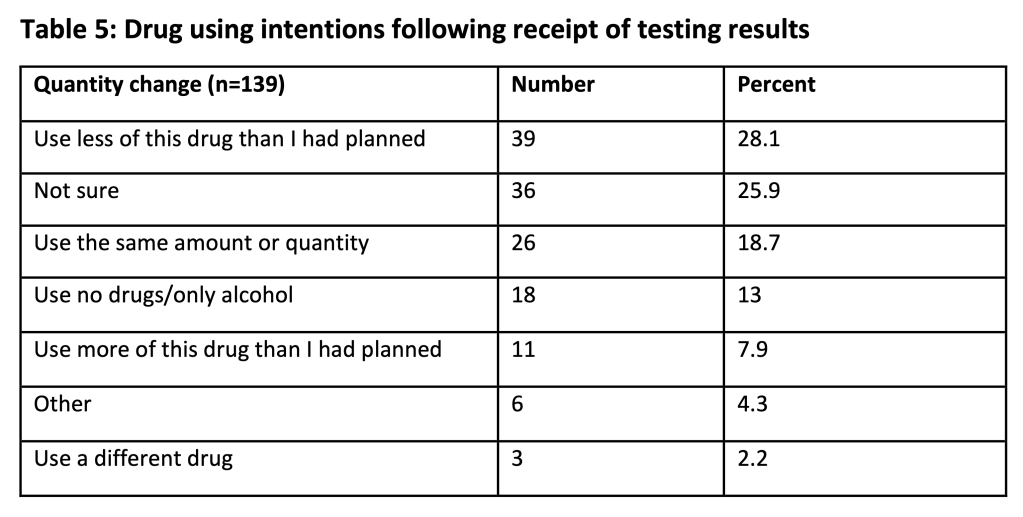
Those slides are from the ACT Pill Testing Trial 2019. DFA attack those findings in a deceptive piece, arguing the opposite to accepted findings. On page 7, they selectively quote from evaluators who discuss that someone who discovers that the drug is what they thought, “…are likely to take as much or more” (p.33). And that “…concordance between expectation and identification is associated with stable or increased intention to take a substance” (p.34). DFA use this to extrapolate to the conclusion that PT will lead to more use and thus, more death. This requires logical fallacies: Decontextualisation and cherry picking of data. Reading the full sentences and paragraphs in which those terms appear leaves the reader with a positive, not negative view of the evaluation. See pp. 33-34, and consider Table 5 from p. 32, below:
When read in context we see that patrons intent to use drugs did not dramatically change, but their intent to engage in harm reduction behaviour notably increased. Eg, also on p.33 (bold mine); Many interviewees reported that the quantity of drugs that they intended to use did not change after testing, as the drug was identified to be what they expected. And, Many interview patrons indicated that their intention to use did not change, but their intention to engage in harm reduction behaviours did increase. Also, this and other evaluations have found non-concordance between patrons’ expectation of what a substance is and what a substance is identified to be, commonly leads to reduced intention to take that substance.
So, the comment pulled from p. 33 by DFA, omits crucial clarification from the evaluation. Some was printed on the same page, just two paragraphs above. For example:
Interview data suggests that this group were looking for confirmation of the contents of the presented drug, and information about how to reduce potential harms. Many interview patrons indicated that their intention to use did not change, but their intention to engage in harm reduction behaviours increased.
Prior research also indicates concordance is associated with an increased likelihood of taking the drug, and non-concordance with a decreased likelihood (Valente: 2019, and Measham: 2018). More so, the evaluators stress that modification of drug consumption can’t be measured alone. Contextual factors, such as type of festival influencing available drugs, need to be considered during interpretation of results and future study design.
Finally, the insistence by DFA that MDMA, not impurities, lead to most fatal overdoses is fashioned only to discredit PT. Still, five deaths in the six months leading up to January 2017 and investigated by Coroner Pares Spanos involved 25C-NBOMe and 4-Fluoroamphetamine. Recent discovery of potent opioids nitazene and metonitazene raise further concern. N-ethylpentalone is regularly found in so-called MDMA pills. But why get hung up on MDMA? Drug checking can check any drugs and CanTEST discovered three unknown substances, later confirmed at ANU. This is how a new type of cathinone (bath salt) was found. Supposed ketamine was actually a new type of benzylpiperazine (BZP) stimulant. The third find was propylphenidine.
Conclusion
Pill testing or drug checking is a harm reduction measure supported by consistent evidence in peer reviewed literature. Globally, where introduced, it has demonstrated success and improved understanding of behaviour. It is supported by most Australians, where valuable data has been gathered from on-site testing at music festivals, and the fixed site CanTEST, in Canberra.
This has expanded the nation’s understanding of drug user insight into, and uptake of harm reduction dynamics. QLD is the most recent state to confirm permanent drug testing. Arguments against the initiative are morally subjective and/or deceptive, leading to their swift deconstruction.
Drug checking saves lives and is supported by public health experts across Australia. As a dynamic, expanding, harm reduction initiative, it should be introduced nation-wide into Australia’s harm minimisation strategy.
♠︎ ♠︎ ♠︎ ♠︎
Originally published as Pill Testing: The harm reduction initiative supported by strong evidence
Mal Vickers is a skeptical activist with a singular focus on shonky so-called treatments, and the much-to-be-desired responses of regulators responsible for keeping our community safe.
In 2016 Mal received the ‘Skeptic of the Year’ award, jointly with Dr Ken Harvey for complaints about chiropractors. While studying towards a Master of Public Health, Mal investigated the complementary medicines market using the complaints made about its advertising and products. Mal is a mild-mannered bio-medical engineer and enjoys photography and tinkering in his workshop.
Working with Dr. Ken Harvey Mal has been instrumental in targeting false claims that can harm consumers. They reported on persistent non-evidence based claims in breach of the Chiropractic Board and AHPRA guidelines, and the absence of appropriate responses from these regulators.
Mal and Ken published the first review of the TGA’s Complaints Resolution Panel over its entire 19 year life. The analysis comprehensively demonstrated the failure of the TGA to ensure regulatory compliance by advertisers of complementary medicines.
While our regulatory system is meant to rein in violations, from 1999 to 2018 complaints and established breaches of the law greatly increased. At Skepticon, Mal will peel back the layers of misleading advertising that ultimately wastes people’s time and money.
How do the companies behind these products get away with it? And, who tops the list for unethical behaviour?