So, should it be a collection? A theorem? A grab bag? A heap? A garble? Perhaps an annoyance? That may do for the purposes of this post. An annoyance of conspiracy theories (CTs).
Running through the collated knowledge of CTs, we know they’ve been around for a very long time, and reflect our awfully human ability to distrust. Throw in some imagination that suits our own bias of how people and society function and it’s a small step to theorise about how others conspire to achieve their goals. Particularly at ones expense.
There’s been a copious amount of research into conspiracy theories and contemporary accounts tend to reference the assassination of President Kennedy, the moon landing, vaccines causing autism and more recently a host of annoyance surrounding COVID-19 the disease and the COVID-19 vaccine. Indeed, the spread and flexibility of CT rhetoric has been marvellously enhanced by the Internet and Social Media. The pandemic was of course a “plandemic”, whilst around the same time the delightfully helpful 5G technology cranking up download speeds was apparently actually spreading a man-made coronavirus.
There was no doubt such conspiracies caused harm. Whether from sabotaging individual confidence in public health, to destroying 5G towers, to nurturing dingbat thought processes, the sheer evaporation of critical thinking in relation to these topics was revealed to be stupendous. As research continued into conspiracy theories, came a fascinating piece in The Conversation just over 4 months ago. The notion that psychological distress leaves people more likely to develop or adopt conspiracy theory thinking, as a means to make sense of the cold indifference of reality, appears to benefit from further examination.
The existential threat model of conspiracy theories, as this notion is called, may not be as certain as previously elucidated. Fortunately the authors concluded that interventions involving critical thinking skills have a welcome role in combating the tendency to accept the flawed reasoning that conspiracy theories offer genuine understanding of our world.
Nonetheless, if we have discovered one alarming piece of information it is both the number of people who certain accept conspiracy theories, and the number of conspiracy theories migrating across cyberspace for the taking. As this month came to a close AOL published50 Totally Insane Conspiracies People Actually Believe And Can’t Stop Talking About, which also links to this piece by BoredPanda with some truly silly notions about what and why a conspiracy theory is.
I myself could come up with a few conspiracies about either article. “America’s turning into 1940s Germany”, is perhaps on equal par with making the country “great again”. “AI is being made to look so real so that we can’t trust anything we see in the future”, may not be a conspiracy theory at all for cat-video lovers. Of course the BoredPanda chuckle-conspiracy theories may actually be an attempt by Big Psychology to plunge us all into depression at the thought this is what passes as humour.
Still, one thing is for sure. Once Epstein moves aside we will have more of that mere 10% of the brain that we actually use (ahem), to waste terabytes of social media and A.I. on new-found conspiracy theories.
Just over a year ago I posted that 12 charges had been brought by the Director of Public Prosecutions against Belinda Gae Harris over the supply and advertising of black salve products. This followed an investigation by the Therapeutic Goods Administration (TGA), which confirmed alleged criminal offences under the Therapeutic Goods Act 1989 (the Act), against Harris.
Harris insisted on her blog she was “helping people” and had written on Facebook about using the dangerous corrosive to “suck out” snake bite poison and COVID-19 vaccines from the injection site. The TGA reported at the time she faced up to “a maximum penalty of 12 months’ imprisonment and/or a fine of up to $222,000 for each charge”. Harris, who traded under ‘Tickety Boo Herbal’, was manifestly spared the maximum sentence. Found guilty of 10 charges on 30 October 2025 in Deniliquin Local Court, the TGA reported on 16 January 2026, that Harris had been:
[S]entenced today to 7 months imprisonment, a community corrections order, and fines of $20,000 for unlawfully advertising and supplying black salve and bloodroot capsules, and for advertising other unapproved therapeutic goods to treat serious conditions such as anxiety.
And that:
Ms Harris was released on recognizance of $2,000 and on condition of good behaviour for a period of 3 years with 6 months supervision. Ms Harris is prohibited from making restricted and prohibited representations about therapeutic goods by any means, including on social media. The term of imprisonment can be imposed if the conditions of the good behaviour bond are breached.
Ms Harris is also subject to a community corrections order with a supervision period of 3 years.
The prohibitions regarding publication about therapeutic goods, particularly on social media, and the threat of prison linked to the good behaviour bond, are certainly welcome. Let’s revisit some of Harris’ response to the charges last January:
I’m just going to keep doing it, because I’m helping people and I’m saving lives. My angels managed to keep this at bay until 2025… This matrix is bullshit. Bullshit lies. They’re allowed to administer carcinogenic chemotherapy to people and fry the fuck out of them with their radiation.
But I’m not allowed to do a simple herbal remedy that I have tested over and over again… I’ll see you in court government… You can’t shut me up. If you put me in jail I’ll just be educating everybody around me. Okay. Namaste. Loving you. Ben Abou.
Okay. Namaste it is.
Her Honour, Magistrate Humphreys, said “the offending was deliberate and planned”. She added:
The Court has an obligation to deter similar offending as it is of a kind that could cause great harm…
…The existence of a community of persons interested in the use of potentially dangerous alternative treatments for serious illnesses such as cancer adds weight to the need for general deterrence. Others involved in such communities must be dissuaded from engaging in similar conduct
In a welcome addition the magistrate also noted the indirect harm Harris’ actions had caused, in that there was, “a real potential for users of the product to delay seeking or obtaining conventional treatment”. This is an important point and often overlooked. Regardless of potential harm, any treatment that interferes with evidence-based medicine or leads to patients withholding information from specialists, can prove disastrous.
Deputy Secretary of the Department of Health, Disability and Ageing and head of the TGA, Professor Anthony Lawler said he was pleased with the outcome. He continued:
This significant penalty sends a clear message to anyone seeking to profit from the unlawful supply and advertising of therapeutic goods. The TGA’s highest priority is protecting the health and safety of the Australian public, and products like black salve have the potential to cause serious harm to people.
We will continue to take strong and decisive action against those who disregard their legal obligations under the Therapeutic Goods Act 1989 by advertising and supplying unapproved therapeutic goods.
Sanguinarine, a primary corrosive agent in black salve, is listed as a Schedule 10 substance in the Poisons Standard. These are described as substances “so dangerous to health that they are prohibited from sale, supply and use in Australia”.
Black Salve is a substance that helps nobody. Don’t be fooled by high-risk, untested so-called “alternatives”.
Back on 7 December, The Skeptic Zone and Why Smart Women podcasts blended to present a unique live episode at The Occidental Hotel in Sydney. Billed as the Why Smart Women Zone Podcast the show featured Why Smart Women host Annie McCubbin with Sue Ieraci, Kate Thomas, Jessica Singer and Richard Saunders. Lara Benham was the MC. Video of the event is available here.
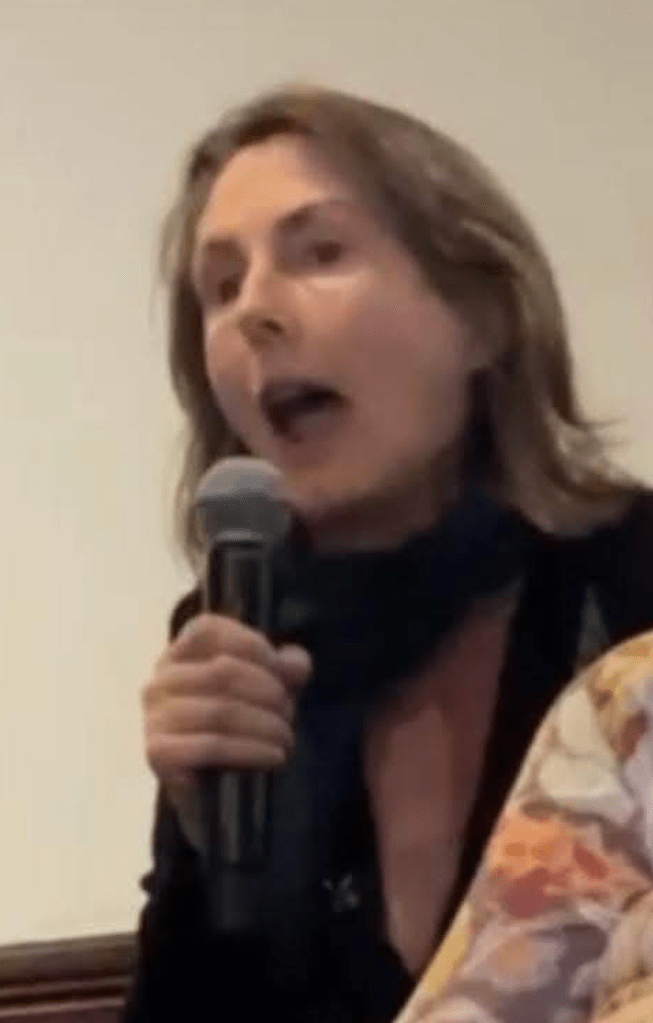
Question-time revealed irony, as the first questioner could benefit from subscribing to Annie’s Why Smart Women podcast. An anti-vaxxer, she seemed to have a plan to accuse, mock, embarrass or verbally pummel skeptics (those who pursue evidence and the scientific method in reaching conclusions), for not actually being “sceptical” (those choosing doubt, cynicism or evidence denial for the sake of it). Where one genuinely believes medical research is flawed, harm has been ignored or “they” stand to benefit, the latter is not uncommon. You can catch that “question” at the end of the video here (although the person is off camera) or listen to the audio embedded below:
In fact thirteen years ago I wrote Skepgoating: why anti vaxxers need to devalue skepticism. The notion of belittling skeptics this way, peaked for a time with all the lethality of wet cabbage. Ordered to change their misleading name, in February 2014 the Australian Vaccination Network initially chose the Australian Vaccination-Skeptics Network, before swapping “skeptics” for “risks”. Occasional tirades of what “real sceptics” should be were rare until COVID-19 had its inevitable effect on the spread of misinformation. Failure to grasp the history of mRNA technology and research, blended with the failure to appreciate the volume of money and talent devoted to combat a dangerous global pandemic.
In 2021 Vaxxed producer and CEO of the Informed Consent Action Network, US anti-vax profiteer Del Bigtree boasted that for the vaccine disinformation machine, the pandemic was “a dream come true”. He was right. That lingering confusion was massaged and still remains. I’m not just assuming the antivax attendee at the Occidental believes unverified doubt, cynicism or evidence denial is the correct mindset. When pushed for her question, she loudly confessed:
Why are you so self-satisfied?
Why do you call other people “cookers”?
Why do you de-platform people? This is not science.
You are a shame on skepticism.
You’re not real skeptics!
I won’t be called a “cooker” by people like you.
You’re a bloody disgrace to skepticism.
Did you ever read RFK’s book?
She actually opened her tirade, seeming to be outraged that skeptics supported the evolving critical approach in mainstream media. When pressed, her question was basically, “In future are you going to continue to crush out the other side and never examine your assumptions? Did you ever examine your assumptions? Did you ever read RFK’s book?”. (Citing RFK evoked laughter and applause). Nonetheless, this was more accusation than question and her queries demonstrated absolutely no understanding of skepticism. She also accused the panel of being “self satisfied” that media outlets had suppressed disinformation, and alleged people had been injured and died because of such “silencing”, by the media.
Of course, here again I must stress of the 14 deaths causally linked to COVID-19 vaccines in Australia only one is linked to the mRNA vaccine. The rest are related to Astra Zeneca. The evidence is not on her side. Period. Perhaps nothing confirmed this greater than her demand, “Did you ever read RFK’s book?”. Titled The Real Anthony Fauci the book champions conspiracy theories about the COVID-19 pandemic, promotes HIV/AIDS denialism and contends Fauci abused power for 30 years. Science Based Medicine labelled it a “conspiracy theory extravaganza”. Little wonder then, that our questioner seemed to argue that real science involved, not facts, experiments or scientific consensus, but questioning of assumptions, and basing evidence on opinions.
There are a number of specific claims in the tirade one needs to address and I’d like to do so, away from the noise of her Gish gallop. This woman claimed to once work for the Daily Mail and wrongly claimed an editor had urged reporters to make anti-vaxxers “sound crazy”, and that this was caught on video. A leaked video has been uncovered on the data-mining disinformation site, Natural News, which is really all one need know about whether the editor did the right thing. This was July 2021 when the vaccines were indeed saving lives and badly needed. Antivax rhetoric was then dangerous conspiratorial nonsense, pushed by trolls filling comment sections of news publications.
The woman said she herself also once thought anti-vaxxers were “crazy”. In fact, in the video the editor described them as “intelligent, otherwise well-educated people”. He added, “If we’re doing something that’s airing anti-vax views make sure that we’re also dismissing them… (‘is that the right way to put it?’ he asks someone off camera)… make sure we’re rubbishing their ridiculous claims”. I completely condone his advice. He criticises the anti-vax claims but not the person making those claims. He never suggested a journalist should make anyone “sound crazy”.
More so as an aside, on 19 December 2011, myself and reasonablehank had seperate complaints upheld against the ABC by ABC Audience & Consumer Affairs, for allowing Meryl Dorey to twice mislead radio audiences about the pertussis vaccine. Suffice it to say there are consequences for not educating your journalists about anti-vaccine disinformation. This editor clearly did the right thing.
She then challenges the panel about not questioning their “own assumptions”. This is absurd, as to a person, the panelists base their conclusions on research and evidence. Assumptions are not entered into. In the same breath she claims such assumptions led to injuries and deaths due to “mRNA and DNA genetic-based vaccines”. This last bit is a word salad that suggests she’s recently been reading up on the false claims that mRNA vaccines are polluted with residual DNA. On the other hand actual gene-based vaccines deliver instructions into the cell to promote synthesis of antigens. I looked at related myths such as “turbo cancer” caused by mRNA vaccines polluted with DNA residue in this post, last March.
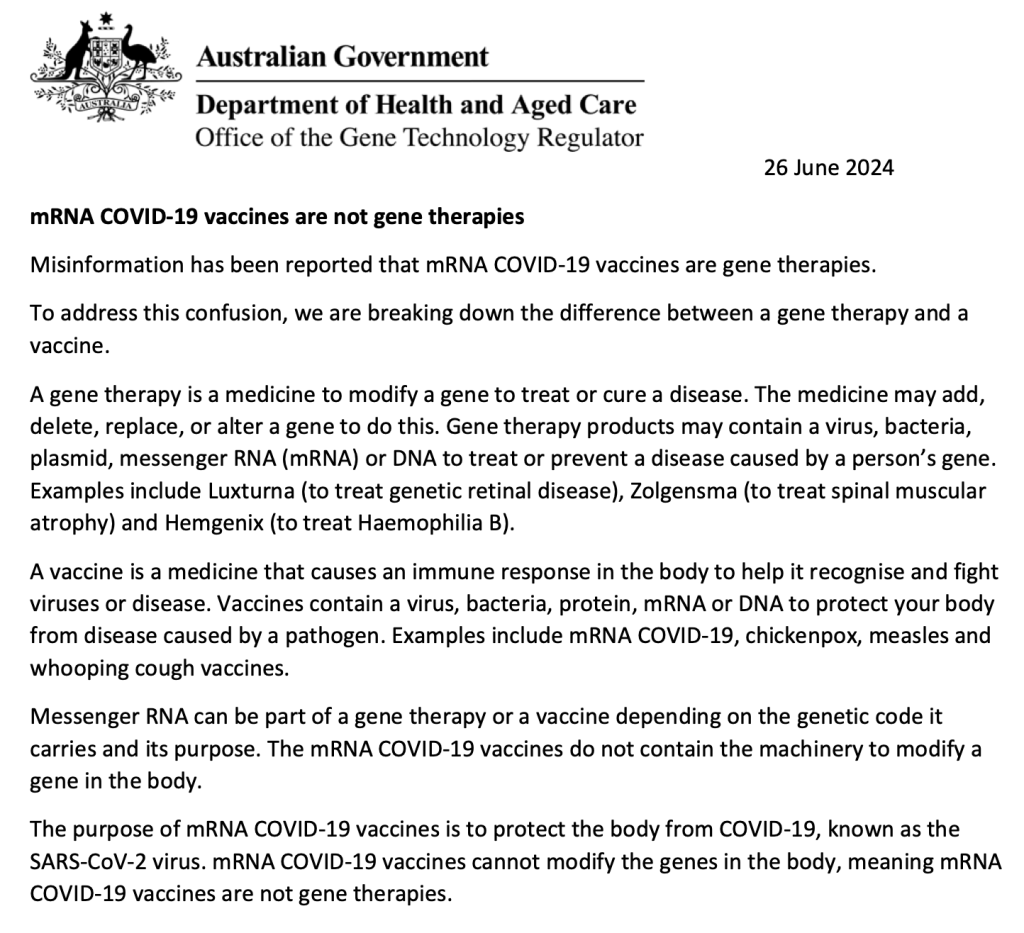
Shortly after, she calls mRNA COVID-19 vaccines “repurposed genetic therapies”. Such therapies do target disease conditions caused by problems in human DNA. Think cystic fibrosis, haemophilia. Distorting this therapy is popular in anti-vax circles and is a refinement of the initial myth that mRNA vaccines enter the cell nucleus and damage DNA: itself an example of outright evidence denial. A comprehensive statement from the Australian Government’s Office of the Gene Technology Regulator (OGTR) published on 26 June 2024. Former Senator Gerard Rennick led many disinformation campaigns on the topic, leading to the OGTR publishing the unambiguously titled, mRNA COVID-19 vaccines are not gene therapies below:
Of course we also heard that the mRNA COVID-19 vaccine “was tested for 2.5 months and is a medical product like any other”. Just as mRNA vaccines are not “repurposed” in the derogatory sense this woman intended, mRNA technology for vaccines actually began in the 1970s. Mice were jabbed with mRNA influenza vaccines in the 1990s and humans took part in mRNA rabies studies in 2013. As nanotechnology developed, the idea of using lipid nanoparticles to carry mRNA and its vital information into cells, was researched, developed and eventually used with an Ebola vaccine on guinea pigs in 2017. Here, Return on Investment had an impact on development, as Ebola affects only a few African countries and yields minimal cases in the USA. Then COVID hit and changed the commercial reality for mRNA vaccines. I recommend this page from John Hopkins to learn more about mRNA vaccine development.
Whilst it may sound catchy to refer to “2.5 months” as an insufficient timeframe to develop a vaccine, this ignores that vaccine development takes time, money and research. When the COVID pandemic hit, global investment was enormous and nations worked in partnership, pulling knowledge and experts together as never before. The genetic sequence of COVID-19 was discovered and within two months human testing began under extremely strict regulation, increasing the time for approval. Emergency authorisation required a minimum of 2 months follow up data. Development further demanded that subjects were monitored for 2.5 months after the second dose. Then came Phase III trials, involving “tens of thousands” of subjects and it is these trials that focus on safety and efficacy. In Australia, the TGA were doubly pedantic when it came to checking the trial data it was presented with. So no. The mRNA COVID-19 vaccine did not take 2.5 months to develop, but rather decades of research topped off with a global effort. Safety monitoring continues today.
Moving on, let me assure you medical products are all vastly different, and not as the woman alleged at one point “like a car or a bus”. Indeed Australia’s Therapeutic Goods Administration (TGA) have a rigid risk-based assessment and rating system for regulated medical products (therapeutic goods), focusing on potential for harm. More so, is a vaccine like a pain killer or is a pain killer like a pace maker (a medical device), or the pace maker like a bilary shunt and is that shunt a product like a titanium hip and the hip like a chemotherapy drug, a vasodilator or an external fixateur? The terms “product” and “medical product” are poles apart.
In that the vaccine did what it was supposed to do within the predicted risk-benefit ratio, even including unforeseen side effects, it is an effective medical product, still saving lives. Clearly, her use of “product” (and “car” and “bus”) was attempting to disparage mRNA vaccines, but in my mind this didn’t advance her argument. Rather it underscored her ignorance and reflects the pitfalls of “doing your own research”. More ignorance was highlighted by her bias in accusing skeptics of being “the magical thinkers”, suggesting skeptics think “nothing can be wrong with [the mRNA vaccine] because it’s got the magical word vaccine.”
At one point the woman promoted emeritus professor Robert Clancy, referring to his book on the subject. In fact he was the primary editor and contributor. Other contributors are anti-vaxxers Maryanne Demasai and John Campbell. Demasai’s work has long attracted criticism, including her 2016 suspension following an internal review into Catalyst at ABC. More recently she targets mRNA vaccines linking them to the myth of “turbo cancer”. Clancy earned himself ample criticism during the pandemic for promoting hydroxychloroquine and ivermectin. He was championed by Craig Kelly and targeted mRNA vaccines as “genetic treatment”. Newcastle University distanced itself from Clancy, and the vice-chancellor stressed Clancy was not “a subject matter expert on COVID-19”.
The woman’s appeal to authority was embellished when she boasted she had walked up Machu Picchu with Richard Dawkins. Yet there’s no evidence Dawkins ever made such a trek. I can’t reject her claim that she “corresponded with Rob T. Carroll of The Skeptics Dictionary in the 90s”. Rather, these events don’t constitute evidence for her argument. Or even, as she contended, protect her from being labelled a “cooker”.
Finally, and most offensively, was the accusation “[Skeptics] are the reason my neighbour’s kid can’t play sport because he’s got a damaged heart. Your attitude got into the newsrooms and we dismissed everything…”. As Richard Saunders later notes on the podcast, skeptics have no such influence over mainstream media. Yet the assumption by the anti-vaccine pressure groups that conspiracies are being suppressed by those who seek evidence, is their go-to blame tactic. This warped thinking is what maintains conspiracy theories. The reality is that myocarditis from COVID-19 infection is consistently rated as far more likely and severe than from the vaccine.
So finally, finally, we may conclude with an answer as to why this woman felt she was being referred to as a cooker. They have worked very hard to become such, and cooker conduct was on loud display during the above tirade.
If having the odd drink too many, and arguing with that strange relative who has a tall tale defending pseudoscience, is your version of strange Christmas traditions, you’re just not trying.
Imagine drawing a face on, and feeding a log you also keep warm with a blanket or hat, then letting the kids beat the shit out of it with sticks on Christmas Day. The uniquely Catalonian idea of “defecating log” is to fatten the woe begotten wood in the lead up to Christ’s birthday, so that it defecates treats of almonds, hazelnuts and nougats as presents for the albeit suddenly violent kids. They also have a chant for what they want, which includes warning against shitting out any herring, which is just way too salty. Aye! Some clever parenting in the wee hours and sleight of hand, ensures the right treats, and definitely no herring, plops onto the floor.
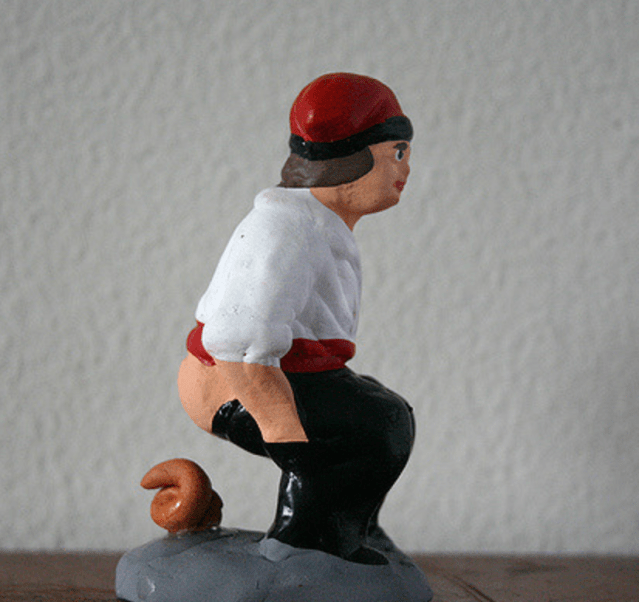
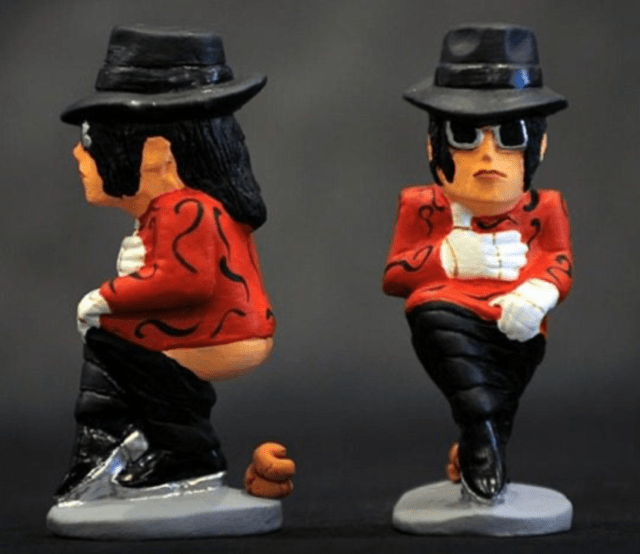
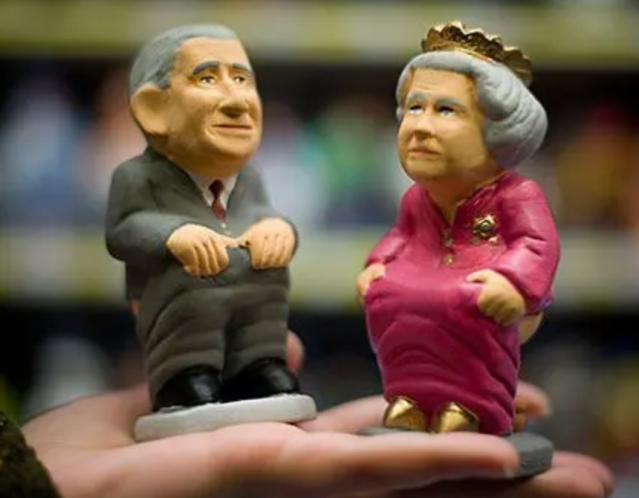
Better yet, is El Caganer or Kagen, which is a nativity scene character answering the call of nature and defecating his or her own, er… yuletide log. It’s thought variously that these fibre-fed figures originally made their way into larger nativity scenes, perhaps representing small villages, and have even been positioned in a quiet corner to offer a “Where’s Wally?” type challenge. Some claim it symbolises birth in a stable (no thanks) or fertilising the Earth (better). Others reckon it’s about good luck in the New Year. The usual job went to a peasant with a Catalan red cap. Clever marketing has now stepped in, leaving no-one safe. Today Kagen characters that represent certain news-worthy folk of the year, can be purchased for the Holy scene. I’m looking at you Hilary… and Donald… and “ooo, ooo, ahhh”, Michael Jackson.
In Norway it’s wise to lock up your brooms because witches and various evil spirits are out and about roaming the countryside. They obviously have some travelling to do, because they spend a good deal of said wandering searching for brooms to ride. There’s also no guarantee they will be happy with just one broom to zoom. Remember to hide your brooms and offer a protective prayer, before they’re swept away. You’ve been warned.
In Iceland the 13 days before Christmas can be plagued with havoc brought about by the 13 troll brothers who dwell in yon mountains. Known as the Yule Lads, a different brother will visit the house each night and leave a gift or a rotten potato in children’s shoes. This depends (you guessed it) on whether they’ve been naughty or nice. The Yule Lads have awesome names reflecting their bothersome natures, such as Pot Licker, Spoon Licker, Window Peeper, Sausage Swiper and Door Slammer (I feel seen). Icelandic kids have long been kept in line with tales of the Lad’s mother, Grýla, who may well come to steal them away.
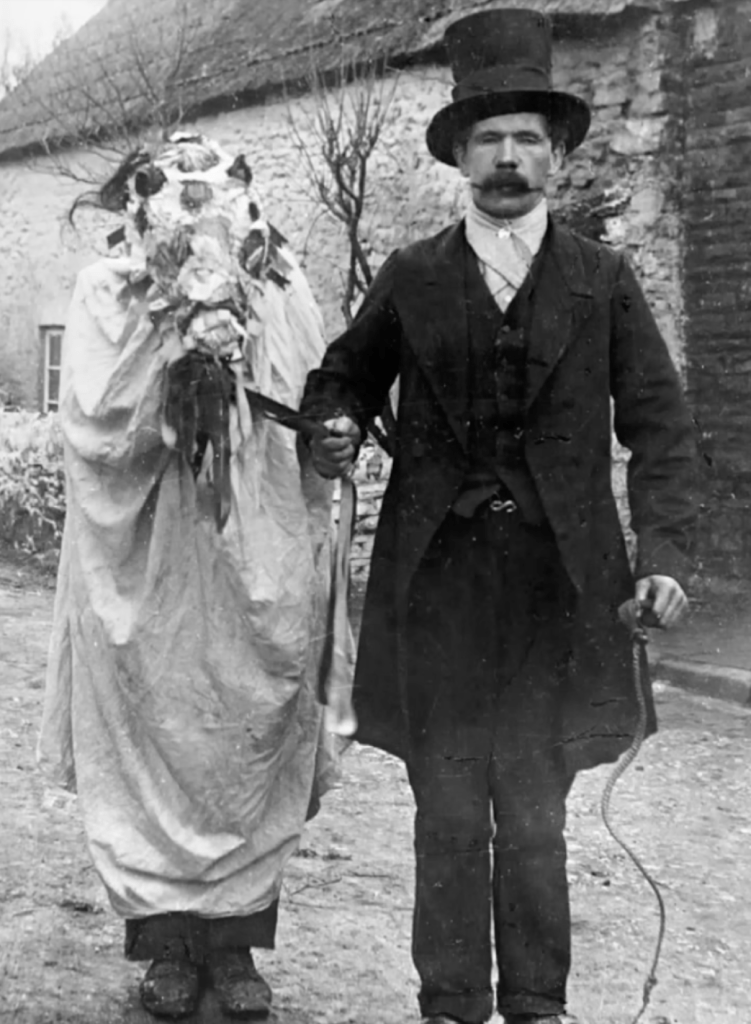
The Welsh have Mari Lwyd (the Grey Mare) the origins of which actually predate modern Christmas, and may reach to the depths of Paganism. The Welsh like to pop a horses skull on a pole, or rather obviously, on the head of an accomplice, before covering it in a white sheet and bright decorations. These jaunty chaps, reminding us that all is not yet dead, then wander to various houses where they sing or engage in rhyming battles with the home owners. If successful, they are rewarded with food and drink, and invited in to dance and evoke further trickery. They then presumably gallop off until next year.
Mari Lwyd – Wales
In Oaxaca Mexico, the Night of the Radishes is held on 23rd December. Locals carve around 20 tons of large radishes into cultural motives, icons and complex nativity scenes. Prizes are given for the most creative of the displays which attract large crowds, adding much to the aura of cheer and celebration. The radishes are not for eating but the care given to the carvings leads to some fascinating artwork. Cancel that Chrissy trip to the beach and head to Oaxaca, I say.
Goats get a Guernsey in a few Christmas carry-ons it seems. In Romania the ancient tradition of Capra involves men wearing sheepskin, bells on their shoes and a colourful, horned, exaggerated goats-head with impressive snapping jaws. Accompanied by musicians and singers, they wander about doing their thing, including jaw snapping in tune to the drum beat. In Sweden the Gävle Goat gets plenty of attention, and thanks to the tendency of loutish Swedes to burn and batter them down, plenty of rather ineffective protection.
The Gävle Goat, constructed in the castle square in Gävle is a giant version of the Yule Goat, and since its original appearance in 1966, 42 of 59 goats have been variously burnt, bashed, shot with fireworks and kidnapped by helicopter after the bribing of a goat-guard, before being abducted to Stockholm. One year the goat was burnt down, rebuilt and burnt down again. This led to the ineffective “Goat Committee” being formed. In 1988 gambling on the goat’s fate was legally sanctioned. Of course, that year it survived. During another year, a DOS attack shut down security cameras allowing the goat to be, yes, burnt to the ground. It’s also been run down by a student in his Volvo Amazon, kicked to pieces by vandals, burnt down after being shot with flaming arrows by Santa Claus and The Gingerbread Man and also hidden in the backyard of an unimaginative thief. One year the Goat committee concluded that the brown fire-proofing was ugly and decided to omit it. It was set alight, extinguished and shortly after, set on fire yet again.
Hot Stuff – The Gävle Goat
Some goats stood 13 metres and weighed 3 tons. Forward thinking students from the Natural Science Club weighed the evidence and constructed smaller less conspicuous goats. These little guys were promptly “smashed to pieces”. Undeterred, the young scientists persisted, only to later find their creations “floating in the river”. I understand they are far from defeated. Go science!
In Finland a lovely tradition sees family members head out into the icy weather on Christmas Eve to place lit candles at the resting place of loved ones and friends. This gives a delightful warm glow to what are usually cold, spooky places of isolation. Nice one Finland. More fascinating is the Ukrainian tale of the poor widow who, with help from her wee ones, grew a pine tree from a fallen pine cone. When Christmas came they had no coin to buy decorations for the tree so went to bed on the Eve with heavy hearts. Mother rose at dawn to find the tree covered in spider webs. She opened the window to get a gander, and when sunlight hit the webs they turned to silver and gold, right on that there tree. And yay, they were never poor again. Mother must have invested the silver and gold in Christmas tree decoration companies, which she later floated on the stock market leaving changes in volatility to impact us poor consumers as we decorate our own trees all these generations later. Okay, I actually made up the stock market thing.
In Slovakia if you want good luck to befall you and yours, the idea is to get the most senior member of the family to throw pudding on the ceiling. The more pudding that sticks, the more luck you can expect. So, the trick is to make that pudding recipe as sticky as possible. Just don’t get a shock if grandad’s teeth are also smiling down at you from the ceiling. Speaking of eating, don’t forget that thanks to a successful ad campaign by KFC in the 1970s, for a Party Barrel to be had at Christmas Time, Japanese sales are greater than any other time of the year. It’s been so successful, finger-lickin’ Japanese have to pre-order weeks in advance and on the day itself there can be queues stretching way out of KFC shops.
There are of course many, many more unique traditions to check out and enjoy around the world at this time of year. If you’re bored sitting at home come night time, a quick search should reveal the location of Christmas lights and/or the suburbs and streets which are known for putting on impressive displays in suburban Australia.
And from this author have a very happy and joyful festive season followed by a safe 2026. El Caganer!
The fact that mRNA COVID-19 vaccines are not contaminated with excessive or dangerous levels of residual DNA should not really have to be addressed. Nonetheless, doing so often comes up in arguments to debunk what is becoming a persistent trope of the anti-vaccine lobby.
In November last year I looked at an excellent report from Australia’s Therapeutic Goods Administration (TGA), which plainly called the claim, misinformation. In March this year refuting the myth of “Turbo Cancer”, I went through a bunch of already well debunked attempts to justify the existence of this non-existent cancer. DNA contamination of COVID mRNA vaccines took up a few paragraphs.
The popularity of residual DNA contamination as a cause of invented harms favoured by anti-vaccine fear mongers shouldn’t surprise us. We received easy to understand information from health authorities well before the COVID vaccine rollout, that mRNA in vaccines never penetrates the cell nucleus and thus, DNA would remain untouched. Yet that very notion was targeted early and often by contrarians. Then came the flawed science with flawed methodology, that still remains unpublished. Remember the testing of vials that arrived anonymously in the mail without cold packs? Don’t forget mRNA vaccines require storage at about -20ºC. Then came sleight of hand by Kevin McKernan et al, using Qubit Fluorometric Quantification (fluorometry) in an unwarranted addition to the original testing regime of Quantitative PCR (qPCR). qPCR indicated DNA below FDA guidelines. Fluorometry significantly and inaccurately inflates results because it measures mRNA when calculating total DNA levels.
In fact there’s a few elements to understanding why DNA in mRNA vaccines is a non-event. That’s why I recommend watching Dr. Dan Wilson of Debunk the Funk on YouTube. Dan’s been flattening bogus bumps in the anti-vaccine world for quite a while now. His video on 2 July called Update on DNA contamination is one of a few he’s done tackling this particular myth. Interestingly, what recently caught my eye was Dan’s praise for the TGA report on misinformation about excessive DNA in mRNA vaccines.
Dan wrote to the TGA to check how they determine COVID DNA in their samples, as there are various ways to do this (see video 7:15). It turns out the TGA used the method that “most over-estimates the amount of DNA that could possibly be in that vial”. This still yielded “zero batches that exceeded the limit of residual DNA”.
So again, what this tells us is that DNA contamination of mRNA vaccines is a total furphy and they remain completely safe. Still, I sincerely recommend spending 10 minutes checking out Dan’s video, and having a look through his others for sound information to educate yourself about persistent and evolving anti-vaccine disinformation and misinformation.







 Losing In The Lucky Country