Measles Vaccination: make an informed choice

Recently in Melbourne Australia, the wanderings of a baby infected with measles prompted Victoria’s Chief Health Officer Dr Rosemary Lester to name certain venues and alert the public. The 11 month old had, while infectious, visited four major shopping complexes, two restaurants, a cafe, a children’s play centre, a church and a chemist. Dr. Lester stressed those who attended these venues should ensure they pay extra attention to symptoms such as;

…common cold symptoms such as fever, sore throat, red eyes and a cough. The characteristic measles rash usually begins 2-5 days after the first symptoms, she said, generally starting on the face and then spreading to the rest of the body.

A bit of a rash, sore throat and temperature then. I’ve heard groups who insist vaccines don’t work or aren’t needed pass measles off as nothing to worry about. Yet the article also included this from Dr. Lester;

“Anyone developing these symptoms is advised to ring ahead to their GP or hospital and alert them that they have fever and a rash,” Dr Lester said. “If you know you have been in contact with a measles case please alert your GP or hospital emergency department. The GP or hospital will then be able to provide treatment in a way that minimises transmission.”

Hmmm. Maybe hospitals in Victoria are running drills this month. Practising for something serious with this little rashy-coughy thing. After all a Slovakian micro-palaeontologist had described it as a simple “right of passage”. And if anyone would know about infectious disease in Australia it is a Slovakian micro-palaeontologist, not a mere Chief Health Officer of a state holding around six million people. But then the piece by the paper’s Health Editor went on to state measles is highly infectious. It is particularly dangerous for young children and young adults.

Those most at risk of getting the disease are people who have not been vaccinated, particularly adults between 33 and 47 years because many in this age group did not receive measles vaccine, and people whose immune systems have been compromised because of cancer treatment, for example.

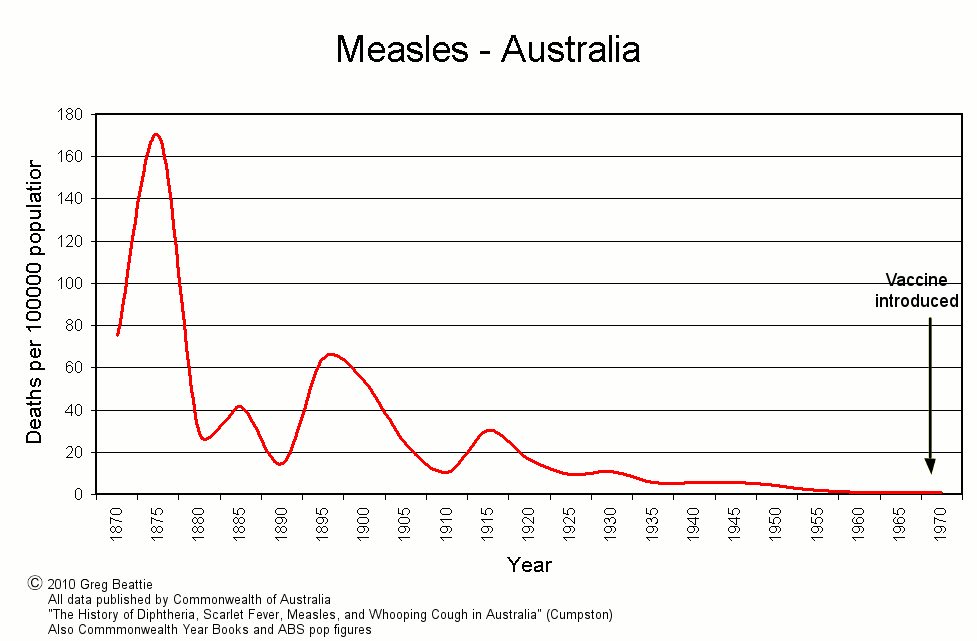
Perhaps, as they say, this is not a drill. I remember reading material from those against vaccination. They spend a lot of time and caps lock justifying why vaccines are dangerous, or useless, or part of a conspiracy. The claim that vaccines are useless is backed by graphs which plot disease induced mortality against time and contend X vaccine was introduced well after mortality reached zero. Clean water, nutrition and better living standards stopped these infectious diseases they insist, not vaccines. So I decided to check the measles graphs drawn up by renowned antivaccinationist Greg Beattie.

Beattie_measles1Greg Beattie’s “Figure 1” from Fooling Ourselves

The above graph is from Beattie’s Fooling Ourselves. The Australian Vaccination-sceptics Network is littered with this and many others from Beattie. Material published by the AV-sN has been independently examined and discredited in the preparation of a public statement and warning by the NSW Health Care Complaints Commission. It appears then, Beattie’s graphs have been examined and discredited in an official capacity. There is no mistake as to why the HCCC warned the public to exercise caution in viewing “misleading” material. It is important to focus on Beattie’s intent here. Namely that vaccines had no impact or an irrelevant impact on the control of infectious disease. In part this post challenges the intent of Beattie’s graphs by presenting independent data that show vaccines most certainly had a powerful effect in controlling the spread of vaccine preventable disease.

Thus Beattie’s cunning use of mortality rate above, is met with absolute and predicted numbers. Greg Beattie cites the Australian Bureau of Statistics, Commonwealth Year Books and “data published by the Commonwealth” in Cumpston’s 1927 The History of Diptheria, Scarlet Fever, Measles and Whooping Cough in Australia. One notes the first problem is his reliance on mortality and not morbidity. Death as a consequence of a vaccine preventable disease is a limited indicator of how effective vaccination has been in reducing infection. Overall morbidity (infection) offers a more realistic picture. Indeed the anti-vaccine lobby are today only too quick to point to the number of pertussis notifications in those vaccinated, when launching attacks on the efficacy of the vaccine or the need to be vacccinated. They concomitantly avoid noting pertussis mortality in Australia hits the unvaccinated.

The vaccinated cop a less dangerous, and to date, non-lethal infection. [Update] Children not vaccinated against pertussis are 24 times more likely to be infected with the wild strain, than those who are vaccinated. Below is another graph from Communicable Diseases Intelligence. I’ve boxed in measles in red and used coloured horizontal lines to link mortality to years pre and post introduction of the measles vaccine. It’s clear that the greatest gap – or in fact drop – in mortality follows the introduction of measles immunisation. Thereafter reductions are smaller and more evenly spaced. Diptheria tetanus polio measles highlight

Source: Communicable Diseases Intelligence

Could there be more important facts left out by Beattie? Clearly his graph is designed to visually convince the reader that the measles vaccine was introduced when measles was all but eradicated. Thus Beattie contends vaccination had no impact on its control. So what of Beattie? Do we afford him the benefit of the doubt? You be the judge. Immediately after the graph he writes in Fooling Ourselves.

The graph for measles (Figure 1) shows us that the five-yearly death rate, 100 years before the vaccine was introduced, was around 170. One hundred years later, and immediately prior to introducing the vaccine, it was less than one. That’s a reduction of 99.5%—before the vaccine arrived. The remainder of less than 1% is therefore the only portion of the decline to which the vaccine can possibly lay claim, because it simply was not around for the first 99.5%. […]

Let’s check that again: One hundred years later, and immediately prior to introducing the vaccine, it (the five year mortality rate from measles) was less than one. Looking at the CDI graph above, and countless others that can (Source: Measles Deaths, pre-vaccine – archived) be wheeled out from developed nations around the world he is simply misinforming his readers.

Update 10 January 2024: I originally published this post with no display of the graph in question. They are USA data, and the aim here is to expose Beattie’s deception, referencing the Australian figures he worked so hard to conceal. Recently, a pingback alerted me to the fact one Jordan Henderson criticised my linking to it. Jordan opined;

For example; he attempts to claim that Beattie’s Australian death rate graph is wrong by referencing a graph for the USA as if that somehow makes the Australian graph wrong because it doesn’t show what the USA graph shows.

Errumm, yes. Or rather, no. The graph in question impressively eliminates Beattie’s case by simply highlighting the impact of vaccine introduction when actual numbers of deaths (not diluted using “per 100,000”) in a population larger than Australia, are presented. Include case numbers and the illusion of his craftwork vanishes. Also, if vaccines didn’t succeed, they didn’t succeed globally, would be my reasoning. Not just where Greg Beattie lived. Anyway, Jordan offers a cornucopia of conspiracy woo online. He writes numbered articles called “The Acorn”, and has sprouted bud by bud (sorry, couldn’t resist) into anti-5G, psyops, sheeple, the great reset, slavery, anti-mask beliefs, the awakening, more acorns and of course, being anti-vax. Now, as they all do as per their manual, he’s defending Beattie. Is Beattie a sprout I wonder? Perhaps more of a chunk of crispy old lichen, given the age of this tale.

So, onto the graph, with some added red annotation:

measlesvax_usaintro1

If QR codes are your thing, enjoy. Otherwise, it’s archived here now. Do read the piece, if the “clean water and sanitation, not vaccines controlled disease”, argument is one you’re entertaining. Engineering, clean water and sanitation did indeed catapult our health and standard of living forward. Diseases were controlled, but not eliminated. In the case of measles, vaccines later eliminated hundreds of fatalities per year and thousands of cases of brain damage, pneumonia, middle-ear infections, deafness and diarrhoea. But this argument is so petty, because we actually have successful vaccines developed long after sanitation, clean water and flushable toilets emerged.

Take the Hib vaccine. In 1985 the first Hib vaccine was launched in the USA. A more successful conjugate vaccine was licensed in 1987. Is it necessary? Have we actually seen its impact?

Hib can cause invasive diseases in young children and people who are immunocompromised. The case-fatality rate for Hib meningitis is between 3% and 6%. Up to 30% of individuals who survive Hib disease have permanent neurological sequelae. Source.

Okay, dear reader. Apologies for the interruption. Where were we? Ah yes. Up above we had… Let’s check that again: One hundred years later, and immediately prior to introducing the vaccine, it (the five year mortality rate from measles) was less than one.

Less than one for five years? Whilst the CDI graph plots 150 from 1966 – 1975. An excellent way to further debunk Beattie’s “vaccines-didn’t-save-us” mess is through statistical estimation of the deaths that would have occurred without immunisation. Cost effectiveness and the money saved through improved health is vital. Love it or loathe it the cost of running a vaccine-conspiracy would be monumental. The savings to be made in controlling infectious disease are also wonderfully impressive and much time and energy goes into ensuring we invest in what pays for itself. The figure loving, graph scribing, number crunching chaps at Applied Economics (archived) are deft hands at such dark arts. In a semantic flick of the bird to antivaccinationists they write;

The trend in measles deaths since 1940 reveals a secular decline. This reflects a reduction in case fatality associated with a general improvement in health status as well as the introduction of antibiotics in the late 1940s (Russell, 1988). By fitting a trend to measles deaths for the period 1940–69 and extrapolating it from 1970 onwards, we can estimate the deaths that would have occurred without immunisation. A trend can also be fitted to actual deaths that occurred with immunisation. The difference between these two trend curves is our estimate of the lives saved because of immunisation.

I’ll leave you dear reader to pop over and peer at their graphs revealing the “lives saved because of immunisation”. They also sacrifice many pure white A4 sheets doing the same with Hib vaccination. Nonetheless here is (the businesses end of) the table born of such mysterious chanting and ritual. Pre immunisation years from 1940 are available. The point here is to further debunk the antivaccinationist claim that vaccines did nothing. By analysing pre and post immunisation mortality and morbidity trends, a strong estimate of lives saved and disease prevented can be clearly demonstrated.

 Estimated deaths due to, and notifications of, measles tabulated as with or without immunisation

Consequently estimated lives saved and estimated cases averted based solely on measles immunisation can be calculated as the difference

Deaths Notification
 Year Without Immunisation With immunisation Estimated lives saved Without immunisation With immunisation Estimated cases averted
1970 16 10 6 110,693 77,000 33,693
1971 15 10 5 112,391 67,459 44,932
1972 14 10 4 114,061 59,100 54,961
1973 13 10 3 115,706 51,777 63,929
1974 13 9 4 117,325 45,362 71,964
1975 12 9 3 118,921 39,741 79,180
1976 11 9 2 120,494 34,817 85,677
1977 11 8 3 122,044 30,503 91,542
1978 10 8 2 123,574 26,723 96,851
1979 10 7 3 125,083 23,412 101,671
1980 9 7 2 126,573 20,511 106,062
1981 9 7 2 128,044 17,969 110,075
1982 8 6 2 129,497 15,743 113,754
1983 8 6 2 130,932 13,792 117,140
1984 8 6 2 132,351 12,083 120,268
1985 7 5 2 133,753 10,586 123,167
1986 7 5 2 135,139 9,274 125,865
1987 6 4 2 136,511 8,125 128,385
1988 6 4 2 137,867 7,118 130,749
1989 6 4 2 139,209 6,236 132,973
1990 6 4 2 140,537 5,464 135,074
1991 5 3 2 141,852 4,787 137,065
1992 5 3 2 143,153 4,194 138,960
1993 5 2 3 144,442 3,674 140,768
1994 5 2 3 145,719 3,219 142,500
1995 4 2 2 146,983 2,820 144,163
1996 4 1 3 148,236 2,470 145,765
1997 4 1 3 149,477 2,164 147,313
1998 4 0 4 150,707 1,896 148,811
1999 3 0 3 151,927 1,661 150,266
2000 3 0 3 153,136 1,455 151,680
2001 3 0 3 154,335 1,275 153,059
2002 3 0 3 155,523 1,117 154,406
2003 3 0 3 156,702 979 155,723

 © Applied Economics – archived original

These are impressive figures. Lives are saved and disease is averted due to the MMR vaccination. Conversely with no vaccine induced protection from measles lives are lost, disease is spread and disability and suffering ensues. There can be few better examples as to the efficacy of mass immunisation, or indeed, the danger of the anti-vaccine lobby.

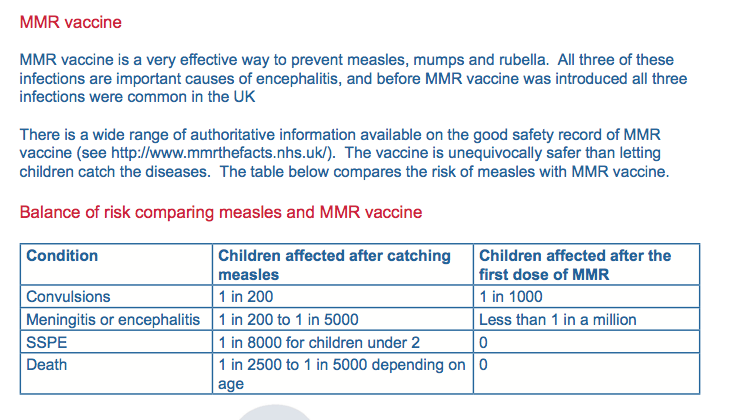
Consulting reputable publications we can see that measles is indeed a potentially very serious disease. Health authorities have never denied that vaccination carries a negligible risk. The anti-vaccine lobby is apt to demand vaccines be both 100% effective and 100% safe. As a public we are rather poor at assessing risk-benefit and thus many fall prey to the anti-vaccine slogans and lies.

Encephalitis is a one in a million plus risk as a consequence of measles vaccination. As a consequence of measles it is a one in a thousand risk. In short those who argue “natural immunity” is best subject their children to the risk of brain damage or death at a rate 1,000 times greater than had they chosen MMR. For every ten who contract encephalitis one will die and four will be permanently brain damaged. Around one third of those infected will develop complications that will likely require hospitalisation.

Depending on age, one child dies for every 2,500 – 5,000 cases of measles.

MMR vs infection

© The Encephalitis Society – Access full document here

Recently the vaccine-autism zombie had some life breathed into it. Fortunately it turns out that just as Wakefield perpetrated his original – and ongoing – fraud for money, the author of the latest scam is a member of a group erroneously believing vaccines cause autism and will stop at nothing to mislead the public to this same misconception. The “paper” was withdrawn in one month. A statement has been published by Dr. William Thompson who was deceived into becomming a “whistleblower”.

He was recorded against his will and it appears the anti-vaccine author Brian Hooker had worked for months to get the pro-vaccine Thompson on record as sounding like a whistleblower.

And so it continues. This is indeed not a drill. We do have reasonably healthy rates of vaccination but the return of measles, varicella and other vaccine preventable diseases means there is no room for complacency.

Make an informed decision. Vaccination saves lives.

The history of measles

Australian Immunisation Handbook – 2013

MMR

Measles Fact Sheet – WA Health

NCIRS – events in MMR vaccination practice


♠︎ ♠︎ ♠︎ ♠︎

Last Update: 10 January 2024

Randi Does Radio

James – The Amazing – Randi chats to Jon Faine and Stella Young on ABC 774.

The occasion was The Conversation Hour on Friday November 30th in Melbourne. Randi was in Melbourne for the Australian Skeptics National Convention for 2012. Join in as Randi, Jon and Stella revisit some of Randi’s memories of earlier visits, including the always-asked-about Don Lane episode.

Download the audio of Randi on The Conversation Hour – or listen below.

randi

Randi enjoys a joke during the Australian Skeptics National Convention


Dealing with the Brian Martin dilemma

Recently Brian Martin a Professor of Social Sciences at the University of Wollongong, published an article in Health Promotion International.

Dealing with dilemmas in health campaigning appears to be a bipartisan analysis of social dynamics and some areas of public health. However whilst Martin relies upon science and methods employed by the scientific community to sustain his argument he demonstrates his signature ignorance of the scientific method and the import of evidence.

In short Martin has continued his campaign to elevate supporters and perpetrators of scientific fraud, pseudoscience, censorship, personal vitriol, calculated deception and dangerous scams to the status of legitimacy. Rather than admit his role in supporting and coaching Australia’s premier anti-vaccination lobby, Martin hides this affiliation behind:

I give a few examples, especially from the vaccination controversy in Australia.

I selected the dilemmas discussed here based on my studies of a large number of public controversies, including informal conversations with prominent as well as lower-profile campaigners. […]

A key aim of this paper is to make these dilemmas explicit so they can be given the scrutiny they deserve.

Health campaigners today face intractable ideological devotion manifesting as evidence denial. The resistance of certain scientifically durable realities that play important roles in the maintenance of public health, is commonly presented as “the other side”. In fact cursory examination reveals malignant intent, bogus information, illegal pursuits, frequent monetary scams and outright fraud.

Certain areas have become key targets of a persistent opposition that uses pseudoscience, conspiracy theory, evocation of public fear and the exploitation of scientific ignorance in an attempt to mask ideological persuasion as legitimate science. Whilst the intellectual paucity of these proposals are immediately apparent to scientists, and consequently dismissed out of hand, the mechanisms behind why this is so are not apparent to the lay reader.

As such, scientists face a dilemma in managing, preventing or containing what may be a disproportionately negative effect on public confidence in crucial areas of health policy. The problem with engaging vested interests that promote pseudoscience and scientific denial is that the risk of lending legitimacy to demonstrably false contention, is significantly heightened when recognised scientists (or health authorities) respond.

On the one hand the public have a right to expect reputable authorities address falsehoods in a transparent manner. On the other hand, notions such as the scientific method, scientific consensus, the impact of evidence and abuse of statistics is poorly understood by the general public. Understanding risk-benefit is a skill the largely scientific illiterate public in developed nations lack. Poor, and at times, irresponsible reporting by media outlets compounds this problem.

Recently a bogus claim by Natasha Bita of The Australian drew immediate condemnation from Australia’s Therapeutic Goods Administration. Influenza vaccination has been conclusively linked to no deaths in Australia. However Bita misused information from the Database of Adverse Event Notifications, to insinuate ten deaths were “linked to anti-flu vaccine”. Meryl Dorey, president of the anti-vaccination group Martin is a member of has been continually pushing the falsehood launched by Bita.

Interestingly in another of his articles, Suppressing Research Data: Methods, Context, Accountability, and Responses Brian Martin offers an excellent account of Dorey’s conduct:

Censorship, fraud, and publication biases are ways in which the availability of research data can be distorted. A different process is distortion of the perception of research data rather than distortion of the data itself. In other words, data is openly available, but efforts are made to shape people’s perception of it.

Although he’s referring to publishers, the above paragraph adequately describes how Dorey conducts herself. In Dealing with dilemmas in health campaigning, Martin raises the prospect that not engaging anti-science proponents such as anti-vaccination lobbyists may have a negative effect on public perception. Yet the complex reality of how adverse reactions are reported, accepted, documented and how they must be interpreted would be lost on the bulk of the public. The catchy, but false, ten deaths linked to anti-flu vaccine would have an impact.

More so, placing a callous, dishonest, unqualified opportunist such as Dorey alongside a genuine health authority creates the illusion that there actually is a debate to be had. Worse is that the individual lies and tricks of the anti-science identity by extension gain credibility. As I note below new research reinforces that opponents to public health and even the myths they create are best ignored when seeking to address they mess they’ve created.

Consequently, engaging such extreme minority views can be detrimental to public confidence and rather than removing respect for ideological falsehoods may well create an impression of legitimacy. Given his affiliations it is almost certain Brian Martin seeks to do exactly this in his article.

In fact the above quote splendidly describes Martin’s own generalised distortion of data. A suitable example follows. Rather than tackle the disparity between anti-vaccination propaganda and say, the risk of flying, driving, overseas travel or any day to day task he writes:

Supporters of vaccination emphasize the large benefits from being vaccinated, notably a reduction in disease, including associated deaths and disabilities. They also emphasize the social benefits, due to herd immunity, from high levels of vaccination (Andre et al., 2008). That is straightforward. But is it wise to mention that a small number of individuals will have adverse reactions, including death and permanent disability?

The advantage of sticking to positives and not admitting shortcomings is that the message is much more powerful. ‘Vaccines are safe’ is far more reassuring than ‘Vaccines are nearly always safe’. ‘Vaccines are safe’ is also clear and uncomplicated and hence far easier to sell. Furthermore, any admission of weakness is likely to be seized upon by opponents and trumpeted far and wide.

Unsurprisingly the second paragraph is without citation. What Martin is doing is constructing a faux dilemma that resonates with poor appreciation of risk-benefit. The fact is vaccines are safe. They are monumentally safe and to use such a vague term as “nearly always safe” conveys a risk-benefit somewhat more dangerous than riding high speed motorcycles on city streets.

To then suggest without breaking stride the proper description of vaccine safety makes them “far easier to sell”, is simply outrageous. This is exactly the sort of bogus information I mentioned above. It is the perpetuation of the malignant untruth that vaccines need a market and supporters of vaccines will pursue this. At one point we read an equally outrageous slur on scientists:

The most common way to deal with vested interests on one’s own side is not to mention them, relying on the belief held by scientists that they are objective, so it does not matter if corporations offer research funding and perks.

Recent research into debunking myths has underscored the perils of not only engaging proponents of evidence denial, but of simply repeating the myth itself. This material may help explain why, on the topic of scientific dissent, Brian Martin continues to give unjustified credence not only to soundly scientifically refuted notions (fluoride in drinking water, vaccination, conspiracy theory put forward as “vested interests” and even HIV/AIDS denialism), but also to the view that a “debate” may be legitimate.

Indeed not only are terms such as “debate” entirely inaccurate in a scientific sense, they at once distract from the true dynamics at play and arguably with tragic consequences, lend even more false legitimacy to what is essentially pseudoscience, abuse of science and denial of evidence.

Martin continues to place anti-science lobby groups on equal footing with public health authorities or refer to unqualified saboteurs of public confidence as “citizen campaigners” seemingly simply raising legitimate concerns. This fails to acknowledge scientific consensus, its import and value to community health, and its dependence upon the rigours of the scientific method.

In short Martin demonstrates an alarming ignorance of the scientific method and its ability to expunge in totality such ill conceived ideas that “debate” rightly applies to numerous areas of outright denial of evidence. Martin is a financial member and published supporter of Meryl Dorey’s anti-vaccination group and the PhD supervisor of radical anti-vaccine conspiracy theorist, Judy Wilyman. Yet again he has labelled volunteers who deconstruct the harmful messages of Meryl Dorey to suit himself.

Thus it is right and just to call into question Brian Martin’s acceptance or not of moral responsibility. Prior to this article he was furnished with ample facts that he’s chosen to ignore despite claiming to have been in discussion with participants. Clear demonstration of the bogus claims of the AVN that impact heavily on his subject material have been omitted. Impartiality is clearly irrelevant if not inconvenient to Brian Martin.

Amusingly he again raises the silliness of Dorey’s obsession with global conspiracies as an apparent fiction invented by her critics. After a frustrating exchange of emails over a year ago I demonstrated that yes, in their own words the AVN do believe in vaccine delivered microchips and global culling. I’m quite surprised he saw fit to republish such a ridiculously irrelevant aspect to this ongoing saga.

More seriously, the scientific community would quite rightly be justified to review reference to the bulk of scientific methodology and accepted consensus as “the dominant paradigm” or “the dominant epistemological position” in dismissive terms. Whilst it is true that scientific findings remain always open to further inquiry and challenge, this process cannot be jump-started by suggesting evidence denial constitutes scientific “debate” or that the very methods and practices that led to The Enlightenment constitute a “paradigm”.

It can be far more adequately argued that proponents of pseudoscientific beliefs and evidence denial have not, over the entire course of their existence, altered scientific consensus as it pertains to their chosen ideology. This is especially true of anti-vaccination, anti-fluoridation, alternatives to medicine and the denial of HIV/AIDS.

In this light we can see such groups as disempowered and effectively divorced from scientific and genuine skeptical inquiry. With no evidence to further their belief structure or force their ideology into reality we witness a constant recycling of well documented falsehood. This is backed by predictable contrariness that is more and more prone to argue their evidence is not flawed, but suppressed or censored by a covert conspiracy. Needless to say this has never been demonstrated.

Alienated, irrelevant and left to defend overwhelmingly debunked and thoroughly refuted notions, those incapable of accepting this reality predictably lash out and attack conventional science in an increasingly extremist fashion. Clearly these groups crave acceptance by the scientific community as they continue to use scientific terminology and mimic scientific research, discussion and reasoning.

However since their inception they have never once produced material that is accepted as genuine research or conclusive evidence. Their modus operandi is to shirk genuine research and produce bogus reviews they falsely label as “critiques”. These are carefully produced selections of cherry picked data presented with a false argument.

In addition they rely overwhelmingly on the alarmist and pseudoscientific work of a small number of faux professionals, whose greatest skill is the abuse of science – not its application.

This impasse has been manifestly apparent for many years. Thus far from accepting these groups have any legitimate contribution to make it should be stressed that the areas they continue to challenge are indeed settled scientifically. Yet Martin writes:

Supporters of the dominant position often say that the existing research base is more than sufficient to conclusively support their stand. Sticking with this claim has the advantage of not admitting weakness. It also can have an economic justification: unnecessary research is avoided.

The disadvantage of rejecting calls for more research is that the critics have a continual source of complaint. When critics have little capacity to undertake their own research—at least research requiring substantial funding—they can portray the defenders of orthodoxy as stonewalling in the face of legitimate doubt.

Again this is manufacturing a dilemma. With respect to vaccination health authorities have gone to extreme lengths researching, and continue to research, every possible adverse reaction or problem with vaccines. The research called for is today unethical and methodologically impossible. Other research demanded has already been conducted. Yet the goal posts are continually moved.

Consequently it is regrettable that certain authors appear to go to extreme lengths to cast denial as genuine dissent whilst insinuating that science has, and will, progress from those who consistently attack the process that does not produce the results they seek.

It should be noted Martin’s article has clearly been firmly edited away from his usual obvious slant in praise of scientific dissent. Its overall tone is seemingly reasonable. Nonetheless that’s not the real point.

Brian Martin has again shown he will be deceptive in the pursuit of his own interests.

Isaac’s Golden Moment

Three weeks ago I attended a public lecture entitled Medicine and Homeopathy.

The latest from Melbourne University Health Initiative, the lineup included homeopath Isaac Golden and chiropractor Simon Floreani to present the argument for homeopathy. Public health physician and medical activist Dr. Ken Harvey and GP Dr. Stephen Basser, one of Australia’s most accomplished critics and analysts of alternatives to medicine, held the fort for medicine.

All but Stephen Basser feature in this video examining claims made by Isaac Golden about homeoprophylaxis. I was confident Golden would pull off a pleasant well meaning presence and equally confident Floreani would flounder and fall. As it turned out he never arrived, leaving Golden to retrace the tired old footsteps he’s been doing for years all by himself.

There’s a few things that I found novel. Golden was quick to label the Cuban homeopathic immunisation study (see video above) as “an intervention”, not a trial. This in one swipe silenced many a prepared question including my own over how the “immunised” demographic returned to levels of Leptospirosis infection similar to those found elsewhere in Cuba (non “immunised”). The “intervention”, which is quoted by homeopaths as hard evidence of efficacy is often criticised for poor methodology, lacking a control group and inexplicably failing to randomise subjects.

So by renaming it an “intervention” Golden could proclaim to have “evidence” and dismiss questions raised about its veracity being flawed due to poor trial practice. Throughout the “intervention” paper the rest of Cuba (RC) is presented where and how a control would normally be presented in a trial. Defenders of the caper point to RC as a quasi-control when it suits the need to convey comparative difference. Thus, Isaac has invented a nifty escape clause from defending poor methodology.

Another point (in fact an inexcusable failing) was Golden’s inability to address what is at once one of the least complex problems, but perhaps the most important. The entire Cuban scam is not Hahnemannian homeopathy. By no means am I the first to note this. It’s more of what I call Supercalifragilistichomeoprophylaxis.

During the evening Isaac Golden made much of remaining true to Samuel Hahnemann’s Law of Similars and Law of Infinitesimals. The Law of Similars is sometimes known as “like cures like” and states that a mother tincture should be made from a substance which produces symptoms similar to that produced by the disease.

Yet in the Cuban study they used four dead – completely inactive – strains of Leptospira bacteria to make the mother tincture. The paper refers to “highly-diluted strains of inactivated leptospiras”. However the paper title is, Large-scale application of highly-diluted bacteria for Leptospirosis epidemic control. Plainly that is misleading in itself.

So I pointed out to Isaac that in view of his insistence upon the law of similars, and noting that the Cuban mother tincture didn’t contain a substance that could produce any symptom like those experienced with leptospirosis (the bacteria were always dead), he had a problem. Confident, he responded that no, it’s not like a traditional vaccine.

Another audience member ran it by him again. Isaac was confused. Ken Harvey explained the problem also. Then I spelled out the obvious. Without the Law of Similars, there’s no Law of Infinitesimals. But he didn’t hear. Clearly stumped, his mind was cranking over. Eventually he produced the claim that the dead bacteria still had the “energy shape” or “energy signature” and were thus still viable. Quickly he turned and selected another questioner.

I was delighted. Isaac Golden had just told me an “energy shape” could produce similar symptoms to live bacteria. But even better, he’d made it up on the spot. After earlier signing his name to the Law of Similars, he then denied its necessity. I still wanted to press the point as this excuse couldn’t explain the “blood, puss, discharge, urine, flesh, causal organisms…”, and other organic goo used in highly dilute nosodes.

No Law of Infinitesimals either with no Similars. We never really made it to discuss that point. But I already had my answer in that he had no answer. For the record, the beaker for the most dilute agent was washed out 9,999 times. On the 10,000th refill it was called a homeopathic immunising agent. That’s not highly diluted – that’s washed away. The less potent (less dilute) was washed out 199 times.

It was Supercalifragilistichomeoprophylaxis if ever I’d seen it. Remember dear reader a nosode is a homeopathic dose. Golden had earlier used the term. Its definition – in this case – demands “causal organisms”. Energy shape just didn’t make it. The audience member who helped Isaac understand wrote, “Get out of jail free” on his notepad and slid it my way. I had to agree. We know homeopaths make it up as they go along, but it was really nice to be there to see that actually happen.

It was truly a Golden moment.

Other points deserve a mention. Already referring patients to conventional doctors, Isaac came across as keen to extend conventional connections and is striving to make something of a research base. He does not entertain the “us and them” combative mindset of the Monika Milka’s and anti-vaxxer types we know and love, and appeared genuinely keen to reciprocate with bilateral trials. One concern was his allusion to conspiracies, when it was pointed out that if efficacy was truly and constantly demonstrable that widespread use and marketing would already be apparent.

One couldn’t miss however that the totality of discourse and questioning was biased toward examining the claims made by Isaac. He did after all kick off by stressing he heals the “entire person”. This means mental, physical, personal, spiritual and probably “quantumal” for all I know. This was “natural medicine” to Isaac. Getting the human healing abilities to function on these levels.

We were promised lots of evidence but regrettably a few excuses related to third parties were raised. Aside from the Cuban standard, Isaac brought in the Swiss “study”. Written by pro-complementary medicine interests for governmental review and favouring popular demand it was a poor choice as the material is known to be highly selective in favour of homeopathy. Isaac appealed to popularity and use as equating to efficacy a number of times.

Dr. Stephen Basser’s deconstruction of why homeopathy is so widely used, sought after and applied by medical professionals was excellent. It highlighted the factors outside of efficacy that drive uptake and continued use of demonstrably non efficacious options. Patient request or demand, choice of placebo, doctors’ role in monitoring complex patients, marketing, what it’s actually used for and the context of these figures.

I’ve noted here before how chiropractors boast how many Aussies per day use chiropractic – after signing them into treatment contracts. Purchasing 100 doses of a homeopathic preparation doesn’t support it being entirely used. Nor do uptake figures represent clearly articulated failures – and dissatisfaction. What is regular? What is novel or first time? And so on. In short there is no association between popularity and efficacy. Or between demand and documented efficacy.

Ken harvey brought up the point I’d have guessed most would have asked at question time. Golden claims to have completed his PhD successfully in homeopathic immunisation. In Golden’s abstract we read:

The effectiveness of the program could not be established with statistical certainty given the limited sample size and the low probability of acquiring an infectious disease.

This didn’t stop Golden from then claiming:

However, a possible level of effectiveness of 90.3% was identified subject to specified limitations. Further research to confirm the effectiveness of the program is justified.

Despite defending the semantics on the night, it’s clear this air guitar of a PhD has only mused over a possibility.

One thing agreed on at the beginning was to not discuss the mechanisms of homeopathy. In other words, to avoid raising the fact it is physically impossible. This did allow the discussion to move forward. In essence, Golden was awarded a huge concession with respect to reality. Something of a microcosm of the larger homeopathic industry perhaps.

All up it was an interesting night given that no new evidence popped up to support homeopathy. Like many homeopaths Isaac really believes in it.

He just needs to conclude that ones belief is not truth.

Judy Wilyman: proof of vaccines’ success

We deserve to see the evidence that vaccinating for all these diseases is good and necessary for the community

Judy Wilyman, June 30th 2010

Read the above statement from prominent antivaccination lobbyist and student Judy Wilyman. It’s a reasonable observation. Defending it would be admirable. Fortunately I don’t have to because the evidence, not only for the success of mass vaccination, but of how this prevents death and disability from disease is readily available.

In fact the success of vaccination is so ubiquitous that vaccines themselves have become a victim of it. Judy Wilyman doesn’t understand she is one of the most fortunate human beings in history. Well into the future even after she dies, billions will dream of the quality of life Judy Wilyman enjoys. Born into the affluence of a developed nation she has lived an entire life protected by medical science, robust economies and public health success stories.

Judy Wilyman is one of the luckiest individuals in one of the luckiest generations in one of the luckiest nations as a mere single offspring of around 107 billion human beings to have lived and died on this planet. She is inestimably healthier, more comfortable, more free and importantly more disease free than around 99% of our species to have seen the sky. With her life protected by her own and others vaccine induced immunity, and now already almost twice the age that genetic predisposition alone permits on this planet, Judy will live on for years enriching her life and exploring any manner of experience.

Every day vaccine success is all around her. It’s invisible. It is the absence of suddenly missing school friends, the grief that parents would bear, the devastation that ravaged cities in the late 17th and 18th centuries. It is the message of those little mossy tombstones I passed that, on rare visits to older family graves, my father would stop and read with reverence long before I knew how to read at all.

It’s removed the throat choking sadness that incredibly meant both my maternal grandparents were long dead and even more years passed before their grandchildren discovered they had an uncle on that side of the family. The only male and last born, he had died within weeks of his birth taking with him my grandfather’s dream of passing on a farm.

Vaccine success is the absence of tears often shed. Tears Often Shed child health and welfare in Australia from 1788, published in 1978 was written by Dr. Brian Gandevia. I’ve heard Wilyman reach into the past to condemn vaccines by misrepresenting the scientific context of the times and wonder if she passed this by on purpose. In 1800 Botany Bay held about 1,000 children, half being orphans. Infant mortality was 11% – over 20 times what it is today. In 1827 pertussis appeared, then measles then diphtheria. Mortality was high.

By 1880 Sydney, Melbourne, Adelaide and Brisbane had children’s hospitals. That year a measles outbreak hit Sydney. Henry Lawson’s 1899 poem entitled Past Carin’ reflects the tragedy of harshness in Australian living at that time. This is a short out-take:

Our first child took—a cruel week in dyin’, …

I’ve pulled three through and buried two

Since then—and I’m past carin’.

Judy Wilyman weaves myth and junk science to justify make-believe notions that we are not allowed to see the evidence of vaccine success. All the time unaware that she is this evidence. In more ways than one also. Not only is Judy here due to vaccination regimes and medical science, but the vacuum left by the need to simply survive is being filled by the fantastic fraud and fiction that Wilyman produces to malign vaccination itself.

So absolute has vaccine success been that we can now turn our attention to the rarity of the potential of an adverse event. Unlike Lawson, we’re not “past carin'”. In an era of health luxury we can choose what to care about, and with disconcerting ease antivaccinationists, divested of evidence, play human emotion.

Abuse of innocent Australians:

Her W.A. State Library talk was a hack job of the worst vaccine myths on offer. Yet supposedly worth retelling because Wilyman is studying to complete a PhD in an Arts faculty and labels herself “an independent researcher who has been scouring the peer reviewed journals for 10 years”.

At the same talk Wilyman allows a glimpse into ego clashing with conspiracy beliefs:

If vaccination was based on science then the media would not have to work so hard to suppress the information. You will notice the media reports rely on discrediting individuals and organisations and running fear campaigns to encourage parents to vaccinate. Did they mention in the papers that myself and [redacted] are both PhD researchers? Did they mention that the lowest vaccination rates in Perth are… where the majority of doctors and other professionals live? No. This topic is about the control of information.

That final appeal to authority is meaningless. It is a myth that “doctors don’t vaccinate”. Economic advantage has not only been firmly linked to the Dunning-Kruger effect but we’ve known since last century that the same demographic refuse to register their children on the Australian immunisation register, or complete appropriate forms. Linear skill sets (job training) and consequent income rises correlate to big mortgages, not critical thinking.

Moving beyond this slur on class status, Judy works quite hard to evoke a feeling of manipulation and abuse of personal rights in her audience. She produces a slide of the Australian Framework for Environmental Health Risk Assessment.

At the top is “community consultation”. Has anyone here been consulted on a preventative measure such as vaccination for the health of your child? The public is being excluded from this process because we’re told it’s a medical procedure. So I’m asking you tonight why are you vaccinating? Are you vaccinating because you have a good idea of the risk of disease and the risk of vaccines or are you vaccinating through blind faith?

I hate to interrupt but this is a gross deception played on her audience. What a set up! Nothing on the impact of vaccine preventable disease (VPD). Nothing on risk benefit. This comes well after claiming herself and Meryl Dorey are presenting “peer reviewed science” that proves there’s no evidence to support vaccination. They will tell the real story, not the contrived story the government and media tell. “The government treats vaccines as if they have no harmful effects at all”, Judy claims.

This makes Definition of adverse events following immunisation, published by the Australian government along with Post-vaccination procedures (focused on adverse effects) and reports on the surveillance of Adverse Events Following Immunisation in Australia quite puzzling then. Judy also claims “They are promoted as if we can put as many as we like into our bodies without harm”.

Convinced that the government “coerces” Australians into vaccination Judy argues vaccination is a human rights issue, that (with incentives) she described recently as “a crime against humanity”. In order to understand Wilyman’s primary deception it’s crucial to note her invention is that we live in an Orwellian type society that forces coercive and mandatory vaccination. Nothing could be further from the truth. We are free to be as stupid as we wish and place our children in as much danger from vaccine preventable disease as this madness allows. Even better, we can spread exposure to countless others who had no choice in the matter and belittle those who protect our children with herd immunity as “vaccinating through blind faith”.

Quoting “the health ethics that our immunisation principles are based upon” Wilyman then misleads her audience [bold mine]:

“The state retains the authority to regulate the human body in order to protect the health and safety of the general public”.

So it is the government that’s deciding how many vaccines we can put into our bodies

Even though this is complete codswallop, it prompts Judy to come up with two questions that set “the context and the ethics of these fundamental principles”.

  1. Did vaccines play a significant role in controlling and reducing infectious diseases?
  2. What is in a vaccine?

Let’s focus for now on question 1.

Abuse of Australian History:

Judy is a champion of the misconception that a reduction in overall death rates is proof that improved living standards, and not vaccines, controlled and reduced infectious diseases. Her abuse of the work of early public health authorities is demonstrably hypocritical. Let’s examine her abuse of J.H.L. Cumpston and H.O. Lancester. To Wilyman they “confirm” vaccines did not reduce infectious disease. Cumpston (1880-1954) was Australia’s first Commonwealth Director-General of Health. Known as “the father of public health in Australia” he features prominently in Child Health Since Federation written for the Australian Year Book 2001 by a present day population health scientist.

That scientist would be Professor Fiona Stanley. Founding Director of the Telethon Institute for Child Health Research she has been receiving awards now for 17 years, and refers to both Cumpston and Lancester in this work. Former Australian of the year professor Stanley is mocked and abused mercilessly by Meryl Dorey of the Australian Vaccination Network for “aggressive commercialisation activities of the Telethon Institute“, being paid off by Big Pharma, hiding the truth and experimenting on children.

She was “invited” by Judy Wilyman to attend the very seminar I’m referring to now. Two days later interviewed on air, Stanley referred to the views presented by Dorey and Wilyman as “bizarre” and “so misinformed that it is scary”.

  • Professor Fiona Stanley speaks about the “so-called” Australian Vaccination Network in Perth

It’s offensive that Wilyman demeans sound legislation and state authority to control disease, just before invoking Cumpston’s name. As Stanley writes in Child Health Since Federation [bold mine]:

He [Cumpston] oversaw the most spectacular falls in mortality and morbidity ever seen in Australia. […]

Essential to this movement was an expert bureaucracy to research, create and administer policy… Other essential ingredients for the success of the public health movement was a competent and independent (from State) group of medical practitioners, devoted to the care of the sick, but willing to accept State interventions for both public health improvements and care (the latter of course on their terms). […]

Throughout the early 20th century, as bacteriology developed, knowledge grew of the role of organisms in disease, and the focus of public health shifted to identifying disease in individuals and control by isolation (quarantine), which opened the way to mass vaccination.

With improvements in sanitation and quality of life came healthier people. Recovery from disease increased and thus mortality fell. But no widespread immunity or viral elimination occurred. Better nutrition certainly increased host resistance to infection. J.H.L. Cumpston died in 1954 just as vaccine success took off.

Citing Ada and Isaacs, Stanley writes:

Infectious deaths fell before widespread vaccination was implemented. However, since the 1950s, mass vaccination has been the single most effective public health measure to reduce the occurrence of infections, to reduce child deaths and to improve child health

There is of course no doubt that access to good nutrition, clean water, public awareness of cleanliness leading to reduced contact with infecting organisms (good hygiene) and a cleaner environment led to improved health. Yet there is no evidence of vaccination as anything but the greatest single contributor to public health. Lancaster as cited by Wilyman (page 6) actually refers to “gastroenteritis, respiratory and other infections”. This in no way supports her claim that vaccines played no role in reduction of disease.

Wilyman is deceptive in other ways also. When writing on pertussis (linked above – page 6 again) her choice of target is 1954 when the NHMRC advised that pertussis vaccine become routine for new born babies. But fatality had fallen to only 15 deaths per year bemoans Judy.

She avoids informing readers that in the 10 years to 1955, 429 deaths occurred (p.2). In the previous decade – that in which the vaccine was introduced (1936-1945) – 1,693 deaths from pertussis were recorded. In the decade before with no vaccine? 2,808 deaths. So, since the vaccine was actually introduced fatalities had been declining dramatically. Period.

Abuse of Alfred Russel Wallace:

Wilyman refers to Alfred Russel Wallace as “the co-designer of the evolutionary theory with Charles Darwin” and mentions his work, Vaccination a Delusion. If anything exposes Wilyman’s lack of scientific rigor it is the abuse of history and the Victorian antivaccination movement. Wallace himself and his three children were vaccinated. His interest in the movement began once his natural science writings had finished. Whilst a source of income, Wallace was also driven by his spiritualism, social reformist views and Swedenborgianism.

Unlike today’s antivaxxers, the Victorian movements based their position on notions and quantitative approaches that were entirely rational for the day. Science itself was unsettled. One approach was prone to blend with spiritualism (experimental psychology, evolutionary biology, and astronomy), liberty and holistic notions. Another took the view that science should be objective, disinterested, factual and that politics should remain separate.

More so, repeated prosecution from 1867 for not being vaccinated against smallpox or having ones children vaccinated was ruthlessly followed through with. Methods like arm to arm vaccination were high risk and equipment (pins, forks, knives and needles) spoke for themselves. But despite his spiritual leanings Wallace was a scientist. An empiricist. He deplored shoddy record keeping and bad statistics – especially assumptions.

So he set to work challenging the gaping holes in epidemiological data. The vaccine status of between 30-70% of people who died from smallpox was unknown. Not because vaccination failed but records were unreliable or absent. Wallace himself probably had good reason to doubt the disease status of fatalities as recorded by doctors. Thomas Weber looked into Wallace’s role here and concluded in part.

The numerical arguments used by Wallace and his opponents were based on an actuarial type of statistics, i.e., the analysis of life tables and mortalities. Inferential statistics that could be more helpful in identifying potential causes did not yet exist. The statistical approach to the vaccination debate used by Wallace and his opponents could simply not resolve the issue of vaccine efficiency; thus, each side was free to choose the interpretation that suited its needs best. However, despite its indecisive outcome, the debate was a major step in defining what kind of evidence was needed. It is also unjustified to portray the debate as a controversy of science versus antiscience because the boundaries between orthodox and heterodox science we are certain of today were far less apparent in the Victorian era. What the scope and methods of science were or should be were topics still to be settled.

So Wallace had many reasons to challenge vaccination in his time, none of them related to the evidence we have today. Indirectly he helped bring about the success of vaccination as we see it presently. Ever the empiricist there is no doubt how he would form his views with contemporary evidence. Wilyman’s appeal to authority this way is quite silly.

Ultimately Judy Wilyman reinforces the success of vaccination. She has no evidence based argument and shockingly has recycled these old myths for years, masquerading as “an independent researcher”. Without fiction she would have little to say. Despite the cloak and dagger tales of “crimes against humanity” and “government coercion” she is simply free. Free to speak, free to be wrong. Completely democratically free.

Judy Wilyman represents the best in Aussie freedom. The freedom to be stupid.