Yesterday I hinted at the cost to the AVN of Justice Christine Adamson’s ruling in favour of their appeal against the HCCC.
Whilst I postulated on what the HCCC could have done to ensure that the appeal was tossed out, the fact remains that Meryl Dorey – “Australia’s foremost expert on vaccination” – has to accept that she has (Ed: in respect of this ruling, arguably) been found to influence no-one. I’m sure being legally insignificant is not the pivotal aspect of the ruling Dorey will recount to members, unless she is grasping to deny the “anti-vaccine” label.
… I am just so pleased that the Supreme Court agreed with our original contention that the HCCC had no jurisdiction to investigate us based on the complaints which were not valid complaints according to the HCC Act. Justice DOES work sometimes.
Not strictly true. A major part of the original contention was that the HCCC acted outside jurisdiction because the AVN was not a Health Service Provider.
By Saturday the deception was tangible. Meryl Dorey posted:
For those who have been asking about our chariity (sic) status, hopefully, I will have more information on that early next week. The HCCC decision did not automatically give us back the authority, but I am hopeful that we will get it back since the OLGR relied completely on the HCCC warning to revoke the authority. Therefore, since the warning was invalid, the revocation may be too. Anyway, I will let you know as soon as I have the information myself.
MD
I’m not sure what game Dorey is playing here. She initially made this claim 16 months ago. There’s no doubt that she has constantly manipulated the flow of information to create the illusion that the OLGR revocation followed directly from, and was based upon the HCCC ruling. Initially in October 2010, Dorey emailed members citing only sections A, C and F of the notice she received from the OLGR and claimed:
As you can see, the OLGR based their entire decision on the HCCC’s demand for us to declare ourselves as being anti-vaccine and putting their disclaimer on our website…
Strange, because as far I can see the HCCC cannot possibly have had anything to do with OLGR findings of :
Fundraising without an authority
Unauthorised expenditure
Failure to keep proper records of income
23 breaches of the Charitable Fundraising Act 1991
On Saturday reasonablehank was quick to look for any substance and I recommend reading what is a complete demolition of this myth that the OLGR “relied completely on the HCCC”.
The holy grail of this HCCC appeal can be gleaned from Dorey’s erroneous claim. She wanted the OLGR decision overturned. But how? Certiorari is the legal term for an order given to set aside a decision. The decision is quashed and expunged from the record. Originally Dorey had named the Minister for Gaming and Racing as a second defendant. On July 5th, 2011 she discontinued proceedings against the Minister.
Dorey then sought to have the HCCC Investigation, Recommendation and Public Warning not only ruled as outside jurisdiction as per the HCC Act – ultra vires – but also sought certiorari to quash the HCCC determination to issue the warning. This would mean the decision was made unlawfully and not just outside jurisdiction as granted under the Act as it pertains to complaints. So what did the AVN put to Justice Adamson as unlawful? What rights had the HCCC abused? Adamson wrote:
When asked to identify the discernible legal right which was affected, counsel for the plaintiff said:
“The damage to its reputation by being labelled a public risk to health and safety.”
I realise it’s looking rather obvious but in plain speech this is where Dorey got to say, I’m not a risk to public safety and I deserve to retain my right to be a health charity. Adamson continued:
The plaintiff submitted that its rights were not only directly affected, but also altered, by the HCCC’s decision to issue the Public Warning and that certiorari is accordingly available… It argued that the decision directly exposed it to a new hazard of an adverse exercise of public power (having its fundraising capacity revoked).
However, the plaintiff could not point to any provision in the Charitable Fundraising Act 1991 that made the Public Warning a mandatory relevant consideration in the Minister’s decision whether to revoke the authority. Accordingly there is no basis on which I could find that the Minister for Gaming is legally obliged to take into account the Public Warning. For these reasons, certiorari does not lie.
The implications of this are huge. With denial of certiorari the linking of the AVN’s fundraising capacity revocation to the HCCC ruling has no basis. The court did not find that the AVN is not a risk to public health and safety because it also did not find that the HCCC erred in its conclusions or that the complaints are unfounded. The significance of Dorey’s clinically impotent insignificance is worth noting.
The AVN is left with the reality that the HCCC acted outside of jurisdiction in its Investigation, Recommendation and Public Warning. Because in this instance, the AVN in effect influences nobody in any significant way.
Also a lot of attention has now been drawn to this “anti-vaccination” group. This led Dorey to complain which led Fran Sheffield of Homeopathy Plus to comment on Dorey’s dishonesty, confirming that the AVN were anti-vaccine.
Fran then backed it up 45 minutes later with something that echoes point one of the HCCC’s pre-warning request, which read: The Australian Vaccination Network’s purpose is to provide information against vaccination in order to balance what it believes is the substantial amount of pro-vaccination information availableelsewhere. The other two points were (2) The information provided should not be read as medical advice and (3) The decision about whether or not to vaccinate should be made in consultation with a health care provider.
Sheffield wrote:
I think if the AVN placed a statement clearly on its website that people saw on first visiting – that it is providing the ‘missing’ information, or the information government and health departments should provide but don’t, then it would explain why weight of information the AVN carries makes it appear to be anti-vaccine.
In what must be one of the most hypocritical replies Dorey has ever managed, she then argued that the “AVN code of ethics” forbade judging anyone on their decisions. It might be harmful to their cause to openly say they were anti-vaccine. She “could not care less what others do” once the AVN have given them information doctors and the government withhold. Then amazingly Dorey herself echoes point one of the HCCC’s pre-warning request:
We provide information on the negative aspects of vaccination in order to balance the purely one-sided information given by the government and the medical community. We provide balance – we don’t tell people they should not vaccinate and we never will.
On Friday the NSW Supreme Court ruled in favour of the Australian Vaccination Network’s appeal against the HCCC’s public health warning.
Based on Justice Christine Adamson’s interpretation of the HCC Act, the HCCC did not act within jurisdiction. This means the HCCC warning is no longer valid. The outcome also means that the HCCC recommendation for the AVN to post warnings as to it’s antivaccination, non-medical and non-governmental stance are void. Complaints upheld by the HCCC can no longer stand.
Whilst congratulations rightly apply to the AVN their “victory” has come at the price of conceding any real community impact and the denial of certiorari (crucial to Dorey’s promised OLGR appeal). Confirmation of being a Health Care Provider may bring complications for the usually free falling AVN.
Initially Dorey’s argument was that the HCCC investigation was “illegal”. That they did not fall under HCCC jurisdiction because the AVN is not a health care provider. Dorey conceded in the Supreme Court on July 28th 2011 that the AVN did fall under the HCCC jurisdiction as a health care provider.
Because the HCCC jurisdiction to investigate requires a complaint, the court ruling then focused on interpreting the HCC Act under section 7(1) – What can a complaint be made about? The HCCC had upheld two complaints against the AVN. The judge deemed that section 80 of the Act provided specific functions of the HCCC that ruled out dealing with complaints “per se”.
The judge rejected the HCCC submission that section 7(1)(b): a health service which affects the clinical management or care of an individual client, was an alternate source of jurisdiction to that provided under 7(1)(a): the professional conduct of a health practitioner. The HCCC submission that the word “affects” should be read broadly, was not accepted. The judge ruled that the HCCC did not have jurisdiction to investigate complaints not concerning subject matter encompassed in section 7(1) entire. The ruling included:
In my view, the use of the words “the clinical management or care of an individual client” evince an intention that only a complaint concerning a health service that has a concrete (even if indirect) effect on a particular person or persons is within jurisdiction. Complaints about health services that have a tendency to affect a person or group, but which cannot be shown to have had an effect, would appear to be excluded.
I’m sure many of you have wrapped your thinking lobes around this outcome by now. Not being a lawyer my opinions are varied. Given that the Act was written in 1993 I think the HCCC inferred somewhat reasonably where Justice Christine Adamson wrote:
The HCCC submitted that I ought infer that the information the plaintiff has published on its website about vaccination has affected the decisions of people to vaccinate themselves or their children.
However the reality of legislation lagging behind lives deeply influenced by online access and communities is axiomatic. In this light perhaps the HCCC could have sought to cover all bases. This question becomes more relevant when we note that with a good deal of legal help Dorey wrote to the HCCC in December 2009 “again asking for information on jurisdiction”. Page 1 and 2 deal explicitly (and strikingly) with interpretation of the Act just as we saw it eventually impact upon the final judgement. Page 2 includes:
It seems however that the HCCC is seeking to interpret section 7 of the Act in a way that extends its jurisdiction beyond the reasonable (and legislatively established) limits set out in section 7(1)
The HCCC had earlier argued (14 December 2009) via correspondence that a complaint may be made under 7(2) “unrestricted in any way”. Regrettably, and with the help of hindsight over two years later, one can now see that section 7(1)(a) and (b) must be taken together. In fact if no tendency to have a direct affect upon the clinical management or care of a person or persons can be shown then jurisdiction does not apply. Adamson again:
In my view, the use of the words “the clinical management or care of an individual client” evince an intention that only a complaint concerning a health service that has a concrete (even if indirect) effect on a particular person or persons is within jurisdiction.
Should the HCCC have ensured this aspect was covered? Arguably yes. The very problem it would face in court had been laid out before them by the AVN well in advance. The Act dictates how the HCCC function and this entire matter had grown from complaints – the subject of section 7.
So yes, the HCCC should have been prepared. Could “direct affect” upon clients have been established?
There are many written examples of individuals attesting to the AVN having a direct affect upon clinical management or care. A small few include the first letter here republished by Meryl a year ago. A proud dad not vaccinating his daughter last month. An extended admission in support of Dorey speaking at Woodford, last December. This one even popped up just yesterday:
I’d not give these absolute credence in court, but a certain volume would be hard to ignore. However there are also doctors, paediatricians, neonatal nurses and many more who may well have confirmed this in a legal declaration. Justice Adamson herself noted the ease with which the HCCC could have accessed proof of direct affect from one of the complainants. She then wrote:
However, the ease with which it might have done so is not the test. It did not do so. As I have found, the evidence adduced before me is not sufficient to bring the complaints within s 7(1)(b) of the Act.
Yes. It appears that direct affect upon clinical management or care could have been established by the HCCC. I wonder if Adamson’s original draft has “head desk”, scribbled in the margin?
Let’s not forget who we’re talking about here. Dorey isn’t just anti-vaccine but pro-disease.
While this became news locally, how many West Australians were killed by medical error, adverse reactions to properly prescribed medications and hospital-borne infections. (sic) Why isn’t that written up in the newspapers? […]
But no – a mother who exposes her child to chicken pox – a disease that has never been considered deadly… an action that all our mothers and grandmothers would have taken – is threatened with police action or child protection because a man who considers vaccination to be a sacrament of medicine, reported her to the authorities and they didn’t laugh him down.
Keep in mind that giving someone a live virus vaccine (chicken pox, measles, mumps, rubella) is already deliberately infecting them with the virus.
Now that the AVN is a Health Service Provider under the HCCC’s jurisdiction one wonders just how much more feral ranting can go unnoticed. There can be no doubt what influence on care is intended by that article.
To this we can add the sum of the rubbish Dorey sells online as alternative health choices and natural cures. The very purpose of such material is to influence clinical care. It is reasonable to suggest the HCCC missed an opportunity which cost it a case.
Yet exactly how much of a “victory” it has been for the AVN has not yet been decided.
At a time when enormous anxiety surrounds vaccination it’s comforting to know large research projects concluding, “that immunisations may reduce the risk of SIDS”, are accepted by SIDS support groups and public health officials.
Not only that but German researchers published in Vaccine have suggested that immunisations should be part of the SIDS prevention campaign, having found in 2007:
Immunisations are associated with a halving of the risk of SIDS
Most compelling has been German research published in Vaccine. Vennemann et al. (2007) conducted meta-analyses on 307 SIDS cases and 971 controls. The findings written in SIDS: No increased risk after immunisation, are unambiguous:
Results:
SIDS cases were immunised less frequently and later than controls. Furthermore there was no increased risk of SIDS in the 14 days following immunisation. There was no evidence to suggest the recently introduced hexavalent vaccines were associated with an increased risk of SIDS.
Conclusion:
This study provides further support that immunisations may reduce the risk of SIDS.
A few months later, Vennemann published with a smaller team again in Vaccine. The paper, Do immunisations reduce the risk of SIDS? A meta-analysis, included:
Results:
The summary odds ratio (OR) in the univariate analysis suggested that immunisations were protective, but the presence of heterogeneity makes it difficult to combine these studies. The summary OR for the studies reporting multivariate ORs was 0.54 (95% CI = 0.39–0.76) with no evidence of heterogeneity.
Conclusions:
Immunisations are associated with a halving of the risk of SIDS. There are biological reasons why this association may be causal, but other factors, such as the healthy vaccine effect, may be important. Immunisations should be part of the SIDS prevention campaigns.
Other studies:
Because babies receive multiple vaccines during the first year of life and SIDS is the leading cause of death between 1 – 12 months of age, the CDC has looked at a possible causal association. They note:
Studies that looked at the age distribution and seasonality of deaths reported to the Vaccine Adverse Event Reporting System (VAERS). SIDS and VAERS reports following DTP vaccination, and SIDS and VAERS reports following hepatitis B vaccination found no association between SIDS and vaccination. ♣
The CDC also report that the USA Institute of Medicine (IOM) formed a committee to examine epidemiological evidence and look for any association between vaccination and, “SIDS, all sudden unexpected death in infancy, and neonatal death (infant death, whether sudden or not, during the first 4 weeks of life”. The committee further searched for relationships between SIDS and individual doses of diphtheria, tetanus, whole cell (and acellular) pertussis – DTwP, DTaP – and HepB, Hib, and polio. Then they looked for combinations of these same vaccines and any association with SIDS.
Another study using the vaccine safety datalink (VSD) examined 517 deaths between 1991 and 1995 that had occurred during the first year of life. No evidence to show vaccines cause SIDS could be found in any of the above studies. Similar projects have been carried out world wide replicating these results. The evidence is strongly in favour of vaccination having no possible causative effect in relation to SIDS.
What about SIDS research?
Recent research (published a month ago in Neuroscience) from the Oregon Health and Science University has raised some fascinating questions about the role of glial cells (supporting but not electrically active neurons) on individual cardiorespiratory neurons in the brainstem. It’s known that extensive growth of cell dendrites (outgrowths) is normal for cardiorespiratory neurons during the post natal period. This leads to optimal heart and lung control in the brainstem of infants. It’s already known however, that excessive glial cell accumulation is found in the brainstems of infants deceased as a result of SIDS.
What the OHSU study may very well show is that glial cells could interfere with the growth of neurons that regulate cardiorespiratory function. They have also established a relationship between glial cell depletion and the amount vs the size of dendritic outgrowth in the presence of certain growth factors. In being able to understand how this relates to the development of healthy cardiorespiratory function, researchers may begin to identify conditions at the cellular level that could preclude sudden death.
Some people blame vaccines for SIDS. Why?
It’s hard to wrap our thinking lobes around, but despite the abundance of evidence and advice from SIDS experts the antivaccination lobby cling desperately to the temporal association. We shouldn’t be surprised. Every single problem that occurs around the time of any vaccination is assumed to be causally related. The concern first arose in 1979 following a report of four deaths within 24 hours of immunisation. What followed was research in Australasia, North America and Europe that sought to confirm the mechanism, but failed to find any link at all.
Much damage was done by a micropalaeontologist who had emigrated from Slovakia to Australia. In 1985 whilst employed as a geological surveyor with NSW Department of Mineral Resources, one Viera Scheibner claimed to have witnessed “stressed breathing” whilst using an infant breathing monitor invented by her late husband. The infants had been recently vaccinated with DTP and Viera thus declared she had discovered the cause of SIDS. An excellent account of Viera Scheibner by Leask and McIntyrecan be found here – (“Public opponents of vaccination: a case study” in Vaccine, 2003 pp.4700-4703).
In her book and elsewhere Scheibner writes deceptively that when Japan moved the vaccination age from under 12 months to 2 years the incidence of SIDS “virtually disappeared”. In fact she sourced figures from Japanese vaccination compensation reports. SIDS is only diagnosed in infants under 12 months. Thus SIDS had not disappeared, only the opportunity to link it to vaccination compensation.
Still, Scheibner argues that “a spate of 37 cot deaths” before the change was purportedly vaccine induced because, “when the vaccination age was moved to two years, the entity of cot death disappeared”. In fact analysis of Tokyo autopsy records suggests the actual incidence of SIDS rose considerably following the shift in vaccination age in 1975.
From 1979 to 1993, the last year studied, incidence of SIDS had increased 12 times (though this huge increase also reflects increased diagnosis, not just rate). What we can take from this is that Scheibner is intentionally deceptive. Actual records proposing the opposite to her claims, are there for her to access.
As Dr. Jay Wile notes whilst demolishing poor Viera in her 2009 article Vaccines Actually Protect Against Sudden Infant Death Syndrome (SIDS) the myth persists thanks to retelling by the usual culprits who fail to check Scheibner’s mere two sources.
Thus, the statement that Dr. Scheibner makes in her book is a lie, and that lie has been repeated over and over again. How in the world could Dr. Scheibner make such an outrageous claim and be believed?
Despite usurping Sweden’s cessation of whole cell pertussis vaccination, Scheibner forgets to recount the immediate rise in pertussis cases and their research effort into new pertussis vaccines. Nor does she recount how Sweden resumed pertussis vaccination to great success. Incredibly she argues that abandoning the vaccine in 1979 is the cause of Sweden’s low infant mortality (which can be traced to before 1960) and also triggered a milder form of pertussis infection.
Sadly, it doesn’t take much mud to stick and Scheibner is oft’ quoted in the appalling claim vaccination causes infant death. Today – as in right now, today – a group of antivaxxers gathered to hear Stephanie Messenger spread her dangerous message. Stephanie is author of Melanie’s Marvellous Measles, which takes kids aged 4 – 10 on a journey of discovering the ineffectiveness of vaccination while teaching them to embrace childhood disease and build immune systems naturally.
Stephanie lost a child to SIDS, blames vaccination and seems to have been twisted to the aims of Dorey’s Australian Vaccination Network. Her antivaccination shin dig was set up cloak and dagger style with the location sent via text only on the day to those who had paid and left a number. Her flyer promises a:
100% success rate [against SIDS]
Learn the latest on SIDS
This information is being hidden from the general public
With 30 years of “research” on vaccines and ten on SIDS Stephanie would provide another rehash of all the standards such as toxic ingredients, children getting sicker, vaccines causing cancer, the myth of herd immunity, “natural” alternatives, ensuring government benefits and so on. I wonder however if one person there will step in and offer her the help she clearly needs. This nonsense is paranoid, vindictive, emotionally damaging and antisocial in the extreme.
The reality is that on the subject of SIDS and infant health in general vaccination has an excellent record. Be sure to speak to your doctor or large support organisations for reputable government approved information.
According to the best informed and most genuine sources in Australia immunisation is associated with a lower risk of SIDS.
Go for it!
– ♣ A cautionary note on VAERS. The raw “data” accessible via VAERS is notoriously unreliable. VAERS exists to alert authorities to reporting trends. These trends reflect growing trends against vaccination, or anecdotal correlation. In short they err toward antivaccination propaganda and reports are often prompted by antivaccination site material.
The role of health authorities is to apply controlled studies to examine persistent trends in reporting. This is the case with SIDS. However, the false correlations that prompted the research will remain on the VAERS data base – and be used by antivax groups to further mislead. So to will the many self reporting mistakes, pranks and ideologically driven distortions.
This is true for all “adverse reactions” reported to VAERS. They are shown to be false, yet remain as original “data sets”. Thus VAERS data itself is not reliable. Follow up research tends to find no conclusive association in the majority of cases.
We deserve to see the evidence that vaccinating for all these diseases is good and necessary for the community
Judy Wilyman, June 30th 2010
Read the above statement from prominent antivaccination lobbyist and student Judy Wilyman. It’s a reasonable observation. Defending it would be admirable. Fortunately I don’t have to because the evidence, not only for the success of mass vaccination, but of how this prevents death and disability from disease is readily available.
In fact the success of vaccination is so ubiquitous that vaccines themselves have become a victim of it. Judy Wilyman doesn’t understand she is one of the most fortunate human beings in history. Well into the future even after she dies, billions will dream of the quality of life Judy Wilyman enjoys. Born into the affluence of a developed nation she has lived an entire life protected by medical science, robust economies and public health success stories.
Judy Wilyman is one of the luckiest individuals in one of the luckiest generations in one of the luckiest nations as a mere single offspring of around 107 billion human beings to have lived and died on this planet. She is inestimably healthier, more comfortable, more free and importantly more disease free than around 99% of our species to have seen the sky. With her life protected by her own and others vaccine induced immunity, and now already almost twice the age that genetic predisposition alone permits on this planet, Judy will live on for years enriching her life and exploring any manner of experience.
Every day vaccine success is all around her. It’s invisible. It is the absence of suddenly missing school friends, the grief that parents would bear, the devastation that ravaged cities in the late 17th and 18th centuries. It is the message of those little mossy tombstones I passed that, on rare visits to older family graves, my father would stop and read with reverence long before I knew how to read at all.
It’s removed the throat choking sadness that incredibly meant both my maternal grandparents were long dead and even more years passed before their grandchildren discovered they had an uncle on that side of the family. The only male and last born, he had died within weeks of his birth taking with him my grandfather’s dream of passing on a farm.
Vaccine success is the absence of tears often shed. Tears Often Shed child health and welfare in Australia from 1788, published in 1978 was written by Dr. Brian Gandevia. I’ve heard Wilyman reach into the past to condemn vaccines by misrepresenting the scientific context of the times and wonder if she passed this by on purpose. In 1800 Botany Bay held about 1,000 children, half being orphans. Infant mortality was 11% – over 20 times what it is today. In 1827 pertussis appeared, then measles then diphtheria. Mortality was high.
By 1880 Sydney, Melbourne, Adelaide and Brisbane had children’s hospitals. That year a measles outbreak hit Sydney. Henry Lawson’s 1899 poem entitled Past Carin’ reflects the tragedy of harshness in Australian living at that time. This is a short out-take:
Our first child took—a cruel week in dyin’, …
I’ve pulled three through and buried two
Since then—and I’m past carin’.
Judy Wilyman weaves myth and junk science to justify make-believe notions that we are not allowed to see the evidence of vaccine success. All the time unaware that she is this evidence. In more ways than one also. Not only is Judy here due to vaccination regimes and medical science, but the vacuum left by the need to simply survive is being filled by the fantastic fraud and fiction that Wilyman produces to malign vaccination itself.
So absolute has vaccine success been that we can now turn our attention to the rarity of the potential of an adverse event. Unlike Lawson, we’re not “past carin'”. In an era of health luxury we can choose what to care about, and with disconcerting ease antivaccinationists, divested of evidence, play human emotion.
Abuse of innocent Australians:
Her W.A. State Library talk was a hack job of the worst vaccine myths on offer. Yet supposedly worth retelling because Wilyman is studying to complete a PhD in an Arts faculty and labels herself “an independent researcher who has been scouring the peer reviewed journals for 10 years”.
At the same talk Wilyman allows a glimpse into ego clashing with conspiracy beliefs:
If vaccination was based on science then the media would not have to work so hard to suppress the information. You will notice the media reports rely on discrediting individuals and organisations and running fear campaigns to encourage parents to vaccinate. Did they mention in the papers that myself and [redacted] are both PhD researchers? Did they mention that the lowest vaccination rates in Perth are… where the majority of doctors and other professionals live? No. This topic is about the control of information.
That final appeal to authority is meaningless. It is a myth that “doctors don’t vaccinate”. Economic advantage has not only been firmly linked to the Dunning-Kruger effect but we’ve known since last century that the same demographic refuse to register their children on the Australian immunisation register, or complete appropriate forms. Linear skill sets (job training) and consequent income rises correlate to big mortgages, not critical thinking.
Moving beyond this slur on class status, Judy works quite hard to evoke a feeling of manipulation and abuse of personal rights in her audience. She produces a slide of the Australian Framework for Environmental Health Risk Assessment.
At the top is “community consultation”. Has anyone here been consulted on a preventative measure such as vaccination for the health of your child? The public is being excluded from this process because we’re told it’s a medical procedure. So I’m asking you tonight why are you vaccinating? Are you vaccinating because you have a good idea of the risk of disease and the risk of vaccines or are you vaccinating through blind faith?
I hate to interrupt but this is a gross deception played on her audience. What a set up! Nothing on the impact of vaccine preventable disease (VPD). Nothing on risk benefit. This comes well after claiming herself and Meryl Dorey are presenting “peer reviewed science” that proves there’s no evidence to support vaccination. They will tell the real story, not the contrived story the government and media tell. “The government treats vaccines as if they have no harmful effects at all”, Judy claims.
Convinced that the government “coerces” Australians into vaccination Judy argues vaccination is a human rights issue, that (with incentives) she described recently as “a crime against humanity”. In order to understand Wilyman’s primary deception it’s crucial to note her invention is that we live in an Orwellian type society that forces coercive and mandatory vaccination. Nothing could be further from the truth. We are free to be as stupid as we wish and place our children in as much danger from vaccine preventable disease as this madness allows. Even better, we can spread exposure to countless others who had no choice in the matter and belittle those who protect our children with herd immunity as “vaccinating through blind faith”.
Quoting “the health ethics that our immunisation principles are based upon” Wilyman then misleads her audience [bold mine]:
“The state retains the authority to regulate the human body in order to protect the health and safety of the general public”.
So it is the government that’s deciding how many vaccines we can put into our bodies
Even though this is complete codswallop, it prompts Judy to come up with two questions that set “the context and the ethics of these fundamental principles”.
Did vaccines play a significant role in controlling and reducing infectious diseases?
What is in a vaccine?
Let’s focus for now on question 1.
Abuse of Australian History:
Judy is a champion of the misconception that a reduction in overall death rates is proof that improved living standards, and not vaccines, controlled and reduced infectious diseases. Her abuse of the work of early public health authorities is demonstrably hypocritical. Let’s examine her abuse of J.H.L. Cumpston and H.O. Lancester. To Wilyman they “confirm” vaccines did not reduce infectious disease. Cumpston (1880-1954) was Australia’s first Commonwealth Director-General of Health. Known as “the father of public health in Australia” he features prominently in Child Health Since Federation written for the Australian Year Book 2001 by a present day population health scientist.
That scientist would be Professor Fiona Stanley. Founding Director of the Telethon Institute for Child Health Research she has been receiving awards now for 17 years, and refers to both Cumpston and Lancester in this work. Former Australian of the year professor Stanley is mocked and abused mercilessly by Meryl Dorey of the Australian Vaccination Network for “aggressive commercialisation activities of the Telethon Institute“, being paid off by Big Pharma, hiding the truth and experimenting on children.
She was “invited” by Judy Wilyman to attend the very seminar I’m referring to now. Two days later interviewed on air, Stanley referred to the views presented by Dorey and Wilyman as “bizarre” and “so misinformed that it is scary”.
Professor Fiona Stanley speaks about the “so-called” Australian Vaccination Network in Perth
It’s offensive that Wilyman demeans sound legislation and state authority to control disease, just before invoking Cumpston’s name. As Stanley writes in Child Health Since Federation [bold mine]:
He [Cumpston] oversaw the most spectacular falls in mortality and morbidity ever seen in Australia. […]
Essential to this movement was an expert bureaucracy to research, create and administer policy… Other essential ingredients for the success of the public health movement was a competent and independent (from State) group of medical practitioners, devoted to the care of the sick, but willing to accept State interventions for both public health improvements and care (the latter of course on their terms). […]
Throughout the early 20th century, as bacteriology developed, knowledge grew of the role of organisms in disease, and the focus of public health shifted to identifying disease in individuals and control by isolation (quarantine), which opened the way to mass vaccination.
With improvements in sanitation and quality of life came healthier people. Recovery from disease increased and thus mortality fell. But no widespread immunity or viral elimination occurred. Better nutrition certainly increased host resistance to infection. J.H.L. Cumpston died in 1954 just as vaccine success took off.
Infectious deaths fell before widespread vaccination was implemented. However, since the 1950s, mass vaccination has been the single most effective public health measure to reduce the occurrence of infections, to reduce child deaths and to improve child health
There is of course no doubt that access to good nutrition, clean water, public awareness of cleanliness leading to reduced contact with infecting organisms (good hygiene) and a cleaner environment led to improved health. Yet there is no evidence of vaccination as anything but the greatest single contributor to public health. Lancaster as cited by Wilyman (page 6) actually refers to “gastroenteritis, respiratory and other infections”. This in no way supports her claim that vaccines played no role in reduction of disease.
Wilyman is deceptive in other ways also. When writing on pertussis (linked above – page 6 again) her choice of target is 1954 when the NHMRC advised that pertussis vaccine become routine for new born babies. But fatality had fallen to only 15 deaths per year bemoans Judy.
She avoids informing readers that in the 10 years to 1955, 429 deaths occurred (p.2). In the previous decade – that in which the vaccine was introduced (1936-1945) – 1,693 deaths from pertussis were recorded. In the decade before with no vaccine? 2,808 deaths. So, since the vaccine was actually introduced fatalities had been declining dramatically. Period.
Abuse of Alfred Russel Wallace:
Wilyman refers to Alfred Russel Wallace as “the co-designer of the evolutionary theory with Charles Darwin” and mentions his work, Vaccination a Delusion. If anything exposes Wilyman’s lack of scientific rigor it is the abuse of history and the Victorian antivaccination movement. Wallace himself and his three children were vaccinated. His interest in the movement began once his natural science writings had finished. Whilst a source of income, Wallace was also driven by his spiritualism, social reformist views and Swedenborgianism.
Unlike today’s antivaxxers, the Victorian movements based their position on notions and quantitative approaches that were entirely rational for the day. Science itself was unsettled. One approach was prone to blend with spiritualism (experimental psychology, evolutionary biology, and astronomy), liberty and holistic notions. Another took the view that science should be objective, disinterested, factual and that politics should remain separate.
More so, repeated prosecution from 1867 for not being vaccinated against smallpox or having ones children vaccinated was ruthlessly followed through with. Methods like arm to arm vaccination were high risk and equipment (pins, forks, knives and needles) spoke for themselves. But despite his spiritual leanings Wallace was a scientist. An empiricist. He deplored shoddy record keeping and bad statistics – especially assumptions.
So he set to work challenging the gaping holes in epidemiological data. The vaccine status of between 30-70% of people who died from smallpox was unknown. Not because vaccination failed but records were unreliable or absent. Wallace himself probably had good reason to doubt the disease status of fatalities as recorded by doctors. Thomas Weber looked into Wallace’s role here and concluded in part.
The numerical arguments used by Wallace and his opponents were based on an actuarial type of statistics, i.e., the analysis of life tables and mortalities. Inferential statistics that could be more helpful in identifying potential causes did not yet exist. The statistical approach to the vaccination debate used by Wallace and his opponents could simply not resolve the issue of vaccine efficiency; thus, each side was free to choose the interpretation that suited its needs best. However, despite its indecisive outcome, the debate was a major step in defining what kind of evidence was needed. It is also unjustified to portray the debate as a controversy of science versus antiscience because the boundaries between orthodox and heterodox science we are certain of today were far less apparent in the Victorian era. What the scope and methods of science were or should be were topics still to be settled.
So Wallace had many reasons to challenge vaccination in his time, none of them related to the evidence we have today. Indirectly he helped bring about the success of vaccination as we see it presently. Ever the empiricist there is no doubt how he would form his views with contemporary evidence. Wilyman’s appeal to authority this way is quite silly.
Ultimately Judy Wilyman reinforces the success of vaccination. She has no evidence based argument and shockingly has recycled these old myths for years, masquerading as “an independent researcher”. Without fiction she would have little to say. Despite the cloak and dagger tales of “crimes against humanity” and “government coercion” she is simply free. Free to speak, free to be wrong. Completely democratically free.
Judy Wilyman represents the best in Aussie freedom. The freedom to be stupid.
Across the globe it is known how important the pertussis (whooping cough) vaccine is in preventing both infection and severity of infection with Bordetella pertussis.
Along with vaccines for diphtheria and tetanus, then polio (1950’s), measles, mumps, rubella (1960’s) the Australian pertussis vaccine has contributed to an astonishing 99% reduction in deaths from vaccine preventable disease. Just after the turn of the century pertussis, diphtheria and tetanus vaccines alone had saved over 70,000 lives whilst the population had almost tripled since their inception. Since then pertussis vaccination alone has saved around another 10,000 Australian lives.
From the World Health Organisation, to national or state health authorities across developed nations to your local doctor, the evidence is compelling. Although anyone can catch pertussis it is babies under 12 months who are most vulnerable to infection. The disease can cause disability and death in the unvaccinated. Whilst immunisation provides antibodies to fight pertussis, it does not provide “magical protection”. For that you need chiropractors or other practitioners of alternatives to medicine.
Immunisation against pertussis does mean:
A significantly reduced chance of being infected
A significantly reduced severity of infection if infected
Protection of unvaccinated individuals that one may come into contact with
Low levels of community infection with high levels of immunisation
Pertussis epidemics follow on from reduction in immunisation across the community, leading to a drop in herd immunity. The present epidemic Australia is experiencing began in Byron Bay, an area with very low immunisation rates, and then spread to other areas of low immunisation. From the backyard of Meryl Dorey’s anti-vaccination lobby group the seeds for this epidemic were sown a decade ago. Brynley Hull and Peter McIntyre wrote in January 2003 [page 12]:
Although immunisation coverage has greatly improved over the past five years in NSW, and many areas have reached coverage targets, there are areas in NSW where the level of registered conscientious objection to immunisation is great enough to affect immunisation coverage, as measured by the ACIR. One such area is northern NSW, and the Byron Bay SLA in particular, where the rate of conscientious objection is one of the highest in the country.
Despite the crystal clear science and undoubted success of immunisation, movements against all vaccines have grown. They have kept pace with internet driven conspiracy theories, imaginary diseases, imaginary cures and new age beliefs. The most successful currency used by those opposed to scientific success is ignorance and misinformation.
An excellent example regarding pertussis vaccination is that many people incorrectly believe all vaccines, with the exception of influenza, provide lifelong immunity. With pertussis, vaccine induced immunity wanes over time and as noted above whilst it reduces the chance of infection, it is not an impervious shield. Antivaccination lobbyists have taken advantage of this to infer that the pertussis vaccination schedule itself has failed. First, we have ignorance – the expectation that immunity is lifelong. Then follows misinformation.
For example as debunked here more than a few times, figures describing vaccination levels and notification of infection are frequently misused by the Australian Vaccination Network to falsely refute the efficacy of immunisation. Yet these clumsy attempts are piecemeal and misleading. Time and again infection notification and vaccination status is highlighted and infused with qualities that serve to misinform. Placing figures in context yields a very different picture which, given that they seek to deny international trends that have existed for decades, is not surprising.
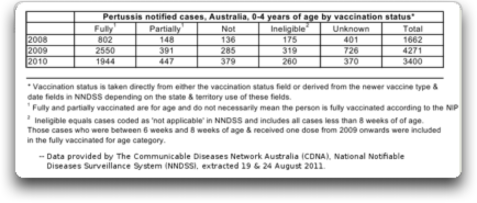
The question, or challenge if you will, is about the veracity of the pertussis vaccination schedule. Thus we must take care to ensure we elucidate notifications related to full immunisation as per the schedule. Take the following table of children between 0 – 4 years old, diagnosed with pertussis:
Pertussis notification by vaccination status 0-4 years, Australia August 2011
We see that a total of 9,333 notifications have been tabulated. 5,296 or 56.7% are fully vaccinated.
986 are partially vaccinated. 800 are not vaccinated. 754 are ineligible for vaccination. This gives us a total of 2,540 or 27.2% who are not fully vaccinated.
1,497 or 16% are unknown.
Do these figures reflect infection in the community? No, they reflect the vaccine status of children diagnosed.
Firstly as the table informs us “fully vaccinated” does not necessarily conform with fully vaccinated under the National Immunisation Program. Ineligible cases between 6-8 weeks of age that had received one dose in 2009 are included in “fully vaccinated”. Both these facts artificially inflate the “fully vaccinated” category.
Next we must accept that this table underestimates the actual number of infections in the community. The National Notifiable Diseases Surveillance System relies on a passive surveillance system which does not capture every case of pertussis in the community.
Which raises the question. Who is not making notification? Can we infer anything about the vaccination status of those not recorded in the above table? If so, does this help us understand the figures in the table better? As a matter of fact, yes.
Do these figures reflect the efficacy of pertussis vaccination? In other words, is this telling us that there are over twice as many infected children in our community who have been vaccinated (56.7%), than those who have not been fully vaccinated (27.2%) and thus reflect low vaccine efficacy? No.
Far more children are vaccinated against pertussis than those who are not. 95% vs 5% in fact. Even with greatly reduced chance of infection the sheer numbers of vaccinated children mean that “fully vaccinated” will dominate notifications. These figures also reflect the greater likelihood of parents who vaccinate to take their child to a GP and follow through with reporting, and also reflect the likelihood of conscientious objectors to avoid a GP and to not follow through with reporting.
For example a USA study published in Vaccine in December last year showed that parents who do not vaccinate their children are four times more likely to take their child to a chiropractor than a conventional doctor. In Australia we already know that chiropractors are vocal antivaccination proponents with strong links to antivaccination lobby groups such as the Australian Vaccination Network. Many chiropractors in Australia actively mislead consumers on the topic of vaccination making impossible claims, actively deriding vaccination.
But we can do much better than this and begin to build a profile of parents who refuse vaccination and later choose conscientious objection. Five days ago Australian Doctor reflected on the study:
A US survey found parents who refused childhood vaccinations were four times more likely to have sent their youngest, school-aged child to a chiropractor than parents of vaccinated children. Parents who conscientiously objected to school immunisation requirements were also more likely to have strong concerns about vaccines, to distrust local doctors and to have had one or more births in a non-hospital, alternative setting. […]
Are naturopathic and complementary healthcare providers reinforcing parental concerns and ‘anti-vaccine’ opinions or promoting exemptions, or are they providing healthcare without emphasizing vaccinations?
The pattern emerging is one of anti-conventional medicine, reinforced by alternatives to medicine masquerading as “complementary healthcare”. For our purposes we must now accept that unvaccinated children may be up to four times less likely to visit a GP when ill with pertussis. This means they may be up to four times less likely to appear as a notification. Regardless of exactly how many unvaccinated children are missed, we can see with confidence that the total is skewed away from highlighting unvaccinated children.
Thus the 8.6% of unvaccinated children noted in the table above (n=800) is possibly a significant underestimation. As parents who do vaccinate are more likely to visit a GP and report diligently, the total is additionally skewed toward the fully vaccinated. What this actually means regarding community impact is best captured in this post written by a mother whose vaccinated child was infected by an unvaccinated child who had been sent to school.
Now comes the fascinating aspect. “Unknown”. What does this mean? Really? For whatever reason, somewhere along the line the child’s vaccination status is not recorded at all, is recorded and fails to make it to the final notification table or is lost to genuine confusion or poor record keeping.
However if parents are not registered on the ACIR as conscientious objectors or as completing their children’s vaccination schedules they are also listed as “unknown”. Thus the following from Brynley Hull and Peter McIntyre is compelling [bold mine]:
Additionally, the proportion of conscientious objectors on the [Australian Childhood Immunisation Register] ACIR is likely to be an underestimate of the proportion of parents who don’t immunise because they disagree with immunisation, particularly in more economically advantaged areas. There are some non-immunising parents who ‘object to registering’, and they will refuse to complete any government-provided form.
“Refuse to complete any government-provided form”. Such as those that question the immunisation status of one’s child? That also is where a significant number of “unknown” cases have their genesis.
In tandem with our emerging profile of anti-conventional medicine beliefs driving the decision to not vaccinate and combined with the observation that CO’s are likely to contribute to the “unknown” category by not registering on the ACIR, we are able to make a strong inference that unvaccinated out-rate vaccinated in this category.
Whilst it is impossible to make outright factual quantified claims and rewrite that table, we may conclude that placed in the context of community trends it gives a less than reliable indication of infected subjects within the community. What it does give us is a snap shot of the vaccine status of notifications. Placed in context those notifications appear to be skewed away from unvaccinated and toward vaccinated subjects.
The most significant reason is the overwhelming numbers of vaccinated children in the community. Although appearing as a notification they have a far less severe case of pertussis and are unlikely to suffer disability or death. Other reasons for this would appear to be the intentional avoidance or substitution of conventional medicine, diagnosis and reporting of vaccination status by those in denial of vaccine efficacy.
Of course, people will use these figures to attack the overwhelming evidence in support of vaccination. That’s just what eccentric parent Greg Beattie has tried. It’s simply gobsmacking to read his misleading claim that only 11% of pertussis infections aren’t vaccinated. Actually it’s only 8.6%.
But the point to be made is whilst only 5% of 0-4 year olds aren’t “fully vaccinated” they make up a disproportionate 27.2% of infection notifications. Unsurprisingly his novel mathematics have been dealt with unceremoniously by A Drunken Madman.
There is no debate here. Pertussis vaccination saves lives.



 Losing In The Lucky Country