Pill Testing: What’s the evidence?

Critical overdose events at three Australian dance parties in January this year, have led to more calls for Pill Testing (PT) to be introduced as part of our nation’s effective Harm Minimisation drug policy. Harm Minimisation consists of three prongs: Demand Reduction, Supply Reduction and Harm Reduction.

Strong evidence

Pill testing is an evidence-based, harm reduction initiative backed in peer reviewed literature. It reduces drug harms and protects the health of those who access the service. Whilst Australian drug markets are uniquely sourced and specifically affect Australians, Harm Reduction Australia cites Harm Reduction International, in answering the question, What is harm reduction?

Harm reduction refers to policies, programmes and practices that aim to minimise negative health, social and legal impacts associated with drug use, drug policies and drug laws. Harm reduction is grounded in justice and human rights. It focuses on positive change and on working with people without judgement, coercion, discrimination, or requiring that they stop using drugs as a precondition of support.

PT has been demonstrated via live trials at Canberra’s Groovin The Moo festival in 2018 and 2019, to be effective in positively changing behaviour related to drug use. The trials were conducted by Pill Testing Australia, and resulting evidence greatly contributed to the fixed-site testing facility CanTEST, an ongoing trial in Canberra, introduced in July 2022. Indicating the controversy of PT, days before a third dance festival trial was scheduled to begin in 2022, Pill Testing Australia had public liability insurance withdrawn, without explanation.

A 2019 election study found two thirds of Australians support PT at music festivals. Examining deaths, PT initiatives, the success of harm reduction and drug user responses, Andrew Groves wrote in The Harm Reduction Journal in 2018:

Using a theoretical frame of pragmatism and drawing from national and international research evidence, this paper recommends the integration of pill testing into Australia’s harm minimisation strategy.

Australia’s Alcohol and Drug Foundation have published an excellent summary of the evidence supporting PT, and provide data on its successful international uptake. They also point out that public health experts have demonstrated support for PT. These include:

Queensland

In February 2023, directly citing the success in Canberra, the QLD Palaszczuk government announced plans to develop Drug Checking at fixed and mobile sites. This very shortly followed the state’s plans to reduce penalties for illicit drug possession, including heroin, ice and cocaine. More so, use of the term “drug-checking” is more realistic, inclusive and in line with international practice, as summed up in this opening paragraph from the QLD Network of Alcohol and other Drug Agencies (QNADA):

Drug checking – also sometimes referred to as ‘pill testing’ – involves members of the public voluntarily providing samples of suspected illicit substances they are intending to consume (e.g. tablets, capsules, powders, tabs/blotter paper etc) for chemical analysis.

Test results are provided back to the individual by health professionals as part of a personalised health and harm reduction intervention. The purpose of the intervention is to increase the person’s awareness of the risks associated with the substance with the aim of effecting behaviour changes that result in fewer harms or incidences of drug-related death.

In September last year the QLD government sought private providers to offer plans for two fixed drug-checking sites and mobile services. Of course, great strides like this rarely escape unhelpful politicisation. It was impossible to miss that when announced, the decision was called “soft on drugs” by QLD opposition health spokeswoman, and registered nurse, Ros Bates. It’s been a long time since I’ve heard that phrase used seriously.

Victoria

It is Victoria, to where we must turn our attention to partly examine the recent overdose events. RACGP reported eight people, most in their 20s were intubated and placed in induced comas after MDMA overdose at the Hardmission dance party in early January. Jollyon Attwooll reported:

Chair of RACGP Specific Interests Addiction Medicine Dr Hester Wilson described the introduction of festival pill testing as ‘a no-brainer’.
‘[Pill testing] actually does change people’s behaviour, and therefore it makes it safer,’ she told newsGP. Dr Wilson said that pill testing is ‘not a silver bullet’ but should be used as part of a range of measures to address drug use.

Following the Hardmission OD events, two women were taken to hospital on January 12 after suspected drug use at Juicy Fest. Current Victorian Premier Jacinta Allan initially stated she had no plans to introduce PT. Not long after, Allan advised that she would seek more information from the health department. The Premier sensibly observed:

I think it’s important to examine the evidence and advice and consider that in the policy setting that we have across all of our alcohol and drug policy measures, which is taking a harm minimisation approach, looking at the safety of people going to events.

The ACT

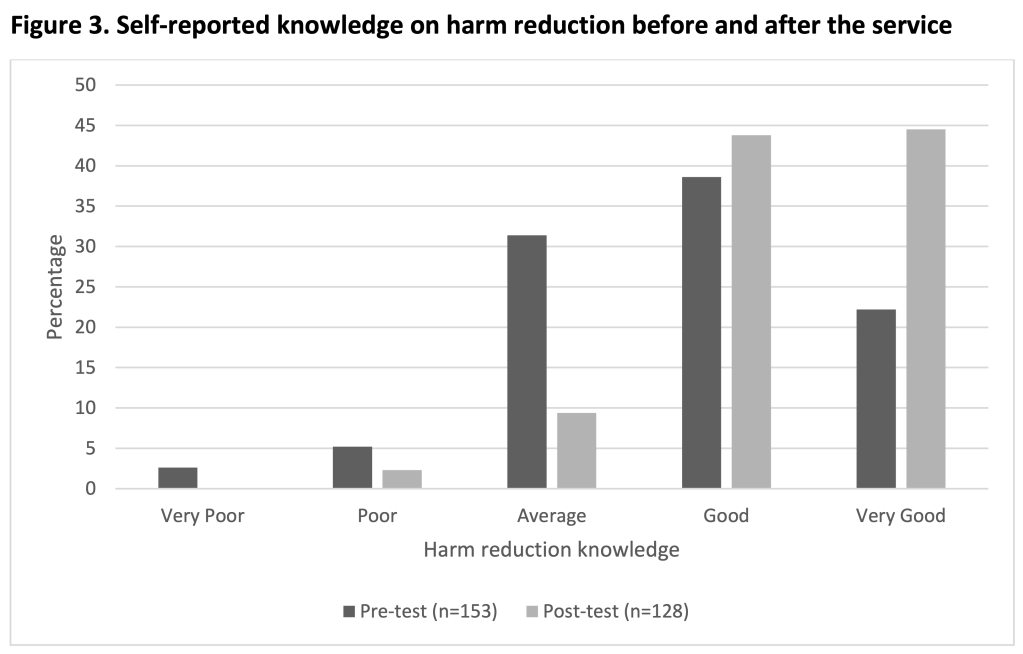
The evaluation document of the 2019 ACT Pill Testing trial is a lengthy read, with confirmation of Dr. Hester Wilson’s words coming through in data and discussion. I won’t copy/paste quotes from patrons who attended the PT facility, but I do recommend skimming through to appreciate that PT, like other harm reduction initiatives, changes drug users behaviour for the better. I did appreciate the graphs on self-reported knowledge of harm reduction before and after having a drug tested. Likewise, when it came to choice of information source, positive changes are evident.

Detailed explanation of the slides below can be found at section/s 6.1 (fig. 1), 6.4.1. (fig. 3) and 6.4.5. (fig.4).

Sydney

At the end of January a challenging scenario unfolded at Sydney’s HTID festival. Having taken what he thought was MDMA, an attendee fell unwell. Ultimately he responded to naloxone, a drug that reverses the effect of opioids. He had taken a tablet cut with nitazene, which is a synthetic opioid reported as “stronger than” fentanyl or heroin. Health workers and members of drug safety volunteers DanceWize, worked to advise the crowd. No doubt they saved lives. It turned out others from around Sydney had been hospitalised that weekend. One pill analysed, contained nitazene and no MDMA. Guardian reported:

Chris Gough, chief executive of the nation’s only pill testing venue in Canberra, said the detection of nitazenes in pills sold as MDMA showed the need for similar services in other states.

“In this case, where a nitazene has been sold as MDMA and therefore people are completely unprepared and potentially opioid naive, the risk of overdose is extreme,” said Gough, who is the executive director of the Canberra Alliance for Harm Minimisation and Advocacy.

“As we have now seen nitazenes in several jurisdictions in Australia it is time to act swiftly to provide drug-checking services throughout Australia so that we can respond to these drug trends as they emerge and thereby save lives and inform the community.”

Canberra

Saving lives is far more about probability than possibility. Indeed that’s been the case with MDMA overdose, MDMA pills cut with N-ethylpentalone or other adulterants. Early last year the Canberra walk-in site CanTEST discovered a pill cut with metonitazene; a synthetic opioid with a potency up to 200 times that of morphine. The owner chose to dispose of the drug on site. In January this year, ANU chemists made an Australia-first discovery of three new recreational drugs. All came from preparations sold as something else. CanTEST staff were able to discern the drugs were not what they were supposed to be, but tests were inconclusive. They were however, able to warn the community. One substance thought to be a derivative of Ritalin was in fact a new variant of cathinone, commonly known as “bath-salts”.

ACT Health have also developed a comprehensive document for festival planners. The Festivals Pill Testing Policy, examines PT options as a service available for festival attendees and how it relates to harm minimisation. Advice on general and specific health and safety measures, the importance of peer support, relaxation areas, emergency services and how PT works with providers and the event itself, is only part of the clear information presented.

Coronial support

A number of fatalities, and the fact that PT promotes positive decision making led to multiple calls to introduce the practice as a policy initiative. Over the last six years, four state coroners have spoken out. A 2020 inquest into five deaths from July 2016 to January 2017, led Victorian coroner Pares Spanos to urge the Victorian government to “urgently” introduce drug checking and a system to warn the community about dangerous substances sold as MDMA. The males aged from 17 to 32 died in a variety of tragic ways after taking what they believed was a modest dose of MDMA. Autopsy revealed the substances 25C-NBOMe and 4-Fluoroamphetamine in their systems. The cluster was discovered after 20 hospitalisations stemming from the Chapel Street nightclub district in January 2017. Victoria Police knew of the dangerous drug’s presence and later defended their decision to not warn the community.

In September last year, Victorian coroner John Cain also called on the government to introduce PT after the death of a man from an MDMA overdose in March 2022. The man had been observed taking a Blue Punisher, a pill with dangerously high levels of MDMA. He was admitted to the Royal Melbourne with brain swelling and multi-organ failure and died four days later. In his findings Cain wrote:

It is impossible to know whether, had a drug checking service existed, [the man] would have submitted a sample of an MDMA pill for testing before taking it at Karnival […] Notwithstanding this, a drug-checking service would have at least created the opportunity for him to do so, and for him to receive tailored harm reduction information from the drug-checking facility.

It is likewise impossible to know whether, had [the man] been provided information of this type, he would have changed his drug consumption behaviour; but likewise, in the absence of a drug checking service, this was not a possible outcome.

Politics

NSW and Victoria have established histories of resisting PT. After the death of a 26 year old at a Sydney music festival in February 2023, Dominic Perrottet mused about his government’s inquiry into methamphetamine and, rejecting any notion of PT offered a most unhelpful contribution:

But my clear message to people right across NSW [is] stay safe, and don’t take drugs and you will be safe.

Associate Professor David Caldicott, one of the driving minds behind CanTEST, suggested Perrottet had engaged in “magical thinking”. In Victoria we have the legacy of Dan Andrews who, citing the demonstrably false [HRJ] claim that PT encouraged pill taking (a belief favoured by Craig Kelly), insisted that under his leadership PT would never be introduced. The state opposition has been steadily opposed to harm reduction measures for conservative political reasons. Ignoring evidence, consecutive opposition leaders have opposed Safe Injecting Facilities and PT alike. I do acknowledge however, that the Victorian opposition has lobbied the state government for more effective emergency drug alert systems.

Recent research

A recent paper Drug-related deaths at Australian music festivals, was published last month in the International Journal of Drug Policy. Examination of the National Coronial Information System (NCIS) yielded the following results about fatalities at music festivals between 2000 and 2019:

There were 64 deaths, of which most involved males (73.4%) aged in their mid-20s (range 15-50 years). Drug toxicity was the most common primary cause of death (46.9%) followed by external injuries (37.5%). The drug most commonly detected or reported as being used was MDMA (65.6%), followed by alcohol (46.9%) and cannabis (17.2%), with most cases reporting the use of two or more drugs (including alcohol) and 36% reporting a history of drug misuse in the coroner’s findings. Most deaths were unintentional, with less than a fifth of cases (17.2%) involving intentional self-harm. Clinical intervention was involved in 64.1% of cases and most festivals occurred in inner city locations (59.4%).

There are complex factors identified in the paper, such as inner city events and multi-day events being more likely to be the site of a fatality. This may reflect policing strategies and the need for harm reduction strategies, respectively. Alcohol is known to be a compounding factor and its use is clearly identified as the second most prevalent substance (see bar graph below). Males are more likely to drink and use MDMA and this is reflected in them making up just under three quarters of deaths. Of 2000 festival goers surveyed, 52% were male. Poor decision making associated with alcohol intake is always a potential factor with illicit drug use.

Total number of drug-related deaths, deaths primarily attributed to MDMA, and deaths primarily attributed to alcohol, at music festivals in Australia by year ranges (n=64)

Harm reduction flexibility

What I took away from this paper was the recommendation that a range of harm reduction measures would each have something to offer in solving this persistent, multifactorial problem. More so, understanding data yielded by such research is vital to establishing the correct harm reduction approach for the Australian population in these instances. In conclusion, the authors write:

Harm reduction strategies such as roving first aid volunteers, mobile medical care, spaces to rest, hydration stations, and drug checking services, may best address some of the risks associated with illicit drug use at festivals, in addition to increased consumer education and awareness. It is important to understand the factors involved in these incidents in order to inform policies around harm reduction and law enforcement at music festivals in future to prevent further deaths.

Just as is the case with injecting facilities, substance checking is a successful, global health policy dynamic. Like all aspects of harm reduction the evidence supporting it is strong, persisting through variations specific to where it is a reality. In Canada, Toronto ran a comprehensive trial from 2019 to 2023. Switzerland has had drug checking available since the 1990’s. Now in a number of cities, the past decade saw a 250% increase in samples tested there. The UK has drug checking services, as does New Zealand.

Despite certain dynamics in NSW and Victoria leaving state governments out of touch with most Australians, there are cabinet ministers and cross-bench teams respectively, raising awareness and pushing for change in each state. When we look at arguments for and against PT, it appears arguments against, lack realistic substance. Indeed these documents recognise the importance of harm minimisation and its place in the National Drug Strategy. The most comprehensive argument “against” is criticism of the limitations of on-site drug checking, compared to laboratory testing. This is well understood and has been directly addressed by Dr. Monica Barratt. Of course the inevitable case that flexible harm reduction measures encourage or create the illusion of safety around illicit drugs is always mentioned. The evidence simply does not support this.

Drug Free Australia

This brings us to the anti-drug lobby. Certain groups contend that law enforcement and zero tolerance are superior in managing drug related harms. Stridently anti Harm Minimisation, they promote the ideology of a drug free world, consistently undermining evidence. In fact my own interest in the anti-vaccination lobby, began in 2009 and I was struck by similarities between their tactics, and those of the more lethal anti-drug lobby, I was long familiar with.

One group, Drug Free Australia (DFA), operate similarly to The Australian Vaccination-risks Network (AVN). DFA aggressively lobby government and an unsuspecting public, frequently using alarming irrelevant information. They attack the media, use meaningless or decontextualised data to dispute published evidence or argue that acknowledging a need for more research, reveals lack of any research. DFA dismiss harm reduction techniques by highlighting the ongoing presence of harm (eg; MDMA has caused deaths, thus no rationale for PT exists) or blame harm reduction for drug user risk-taking, and the familiar contention that PT “green lights” the taking of MDMA.

Such contentions stem from ignoring that high risk behaviour via illicit drug use continues all day, every day in Australia. Harm reduction aims to reduce the harms associated with this behaviour. It provides education, promotes safe choices, saves our health-system money, and yes, saves lives. One way DFA contend PT actually kills, is by misrepresenting the PT card system. A drug found to contain what the owner expected is “white-carded”; as is say, an MDMA pill free of any pollutant. Yet, MDMA causes most overdoses say DFA, so a white-card result must be potentially lethal. Well, no. The drug is what the person expected. Not double or five times the amount. So the patron may take the drug they bought and, remembering the slide show above, will henceforth access reputable information on harm reduction.

Those slides are from the ACT Pill Testing Trial 2019. DFA attack those findings in a deceptive piece, arguing the opposite to accepted findings. On page 7, they selectively quote from evaluators who discuss that someone who discovers that the drug is what they thought, “…are likely to take as much or more” (p.33). And that “…concordance between expectation and identification is associated with stable or increased intention to take a substance” (p.34). DFA use this to extrapolate to the conclusion that PT will lead to more use and thus, more death. This requires logical fallacies: Decontextualisation and cherry picking of data. Reading the full sentences and paragraphs in which those terms appear leaves the reader with a positive, not negative view of the evaluation. See pp. 33-34, and consider Table 5 from p. 32, below:
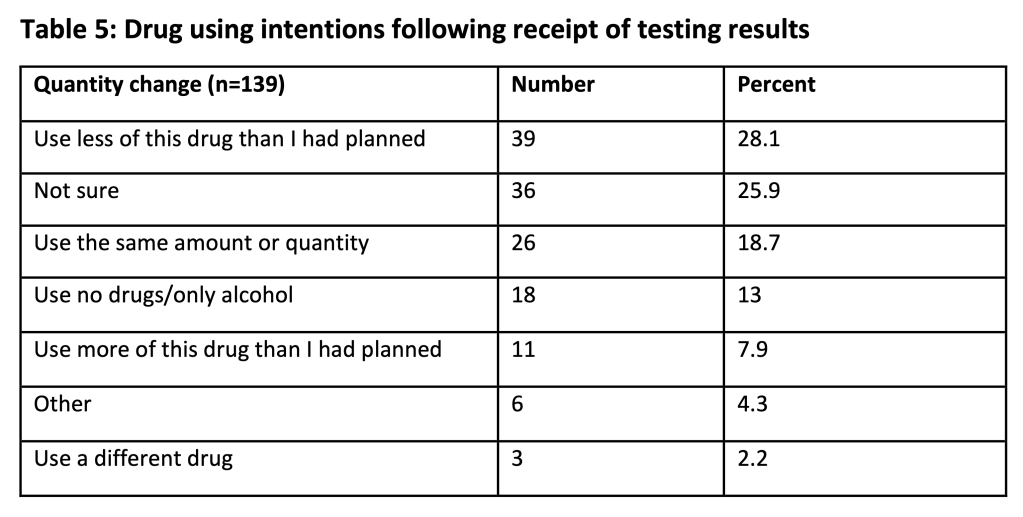
When read in context we see that patrons intent to use drugs did not dramatically change, but their intent to engage in harm reduction behaviour notably increased. Eg, also on p.33 (bold mine); Many interviewees reported that the quantity of drugs that they intended to use did not change after testing, as the drug was identified to be what they expected. And, Many interview patrons indicated that their intention to use did not change, but their intention to engage in harm reduction behaviours did increase. Also, this and other evaluations have found non-concordance between patrons’ expectation of what a substance is and what a substance is identified to be, commonly leads to reduced intention to take that substance.

So, the comment pulled from p. 33 by DFA, omits crucial clarification from the evaluation. Some was printed on the same page, just two paragraphs above. For example:

Interview data suggests that this group were looking for confirmation of the contents of the presented drug, and information about how to reduce potential harms. Many interview patrons indicated that their intention to use did not change, but their intention to engage in harm reduction behaviours increased.

Prior research also indicates concordance is associated with an increased likelihood of taking the drug, and non-concordance with a decreased likelihood (Valente: 2019, and Measham: 2018). More so, the evaluators stress that modification of drug consumption can’t be measured alone. Contextual factors, such as type of festival influencing available drugs, need to be considered during interpretation of results and future study design.

Finally, the insistence by DFA that MDMA, not impurities, lead to most fatal overdoses is fashioned only to discredit PT. Still, five deaths in the six months leading up to January 2017 and investigated by Coroner Pares Spanos involved 25C-NBOMe and 4-Fluoroamphetamine. Recent discovery of potent opioids nitazene and metonitazene raise further concern. N-ethylpentalone is regularly found in so-called MDMA pills. But why get hung up on MDMA? Drug checking can check any drugs and CanTEST discovered three unknown substances, later confirmed at ANU. This is how a new type of cathinone (bath salt) was found. Supposed ketamine was actually a new type of benzylpiperazine (BZP) stimulant. The third find was propylphenidine.

Conclusion

Pill testing or drug checking is a harm reduction measure supported by consistent evidence in peer reviewed literature. Globally, where introduced, it has demonstrated success and improved understanding of behaviour. It is supported by most Australians, where valuable data has been gathered from on-site testing at music festivals, and the fixed site CanTEST, in Canberra.

This has expanded the nation’s understanding of drug user insight into, and uptake of harm reduction dynamics. QLD is the most recent state to confirm permanent drug testing. Arguments against the initiative are morally subjective and/or deceptive, leading to their swift deconstruction.

Drug checking saves lives and is supported by public health experts across Australia. As a dynamic, expanding, harm reduction initiative, it should be introduced nation-wide into Australia’s harm minimisation strategy.


♠︎ ♠︎ ♠︎ ♠︎

Originally published as Pill Testing: The harm reduction initiative supported by strong evidence

Dr. Albert Stuart Reece again restricted by medical authorities

The Medical Board of Australia has placed fifteen limitations on the practice of Dr. Stuart Reece of Highgate Hill QLD. The conditions, enforced on 21 December 2022, have resulted in the temporary closure of the Southcity Medical Centre where Reece practices.

Reece (pictured) is a controversial figure in addiction medicine and a vocal critic of Australia’s successful policy of harm minimisation. He holds no formal qualifications in addiction medicine, but has authored or coauthored extensively on the subject, presently as an adjunct professor at UWA. Almost exclusively, his writings link illicit drug use, methadone and medical cannabis to death and disease.

Experts have refuted certain works as “reefer madness”. Reece has long associated his Christian faith with treating addiction. His book, titled “Let My People Go: A Theology of Addiction”, was published in 2016. His work is favoured by extreme anti-drug pressure group, Drug Free Australia, and frequently cited by them in lobbyist material, media replies and parliamentary submissions.

This is not the first time regulators have acted to ensure the safety of his patients. An article published on this blog in December 2011 examined his use of unapproved naltrexone implants and the deaths of 25 patients who had undergone the treatment. In 2009 Reece was suspended from practice for supplying morphine to opiate dependent patients and falsifying records to disguise the fact. This was because of his ideological opposition to evidence backed methadone maintenance therapy. That suspension was in turn suspended for three years.

The Medical Board of QLD, Health Practitioners Tribunal observed at the time that Reece:

… has a somewhat evangelical approach to this area of medicine and because of that he does appear to lack a degree of insight and objectivity in relation to the treatment of his patients. Furthermore, he seems to feel that the ends justify the means in terms of treatment of patients.

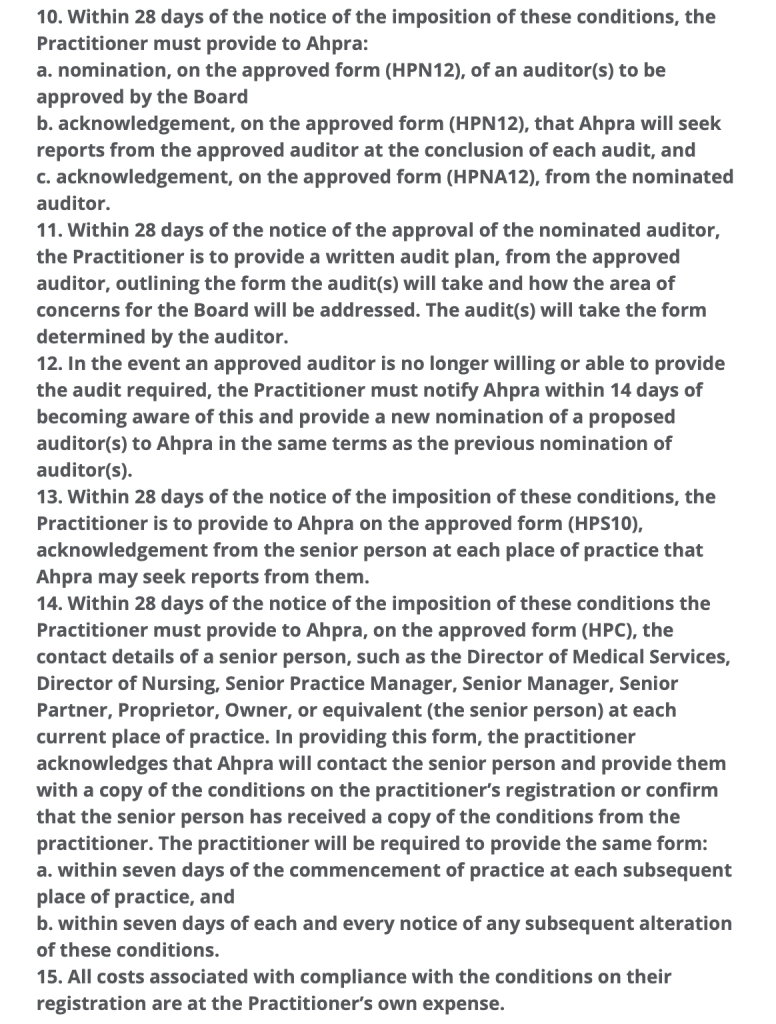
Today, the catalyst for intervention includes the number of patients being bulk billed per hour and quality of care. This is reflected in the limitations on practice (complete list in slideshow below).

1. The Practitioner must not exceed four (4) of patient consultations in any one hour (60 minutes). […]

5. The Practitioner must only practise as a general practitioner when supervised by another registered medical practitioner with knowledge and experience in addiction medicine (the supervisor).
For the purposes of this condition, ‘supervised’ is defined as:
The Practitioner must consult with the supervisor who is always physically present in the workplace and available to observe and discuss the management of patients and/or performance of the Practitioner when necessary and otherwise at weekly intervals. […]

7. In the event that no approved supervisor is willing or able to provide the supervision required the Practitioner must cease practice immediately and must not resume practice until a new supervisor has been nominated by the Practitioner and approved by the Board. 

A search for general practitioners providing services in addiction medicine in the Brisbane area yields modest results. There just isn’t enough practitioners providing these select services across Australia. If one adds the fact that such providers have often taken on all the patients they can, it isn’t beyond comprehension that Dr. Reece is unable to find a supervisor. Reece has loyal supporters amongst his patients, who have a Facebook page here. They have argued in a petition that finding a supervisor is “an impossibility”. The petition, “Reinstate Dr. Stuart Reece Immediately”, contends that the predictable lack of a supervisor indicates that the action taken is about the control of services offered under bulk billing.

AHPRA is also advising that Dr Reece must have another Doctor with him for consultations into the future to oversee his work to their satisfaction. This requirement is an impossibility. AHPRA and Dr Reece both know that this doctor does not exist. There is not a ‘spare doctor’ lying around that is available for this. […]

THIS IS NOT ABOUT PATIENT CARE OR BETTER HEALTH OUTCOMES. THIS APPEARS TO BE ABOUT CONTROL OF THE TYPE OF SERVICES OFFERED TO PATIENTS WHO NEED BULK BILLED DOCTORS. 

The petition is a long heartfelt plea seeking to justify the way Reece operates his practice. It makes the point that certain appointments, particularly prescription refills, may require only five minutes. The petition also notes that Reece would be forced to close his doors in part because, “his practice would be limited dramatically by the immediate reduction of the number of patients he is able to see daily…”. Whilst I empathise greatly with these patients and find removal of any addiction treatment services troubling, one cannot escape the fact that such a huge patient load should never have eventuated. Health Practitioner Regulations state, “A Practitioner must NOT exceed four (4) patient consultations in any one hour (60 minutes)”.

There’s no doubt that Medicare is not meeting the needs of Australian General Practitioners. The patient rebate is beyond inadequate, being markedly out of step with the Consumer Price Index (CPI). This manifests in significantly fewer consultations being bulk billed, and in many practices fees now apply to concession card holders. For Australians surviving on the aged or disability support pensions a visit to their GP is now financially prohibitive. The end result is a health system under strain. However there comes a point where increased patient quantity, means decreased quality of care. Let’s remember that the Health Practitioners Tribunal observed in 2009 that when it came to treating patients Reece lacked insight and objectivity, and felt the ends justified the means. The same document notes (point 22):

He does provide care to a large number of detoxifying and drug dependent patients. In June 2009, alone, he had 409 Subutex patients in Queensland and I understand the numbers are larger at the moment. From 2001 to 2007 he was responsible for 8681 registrations of opiate withdrawal registrations in Queensland.

Arguably, Reece is the architect of his own professional distress. As noted above, in November 2009 the practice suspension applied to Reece was itself suspended for three years. Yet less than two years later there was no tone of contrition for falsifying medical records to supply opioid dependent patients with morphine. The occasion was a Senate Inquiry into the Professional Services Review (PSR) Scheme, to which Reece, representing the now defunct Australian Doctors Union, made a submission. Bear in mind Reece has today been saddled with limitations to prevent excessive bulk billing at the expense of Medicare. The PSR “aims to protect the Australian public from the risks and costs associated with inappropriate practice within Medicare…”. Reece began his submission:

Prof. Reece: The Australian Doctors Union is a nascent union which has come together to support each other through the nightmare experience of PSR’s incompetence, lies, intimidation and bullying. In addition to doctors damaged by—

CHAIR: Hang on please. That is making accusations and it is not the way that we take evidence. If you could please refrain from using that sort of language, that would be appreciated.

Reece continued for a full five minutes explaining why he believes the PSR “has been shown to be waging a very successful war against general practice in this country”. He blamed the PSR for doctor suicides, marriage breakdowns, a lowered bulk billing rate, marginalisation of women, being racist, sexist and for damaging “many excellent doctors”. One of these was his ideological colleague, “Dr George O’Neil of naltrexone implant and detox fame”. Despite the fact naltrexone implants are not TGA approved Reece felt O’Neil should have been assisted by Medicare. Perhaps most alarming was when Reece included himself as one of those excellent doctors. Referring to himself in the third person, he humbly submitted:

Associate Professor Stuart Reece, one of the foremost detox doctors in the nation and a world authority on the long-term effects of opiate addiction.

This dear reader, is the crux of the matter. Stuart Reece is not a world authority on the long term effects of opiate addiction. In 2007 he opposed needle-syringe programmes, methadone maintenance therapy and the policy of harm minimisation in general. He informed a parliamentary inquiry that condom use was linked to AIDS deaths. Yet in June 2009 Reece was managing 409 Subutex patients. Buprenorphine is the opioid in Subutex and today it is distributed in combination with naloxone under the brand name Suboxone. It is a successful mainstay of substitution therapy for opioid dependent patients seeking to manage addiction and eventually cease opioid use. It is a key element of harm minimisation.

Exactly how a strident opponent of harm minimisation has today found himself with so many opioid substitution patients that Ahpra require supervision and auditing of him, is baffling. It may however have something to do with the attitude toward Medicare and the PSR Scheme reflected in his 2009 submission. Or his 2012 comment, What is wrong with medicare? (p. 170) bemoaning the PSR and Medicare audits. It may also have something to do with the disdain Reece has for evidence based health policy and genuine, original research. Reece has spent a career convinced he simply knows better. Better than the bulk of his colleagues, better than global research trends and better than health authorities. In short, Stuart Reece is the cause of the dilemma faced by so many of his patients.

Having said that, one cannot deny that Reece and Southcity Medical Centre have been accomodating the needs of a great many patients. An excessive number of patients. However accounts such as this on reddit aren’t isolated. They suggest the practice is busy, waiting times are high but Reece is attentive and compassionate. Google reviews are more varied. According to the petition there are 1100 patients in need of treatment. Over the last 18 days, 224 people have signed. The goal is presently 500.

Ultimately this situation doesn’t bode well for these patients. It is doubly sad that many are not able to see that the cause of their problem is Stuart Reece himself and not Ahpra. Funnelling high numbers of vulnerable in-need, at-risk patients through the surgery is far from acceptable. The only way forward is to abide by the limitations. Anything less is to abandon his patients.

Stuart Reece must accept that the ends do not justify the means. It is time to place patients first.

Medical Board of Australia restrictions imposed on Dr. Stuart Reece


♠︎ ♠︎ ♠︎ ♠︎

Latest update: 3 January 2023

Harm Reduction: How Australia Stopped HIV

In 1985 before the introduction of needle and syringe programmes (NSP) 90% of Australian injection drug users reported sharing injection equipment. By 1994 following introduction of NSPs this figure had fallen to 20%. In 2009 this figure was around 15% possibly reflecting the constant number of distributions from NSP programmes over the previous decade.

One of the most powerful modes of resistance to the spread of HIV/AIDS is Harm Reduction (HR) measures.

In Australia, HR exists as one of three pillars of Harm Minimisation (HM) – our official illicit drug control policy. The other two pillars are Supply Reduction and Demand Reduction. Reduction in supply receiving the lions share of funding directs energy at reducing international and domestic supply. Reduction in demand receiving less funding delivers programmes and initiatives designed to reduce the demand for drugs within communities.

Harm Reduction receiving the least funding from the HM pile targets the harm to individuals that eventuates from behaviour. HR has always drawn condemnation from conservative groups because of the association with drug use and sex. Initially men who have sex with men (MSM). Then later through maximal exploitation of drug using pop culture. Nonetheless, study after study comparing countries and districts within countries to have implemented HR or not done so, show a stunning success in favour of HR.

This post will look almost exclusively at IV drug use. HR for Injection Drug Users (IDU) includes provision of clean needles and sterile water, swabs, sharps containers for disposal and specialised filters capable of removing bacteria. Opioid Substitution Therapy (OST) including methadone and buprenorphine and safe injecting facilities are pivotal aspects of HR. Heroin on prescription is not available in Australia but has shown unprecedented success as a HR measure where it has been implemented.

Despite the evidence supporting HM as an effective policy and the reality that Supply Reduction [law enforcement] is the most highly funded pillar, Aussies are still subject to notions such as “Tough on drugs” and code words such as Drug Free Australia’s Harm Prevention. Intuitively it sounds fine. Why minimise harm if you can prevent it?

Yet on examination “harm prevention” is the abandonment of HM for the reintroduction of Just Say No approaches. Known to have had deleterious effects on self esteem, no effect on lowering drug use and providing the field upon which drug use flourished, Just Say No quite simply failed, and failed Epically. Today of course, skeptics are well aware of how beliefs and behaviours are reinforced through attacking them. Harm Prevention even more so is code for punitive, custodial and forced behaviour control.

It is at times perplexing as to why so much energy is spent on attacking HM entirely. Supply Reduction however is based in part upon the reality that people want, seek, use and enjoy illicit drugs. Education to accompany this is open and honest – not promotion of illicit drug use . Yet to the conservative mind the idea that their children, friends or the community at large is the demographic from which drug demand comes, is morally untenable.

With HR it is aspects of this pillar that equally cannot be accepted. To the conservative mind, just as condoms cause AIDS and promote sexual promiscuity so too do clean needles, safe injecting facilities and safe injecting education encourage drug use. Drug Free Australia write:

We need to re-focus our drug policy and practice on an approach that prioritises primary prevention, if we are to see any real change in the health and wellbeing of our current and future generations of young people. We need to acknowledge that Australia has one of the highest rates of drug use, because of a priority on Harm Minimisation rather than Harm Prevention, and we now need to take a leaf out of the books of the policy makers in the UK and United States. Both these countries have given greater emphasis to prevention initiatives, while still aiming to help people who are drug dependent, to recover.

The towering dishonesty inherent in this nonsense is typical of the tactics used by DFA in what has become over just a few years, one of the most immoral lobbying groups on the illicit drug landscape. Australia has high levels of cannabis use and abuse. This is handy in arguing that we have high drug use generally. A synopsis of the above is simply: Harm Minimisation has caused Australia to have one of the highest drug use levels in the world. We should be doing what America and the UK do.

The UK get a mention because they reclassified cannabis to a Class B (like speed/other amphetamines) from a Class C drug and punish users accordingly. Of 2.3 million USA prisoners in 2010, over 65% or 1.5 million meet DSM IV medical criteria for substance abuse or addiction. On top of this another 458,000 have a history that meets DSM IV criteria for addiction, were under the influence when they committed their crime, committed a crime to finance the purchase of drugs or were incarcerated for a drug law violation.

Between 1960 and 1990 official crime rates in Finland, the USA and Germany were similar. Incarceration in Finland dropped 60%, remained stable in Germany and quadrupled in the USA, driven primarily by drug convictions.

Today around around 80% of USA prisoners are incarcerated due to illicit drugs. 11% are receiving some type of “treatment”. The last thing Aussies need is a dose of the USA nightmare.

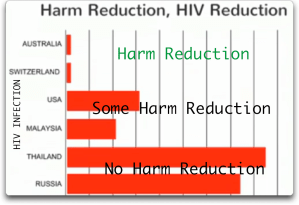
What of the impact of changing our strategy on HIV and consequently other types of blood borne virus transmission? The graph below is from a TED talk by Sereen El-Feki, vice-chair of the Global Commission on HIV and the law:

HIV infection in Injection Drug Users

Whilst Thailand and Russia have ignored Harm Reduction and Australia and Switzerland have embraced it the USA and Malaysia employed only some Harm Reduction techniques. Should Australia embrace USA tactics our prison population will explode, HIV infection in IV drug users will increase by about eight times the present rate and treatment – presently some of the best in the world with plunge to 11%. The cost to the public health purse would simply gut present programmes and destroy any hope of improvement for say, dental, mental health, public hospital care, nursing home care etc.

There is a 4 minute out-take from Sereen El-Feki’s TED talk in April this year below. Or download MP3 here.

The first case of AIDS was reported in Australia in 1983. At that time morbidity rates to rival World War II were expected. Following the innovative approach of HR, levels of infection in all demographics fell from 2,500 per year to 500 in the decade following inception of HR. This infection rate has remained stable.

At the time, initiation of clean needle supply contravened the states Drug Offensive which, already highly criticised, had regrettably escalated drug use and criminalisation via the failed “Just Say No” approach. The pilot programme ran from St. Vincents Drug and Alcohol Service on November 13 1986. It was run in the suburb of Darlinghurst. An evaluation recommended they should be adminstered by social workers, drug agencies, pharmacies, medical professionals and urged:

The urgent widespread introduction of needle exchange programmes in all states and territories

There needed to be an amendment to the Drug Misuse and Trafficking Act following which NSW pharmacies sold “anti-AIDS kits”. By mid 1989 there were 40 public outlets run across Sydney. By 1994 there were 250 outlets run by NGOs, government agencies and pharmacists distributing 3.5 million syringes annually. For the year 1993-1994 10.3 million syringes were distributed across Australia. The USA with 15 times the population of Australia distributed 8 million syringes in 1994-1995.

More comprehensive analyses refuted the concerns of increasing drug use. No increase in drug use was seen in any country that had instigated needle exchange and more so, attendance at rehabilitation and abstinence programmes had increased. Australia’s Commonwealth Department of Health (now Dept. of Health and Ageing) estimated that 25,000 cases of HIV were averted in the 12 years from 1988 – 2000 due to needle exchange alone (page 10 – 3.5.3).

The infection rate among Aussie IDU sat at around 3%. Users who were also MSM had an infection rate of 27%. In Russia where HR for drug users was denied, the figure for IDU was between 75 and 90%. One study in 1997 looked at 81 European cities with and without needle exchange programmes. Seroprevalence (measured from the presence of HIV within blood taken from used syringes) increased 5.9% annually in cities without clean needle distribution, and decreased 5.8% in cities with needle exchange.

In an astonishing comparison, Edinburgh with no NSP experienced a 65% HIV infection rate amongst IDU. Glasgow, less than an hours drive away and with NSP experienced a 4.5% increase in HIV infection amongst IDU. The one issue Australia faced was return of used syringes. Users were placing them in sharps bins. Yet to return any syringes to Exchanges meant risking being questioned by police. A used syringe is evidence of illicit drug use and this acted as a disincentive to return items for safe disposal.

Of note however is that fears and front page headlines of beach goers and joggers stepping on syringes and undergoing “agonising waits” for blood tests to be cleared of HIV infection are out of proportion. HIV dies very quickly once outside the body and syringes on beaches have been discarded into drains, washed out to sea and then beached. Nonetheless despite the absence of actual transmission it is an unpleasant experience which can be lessened by removing all offences for possession of a used syringe.

Clearly, Australia’s decision to take the necessary steps and bring together members of drug using demographics, gay rights advocates and prostitutes collectives and allow them to consult upon and shape this programme was one of it’s greatest public health initiatives ever.

Between 2000-2009 NSPs have averted 32,050 new cases of HIV and 96,666 Hepatitis C infections. Needles distributed increased from approximately 27 million to 31 million in that decade. For every one dollar invested, four dollars have been saved. 140,000 Disability Adjusted Life Years were gained over the same decade.

Still, conservative biblical fundamentalist group Drug Free Australia boldly inform us that Return On Investment is quite wrong and should show an expense. In earlier posts you can access from the tag on the right, I highlight how they cherry pick phrases and select data out of context. At other times they simply dismiss WHO findings based solely on the reviews of just one Swedish researcher, Dr Kerstin Käll.

So to be very clear, Dr Kerstin Käll, working for the Swedish government who are dodging UN demands to establish more Needle Exchanges and accelerate HR or remain in breach of the international right to health, conducted no research but criticised methodology that was favourable of NSP success. Her own research argues regular testing for HIV is more of a prevention – yes prevention – than clean needle supply.

It’s easy to get confused because whilst Käll supports NSP programmes as reducing hepatitis C in prisons DFA refute any change in HCV attributable to NSP programmes… anywhere. They also lobby stridently against the establishment of needle exchange in Australian prisons. Of course, despite the evidence above they insist the impact of NSP on HIV is “inconclusive”.

Ultimately it’s irrefutable how successful Harm Reduction has been in controlling the spread of blood borne viruses. Paramount amongst these is HIV, Hepatitis C and Hepatitis B. The most significant and visionary measure to now apply would include steps to decriminalisation and regulation.

Today however, this is where Australia is falling behind.

Australia still shirking drug policy discourse

The prohibition of illicit drugs is killing and criminalising our children, and we are all letting it happen

Senator Bob Carr (Foreign Affairs Minister), Mick Palmer (former Federal Police Chief), Nicholas Cowdery (former Director: NSW Public Prosecutions), Geoff Gallop (ex W.A. Premier)

On April 3rd this year Aussies woke to news of “the most significant challenge to drug laws in decades”, as reported by Fairfax media below. Or download MP3 [41sec]:

Interesting then that Bronwyn Bishop looks set to sit on the Front Bench of Australia’s next Federal Government. In 2007 Bishop chaired a House of Representatives Senate Inquiry into the impact of illicit drug use on families. Dreamed up by John Winston Howard to give an airing to the extreme right wing anti-drug movement whilst simultaneously heaping shame upon the brilliant minds driving the policy of Harm Minimisation, it was an appalling example of a predetermined agenda.

For many years prior it was axiomatic to those involved with illicit drug policy and the impact of organised crime that prohibition was a failure. The War on Drugs is a war on people and it surprised no-one that Bishop entitled her all singing all dancing moral panic final report “The Winnable War”. It was rejected by every D&A policy, funding and health service of any standing. Indeed by many more with pretty much no standing.

Drug Free Australia (DFA) and a range of conservative anti-drug lobbyists held it in high regard. Ann Bressington, who squeezes anti-vaccination, anti-fluoride, anti-Harm Minimisation and Festival of Light fundamentalism into her day, was delighted. Then again, Ann verbally coached a witness through his submission to say he “escaped harm minimisation, not addiction”.

Bishop had given succor to one of their fundamentalist favourites, and on the same day attempted to batter one of their sworn enemies for his devotion to health policy, science and evidence. Perhaps I shall recount one exchange with the G.P. who used naltrexone, sedatives and the bible in bringing about the death of 25 of his heroin dependent patients in 20 months [summary]. Now an “expert” in naltrexone related fatality with Drug Free Australia (I kid you not) he said then:

I was interested to discover that the actual historical site of Sodom and Gomorrah has recently been found in Israel. On the bottom right of this slide are pictures of sulphur balls that have been found there. So consequences matter, and they can destroy a civilisation quickly, as we saw with yesterday’s tsunami and so on.

This slide shows a tree with snakes, which to my mind is a lot of the stories that you hear from harm minimisation. Methadone, syringe giveaways, injecting rooms, medical cannabis, heroin trials all those are catered for by the same people. But, on the other side of the tree, you have all the downsides, the side effects, which are not talked about in this culture.

It is of extreme concern to me that medical science which is known and understood overseas is not understood and not talked about and given no airplay whatsoever in this culture.
These are old slides I made several years ago, charting a lot of these behaviours: this is condoms and the AIDS risk, charting the parallel between condoms and AIDS deaths.

Ms GEORGE (Senate committee member): Sorry, I do not understand. What are you saying – condom protection and AIDS deaths are correlated?
Dr Reece: Yes, condom sales and AIDS deaths. I am saying that there is a statistical association between the two.

Under Keeping Up The War On Drugs Bishop wrote in her report:

A significant amount of damage to families and the community has been avoided by the government’s uncompromising approach to the trafficking and use of illicit drugs. Drug industry elites who have repeatedly claimed that the ‘war on drugs’ has failed are simply wrong. […]

The Australian Federal Police (AFP) and its partners have been highly successful in limiting the damage of illicit drugs in Australia. The number and weight of detections for selected illicit drugs are generally higher than before 2000…

Increasing drug seizures reflect increasing drug traffic. Increasing traffic reflects increasing and increasingly varied demand. Such demand indicates more use and we already knew more use was due to ineffective tactics globally. The snide term “drug industry elites” still has life in certain circles. Essentially it demeaned those who dealt in evidence alone and advised accordingly.

Australia endured the rejection of science by politicians for the very tenuous reason of hopefully securing votes. At the States and Territories health ministers’ conference in Cairns in 1997, the issue of a heroin trial – the latest step in Harm Reduction to show exciting success in Europe – was raised. Ultimately Michael Wooldridge, four states and the ACT voted for trials to begin. The result was 6-3 in favour.

Whilst credit is due for his continued funding of needle exchange programmes, Howard had not just a conservative eye but a retributive one. The success of Harm Minimisation under the previous government left him keen to change the essence of a policy that had seen Australia emerge as world leaders. Thus we copped his Tough On Drugs approach – a dismal failure. He immediately cancelled the trial on advice from his Evangelical adviser and first Chair of the ANCD, Major Brian Watters.

Watters was already making enemies in the ANCD itself, for merging his Salvation Army role with what should have been best practice. A Drug Free Australia Board member, Watters’ disdain for science and academics was manifest. He had spoken on an episode of Four Corners with John Howard:

WATTERS: I mean, the Salvation Army’s been doing it for 120 years. No good these academics telling us it doesn’t work.

HOWARD: And I feel in very safe hands, with the police on the one side and the Salvation Army on the other.

WATTERS: It’s the law and the prophets.

HOWARD: It’s the law and the prophets. That’s right.

So it continued. The “law and the prophets” looking after in-need Aussies. One of the most used phrases in the bible, it’s most significant aspect is that Jesus came to “fulfill” The Law and The Prophets. Then we got the faith healers and the purists. The Evangelists and the righteous. Anti-harm minimisation groups arose – DFA itself funded by [then] Health Minister, Tony Abbott. Others re-emerged keen to sink the conservative boot in to such sinful wickedness as clean needles, condoms and honest, open health education.

In 2007 The World Federation Against Drugs firmed it’s resolve in Sweden in striking mockery of the NGO Forum at the 50th Commission on Narcotic Drugs. Human Rights, Harm Reduction and Health Responses we heard from [then] UNODC Executive Director, Antonio Maria Costa, would be crucial to future global policy initiatives. Apparently not if conservatives could help it. Populated, perhaps unsurprisingly, by a number of biblical fundamentalists, evangelists and young earth creationists one might appreciate the uncompromising stance and anti-rights position that WFAD entertain.

On May 21st Mark Metherell reported:

DRUG Free Australia may not be a household name but its leaders claim a role in repelling further moves towards what they see as the evil of drug decriminalisation.

It fears the ”tough on drugs” regime of the Howard government is unravelling, with the abandonment of the school drug education strategy and declining use of community advertising campaigns. […]

‘Our view is that Australia’s illicit drug policy is too lenient, sending mixed messages to our youth,” [Jo Baxter] said.

Here’s a picture drawn by a child attending a DFA school education strategy (Hint: be drug free, go to heaven). Interestingly the Education Department in S.A. has a different view to Baxter on the matter. That article mentions a member of Youth for a Drug Free Australia, who is also head of The Recovered Drug Users League SA, Ryan Hidden.

He just happens to be the chap Ann Bressington coached to lie to the House of Representatives. But later Jo had him chatting to kiddies in school against Education Department instructions. A few weeks earlier he chose to dob in tobacconists the very day after Ann Bressington’s “bong ban” came into force.

Now… where did I read “mixed messages”?

Jo Baxter is Executive Officer of Drug Free Australia, Spokesperson for the S.A. “campus” of the evangelist driven Delgarno Institute is also vice-president of the World Federation Against Drugs. If you want an attack on human rights driven policy in Australia, Drug Free Australia is the group. If you want a “Heads Up People!” attack on the Global Commission on Drug Policy, whose main report also concludes prohibition has failed, the Delgaro Institute is the place.

But if you want to read an attack on the host of eminent Australians who produced the report raised in Parliament last April 3rd, Jo Baxter will even pop on her WFAD V.P. hat. So what do we get? Labelling the report compiled by 24 former senior state and federal politicians, experts in drug policy and public health, young people, a leading businessman, legal and former law enforcement officers, as “lacking substance” Jo begins:

The so-called ‘high level’ report on illicit drugs, suggesting that decriminalisation across the board, will solve Australia’s drug problems, lacks sound scientific basis and credibility and, as such should be discounted. The following a (sic) just some of the reasons:

First, it is not the ‘War on Drugs’ that has failed, but rather, it’s the failure of Australia’s Illicit Drugs Policy to satisfactorily address primary prevention.

For over 25 years Australians have endured a policy of Harm Minimisation, which has left a ‘train wreck’ in families and communities across the nation. […]

They have failed to recognised that, between 2000 and 2006, Australia had a Tough on Drugs Strategyand our illicit drug use rates dropped significantly. The trend is now turning around. […]

Which is it I wonder? A Harm Minimisation train wreck or a Tough on Drugs victory? Harm Minimisation arrested the spread of HIV, Hepatitis B and harmful drug using practices. The surge in heroin use is well documented as due to immigration of a S.E. Asian demographic able to import large quantities and sell at reduced rates. If prohibition was working initially this would not have happened.

Instead criminal cartels blossomed and later shifted to manufacturing their own product indoors. If prohibition worked that would never have happened. It seems to me like Tough On Drugs actually oversaw the rise of many new classes of drugs and an actual shift in the drug using habits of our community more in line with criminal profit.

As always Harm Minimisation and Reduction have functioned to manage the fallout from prohibition’s failure.

Effectively Jo’s article is a repeat of what the Drug Free Australia mantra has been, no matter what the title, debate, paper or conference. A synopsis of what Bronwyn Bishop concocted in 2007. A reflection on their bogus research on Supervised Injecting Facilities, Needle Syringe Programmes, Medicinal Cannabinoid research and so on.

The global Drug Free movement is to illicit drug policy in the community, what creationism is to evolution in the science curriculum.

Given the demonstrable failures of prohibition, we are still reticent to discuss this issue vociferously. Clearly it is a topic that can be easily misinterpreted, accidentally misrepresented or used to cast mischievous accusations toward those who mount firm evidence backed arguments. Much of the confusion stems from the fear that drug use under relaxed laws will equate to greater use. Often this is expressed as if one believes use will be compulsory.

Yet needle provision did not lead to increased use. The return on investment is four dollars for every one dollar invested. As needles are returned potential virus reserves are removed from the community. Users reciprocate with services learning to manage health and exploit opportunity to cease using. New users are resourced and educated to develop the means to never risk cross infection. The entire community benefits and vital dollars are not spent dealing with preventable problems.

Still, the false belief that use is encouraged this way persists in the face of overwhelming evidence to the contrary. Similarly the notion of deregulation is seen as a “free for all”, quite bizarrely likened to alcohol. Perhaps understandably challenges to drug prohibition evoke images of the end of alcohol prohibition. With this comparison comes the assumption all drugs will be readily available and an integral part of culture. Businesses will provide and houses will be stocked. The roads will be full of talkative, super-horny, hallucinating, dozing, dancing, slurring and very hungry drivers heading for pizza.

No. The only relationship to alcohol prohibition will be the removal of the millions of Al Capone types and the violence, intimidation, corruption, ruined families and poisoned customers that inevitably evolve. The failure of prohibition can be seen in a top down, if not linear fashion. Yet the way in which it is finally dismantled is in my mind not completely predictable and remains a complex bottom up venture to be managed with flexibility.

Evidence across the world shows use drops or remains stable with relaxed laws. The Portuguese example has presented in over a decade, remarkable success. The advantages of removing extensive punitive measures and simple stigma become manifest in a few short years. Legal resources freed from the waste of hassling petty users are brought to bear on serious crime. Users, freed from the fear of severe prosecution and shame become proactive in seeking help.

Potential users become a smaller market as drugs become controlled by authorities and subject to medical oversight – not criminal endeavour. More so, the opportunity to get ones life back on track is a reality that provides huge motivation to avoid drug use and experimentation. Presently in Australia, by the time users need substantial help they may be alienated from society, ashamed, angry and overwhelmed by the prospect of “perhaps” getting a decent life back under way.

Options used to mange illicit drug use are well explained in the Australia 21 Report:

  • Decriminalisation means specified proscribed behaviour is removed from the criminal law and is dealt with under the civil law.
  • De-penalisation means reducing the severity of penalties.
  • Legalisation means that the specified forms of behaviour are no longer offenses dealt with by the law.
  • Regulation means establishing a strictly controlled legal market for drugs as is the case with pharmaceutical drugs, tobacco products and alcoholic beverages.

Deconstructing prohibition is not a licence to take drugs. It is a means to remove lucrative profits from criminals and steer in-need and at-risk Aussies toward a healthier and more hopeful future. Those able to see a way out of the present mess all hold a somewhat unique view. No one person holds the solution, but certainly as experts and visionaries, groups such as the Australia 21 Board are urgently needed to begin the process of improving Australian lives and saving tax payer dollars.

400 Aussies die from drug related causes annually and countless others suffer a range of related harm that varies from mild to severe interpersonal conflict, financial tragedy or horrific violence. Lives are cropped of potential and under the present system valuable, talented and vital community members slowly withdraw from society even years after they have ceased to use any drugs.

Stopping us from turning this mess around is the movement I opened this article with. Whether it’s same sex marriage, being an atheist or removing the stigma from elicit drugs a vocal and well organised minority conclude that they can do any and everything to impose their own moral values on the rest of the society. In effect however, knowing that they cannot successfully do this the outcome is merely to impede progress to equality and thus limit the freedom of others.

Hence we cannot really have this discussion without at some point acknowledging it isn’t resisted just on philosophical grounds. The continuance of the war on people and the fruitless prohibition of illicit drugs, regardless of means used, is the single aim of those who today are seen attacking Harm Minimisation and Harm Reduction.

Therein lies the problem. Whilst arguments are akin to anti-vaccination rhetoric: repetitive, evidence free, conspiratorial, personal and peppered with linking all related ills to the present policy, in this case conservatives do have political sway. Thus full and open discourse regarding the retrieval of control from organised crime must include the reality that the anti-drug movement is guilty in it’s own way of inflicting suffering, corruption and death on our nation.

More so, they know this well. The bulk of attacks on Harm Reduction revolve around creating the pseudoscience and pathological theories to argue HIV has not been controlled by reducing the personal exchange of blood and body fluids. Despite the exquisite correlation between Harm Reduction absence and HIV presence across the globe it is still argued that HR “enables” drug use, thus causes all negatives that go with it.

Discourse is poor because the reality is that no government would dream of even broaching the subject for fear of alienating the conservative vote. Dr. Reece states above that condom use parallels AIDS deaths and God’s wrath will follow Harm Reduction measures as a “consequence”. Rhetoric fed to parliamentarians about Injecting Facilities is nowhere near as absurd, looks genuine to the untrained eye and can influence decisions. We should expect the same polish in defence of prohibition.

Changes in equal rights now look set to take years. The public is well versed in who the bigots are in matters of marriage, abortion and euthanasia. For the public to be prepared to take on a gradual change in their world view as it pertains to drug use and abuse, those truly dedicated to abolishing prohibition need to expose the bigots and the saboteurs also. And yes, it may be that simply opening channels of discussion will be enough to do this.

The evidence is irrefutable. Prohibition has failed and it is killing Australians. We don’t just need discussion on the necessity for change. We need discussion on why there is as yet no change and instead a persistent silence. Every report on this issue and every report on Harm Minimisation success is attacked by anti-drug lobbyists such as Drug Free Australia.

When we do expand the discussion we must be prepared to lay the blame at their door.

Dr. Stuart Reece: Drug Free Australia’s secret

An interesting story sits hidden away in the June 2003 edition of Focus magazine – a QLD based fundamentalist Christian publication.

On page one we meet Graham Preston who was jailed back in June 2003 for pro-life antics. His sole direction was Proverbs 24, verse 11: “Rescue those being led away to death”. 

The story on page two is about Drug Free Australia member, Dr. Stuart Reece (below). Thinking of the above proverb, it is disturbing to learn that over a period of twenty months, twenty five opioid dependent patients who sought his care, died following insertion of unregistered naltrexone implants.

Story from Focus QLD June 2003

Naltrexone is an opioid antagonist. In a 2013 position statement on naltrexone implants the Royal Australasian College of Physicians stated on page 6:

The World Health Organisation, UNODC (United Nations Office on Drugs and Crime) and UNAIDS (United Nations Program on AIDs/HIV) have endorsed treatment with methadone and buprenorphine. The World Health Organisation has included methadone and buprenorphine in its Essential Medicines List. Naltrexone has not been endorsed by any United Nations organisations nor is it included on the Essential Medicines List. […] The RACP does not support the routine use of sustained release naltrexone formulations (implants or depot injections) while the product is not registered with the TGA.

In 2003 when the Health Practitioners Tribunal adjourned Reece’s case indefinitely, such implants were available through the TGA Special Access Scheme. This 2008 article posing the question of safety, examines implications of the scheme and difficulty in securing sound data. The authors note:

The strong theoretical rationale for the usefulness of naltrexone in treating heroin dependence justifies further rigorous investigations. However, the uncontrolled use of unregistered products of uncertain quality hampers the development of proper clinical trials.

Above, we read that Reece was “deeply hurt” by the investigation that followed. The families of his dead patients are not considered. Incredibly, the above Focus article claims that the charges brought against Reece were “based on false reports by drug addicts”. No evidence is presented in support of this statement. No independent source has confirmed the existence of false reports. Brought by QLD Health, the charges were just and likely saved lives.

There’s a familiar, yet awkward tactic advanced in his defence. The type of logical fallacy that suggests if positive feedback is presented then to suggest otherwise is not only wrong but “false”. Someone has provided the Focus author with decontextualised data designed to be critical of methadone maintenance therapy. This argument is frequently used by the opponents of harm reduction and proponents of naltrexone. We read “590 patients died with methadone in their system”. It’s an underhanded attempt to suggest methadone was the cause of death. Note this doesn’t read, “died because of methadone overdose or complications”. 

We don’t know the cause of death, but I’m certain if methadone was the cause this article would have made it abundantly clear. These figures are pulled from toxicity data in coronial reports. They include hospital patients receiving palliative care, out-patients receiving pain relief, road fatalities, suicides, homicides, poly-drug related deaths and so on. All opioids carry risks and fatalities do occur in the opioid maintenance demographic. Nonetheless, when prescribed by a GP and dispensed in a controlled environment as is the case in treatment of opioid addiction, methadone is a safe option.

I can’t comment much on a reference to a “recently published article” without the source, other than to note that rapid detoxification can pose a significant risk of overdose. Naltrexone has been used orally to block the effects of opioids. The National Drug and Alcohol Research Centre note in, Mortality related to naltrexone in the treatment of opioid dependence: A comparative analysis;

Because naltrexone blocks the actions of opioids, naltrexone rapidly removes a person’s tolerance to opioids so that a given dose of opioids would have more effect than previously. The lack of naltrexone, not its presence, exposes a naltrexone-maintained patient to risk of opioid overdose. If naltrexone treatment is ceased, individuals may be at risk of opioid overdose if they choose to return to opioid use.

Regarding the safety of naltrexone in comparison to the safety of methadone or buprenorphine in the management of opioid addiction, one reads:

When considering deaths per periods of high and low risk, the mortality related to naltrexone was approximately seven times that of methadone during the period of high risk and three times the rate during the period of low risk. […]

This study also found that the mortality related to oral naltrexone treatment was higher than that for buprenorphine and methadone… whether estimated as deaths per 1000 treatment episodes or per 100 person years of risk, the death rate for naltrexone was higher and we believe the estimate provided here is a conservative one. […]

The mortality rates suggest that oral naltrexone treatment, as it is provided in Australia, can place recipients at significant risk of death, and at higher risk than buprenorphine and methadone. However, it should be noted that naltrexone treatment is a useful option in some well-motivated patient subgroups that form a minority of the opioid-dependent population.

Regarding implant technology:

A number of potential issues also relate to this form of treatment, and rigorous research is certainly required to carefully examine the potential for this delivery system to represent a viable treatment option for opioid-dependent persons. Specifically, these issues are: the lack of randomised controlled trial evidence of naltrexone implant efficacy in the treatment of opioid dependence; considerable inter and intra-subject variability in the blood levels of naltrexone resulting from an implant (and so the level of opioid blockade); the lack of good monitoring of adverse events relating to the use of naltrexone implants; and the acceptability of the naltrexone implant preparation to patients and medical professionals.

The article also identified that an existing lack of systematic data reception by coronial databases, hinders accurate assessment of fatalities related to treatment with naltrexone. In 2008 The Medical Journal of Australia elucidated on this problem when it published a paper identifying twelve hospital admissions, related to implants, to two Sydney hospitals over a 12 month period beginning in August 2006. The Abstract conclusion read:

These severe adverse events challenge the notion that naltrexone implants are a safe procedure and suggest a need for careful case selection and clinical management, and for closer regulatory monitoring to protect this marginalised and vulnerable population.

Thus, in attacking methadone as a treatment modality, Reece raises concerns with this author about his impartiality. A read of Dr. Reece’s articles in the arguably biased Journal of Global Drug Policy and Practice is revealing. Also, purporting that methadone causes premature ageing and cell death, without presenting a mechanism and correcting for other variables such as smoking, nutrition and other lifestyle habits is poor science. In the above Focus article this is presented, without a source, as “new research suggests”.

The Focus article was in error to claim vindication. The QLD Health Practitioners Tribunal adjourned indefinitely over the twenty five deaths. It was beyond ambitious for Reece to claim, before a Parliamentary inquiry, to “hold the world safety record” in administering this very treatment. Such comments have little to do with supporting evidence, and more to do with misinformation.

By 1999 research indicated naltrexone was potentially unsafe despite seemingly miraculous stories of recovery. As an opiate blocker, it was emerging with the promise of a quick solution. Yet controlled trials were lacking. Wodak and Hall discussed the evidence in an editorial in the MJA, that also briefly noted the role of the media in confusing community attitudes. Under Parliamentary protection Dr. Reece accused Hall of “scientific fraud”. 

In September 1999 the practice of Dr. Stuart Reece was raided following concerns with his approach to addiction treatment. Threatened with closure, he claimed that the QLD government would have blood on itʼs hands if he could not resume practise. Ultimately, he was not closed. Twenty months later, 25 of his patients were dead. ABC 7:30 reported on 4 June 2001.

KERRY O’BRIEN: When the anti-heroin addiction drug Naltrexone was introduced to Australia five years ago, it was hailed as a breakthrough.

Since then, thousands of addicts have been treated with Naltrexone, successfully breaking their deadly habit.

But despite initial expectations it hasn’t proved to be a universal remedy by any means.

Many addicts have lapsed back into heroin abuse and some have subsequently died from overdose.

In Queensland, an investigation is now under way into the practice of Naltrexone activist Dr Stuart Reece, after the deaths of 25 addicts who had undergone his program.

The investigation has already prompted a ban on the use of experimental Naltrexone implants, designed to take the place of tablets.

All had followed the Reece regimen. He was raided by the QLD Medical Board and again closed down. Rev. Fred Nile, speaking as leader of the Christian Democratic Party said at the time:

The action taken by Queensland Health is heavy handed intimidation against those who show true compassion toward heroin addicts. It would appear, by this move, that Queensland Health would prefer that addicts remain addicted to heroin. I fear that this is another step in the mounting campaign for government provided free heroin

Three months later he claimed twenty five “drug addicts” died as “part of a conspiracy”. In September 2003, The ABC featured Reece on their Sunday Nights programme:

Stuart Reece is a Brisbane doctor who finds himself in a bit of bother some of his fellow medico’s at the moment because of his conviction that faith can be instrumental in curing what ails one… The difference perhaps is that Stuart Reece is a born again Christian believer, and makes no apologies for his direct appeal to the Christian Gospel and the power of Christ.

Clearly, the largely untested naltrexone implants were in this case a problem. Had basic support, such as a contact or counselling been available, the recovering patients would have been more safely monitored. It is regrettable that there was undue faith in naltrexone combined with a moral objection to opiate replacement therapy. This is complicated further, in that had naltrexone been demonstrated as effective, financial rewards would have been significant.

In addition, the November 2009 Health Practitioners Tribunal transcript, Medical Board of QLD vs Albert Stuart Reece makes for compelling reading.  An unrepentant critic of methadone Reece chose to illegally supply opioid dependent patients with morphine. The transcript includes:

It is clear from his evidence before the Tribunal that he is also very passionate about his practice and in strong disagreement about the continued use of Methadone as a treatment for heroin addiction. […]

Particulars of the referral notice in this matter are that the Registrant on 39 separate occasions supplied Morphine intended for use by drug dependent persons without obtaining approval from the Drugs of Dependence Unit in preparation either for Naltrexone treatment or other detoxification treatment. […]

He admits to doing so and to falsifying medical records when doing so and involving third parties in this conduct. […]

But it is also clear from his evidence, and as I’ve already said that he’s a man who has a somewhat evangelical approach to this area of medicine and because of that he does appear to lack a degree of insight and objectivity in relation to the treatment of his patients. Furthermore, he seems to feel that the ends justify the means in terms of treatment of patients.

In October 2005 Christian conservative MP Tony Abbott Liberal (then Federal Health Minister) funded Drug Free Australia to the tune of $600,000. They did not adhere to conditions under which they were awarded the funding, ultimately emerging as right wing lobbyists. They are followers of Swedenʼs zero tolerance policy and the USA hardliners [open letter]. Reece, a supporter of biblically driven abstinence and a Texas trained fundamentalist, was supported by Drug Free Australia.

By April 2007 Dr. Reece was testifying to the Standing Committee on Health and Human Services (see below) that the immoral policies that permitted condoms – the real cause behind AIDS – clean needles, opioid therapy for addicts, non-punitive cannabis laws, harm reduction and general tolerance for ill Aussies would be our doom. The Senate Standing Committee looked on as Reece introduced himself by saying, “I certainly know the science”. He then displayed a photo of “the archaeological site of Sodom” and a tree with snakes instead of branches. [Page 33/FHS 27]. He explained its relevance. “There will be consequences”.

Reece attempted to explain the moral consequences of policies such as Harm Minimisation, by blaming a tsunami on Divine punishment. He added:

I was interested to discover that the actual historical site of Sodom and Gomorrah has recently been found in Israel. On the bottom right of this slide are pictures of sulphur balls that have been found there. So consequences matter, and they can destroy a civilisation quickly, as we saw with yesterday’s tsunami and so on.
 
This slide shows a tree with snakes, which to my mind is a lot of the stories that you hear from harm minimisation. Methadone, syringe giveaways, injectingrooms, medical cannabis, heroin trials all those are catered for by the same people. But, on the other side of the tree, you have all the downsides, the side effects, which are not talked about in this culture. It is of extreme concern to me that medical science which is known and understood overseas is not understood and not talked about and given no airplay whatsoever in this culture.
 
These are old slides I made several years ago, charting a lot of these behaviours: this is condoms and the AIDS risk, charting the parallel between condoms and AIDS deaths.
 
Ms GEORGE (Senate committee member): Sorry, I do not understand. What are you saying – condom protection andAIDS deaths are correlated?
 
Dr Reece: Yes, condom sales and AIDS deaths. I am saying that there is a statistical association between the two.
 

As reported in Crikey by Ray Moynihan Reece decided the “disease drugs, sex and rock-n-roll” was the problem. Asked about the safety of naltrexone, Dr. Reece chose instead to attack internationally renowned scientist, Dr. Alex Wodak [Page 59/FHS54], who specialiseʼs in blood born viruses and epidemiology. Put differently, this means Wodak supports condoms, clean syringe access and used syringe collection: dire threats to our very civilisation, contended Reece. Yet Australian communities with dozens of dispensaries and hundreds of clients report no methadone deaths.

How did Committee Chairperson react to this? Bronwyn Bishop abused public health scientists (who had outlined the success of decriminalisation in Europe), yet she gushed in support of Dr. Reece. A pre-determined agenda in what was billed as the most important family-relevant inquiry of Howardʼs government spoke volumes. Bishop’s final report was rejected nationwide by all but religious fundamentalists and Christian lobbyists. Not one publically funded treatment or advocacy agency missed the opportunity to criticise the report. Bishop went on to call for the removal, and adopting out, of the children of parents struggling with addiction. Should parents conquer their addiction there would be no chance of reunion:

Their [Liberal-led House of Representatives] controversial plan – which also includes compulsory treatment for teenage addicts, restrictions on methadone programs and withdrawing funding from drug programs that promote harm minimisation – was dismissed as “a disgrace” and “frightening” by some anti-drug campaigners.

Gordon Moyes, the “Christian voice in politics” is also quoted on rumours in Drug Free Australia’s recent attack upon Lancet authors, of which Reece is a co-author. This involves quoting Moyes, who is quoting drug addicts he happened to speak to. Moyes also praised naltrexone despite the concerns of our medical community about it remaining unregulated. Regrettably, regulators have not prevented its use by the same people year in, year out.

When the Medical Journal of Australia exposed the fact these same prescribers were not reporting adverse reactions, despite TGA requirements under the Special Access Scheme, Drug Free Australia published a rebuttal. It made direct reference to Dr. Stuart Reece himself. Offensively, it reported that Reece “studies” death rates post naltrexone treatment. It was titled, Australia could be the biggest loser.

Dr. Reeceʼs motivation is arguably reflected in his obsession with teenage and childhood sex and sexual assault, murder, violence… all due to “the depraved advertising industry” which catalysed “the disease sex, drugs and rock-n-roll”. Advertising womenʼs nudity, outside of “a strictly medical context” is “incredibly powerful pornography”, he has observed.

Today, a decade plus since this evidence-free pursuit began, Reece is arguably a pin up boy for religious fundamentalism. Five or more years ago he promised Parliament that his results were “statistically powerful” and “revolutionary”. Of course, there are no results. Itʼs the same certainty that only faith can sustain. If prayer cures homosexuality, addiction is a certainty. His latest work “proves” naltrexone is safer than opioid therapy.

As reported on ABCʼs 7:30 Report,  in 2006 multiple disciplinary teams have steadily found naltrexone has a fatality rate over four times that of opioid therapy. Dr. Reece, and others who seek funding and likely lucrative contracts seem to have a formula no others can find. More recent work with implants by his colleague, gynecologist George O’Neil, show ambiguous results, despite claims of success.

Regrettably this work is tainted with poor practice and again, Christian healing. Their biggest problem is the fraud published in the MJA surrounding suppression of negative outcomes – some almost fatal. Failure and coercion to boost sample numbers seems to be the norm. W.A.’s Freshstart clinic observes on its website chaplaincy page:

Our Christian Beliefs

The Nature and Character of God: we believe in one God, who has existed forever as Father, Son and Holy Spirit in a community of pure and eternal love.

The Fresh Start Statement of Belief embodies the second of the core commitments of the organisation:

The Creation of Humanity: men and women were created in God’s likeness with God-given dignity and worth in order to know, love and serve him forever.

Sin and Evil: sin came into existence through human rebellion against the good purposes of God. Sin is self-centred opposition to the love of God that separates humans from God and leads to death and eternal lostness.

Etc, etc….

There is no problem with having a strong faith. Yet there’s a difference between faith based welfare and faith based practices. When the supernatural impinges on your objective reasoning in managing the lives of others, no amount of friendly lobbyists can assuage this conflict of interest.

Today, Drug Free Australia bill Reece as “an expert in naltrexone” and in fatalities. Is this a joke? I honestly don’t know. What’s certain however is that his role in the recent DFA misleading outing to attack Vancouver’s Insite and the research backing it is not based upon any skill in harm reduction.

Drug Free Australia have many secrets. This one is quite shameful.

  • Comments posted online from a relative and a friend of Reeceʼs patients.

Just Jules says: June 5, 2010 at 6:01 am Ahhh there is none so blind as those who can not see .. Dr Reece in my eyes is a discusting (sic) human being .. I am the mother of a child he treated .. He also treated my daughter in law and the mother of my first grand child .. If you want to see what his methods leave you with, go see my daughter in law who for the last 11 years has been in a home for the severely brain damaged .. In is own words to me ” they are just reoffending drug addicts”. He is a wolf in sheeps clothing and should of been stopped before he started.

Vicki PS says: July 5, 2010 at 12:02 pm I came across this site looking for help for a friend of my daughterʼs. This young woman has been increasingly unhappy with her treatment under Dr Reece. He is treating her addiction with Suboxone, a subutex/naltrexone combination drug. Her big concern is that this unethical, immoral disgrace to the profession reduces her dosage if she has not been to church! This girl is now in early pregnancy and is scared that she could miscarry if this idiot messes around with her medication to suit his pathological world view. I find it frankly incredible that Dr Reece is still permitted to practice.


References:

  1. MORTALITY RELATED TO NALTREXONE IN THE TREATMENT OF
    OPIOID DEPENDENCE: A COMPARATIVE ANALYSIS – NDARC (HTML) (Download PDF)
  2. Unplanned Admissions to two Sydney Public Hospitals after Naltrexone Implants – MJA. (HTML) (PDF)
  3. IMPACT OF ILLICIT DRUG USE ON FAMILIES: HOUSE OF REPRESENTATIVES – Tuesday, 3 April 2007 (Download PDF)


Last update: 12 February 2023

♠︎ ♠︎ ♠︎ ♠︎