Less than a month after Sydney coroner Mary Jerrum referred a provider of naltrexone implants to the NSW Health Care Complaints Commission, the Christian Democrats’ Reverend Fred Nile revealed he wants them used as compulsory treatment for opioid addicts.
Naltrexone implants are not backed by any convincing evidence but the rapid opioid detoxification [ROD], opioid blocking properties they offer appeal greatly to anti-drug crusading Christian evangelists. Long opposed to harm reduction measures and evidence based treatment of addiction, such as methadone maintenance, far right Christians and conservatives see naltrexone implants as a moral masterstroke. Muscling into the action in recent years are the profit-focused, such as Sydney’s Ross Colquhoun, director of Psych ‘n’ Soul.
I’ve previously written about Dr. Stuart Reece, who features in the video below with the same title as this post. His abuse of patients with naltrexone and Jesus saw 25 of them die in 20 months. His career is the epitome of callous faith based pseudoscience which uniquely targets evidence based harm reduction measures. When I posted on a faux “research” paper he had co-authored with other members of Drug Free Australia, I referred to an exchange on an email list hosted by the Alcohol and Drug Council of Australia. It was on this list years ago that I first read Ross Colquhoun defend naltrexone implants as “common sense”. Indeed his evidence free defence of implants led me to conclude that his “common sense” was the equivalent of the religious zealots’ “belief”.
Both individuals are signatories to Drug Free Australia’s so-called position statement which includes funding of naltrexone implants as an “urgent pro-active change to our illicit drug policies”.
Handing down scathing findings into three deaths, the coroner recommended that the HCCC consider proceedings against a doctor working at Colquhoun’s Pysch ‘n’ Soul, Dr. Jassim Daood. According to the ABC she noted, “a number of disciplinary cases have already been completed about some of the clinic’s other staff”. The scale of potential problems becomes clear when one considers the implants have never been approved for use, eager staff have little or no training and post-implant support regimes are entirely absent. For over a decade these implants have been available via the TGA’s Special Access Scheme, which is designed to allow patients access to otherwise unavailable drugs to treat conditions deemed potentially fatal in the absence of that drug.
In this case the Scheme is being exploited as a loophole whilst the implant option itself has left in it’s wake a litany of failure and fatalities. Colquhoun is unlicenced to perform ROD but ignored requests from the NSW Health Department in mid 2010. SMH wrote on October 20:
Despite this direction, Colquhoun resumed the treatments while still unlicensed between July and September of that year, only desisting when Grace Yates, a 23-year-old with a five-month-old baby, was given ROD and naltrexone at the clinic on September 29, 2010. She suffered a heart attack and died two months later, having never regained consciousness.
It’s worth considering this failed treatment option is likely to be expanded under a coalition government. As health minister in the Howard Government, Tony Abbott provided the funding for the launch of the evangelical Drug Free Australia from the Tough on Drugs/Assets of Crime kitty. Describing themselves as “Australia’s Peak Drugs Body” they failed to meet the conditions of the funding, choosing instead to sabotage related health policy basics. Without doubt they have proven to be to addiction treatment what the Australian (anti) Vaccination Network is to the management of vaccine preventable disease.
Abbott also sent $50,000 they way of Psych ‘n’ Soul in the same year, showing exceptionally poor judgement. There is little doubt with enemies of Harm Minimisation such as Bronwyn Bishop, Sophie Mirabella and Christopher Pyne on his proposed front bench, Australia’s strong evidence based approach to addiction management would suffer. As the coroner noted:
It appears that a patient only had to present at the clinic to be enthusiastically recommended for rapid opioid detoxification, no matter what their history or situation, without alternatives being discussed or considered or any information given out of the risks involved.
Another death related to the attempts at ROD Psych ‘n’ Soul is now infamous for, involved Michael Poole, 48. He was described as “delirious and delusional” after ROD and died at the Prince of Wales Hospital in Sydney two days later. The third death involved James Unicomb, 23 who died from drug toxicity following a poly-drug overdose, which followed the ROD and occurred whilst an implant remained active. This lack of appropriate follow up of patients is perhaps the most appalling failure related to the practice of ROD and implants.
Rapid detox’ doesn’t treat addiction. It removes cravings and leaves patients open to the possibility of overdose. Often they are dependent upon high doses of benzodiazapines which raises the risk of opioid induced respiratory depression. As addiction is not treated, behaviour cannot be expected to change. It is for this reason follow up should form the most important aspect of rapid detoxification. It is for the same reason that implants have such a high failure rate in “curing” addiction.
One can only imagine the profit made and moral crusading accomplished from treating now dead addicts who were essentially exploited, not treated. Of course, testimonials abound. Whether it’s those who adore Reece for showing them the way to Jesus or Colquhoun’s (third time lucky) performer in the below video, let’s not kid ourselves. The dead cannot speak.
Alex Wodak, director of Sydney’s St. Vincents Hospital Alcohol and Drug Service observed:
How they are allowed to be used for routine purposes in several states in this country beats me. It goes against all the normal regulations and I think the only explanation I can understand is that this is allowed in this case because they’re only drug addicts. […] We really need a national independent inquiry into the regulatory failure, the serious regulatory failure that’s gone on with Naltrexone implants for over a decade.
Indeed we do.
Naltrexone implants backed by zealotry but not evidence
The Global Commission on Drug Policy recently released yet another report condemning illicit drug prohibition and the War on Drugs.
Entitled The War on Drugs and HIV/AIDS – how the criminalisation of drug use fuels the global pandemic the report lists 6 key dynamics behind the trend.
1.) Fear of arrest drives persons who use drugs underground, away from HIV testing and HIV prevention services and into high risk environments. 2.) Restrictions on provision of sterile syringes to drug users result in increased syringe sharing. 3.) Prohibitions or restrictions on opioid substitution therapy or other evidence based treatment result in untreated addiction and avoidable HIV risk behaviour. 4.) Conditions and lack of HIV prevention measures in prison lead to HIV outbreaks in incarcerated drug users. 5.) Disruptions of HIV antiretroviral therapy result in elevated HIV viral load and subsequent HIV transmission and increased antiretroviral resistance. 6.) Limited public funds are wasted on harmful and ineffective drug law enforcement efforts instead of being invested in proven HIV prevention strategies.
Let’s forget “drug war” and call this problem what it is. Treating drug use as a criminal offence. Now, just by raising that image we’re into different waters entirely. Pointing to problems with the criminal model immediately evokes suspicion of compulsory promotion of illicit drug use. We’re conditioned to assume if we don’t punish drug use, it will be everywhere and bring about a host of nasty outcomes.
Mostly, we’re well conditioned to associate drug use with crime and to see it as criminal. Stitched on to this is the pop culture image from which we draw stereotypes. My favourite is one I often refer to as Quinn Martin. Quinn Martin Productions brought us Streets Of San Francisco and a host of other unrealistic 1970’s TV Cop shows. If you wanted a crime – it was drug related. A bad guy or a weak willed loser? Toss in a druggie.
Of course, I’m not suggesting we imagine this. The reality is criminals are made from associating in criminal circles and from being incarcerated, regardless of the reason. How this fits in with the drug-crime punishment model was addressed recently by eminent Australians who authored the Australia 21 Report. They state:
The prohibition of illicit drugs is killing and criminalising our children, and we are all letting it happen
Rather than legalisation alone, that report discussed regulation, decriminalisation and de-penalisation. Far from being an open slather free ride these measures involve control, certain losses of freedom, the need to demonstrate responsibility and a major focus on rehabilitation back to a productive and useful lifestyle. What they don’t involve is the destruction of lives and sustaining criminal enterprise at huge cost to the community.
Yet in Australia we do very well managing HIV/AIDS in injection drug users [IDU]. 16 million use IV drugs globally. Almost 20% live with HIV. Fortunately, Australia managed to keep that level at 3%, and a significant number of that sample were at higher risk statistically from acquiring HIV from another high risk behaviour. This level remained stable for decades.
So the question does arise. Apart from acknowledging shocking human rights abuses, tragedy in many nations and an ongoing source of disease and corruption, what policy aspects need we mull over?
Since the Howard years Tough On Drugs initiative and emergence of groups like Drug Free Australia lobbying against expanded protective measures, the level of HIV in IDU jumped to 4%. It remains an exquisite example of how just a few years of delayed and abandoned Harm Reduction responses, increased punishment and disinformation about Harm Reduction efficacy has an immediately devastating impact on HIV control in Aussie IDU.
The fact that this collective undermining of Harm Minimisation occurred during a period when Harm Reduction services, research and supporting evidence expanded rapidly in Australia is testimony to how effective disinformation and intuitively themed attacks on evidence can actually be.
Still, as of April this year we remain extremely fortunate thanks to Harm Reduction:
HIV in IV Drug Users matched to Harm Reduction
The single greatest sabotage of Harm Reduction initiatives under the auspices of John Howard, was the suppression of a heroin on prescription trial in 1997. This had strong bipartisan support and the Federal Health Minister, four States and the ACT were excited about the decision to go ahead. Under instructions from then ANCD head Major Brian Watters – later to become a Board member of Drug Free Australia – Howard immediately vetoed the decision.
Exactly how many HIV cases, ruined lives and deaths this led to is impossible to estimate, and I would err toward a minimal estimate. Still, 15 years later we can assume the body pile is now somewhat impressive. In what is unique insight into how Howard in turn manipulated the zealots who tried to manipulate him, he never flinched on needle exchange.
To his credit he continued to fund over a thousand outlets across Australia, with some specialising in bulk dispensing, others in hard core risk management. Abandoning these programmes was insanity, despite conservative lobbyists being convinced he might do so. Yet to Howard, being seen to usher in heroin prescription – “free heroin” – as shock jocks called it was political suicide.
Despite strong support for our official policy of Harm Minimisation, which accommodated extreme spending against smuggling (Supply Reduction), this is how he presented his thoughts in 1998:
The policy of zero tolerance of drug taking in this country is a wholly credible policy and policy that ought to be pursued more vigorously by government and by people who are concerned about the problem.
Of all the lies he told, this remains one of my favourites. There was no such policy beyond words. He seemed to despise everyone equally. Which was essential for the politician he became. All that mattered to Howard was Howard, and securing votes. Manipulating drug workers, users, science advisers, policy experts and voters over what was a social crisis at the time was pure business.
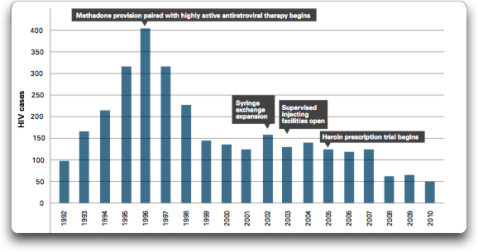
British Columbia did introduce heroin on prescription in 2005. 5 years later the effects of the combined measures on HIV were compelling:
British Columbia: HIV infection matched to Harm Reduction initiatives
Similar success from heroin on prescription is found in every nation to usher in trials and programmes. Sadly, Australia was ready before the Howard years. We were in fact, world leaders. Now it’s a different story. We have one Medically Supervised Injecting Facility that ran as a successful trial for 11 years.
Seven of those 11 years were due to disinformation and sabotage from conservatives. In October 2010 the Kenaelly NSW State government passed a Drug Misuse and Trafficking Amendment bill to ensure the Centre became permanent. 11 years of moral panic was, at least legislatively, silenced.
Whilst actually attacking Harm Reduction initiatives, confusing methadone and buprenorphine with illicit drugs and muddling the lot in with AFL drug policy, Alan Jones delighted us with his wisdom on “Harm Minimisation”, in mid 2007 [MP3 here]. Obnoxious, offensive and completely ignorant of facts it is also somewhat representative of Aussie views today:
So today Australia has a long, long way to go before we do, if ever, fully recover from the rise of anti-drug conservatives under John Howard. They did far more damage than just raise HIV infection by 1% in injection drug users. Our fluency with progressive policy and public maturity has been undermined. Australia waits, on pause.
33 million people live with HIV today. Outside sub-Sahran Africa IV drug use accounts for 1/3 of new infections. For almost 15 years annual HIV infections have been falling on a global scale. Except for seven countries wherein HIV infections increased by about 25% primarily due to IV drug use.
The “drug war” is full on in Eastern Europe and Central Asia and unsurprisingly 5 of these 7 countries are in these boundaries. In the last decade people living with HIV in these areas has close to tripled. Russia has resisted Harm Reduction measures keeping methadone illegal and charging users for needle possession. As this demographic is actively abused by law enforcers the motivation to use needles based on access convenience and minimal time is heightened. The results are clear:
HIV infections – Russian Federation
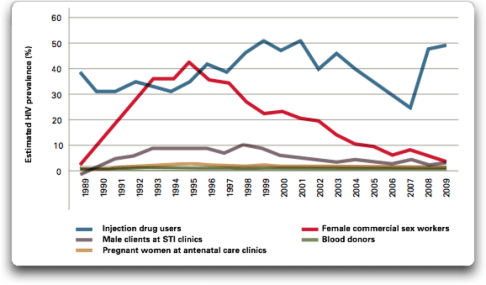
Thailand has impressively cut HIV infection in workers in the famous tourist attracting sex industry from 40% in the mid 1990’s to around 5% today. This pulled male clientele infection rates down in parallel. At the same time fierce drug war tactics led to 2,500 “death squad” murders in 2003 and HIV is up to 1 in 2 IDU in some regions. A comparison of different demographics for HIV infection is compelling:
THAILAND: HIV infections per demographic
In a splendid example of stupidity the USA reinstated it’s 21 year ban on federal funding for needle exchange programmes only 2 years after ending it. A stark lesson for Australia, constantly under the assault of disinformation from anti-drug group Drug Free Australia, can be found on page 9 of the GCDP Report.
Recently in reviewing the history of Harm Reduction and HIV, I noted the stark difference between not just nations, but regions within nations favouring HR as a powerful controller of HIV spread. Similarly today it can be seen that in nations with extreme law enforcement, and regions within the USA with the most intense law enforcement that HIV levels are higher than those with low law enforcement.
For instance, a study of the 96 largest US metropolitan areas found that measures of anti-drug “legal repressiveness” were associated with higher HIV prevalence among injectors and concluded: “This may be because fear of arrest and/or punishment leads drug injectors to avoid using syringe exchanges, or to inject hurriedly or to inject in shooting galleries or other multiperson injection settings to escape detection.”
DFA fallaciously – and skillfully – report the exact opposite. Similarly DFA urge for dedicated Harm Prevention measures, described already on this blog as crude behaviour modification. Whether through blind or biblical force the aim is to do just that: force drug users to stop by changing behaviour. Forget the addiction and crush the symptom.
The easiest way to do this is control the environment. Enter compulsory detention. What DFA have called “compassionate detention”. The models they are considering are terrifying. Not only is HIV infection spread through these centres, they fail to offer any addiction treatment. Forced abstinence is associated with high fatality relapse.
Once infected with HIV criminal and punitive approaches act as a disincentive to testing and treatment. Requirements to be drug-free in order to receive treatment (as in Sweden) and denial of certain rights like child custody and employment correlate directly to higher HIV/AIDS fatalities. Confidentiality breaches and stigma impact frequently due to law enforcement regardless of country.
This leads to higher circulation of HIV in the community as treatment has been shown to reduce HIV transmitted via blood and body fluids. As such it is vital all demographics in all communities can be reached through treatment which ultimately leads to prevention.
Incarceration also increases HIV infection and Australia is heading toward a USA type model which has 25% of prisoners listed as HIV positive. Fortunately our initial lower levels in the IDU population will protect us significantly from such a nightmare. Unusually, prison needle exchange is resisted strongly. DFA play the key lobby role nationally and prison guard unions seem intent to deny evidence in favour of their health.
Australian prison guards profit enormously from selling syringes to prisoners. Secondary to money is the control of prison dynamics, control of prisoner behaviour and the essential control of these transactions in corruption entire. A syringe is power in the prison setting. The sooner we remove this tool from guards and protect prisoner health with clean exchanges, the better.
Resources spent on law enforcement are resources not spent on health initiatives generally, on a global scale. With drug crime and infection encouraged by the former and lessened by the latter, it is clear we face a major global challenge. Public health is the first principle of drug control.
Settings where HIV prevention measures have been curtailed as a result of economic concerns have been particularly vulnerable to increases in HIV risk among injection drug users. For instance, a greater than 10-fold increase in newly diagnosed HIV infections among injecting drug users has recently been reported from Greece during the first seven months of 2011.
Australia remains incredibly lucky and indeed most fortunate in this global picture. What cannot be ignored and what must be cautioned against is our slow morphing into a landing pad for USA styled conservative disasters. DFA is an arm of Drug Free America Foundation and act at their bidding. DFAF have their “division”, the Institute on Global Drug Policy who fund the Journal of Global Drug Policy and Practice.
This is no journal but a vehicle for lobbying against progressive drug policy primarily that which targets HIV control. All get together and play at the Swedish based World Federation Against Drugs which similarly is nothing like a “world federation”. What they strive for is patently out of this world.
As today’s most brilliant minds accept the evidence condemning prohibition, the global Drug Free Whomever groups seek to defend the UN Drug Conventions that originated in 1961.
Fortunate we may be, but complacent we cannot afford to become.
In 1985 before the introduction of needle and syringe programmes (NSP) 90% of Australian injection drug users reported sharing injection equipment. By 1994 following introduction of NSPs this figure had fallen to 20%. In 2009 this figure was around 15% possibly reflecting the constant number of distributions from NSP programmes over the previous decade.
One of the most powerful modes of resistance to the spread of HIV/AIDS is Harm Reduction (HR) measures.
In Australia, HR exists as one of three pillars of Harm Minimisation (HM) – our official illicit drug control policy. The other two pillars are Supply Reduction and Demand Reduction. Reduction in supply receiving the lions share of funding directs energy at reducing international and domestic supply. Reduction in demand receiving less funding delivers programmes and initiatives designed to reduce the demand for drugs within communities.
Harm Reduction receiving the least funding from the HM pile targets the harm to individuals that eventuates from behaviour. HR has always drawn condemnation from conservative groups because of the association with drug use and sex. Initially men who have sex with men (MSM). Then later through maximal exploitation of drug using pop culture. Nonetheless, study after study comparing countries and districts within countries to have implemented HR or not done so, show a stunning success in favour of HR.
This post will look almost exclusively at IV drug use. HR for Injection Drug Users (IDU) includes provision of clean needles and sterile water, swabs, sharps containers for disposal and specialised filters capable of removing bacteria. Opioid Substitution Therapy (OST) including methadone and buprenorphine and safe injecting facilities are pivotal aspects of HR. Heroin on prescription is not available in Australia but has shown unprecedented success as a HR measure where it has been implemented.
Despite the evidence supporting HM as an effective policy and the reality that Supply Reduction [law enforcement] is the most highly funded pillar, Aussies are still subject to notions such as “Tough on drugs” and code words such as Drug Free Australia’s Harm Prevention. Intuitively it sounds fine. Why minimise harm if you can prevent it?
Yet on examination “harm prevention” is the abandonment of HM for the reintroduction of Just Say No approaches. Known to have had deleterious effects on self esteem, no effect on lowering drug use and providing the field upon which drug use flourished, Just Say No quite simply failed, and failed Epically. Today of course, skeptics are well aware of how beliefs and behaviours are reinforced through attacking them. Harm Prevention even more so is code for punitive, custodial and forced behaviour control.
It is at times perplexing as to why so much energy is spent on attacking HM entirely. Supply Reduction however is based in part upon the reality that people want, seek, use and enjoy illicit drugs. Education to accompany this is open and honest – not promotion of illicit drug use . Yet to the conservative mind the idea that their children, friends or the community at large is the demographic from which drug demand comes, is morally untenable.
With HR it is aspects of this pillar that equally cannot be accepted. To the conservative mind, just as condoms cause AIDS and promote sexual promiscuity so too do clean needles, safe injecting facilities and safe injecting education encourage drug use. Drug Free Australia write:
We need to re-focus our drug policy and practice on an approach that prioritises primary prevention, if we are to see any real change in the health and wellbeing of our current and future generations of young people. We need to acknowledge that Australia has one of the highest rates of drug use, because of a priority on Harm Minimisation rather than Harm Prevention, and we now need to take a leaf out of the books of the policy makers in the UK and United States. Both these countries have given greater emphasis to prevention initiatives, while still aiming to help people who are drug dependent, to recover.
The towering dishonesty inherent in this nonsense is typical of the tactics used by DFA in what has become over just a few years, one of the most immoral lobbying groups on the illicit drug landscape. Australia has high levels of cannabis use and abuse. This is handy in arguing that we have high drug use generally. A synopsis of the above is simply: Harm Minimisation has caused Australia to have one of the highest drug use levels in the world. We should be doing what America and the UK do.
The UK get a mention because they reclassified cannabis to a Class B (like speed/other amphetamines) from a Class C drug and punish users accordingly. Of 2.3 million USA prisoners in 2010, over 65% or 1.5 million meet DSM IV medical criteria for substance abuse or addiction. On top of this another 458,000 have a history that meets DSM IV criteria for addiction, were under the influence when they committed their crime, committed a crime to finance the purchase of drugs or were incarcerated for a drug law violation.
Between 1960 and 1990 official crime rates in Finland, the USA and Germany were similar. Incarceration in Finland dropped 60%, remained stable in Germany and quadrupled in the USA, driven primarily by drug convictions.
Today around around 80% of USA prisoners are incarcerated due to illicit drugs. 11% are receiving some type of “treatment”. The last thing Aussies need is a dose of the USA nightmare.
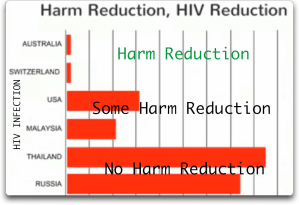
What of the impact of changing our strategy on HIV and consequently other types of blood borne virus transmission? The graph below is from a TED talk by Sereen El-Feki, vice-chair of the Global Commission on HIV and the law:
HIV infection in Injection Drug Users
Whilst Thailand and Russia have ignored Harm Reduction and Australia and Switzerland have embraced it the USA and Malaysia employed only some Harm Reduction techniques. Should Australia embrace USA tactics our prison population will explode, HIV infection in IV drug users will increase by about eight times the present rate and treatment – presently some of the best in the world with plunge to 11%. The cost to the public health purse would simply gut present programmes and destroy any hope of improvement for say, dental, mental health, public hospital care, nursing home care etc.
There is a 4 minute out-take from Sereen El-Feki’s TED talk in April this year below. Or download MP3 here.
The first case of AIDS was reported in Australia in 1983. At that time morbidity rates to rival World War II were expected. Following the innovative approach of HR, levels of infection in all demographics fell from 2,500 per year to 500 in the decade following inception of HR. This infection rate has remained stable.
At the time, initiation of clean needle supply contravened the states Drug Offensive which, already highly criticised, had regrettably escalated drug use and criminalisation via the failed “Just Say No” approach. The pilot programme ran from St. Vincents Drug and Alcohol Service on November 13 1986. It was run in the suburb of Darlinghurst. An evaluation recommended they should be adminstered by social workers, drug agencies, pharmacies, medical professionals and urged:
The urgent widespread introduction of needle exchange programmes in all states and territories
There needed to be an amendment to the Drug Misuse and Trafficking Act following which NSW pharmacies sold “anti-AIDS kits”. By mid 1989 there were 40 public outlets run across Sydney. By 1994 there were 250 outlets run by NGOs, government agencies and pharmacists distributing 3.5 million syringes annually. For the year 1993-1994 10.3 million syringes were distributed across Australia. The USA with 15 times the population of Australia distributed 8 million syringes in 1994-1995.
More comprehensive analyses refuted the concerns of increasing drug use. No increase in drug use was seen in any country that had instigated needle exchange and more so, attendance at rehabilitation and abstinence programmes had increased. Australia’s Commonwealth Department of Health (now Dept. of Health and Ageing) estimated that 25,000 cases of HIV were averted in the 12 years from 1988 – 2000 due to needle exchange alone (page 10 – 3.5.3).
The infection rate among Aussie IDU sat at around 3%. Users who were also MSM had an infection rate of 27%. In Russia where HR for drug users was denied, the figure for IDU was between 75 and 90%. One study in 1997 looked at 81 European cities with and without needle exchange programmes. Seroprevalence (measured from the presence of HIV within blood taken from used syringes) increased 5.9% annually in cities without clean needle distribution, and decreased 5.8% in cities with needle exchange.
In an astonishing comparison, Edinburgh with no NSP experienced a 65% HIV infection rate amongst IDU. Glasgow, less than an hours drive away and with NSP experienced a 4.5% increase in HIV infection amongst IDU. The one issue Australia faced was return of used syringes. Users were placing them in sharps bins. Yet to return any syringes to Exchanges meant risking being questioned by police. A used syringe is evidence of illicit drug use and this acted as a disincentive to return items for safe disposal.
Of note however is that fears and front page headlines of beach goers and joggers stepping on syringes and undergoing “agonising waits” for blood tests to be cleared of HIV infection are out of proportion. HIV dies very quickly once outside the body and syringes on beaches have been discarded into drains, washed out to sea and then beached. Nonetheless despite the absence of actual transmission it is an unpleasant experience which can be lessened by removing all offences for possession of a used syringe.
Clearly, Australia’s decision to take the necessary steps and bring together members of drug using demographics, gay rights advocates and prostitutes collectives and allow them to consult upon and shape this programme was one of it’s greatest public health initiatives ever.
Between 2000-2009 NSPs have averted 32,050 new cases of HIV and 96,666 Hepatitis C infections. Needles distributed increased from approximately 27 million to 31 million in that decade. For every one dollar invested, four dollars have been saved. 140,000 Disability Adjusted Life Years were gained over the same decade.
Still, conservative biblical fundamentalist group Drug Free Australia boldly inform us that Return On Investment is quite wrong and should show an expense. In earlier posts you can access from the tag on the right, I highlight how they cherry pick phrases and select data out of context. At other times they simply dismiss WHO findings based solely on the reviews of just one Swedish researcher, Dr Kerstin Käll.
So to be very clear, Dr Kerstin Käll, working for the Swedish government who are dodging UN demands to establish more Needle Exchanges and accelerate HR or remain in breach of the international right to health, conducted no research but criticised methodology that was favourable of NSP success. Her own research argues regular testing for HIV is more of a prevention – yes prevention – than clean needle supply.
It’s easy to get confused because whilst Käll supports NSP programmes as reducing hepatitis C in prisons DFA refute any change in HCV attributable to NSP programmes… anywhere. They also lobby stridently against the establishment of needle exchange in Australian prisons. Of course, despite the evidence above they insist the impact of NSP on HIV is “inconclusive”.
Ultimately it’s irrefutable how successful Harm Reduction has been in controlling the spread of blood borne viruses. Paramount amongst these is HIV, Hepatitis C and Hepatitis B. The most significant and visionary measure to now apply would include steps to decriminalisation and regulation.
Today however, this is where Australia is falling behind.






 Losing In The Lucky Country