Manipulation, not gullibility may be driving alternatives to medicine

We hear so much about what alternatives to medicine are not doing, it’s perhaps worth pondering what they might be doing.

Beyond producing a placebo effect, which I stress is nothing to sniff at, it seems we can articulate other accompanying features we would do well to understand. One usually thinks of prescription writing conventional doctors upon hearing expressions like “we expect a pill for every ill”. This is not without good cause. As we saw medicine leap forward and family consulting rooms multiply, the gap between symptom severity and seeking attention quite naturally narrowed.

Yet whatever was going on in our minds that modified our part in closing that gap is a restless beast indeed. Part worry, part suspicion, part urgency, part ignorance, part arrogance, part fear, part expectation, part assumed knowledge and more, it can play a role in convincing us we’re ill – or far more ill than we are. Doctors now know that pandering to this aspect can lead to over-prescription, self medication and hypochondriacs. As a result the medical profession has learned how to manage certain traits with placebo and/or skilled bedside manner.

However, the industry to far and away exploit the sole notion of people needing attention for absolutely no reason is the so-called Wellness Industry. It is aptly named, proffering entirely useless or arguably harmful potions, rituals, observances, gizmos, pokes, prods, states of mind and more, to the entirely well.

But why? As one woman informed ABC’s Lateline some time back as they examined the scams used by chiropractors, It’s “…maintenance… making sure everything’s working properly, making sure everything’s working at its best”.

Sure enough the chiropractor asked her to bend to the left, then right. “How that going for you?”, he asked in the tone real doctors might use when examining an actual problem. The woman gets a check up every 4 to 6 weeks. The question we need to ask is about the driving force for her to ask someone if she is in good health. Is it a type of hypochondria? Is it a type of “self medication” in which one seeks out excessive treatment? Is not this chiropractor simply pandering to a psychological state, when his best advice would be to encourage less dependence?

I’m sure she felt better after paying, because just like with Cold Reading all the action occurs within the patients mind. In this case a complex array of cues, sciency stuff, repetition, anatomy posters and models, machines that go “Bing!”, tones of voice and even payment lead up to a nice squirt of dopamine upon completion. The woman is simply conditioned to associate the entire hanky panky with feeling good and thus, better health.

Of course take away this experience without the woman’s consent, and the more time that passes the more anxiety will mess with critical thinking and the usual creaks and twangs she’d ignore become directly attributable to not making it to her “maintenance”. This is the truly brilliant aspect of Wellness Scams. Even when their “patients” are well away from them the urge to return is steadily growing.

People don’t need chiropractic rituals as “maintenance” of health. Thus to continue to exploit this woman is unethical abuse simply for monetary gain. Get them hooked on this notion and it’s easy money. When challenged for evidence of efficacy these visits are trotted out, as if volume of attendance equates to success.

This is why chiropractors, shady nutritionists, reflexologists, reiki magicians, homeopaths, traditional therapists/masseurs work so hard at reinforcing “hits” between their scam and the patient verbalising an association. In the case of New Age diagnostics – often combined with a “therapy” (say iridology and vitamin therapy) – it’s quite simple to create a syndrome that just might be about to run amok.

“Hmmm. We’d better double the selenium, calcium and vitamin E and get you to come in at least twice a week. Let’s see if we can’t nip this in the bud, shall we?”.

It is actually a welcome trait seeing individuals wanting to take more charge of their own health. Certainly that plays a role in the viability of ongoing pseudosciences that masquerade as health services. Perhaps combined with the highly visual and ritualised capers pretending to offer health people are feeling in more control of their health than with brief doctors consultations. It may be that in our present uncertain world of such frequent change to once permanent features, that one seeks out modes of reassurance.

What is certainly a concern is that as people seem intent on taking more control over, and playing more active roles in their own health management, there are charlatans highly skilled at taking advantage of human needs. Nothing is too  difficult for them, nothing cannot be understood, all can be managed and all will be well.

At the top of the scam pyramid reign chiropractors, at once tuning, “diagnosing” and “curing” entirely made up syndromes that engender fear, anxiety, poor decision making and dependence upon ritual in innocent people. So good are chiropractors at this that pregnant patients, fed lies about the needs of newborns, express an impatience for delivery. All so that their neonate can begin chiropractic and thus, start to overcome the abnormalities they believe all children are born with.

Chiropractors run workshops on increasing income. The malleable state of women in a state of hormone flux either side of gestation is well understood. Not for the “patients” benefit. For the benefit of profit born of maternal anxiety and parental fear. It becomes a matter of urgency. The longer left, the more “abnormal” the child will be. Antivaxxers make use of the maternal instinct also, as do renegade home birth groups.

It’s a trait that has served our species well. If mum receives bogus input suggesting the foetus or bub is under threat, no harm comes to either if mum acts upon it. But if mum hangs around to weigh up the risks or ignores constant cues for some time and the risk is real, the chance of this remaining as a successful evolutionary trait is zero. The strength of this trait is notable in that addiction to harmful substances can overrun it. Yet this is following changes in the reward-pleasure centre of the brain, that then initiate neuronal projections into the frontal lobe that serve to inhibit reasoning, decision making, self control and inhibition of behaviour.

Antivaccination lobbyist, AVN member, anti-medicine advocate, homeopathic immunisation promoter and chiropractor Simon Floreani who has children making up 60% of his client base once told Today Tonight:

Babies often come directly from the hospital. They’re referred from the obstetricians, the doctors, the pediatricians, the nurses because chiropractic care’s so safe for them. Many of the current medical procedures just don’t work and parents aren’t silly. They’re looking for good alternatives from people that care and are prepared to look into diet and lifestyle.

As one time Skeptic of the year, Loretta Marron contends, “what they are is faith healers”. Traditional chiropractor John Reggars insists it’s a case of self limiting conditions or perceived changes. From an evidence viewpoint there’s nothing to support chiropractic – even with sore backs.

Update: In fact studies of infant crying and chiropractic therapy suggest treatment reduces crying have a high risk of performance bias. Indeed as parents are the assessors the results may be shared by parental belief. This Cochrane review of infantile colic and chiropractic notes (p.2);

However, most studies had a high risk of performance bias due to the fact that the assessors (parents) were not blind to who had received the intervention. When combining only those trials with a low risk of such performance bias, the results did not reach statistical significance. Further research is required where those assessing the treatment outcomes do not know whether or not the infant has received a manipulative therapy.

There are inadequate data to reach any definitive conclusions about the safety of these interventions.

It’s important to realise that this review concluded the above based on “most studies”. It has consulted this RCT by Miller, Newell and Bolton (see p.25 of Cochrane review), and still found data to be inadequate to reach definitive conclusions.

Thus potentially, if parents think the infants are getting treatment they may be reporting improvement even if there is none. Conversely if they believe the child is not being treated when it is, they may report adversely. /Update

The Courier Mail reported recently:

SCIENTISTS spent $374,000 recently asking people to inhale lemon and lavender scents to see if it helped their wounds to heal. It didn’t.

The National Centre for Complementary and Alternative Medicine in the US also outlaid $700,000 to show that magnets are no help in treating arthritis, carpal tunnel syndrome or migraines.

The centre spent $390,000 to find that old Indian herbal remedies do not control type 2 diabetes and $406,000 to prove coffee enemas do not cure pancreatic cancer.

It’s the same story around the globe. One by one, weirdo treatments are being exposed as bunkum.

Why are people so gullible, handing over their hard-earned cash for unproven alternative therapies?

Why do usually sane people get sucked in by pseudo-scientific fiddle-faddle such as homeopathy, reiki, reflexology, naturopathy, aromatherapy, iridology and crystals? […]

Chiropractors have now been discredited by every reputable medical organisation from the Royal Society down, yet people still spend up on these bone-crunchers and state and federal governments seem unwilling to shut them down.

Recently I reported on two experts on alternative medicine who reviewed all the evidence and concluded chiropractic was “worthless”.

Professor Edzard Ernst and Peter Canter found no convincing data to support claims the technique was effective.

With the possible exception of the relief of some back pain – where spinal manipulation is as good but no better than conventional treatments – the technique is worthless, the review in the Journal of the Royal Society of Medicine concluded.

Another impacting feature is the “legitimising” tricks buffering complete rubbish. “Diplomas” in homeopathy. “Degrees” in chiropractic. The meaningless but very powerful use of the term Doctor. Flashy titles given to Boards or National Bodies. Misleading titles such as The Australian Vaccination Network that supports zero vaccines calling them “instruments of death”. “Pro-choice” groups. All this is strictly designed to mislead from the outset.

Yet I’m not sure asking only about gullibility is enough. Gullibility persists often due to a conscious decision to not examine criticism of what has become a comforting belief or set of beliefs. More so we are hard wired to seek out information that confirms what we think we know as fact and associate with people who reinforce our beliefs. Even internalising contradictory information about our beliefs can in time lead to reinterpretation that reinforces the opposite of the information we took in. Cognitive bias is a powerful master.

An admirable foe to conventional medicine who pops up here, Meryl Dorey, completely dismisses the findings above. Yet, when criticising vaccines she relies upon respect for the same scientific approach. “The gold standard of scientific research”, she argues, is the Randomised Controlled Trial. As RCT’s mow down alternatives to medicine Meryl insists that until vaccines are subject to RCT’s they cannot be regarded as “properly tested”. Although Meryl is beyond reason (as evidenced by this level of ignorance about how RCTs work) it’s a fine example of how belief can eliminate respect for evidence.

Perhaps we should be asking more about what leads people to internalise so much misinformation about the world we live in and the basics about how it works. So much of the market sustaining disproved alternatives to medicine also accept without question that our environment is highly toxic, it pollutes our health and natural new age “cures” are needed. They also believe conventional medicine, hiding the truth about “natural cures”, is irrevocably corrupt, peddles poison as medication and is ironically creating a world of sickness from which it profits.
Much of this is provided to them from so-called “alternative practitioners”. Detox’ is necessary. No, it’s quite dangerous. Medicines treat the symptoms not the cause. Quite true, I hasten to add in many cases. I’m just not sure why this is assumed to be a blanket flaw. Figures on medical mishaps draw concern. Yes real doctors are accountable and mishaps are still a small percentage. Adverse reactions from drugs prove medicine is lethal. Quite wrong. Primarily ADR’s underscore patient error, and again given the millions of scripts dispensed is another small symptom of accountability.

The truth is, Conventional Medicine is not peddling sickness and keeping you ill for profit. But Alternatives to Medicine are profiting from the false belief you need maintenance and from keeping you splendidly ignorant.

This continued misinformation about real medicine takes up an exorbitant amount of the message coming from the supposed “complimentary”, “alternative” or “integrative” chapters. From antivaccination messages to the vast bulk of alternatives to medicine the claim of “efficacy” is buoyed upon a childish notion. “We are good, because they are bad”. The more “bad” squeezed in the less the need for evidence to show Theta Healing could possibly work or that oscillococcinum isn’t plain nonsense.

Still this doesn’t explain everything and I don’t imagine I could. What causes one mother to accept antivaccination hogwash in a maternal embrace and another to sink her teeth into its carotid artery, so to speak? Personal experience can shape belief but even here outside forces tend to be the final decider. Certainly scientific literacy and the awareness that one must trust experts in certain fields is crucial to good decision making.

Alternatively, having “researched” every crackpot self affirming, disreputable source whilst avoiding reputable – indeed any source – material is intellectual sabotage. Likewise being affluent and highly skilled in one area doesn’t immediately make a person “educated” as the media insist on telling us.

At best one could argue that so many scams continue to attract patronage because they offer an emotional and psychological package of oneself taking control. Lengthy consultation sessions provide for bonding and a sense of loyalty.

Much of the practice or ritualised session is designed to instil reliance and dependence upon the so-called practitioner. Bogus symptoms and syndromes are tacked on whilst alienation from conventional medicine evoking feelings of betrayal and self-superiority sinks in. Reading material and other patrons readily reinforce this.

Some charlatans often claim their Wonder Woo is suppressed by Big Pharma, as was the case with Francine Scrayen, Dr. Death Sartori charged in multiple countries and QLD MMS wielding cancer curing, scam artist Jillian Newlands. Although most often this is announced to the very desperate and the most ill.

Ultimately it appears that if we are to push down this bubble of bogus practices we need to understand just why so many of us are seeking attention to our state of being. It is not last ditch desperation or even seeking treatment for obvious illness. People need attention and in seeking it they are being sold dependence.

Dependence upon forces, rituals, cleanses and superstitions they previously never knew existed. That so much of this comes with ready packaged insults toward conventional medicine instills distrust of the very regulators who must act for the public good.

Perhaps as more and more scams are shown to be clinically useless, those that have depended upon them need to be educated in how they’ve been manipulated.

Isaac’s Golden Moment

Three weeks ago I attended a public lecture entitled Medicine and Homeopathy.

The latest from Melbourne University Health Initiative, the lineup included homeopath Isaac Golden and chiropractor Simon Floreani to present the argument for homeopathy. Public health physician and medical activist Dr. Ken Harvey and GP Dr. Stephen Basser, one of Australia’s most accomplished critics and analysts of alternatives to medicine, held the fort for medicine.

All but Stephen Basser feature in this video examining claims made by Isaac Golden about homeoprophylaxis. I was confident Golden would pull off a pleasant well meaning presence and equally confident Floreani would flounder and fall. As it turned out he never arrived, leaving Golden to retrace the tired old footsteps he’s been doing for years all by himself.

There’s a few things that I found novel. Golden was quick to label the Cuban homeopathic immunisation study (see video above) as “an intervention”, not a trial. This in one swipe silenced many a prepared question including my own over how the “immunised” demographic returned to levels of Leptospirosis infection similar to those found elsewhere in Cuba (non “immunised”). The “intervention”, which is quoted by homeopaths as hard evidence of efficacy is often criticised for poor methodology, lacking a control group and inexplicably failing to randomise subjects.

So by renaming it an “intervention” Golden could proclaim to have “evidence” and dismiss questions raised about its veracity being flawed due to poor trial practice. Throughout the “intervention” paper the rest of Cuba (RC) is presented where and how a control would normally be presented in a trial. Defenders of the caper point to RC as a quasi-control when it suits the need to convey comparative difference. Thus, Isaac has invented a nifty escape clause from defending poor methodology.

Another point (in fact an inexcusable failing) was Golden’s inability to address what is at once one of the least complex problems, but perhaps the most important. The entire Cuban scam is not Hahnemannian homeopathy. By no means am I the first to note this. It’s more of what I call Supercalifragilistichomeoprophylaxis.

During the evening Isaac Golden made much of remaining true to Samuel Hahnemann’s Law of Similars and Law of Infinitesimals. The Law of Similars is sometimes known as “like cures like” and states that a mother tincture should be made from a substance which produces symptoms similar to that produced by the disease.

Yet in the Cuban study they used four dead – completely inactive – strains of Leptospira bacteria to make the mother tincture. The paper refers to “highly-diluted strains of inactivated leptospiras”. However the paper title is, Large-scale application of highly-diluted bacteria for Leptospirosis epidemic control. Plainly that is misleading in itself.

So I pointed out to Isaac that in view of his insistence upon the law of similars, and noting that the Cuban mother tincture didn’t contain a substance that could produce any symptom like those experienced with leptospirosis (the bacteria were always dead), he had a problem. Confident, he responded that no, it’s not like a traditional vaccine.

Another audience member ran it by him again. Isaac was confused. Ken Harvey explained the problem also. Then I spelled out the obvious. Without the Law of Similars, there’s no Law of Infinitesimals. But he didn’t hear. Clearly stumped, his mind was cranking over. Eventually he produced the claim that the dead bacteria still had the “energy shape” or “energy signature” and were thus still viable. Quickly he turned and selected another questioner.

I was delighted. Isaac Golden had just told me an “energy shape” could produce similar symptoms to live bacteria. But even better, he’d made it up on the spot. After earlier signing his name to the Law of Similars, he then denied its necessity. I still wanted to press the point as this excuse couldn’t explain the “blood, puss, discharge, urine, flesh, causal organisms…”, and other organic goo used in highly dilute nosodes.

No Law of Infinitesimals either with no Similars. We never really made it to discuss that point. But I already had my answer in that he had no answer. For the record, the beaker for the most dilute agent was washed out 9,999 times. On the 10,000th refill it was called a homeopathic immunising agent. That’s not highly diluted – that’s washed away. The less potent (less dilute) was washed out 199 times.

It was Supercalifragilistichomeoprophylaxis if ever I’d seen it. Remember dear reader a nosode is a homeopathic dose. Golden had earlier used the term. Its definition – in this case – demands “causal organisms”. Energy shape just didn’t make it. The audience member who helped Isaac understand wrote, “Get out of jail free” on his notepad and slid it my way. I had to agree. We know homeopaths make it up as they go along, but it was really nice to be there to see that actually happen.

It was truly a Golden moment.

Other points deserve a mention. Already referring patients to conventional doctors, Isaac came across as keen to extend conventional connections and is striving to make something of a research base. He does not entertain the “us and them” combative mindset of the Monika Milka’s and anti-vaxxer types we know and love, and appeared genuinely keen to reciprocate with bilateral trials. One concern was his allusion to conspiracies, when it was pointed out that if efficacy was truly and constantly demonstrable that widespread use and marketing would already be apparent.

One couldn’t miss however that the totality of discourse and questioning was biased toward examining the claims made by Isaac. He did after all kick off by stressing he heals the “entire person”. This means mental, physical, personal, spiritual and probably “quantumal” for all I know. This was “natural medicine” to Isaac. Getting the human healing abilities to function on these levels.

We were promised lots of evidence but regrettably a few excuses related to third parties were raised. Aside from the Cuban standard, Isaac brought in the Swiss “study”. Written by pro-complementary medicine interests for governmental review and favouring popular demand it was a poor choice as the material is known to be highly selective in favour of homeopathy. Isaac appealed to popularity and use as equating to efficacy a number of times.

Dr. Stephen Basser’s deconstruction of why homeopathy is so widely used, sought after and applied by medical professionals was excellent. It highlighted the factors outside of efficacy that drive uptake and continued use of demonstrably non efficacious options. Patient request or demand, choice of placebo, doctors’ role in monitoring complex patients, marketing, what it’s actually used for and the context of these figures.

I’ve noted here before how chiropractors boast how many Aussies per day use chiropractic – after signing them into treatment contracts. Purchasing 100 doses of a homeopathic preparation doesn’t support it being entirely used. Nor do uptake figures represent clearly articulated failures – and dissatisfaction. What is regular? What is novel or first time? And so on. In short there is no association between popularity and efficacy. Or between demand and documented efficacy.

Ken harvey brought up the point I’d have guessed most would have asked at question time. Golden claims to have completed his PhD successfully in homeopathic immunisation. In Golden’s abstract we read:

The effectiveness of the program could not be established with statistical certainty given the limited sample size and the low probability of acquiring an infectious disease.

This didn’t stop Golden from then claiming:

However, a possible level of effectiveness of 90.3% was identified subject to specified limitations. Further research to confirm the effectiveness of the program is justified.

Despite defending the semantics on the night, it’s clear this air guitar of a PhD has only mused over a possibility.

One thing agreed on at the beginning was to not discuss the mechanisms of homeopathy. In other words, to avoid raising the fact it is physically impossible. This did allow the discussion to move forward. In essence, Golden was awarded a huge concession with respect to reality. Something of a microcosm of the larger homeopathic industry perhaps.

All up it was an interesting night given that no new evidence popped up to support homeopathy. Like many homeopaths Isaac really believes in it.

He just needs to conclude that ones belief is not truth.

Essential addition to understanding the importance of keeping up pertussis vaccination/s and not succumbing to antivax fear mongering. Remember, whilst only 5% of children are not vaccinated against pertussis they make up close to 30% of infections.

And that’s on top of being up to four times less likely to visit a conventional doctor and be diagnosed in the first place!

kill3rtcell's avatarThe LymphoSite

Before reading this post be aware that as of April 2014 we now know that Australian strains of B. pertussis have largely lost expression of the protein whose variation is a key feature of this piece. An explanation of that study can be found here.

Summary

Whooping cough is a potentially deadly infectious disease. While vaccination against it has managed to significantly reduce the incidence of the disease, it still remains a global presence.

Recent coverage in the mainstream media and from anti-vaccine proponents has suggested that the whooping cough bacterium has evolved around the current acellular vaccine. Such reports occurred following publication of a paper attributing over 80% of Australian cases to a new strain apparently not well covered by the vaccine.

This review analyses these claims. Careful examination of the current literature indicates that while the bacterium’s genome does appear to have changed in response to…

View original post 5,952 more words

The Real Australian Sceptics

A short time ago the Skeptic community received a delightful tickle on the collective ribcage.

A rather intellectually dishonest blog appeared with the title The Real Australian Sceptics under the pretence of “critiquing” articles. It was, predictably, Meryl Wynn Dorey’s latest shot at the ontology of her assumed foes. Those worshippers of evidence and scientific consensus: The Skeptics. It’s an old tactic. If you can’t sustain an argument attack the party that holds an opposing viewpoint.

This isn’t the post to dissect the intellectual absurdity of Ms. Dorey’s attack on Skeptics. Suffice to to say – again – this game of provocation wherein Ms. Dorey futilely seeks to alienate and besmirch skeptics has it’s genesis within stratospheric errors she has made in the wake of being held to account.

The blog itself is monumental dreck. To date it’s emerging as a rehash of all the disproved antivaccination creeds and attacks on accepted evidence. Magically, everything old is new again. The usual rules of ultra-strict comment censorship apply.

If you’re keen for your daily dose of Merylisms, The Real Australian Sceptics doesn’t disappoint, opening with an attempt at selective deception in the first sentence.

According to the Oxford English Dictionary, a sceptic is defined as, “a person inclined to question or doubt accepted opinions”.

Actually the Oxford English Dictionary entry reads:

1 a person inclined to question or doubt accepted opinions.

  • a person who doubts the truth of Christianity and other religions; an atheist.

2 Philosophy: an ancient or modern philosopher who denies the possibility of knowledge, or even rational belief, in some sphere.

Meryl appears to take advantage of the phrase “accepted opinion”, by omission of the widely accepted opinion of theistic persuasion as a working example. Furthermore the second entry refers to philosophical denial of the possibility of knowledge or even rational belief. Having falsely defined “sceptic”, this then leaves the door open for Meryl to potter about on the very fringes of rationality and knowledge, wearing the guise of evidence whilst ranting about science.

Surely even with limited use of “accepted opinions”, we must include Naturopathy, Homeopathy, Home Birth, Vaccines causing Autism, Vaccine Dangers, Pharmaceutical bias, etc, etc. These are all irrefutably on the scale of accepted opinions. An opinion moves toward fact or mere belief based upon the amount of evidence that sustains it. The subtitle of Dorey’s blog is Accept Nothing. Question Everything. Apparently then, this is applied only to suit the author.

I think we can see, straight out of the blocks as it were, problems with her method of attack. Like two Meryls in a particle accelerator one is shooting off counter-clockwise at the speed of light confident those Wascally Skeptics will finally get theirs. Another Meryl is shooting clockwise questioning everything, accepting nothing… including the existence of the other Meryl. Eventually they collide head on in a great splattering mess.

Meryl also takes a shot at “the American spelling”: Skeptic. Wrong again. In doing this she’s really having a go at the Skeptic movement. Nothing new here, and as we’ll see her tactics are also copied and pasted from others whose beliefs have failed to endure scientific scrutiny. Skepticism is not cynicism or denial as we might associate these concepts with climate science denial, vaccine denial, HIV/AIDS denial and the steadily growing denial of conventional medicine.

Colloquially, Skeptics can be said to seek the evidence, consider existing evidence or ask for evidence when presented with certain claims. Skepticism is the rejection of predetermined ideas that aren’t supported by evidence. Skeptical activism may be described as where evidence, science and consumer and/or human rights overlap. Under What Is Skepticism? Brian Dunning writes in part:

The true meaning of the word skepticism has nothing to do with doubt, disbelief, or negativity. Skepticism is the process of applying reason and critical thinking to determine validity. It’s the process of finding a supported conclusion, not the justification of a preconceived conclusion… The scientific method is central to skepticism. The scientific method requires evidence, preferably derived from validated testing. Anecdotal evidence and personal testimonies generally don’t meet the qualifications for scientific evidence, and thus won’t often be accepted by a responsible skeptic; which often explains why skeptics get such a bad rap for being negative or disbelieving people. They’re simply following the scientific method.

Okay. So Skepticism is not Accept Nothing, Question Everything. It revolves around the scientific method and evidence. Yet in attacking science Dorey clumsily raises the notion of “true scepticism”.

There are those in Australian society today who call themselves sceptics (or skeptics – which is the American spelling of that word). Yet by their actions and stated beliefs, they are far removed from true scepticism.

Now we can see the purpose of the second definition in the Oxford Dictionary. I doubt Meryl is aware of the metaphilosophy of True Scepticism, most commonly associated with David Hume, the 18th Century Scottish Philosopher. Nonetheless in a roundabout sort of way Meryl has painted herself into a very tight corner wherein she is seemingly defending denial of knowledge and rational belief, as a means to critiquing scientific arguments and articles.

Oh my.

We need a term for these traitors of true scepticism of course. Some time back on her Facebook page Meryl spotted the term pseudo-skeptic. She decided there and then it was “a keeper”. Unfortunately it was already being kept and here is where it all gets a little more silly.

RationalWiki has an entry on Pseudoskepticism. Interestingly is does not describe anything like Meryl’s contention. There is Legitimate use. The use by those who deny climate change science, vaccine success, etc. In fact it does a good job of describing Meryl Wynn Dorey. The description includes:

In this case the word is simply a synonym of denialism, as there is a vast amount of real evidence which is simply willfully ignored by these pseudoskeptics. The use of the phrasing “I am skeptical of X” is to sound more rhetorically reasonable that “I don’t accept X and never will regardless of the evidence”, even if the latter is more accurate.

Then there’s the delightfully headed paragraph on Usage By Woo Promoters, which also describes Meryl Wynn Dorey:

It is perhaps more often used as a loaded term by promoters of woo to dismiss skeptical criticism of their beliefs as unfounded… Given the difficulty of absolutely disproving even the most absurd hypothesis they then go on to maintain that all those who ask for evidence are “pseudoskeptics”.

Oh, snap!

We seem to have established Meryl’s hijacking of terms for the purpose of provocation and revenge. With the greatest of respect to Meryl is must truly be the nadir of her two decade assault upon scientific knowledge. The world is full of those who despise the notion of skepticism because it quite simply requires evidence for ones claims. Dorey has no evidence. She deals in falsehoods. Very lucrative falsehoods. Scams.

The abuse of authority or the demanding of privilege based upon certain claims crumbles before skepticism’s quiet and calm request for evidence. Meryl’s fraudulent donation campaigns, subscriptions for a non existent magazine, promised vaccine tests and boasts of phoney “protection” from mandatory vaccination evaporate in the presence of just one skeptic.

In some strange anger driven fever, Ms. Dorey seeks to discredit the Skeptic movement by making absurd claims about the nature of reality and science. Suddenly claiming something isn’t true does not make one a skeptic. Nor does it remotely undermine the accepted notion of Skepticism. Accepting nothing cannot be any further removed from the outcome of scientific research. Science, as skeptics understand and accept it, is not about belief. It is about conclusion. The weight of evidence.

There is nothing wrong with doubting and questioning. Far from it. Yet at some point we need a method from which to exploit our knowledge – not a mangled pseudoskepticism that denies knowledge exists in the first place. That method is the scientific method. Proper doubt and proper questions are what give us scientific consensus.

Because of doubt, questions and the demands for evidence that skeptics and scientists continually entertain, scientific consensus can and does change. Because it can change it is arguably fragile and unfairly criticised by opponents of skepticism. Yet because of what is required to change scientific consensus, it makes for an incredibly robust source of evidence. Thus “accept nothing” is naught but a position of intellectual paucity.

Accept Nothing, Question Everything is sheer, utter denial. It demands to be seen for the intellectual cowardice it really is: Shirk Certainty.

Meryl Dorey is happy to quote Hippocrates when it suits her. I hope she is aware of this quote:

There are in fact two things, science and opinion; the former begets knowledge, the latter ignorance.

The Real Australian Skeptics is an emerging cornucopia of contrary, provocative nonsense based upon grossly misunderstood notions of evidence, opinion and philosophy. Whatever it is intended to be, it is certainly not a place for truth.

It is presently the very home of Ignorance.

Australia’s role on the global vaccine stage

Last Thursday evening The University of Melbourne’s Spot Theatre hosted a unique and impressive event.

Australia’s Role In The World is an initiative of UN Youth Australia, the Australian Institute of International Affairs and the University of Melbourne. It’s purpose is to “engage young people, academia and the wider public in debate
about major global issues”. The official launch of the initiative was a forum entitled Vaccines To Change The World and made for a perfect Live @ Melbourne event.

The panelists were Dr Seth Berkley, CEO of the GAVI Alliance (formerly the Global Alliance for Vaccination and Immunisation), Tim Costello, CEO of World Vision Australia, Sir Gustav Nossal, University of Melbourne and Dr Kate Taylor from the Nossal Institute for Global Health. ABC Correspondent, Ben Knight having just returned from the Middle East made for an appropriate and excellent moderator.

When it comes to funding vaccination in developing nations and contributing to vaccine research and development, “Australia punches way above it’s weight”, Seth Berkley informed a large audience shortly into his address. Given the global challenge, and the positive impact of these programmes, this is something to feel good about.

Presently one child dies every 20 seconds from VPD. 270,000 women die annually from HPV related cancer with 85% in developing nations. More so, the percentage of mortality to cervical cancer incidence is disproportionally high in low to middle income nations. HPV vaccine coverage is least in these nations – something GAVI is working to address.

Lower income nations experience higher incidence and mortality from HPV related cancer

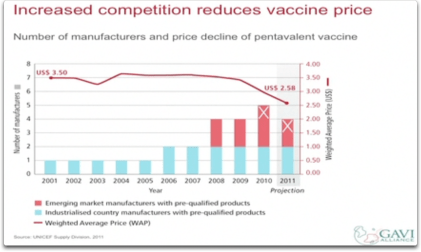
With pneumonia and diarrhea the top killers it’s satisfying to know Aussies contribute significantly to the “huge task” of rolling out of Pnuemococcal and Rotavirus vaccines. Along with Hepatitis B, DTP3 and Hib, GAVI has slashed the cost of access. In the case of the Pneumococcal vaccine market GAVI fund 97% of cost as compared to the USA market.

Pneumococcal and Rotavirus vaccines directly target two major child killers

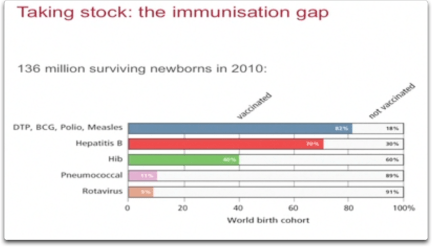
However with 19 million children still missing out on immunisation and 15.4 million of those in GAVI eligible nations, one can appreciate the significance of GAVI’s mission and goals. Along with the mission to save lives and improve health via access to immunisation, GAVI seek to accelerate the uptake and use of underused and new vaccines. Helping strengthen the capacity of integrated health systems will be crucial in achieving this.

One child dies every 20 seconds from a VPD. Of 19 million missing out, 15.4 million are GAVI eligible

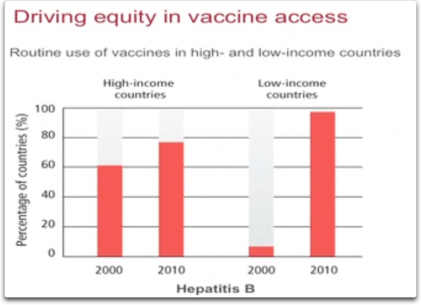
Increasing the predictability of global financing and improving the sustainability of national financing for immunisation, along with shaping the vaccine market are GAVI’s final two goals. GAVI also aim to drive equity in vaccine access across the globe. An impressive example of this is the uptake of the Hepatitis B vaccine in the decade from 2000.

High income nations increased uptake from 60% to around 77%. Low income nations shot from just over 5% to 98%. The impact of the consequential lowering of liver cancer incidence, particularly in China which experienced epidemic levels, cannot be understated.

“Only good for junkies and hookers” – anti-vaccination slurs of the HBV vaccine reflect pop culture mentality

This brings into focus how important immunisation is not only in preventing disease but in sustaining economies, and earning potential in adults. Immunised children maintain the health to attend and complete school. Reaching adulthood they have the potential to earn a competitive wage and thus contribute significantly to family income.

Parents need not produce large families to combat childhood sickness and death, or to meet the need for labour and their own care in old age. The cost of a disabled child or adult added to the tragedy of a deceased parent is a reality for many in developing nations. It’s estimated a one year increase in life expectancy equates to increased labour productivity of 4%. In this light it’s been estimated immunisation programmes have a rate of return between 12.4 – 18%.

One study cited by Seth Berkley noted that a fully immunised 11 year old would present with increased IQ, language skills and math testing results. Over time the “democratic dividend” is to invest more in fewer children. Thus we can see that by ensuring healthier children and smaller populations immunisation can pull families, villages, districts and  entire nations from poverty. According to Dr. Kate Taylor 100 million people per year are driven back into poverty due to illness.

Hib meningitis in Kenya’s Kilifi region fell 88% in three years following vaccine introduction

Results from immunisation are undeniable. With a 54% increase in population from 1980 – 2010 came a 95% reduction in diptheria and tetanus cases, a 92% reduction in measles and pertussis and a 97% reduction in polio. $1.3 billion per year is saved due to the absence of smallpox, which is over ten times the cost of the 1979 eradication programme.

When the Global Polio Eradication Programme was launched in 1988, 125 countries were endemic and 350,000 children were paralysed annually. Today only three countries remain endemic. India is an example of strong political will and determination in that two years ago it had the largest number of cases, yet today has been free of polio for a full year.

Rolling out new vaccines to close the immunisation gap is a major GAVI priority

Future challenges for GAVI will be expanding it’s reach and overcoming political apathy to make the most of emerging new vaccines and to roll out those yet to hit the market. The newer the vaccine the higher the percentage of those unimmunised. Poor political will is an obstacle. Part of the answer is to get the public and the global community to care, without placing excessive reliance on ministries of health by also including financial and planning ministries.

Australia is presently the sixth largest supporter of GAVI. Recently, thanks to Kevin Rudd, our commitment rose from $6 million to $250 million in the lead up to 2015. Kate Taylor underscored that private individuals with enormous wealth had dramatically also changed the landscape in securing funding dollars.

As competition drives down vaccine prices quality control in emerging markets is vital

Focusing on two research initiatives Sir Gus Nossal declared, “The future is bright”. Australia is contributing strongly to the “second generation” malaria vaccine, which given that the RTS,S is 56% effective in toddlers, is an essential avenue of pursuit.

Closer to home he mentioned emerging research into a vaccine for Group A Streptococcus. This disease has given Australia the unenviable status of having the highest incidence of rheumatic fever and rheumatic heart disease in remote indigenous communities.

Tim Costello reinforced that Australia and AusAID is committed to 0.5% of Gross National Income. Presently Australia has no billionaire analogues to the Bill Gates’ of this world. Letting no-one off the hook, Tim pointed out that, per capita, W.A. also donate the least to charity despite their expanding wealth. Aussies donate 35 cents per $100 of tax payer monies to global charity.

Over 90 or so minutes a fascinating account of Australia’s role in the World was presented by some rather heavy hitters in global charity and health.

Aussies can be proud that an unmistakable message is that when it comes to global vaccine equity, our nation is an accomplished heavy hitter also.

How can anyone doubt? Vaccination Saves Lives.

All slides © GAVI