Turbo Cancer: Time for this anti-vaccine myth to die

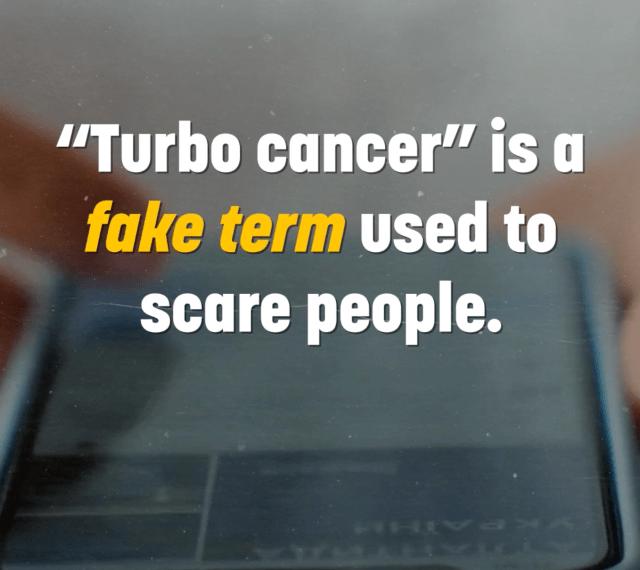
“Turbo cancer” does not exist. Oncologists reject the notion entirely. Aside from the ridiculous name, there is no evidence to support it. Bold claims promoting it as fact, are not merely invalid, but scientifically incompetent. Proponents offer no clear definition, other than insist DNA can be damaged by COVID-19 vaccines, leading to aggressive cancers. As the “died suddenly” trend begins to die out, “turbo cancer” is in top gear.

We’re told residual DNA in vaccines is responsible. Or, the vaccines enter the cell nucleus. Or, it’s not a vaccine – it’s gene therapy. Or, simian virus 40 (SV40) is the cancer-causing agent in mRNA vaccines. This last claim has origins reaching back to the 1950s and 1960s when discovery of SV40 present in oral polio vaccine was responsible for safety concerns and later cancer fear-mongering. Mechanisms of infection were verified as possible but rare, and allegations of a surge in cancers decades later, are unverified. SV40 was one of the first oncogenic viruses discovered. These viruses cause cancers in experimental animals and in some cases humans. However, not in this case. When it comes to COVID-19 vaccines, some mRNA preparations may contain SV40 fragments, which aren’t the same as the virus and are not carcinogenic. In fact there is no evidence of this ever having occurred. The fragments occur because part of SV40’s DNA sequence is used in the beginning of mRNA vaccine development.

As for so-called “turbo cancer” [Wikipedia] the term has its origins at least as far back as November 2020, according to the indefatigable Orac, who identified it in a smarmy comment to a forum post about Moderna’s request for clearance of its mRNA vaccine. By November 2022, use of the term had spiked online. It was being promoted and amplified by a number of anti-vaccine activists on social media. One such group was RFK Jr.’s Children’s Health Defense (CHD) which had emerged as a major distributer of COVID disinformation during the pandemic. In January 2023 AFP fact-checked a November 2022 Rumble video produced by CHD, featuring disgraced Canadian doctors Charles Hoffe and Stephen Malthouse. AFP reported that oncologists had informed them the claims were baseless, and added:

“There is no evidence in Canada or globally that vaccination leads to any forms of cancer or that Covid vaccines lead to rapid advancement in cancers,” British Columbia’s Ministry of Health said in a statement emailed January 11. “There is also no evidence to support Covid vaccines leading to harm to the immune system; on the contrary evidence strongly supports that Covid vaccines produce strong, effective immune responses that protect from serious illness from SARS CoV-2.”

Continue reading

Fidge v Pfizer: The constitutional complaint dismissed

I shall confess to some procrastination on this topic, dear reader, as it was back on 10 October that the conspiratorial constitutional complaint against Justice Helen Rofe was dismissed. It appears Chief Justice Debra Mortimer, as we shall see, found the proposed bases for the complaint as bereft of legal integrity as any who struggled through the convoluted contortions composed by the discombobulations of retired barrister, Julian Gillespie, and company.

Memories may be refreshed about the original Fidge v Pfizer case here, the extensive accusations within said complaint (lodged 22 March 2024) here, and the High Court writ of mandamus courageously cobbled to force Chief Justice Mortimer to acquiesce to the complaint (filed 3 July 2024), here. I should rush to add that the complaint and writ were filed on behalf of Dr. Julian Fidge, who is the applicant in all things Fidge v Pfizer. Thus, rulings and complaint dismissals refer to Fidge’s arguments. However, the conspiratorial allegations serve to remind us that Gillespie, enabled by Katie Ashby-Koppens of PJ O’Brien & Associates, are the individuals shaping Fidge’s legal moves.

In her dismissal ruling (also embedded below) Chief Justice Mortimer notes that Fidge’s legal firm lodged an amended draft notice of appeal on 27 March 2024, containing 24 grounds of appeal. Mortimer highlights key allegations against J Rofe, on page 3 of her dismissal (the “First Respondent” is Pfizer):

23. There is a reasonable apprehension that the learned judge’s decision was affected by bias by reason of the factual matters and circumstances of the relationship of the learned judge to the First Respondent thereby manifesting a reasonable apprehension that the learned judge possessed a motive to decide the case in favour of the First Respondent.

24. The learned judge erred by failing to accord the appellant procedural fairness and natural justice by failing to disclose material adverse to the interests of the appellant thereby failing to grant to the appellant an opportunity to be heard adequately or at all concerning those matters, specifically the relationship of the learned judge to the First Respondent manifesting a reasonable apprehension that the learned judge possessed a motive to decide the case in favour of the First Respondent.

On 2 August Fidge withdrew the application for leave to appeal, and on 26 August the High Court proceeding was discontinued. Feel free to read more of the specifics pertaining to the relevance of both procedures over pages 4 and 5 below. A complaint to the Chief Justice may be dismissed if it relates to judicial findings subject to appeal, as Fidge was seeking. However, to his benefit it was held in abeyance. By discontinuing both leave to appeal, and the High Court proceedings (which complained about his complaint being in abeyance), Fidge was open to grounds for dismissal of the complaint as it related to “matters which could have been the subject of an appeal”. Mortimer observes:

I reject the contention in Dr Fidge’s lawyers’ correspondence that there was more to Dr Fidge’s complaint than allegations of bias (actual or apprehended; see below) against Justice Rofe. […] It was the conscious election of Dr Fidge, I infer on legal advice, not to continue pursuing this avenue. I reject the contention in the complaint that the alleged conduct could not be raised on appeal because the Court’s orders were “void ab initio” (invalid from the start). […] I consider this contention nothing more than an attempt to circumvent the appellate processes of the Court.

Mortimer continues, arguing allegations within the complaint have no basis or merit. She adds that some are scandalous, “and this provides an independent basis for their summary dismissal”. None of the allegations were presented in court to J Rofe, leading Chief Justice Mortimer to mention the “causal connection” between Fidge’s unsuccessful application and the lodging of the complaint (para 32):

In my opinion the causal connection is clear and Dr Fidge has made these complaints at least in part because his originating application was unsuccessful.

Continue reading

TGA refutes DNA contamination in mRNA vaccines but anti-vaxxers double down

The Therapeutic Goods Administration (TGA) is aware of misinformation in recent media and online reports that claim the COVID-19 mRNA vaccines are contaminated with excessive levels of DNA. This is not the case.

TGA 18 October 2024

So opens the TGA report Addressing misinformation about excessive DNA in the mRNA vaccines. It is, for those of us aware of this issue, an understatement. The sheer volume and scope of misinformation, combined with relentless pressure from repeat offenders including members of the Australian parliament, more accurately suggests a campaign. A calculated campaign of misinformation designed to spread fear and intimidate the vaccine hesitant. Despite there being accepted means for discerning DNA residue in vaccines, two claims persist. Namely levels are hundreds of times greater than the accepted safe level, and that aggressive cancers will, and do, directly result.

Background

The original claim stems from a preprint paper by Kevin McKernan dated 11 April 2023. Amplitude, via the Australian anti-COVID vaccine lobby, was lent to this claim in July 2023. The legal guru behind all Australian court cases to challenge approval of COVID-19 vaccines, retired barrister Julian Gillespie, penned The Canaries in the Human DNA Mine. Falsely labelled “peer reviewed” by his anti-vaccine compatriots, it was published in the unabashedly anti-vaccine International Journal of Vaccine Theory, Practice, and Research. Gillespie also crafted the case material used by Dr. Julian Fidge, in what became known as the Fidge v Pfizer case in which Fidge was represented by Katie Ashby-Koppens of P. J. O’Brien and Associates. I summarised the unsuccessful case here, in April this year. Gillespie and Co. followed with a conspiratorial constitutional complaint against the presiding judge, Justice Helen Rofe. Then via a High Court writ they targeted Chief Justice Debra Mortimer for not accepting their complaint. Both complaints were lodged on behalf of Dr. Fidge

Around the same time, the outrage manufactured by the anti-vax lobby shifted from the claim in Fidge v Pfizer that mRNA vaccines were Genetically Modified Organisms (GMOs), to the claim that vast amounts of DNA were contaminating these vaccines. Julian Gillespie, who wants a COVID Royal Commission, publishes for his “good substack folk” regularly on DNA contamination. He claims to have commissioned Canadian molecular virologist Dr. David Speicher to pursue said contamination, ultimately announcing confirmation on 6 June. Speicher was not a surprise choice for Gillespie. He had published with McKernan, Jessica Rose, Maria Gutschi, and David Wiseman in Canada in October 2023, reaching the contamination conclusions Gillespie wants to hear about.

It bears stressing that Kevin McKernan’s preprints lost credibility long ago, when it became apparent the vials he tested were of unknown origin. More so, if origin is unknown then cold chain transport requirements are by default, breached. In October 2023, David Gorski referred to McKernan’s initial preprint as an “awful study” and follow up studies being “equally as bad”. Thus it is unsurprising further attempts were made to label COVID vaccines as DNA contaminated. The Global Vaccine Data Network provide an excellent refutation of what they call Plasmid-Gate. As a highly COVID-19 vaccinated nation, Australia is used in their piece as an example to debunk the claim of so-called “turbo cancers” resulting from COVID-19 vaccination. SBS recently reported that last year, biologist Phillip Buckhaults from the University of South Carolina spoke before a state panel postulating the possible consequences of DNA contamination. When his comments took flight on social media he quickly followed up on X with insistence that such a risk was “purely theoretical”. They further reported that:

Dr Paul Offit of the Children’s Hospital of Philadelphia said [DNA] fragments were “clinically and utterly harmless”.

“These DNA fragments would have to enter the cytoplasm, which is that part of the cell outside of the nucleus, and our cytoplasm hates foreign DNA,” Offit said. “It has innate immune mechanisms as well as enzymes to destroy foreign DNA.”

Also interested in supposed DNA contamination of mRNA vaccines are Senators Malcolm Roberts, Gerard Rennick, Ralph Babet, Alex Antic and Russell Broadbent. Rennick has pushed both the GMO and DNA contamination angle for well over a year. Broadbent remains vocal in parliament to this day, has congratulated Port Hedland Council for calling for an end to COVID vaccines and has furnished Australia’s PM with material on the matter. Broadbent raised his concerns in parliament on 18 November, and I recommend watching this 5 minute video of him speaking.

Another voice to echo Julian Gillespie, is erstwhile ABC journalist Maryanne Demasi. Perhaps her contribution is best summed up in the COVID vaccine conspiracy film she narrated, The Truth – About COVID-19 shots. Erroneously labeled a documentary, it was raved about by Gillespie. And understandably so, given that it includes all his favourite vaccine conspiracies, champions the case and complaints associated with Fidge v Pfizer and lists Gillespie as a source. Demasi also has a Substack account, and has kept her subscribers up to date with DNA contamination developments. In addition Demasi claims the TGA “hides from” reports of SIDS, post vaccination, the TGA and FDA ignored DNA contamination of the HPV vaccine Gardasil, and of course that the TGA response to the claim that mRNA vaccines exhibit DNA contamination, is wrong.

Continue reading

Fidge v Pfizer: High Court writ targets Chief Justice Debra Mortimer

Last we visited developments related to the Fidge v Pfizer case, we had a long look at ambitious arguments arranged to convince Federal Court Chief Justice Debra Mortimer to uphold a constitutional complaint against Justice Helen Rofe. Rofe had summarily dismissed Dr. Julian Fidge’s application for injunctive relief under the Gene Technology Act on 1 March 2024. The judgement is here and my post summarising the case is here.

Fidge was found to lack standing and the case did not proceed. As I mentioned at the time, this was the latest failure of case design by solicitors Katie Ashby-Koppens and Peter Fam, and retired barrister Julian Gillespie. By 22 March Ashby-Koppens and PJ O’Brien and Associates had filed the constitutional complaint with the Chief Justice, alleging Justice Rofe had concealed “her connections to Pfizer and the pharmaceutical industry, before dismissing a case to Pfizer’s advantage”. Reading the complaint, one is struck by both the tenuous nature and the sheer range of the arguments put forward to establish motive, as alleged by the complainants.

Justice Rofe omitted to disclose her role as a barrister acting for Pfizer in patent law cases around 20 years before; hence the “connections to Pfizer”. Yet her connections to “the pharmaceutical industry” rely on one following a convoluted web of associations, that are presented by the complainants as potentially nefarious only through the lens of conspiracy theory thinking. In fact the reader must also accept there are inherent flaws and a predisposition to deception associated with scientific and medical research per se, and indeed any acceptance of COVID-19 vaccines and/or COVID public health initiatives.

On 27 June a writ of mandamus was lodged on behalf of Dr. Julian Fidge at the Brisbane registry of the High Court of Australia. The defendant named was Chief Justice Debra Mortimer. As we’ve observed before, such a writ commands or dictates that an individual or government department carry out a duty that falls within their remit. We saw this in the AVN case targeting the Secretary of the Department of Health to use his powers under the Therapeutic Goods Act to cancel or suspend the provisional registration of three Covid-19 vaccines, including the Pfizer and Moderna vaccines (Australian Vaccination-Risks Network Incorporated v Secretary, Department of Health [2022] FCA 320). They too were found to lack standing.

Clearly Julian Gillespie and Katie Ashby-Koppens feel that three months is long enough to wait. Justice Mortimer has not commented and Gillespie writes that they have argued in “countless correspondence with her office ever since the Complaint was lodged with her”, pointing out their argument. It basically runs as follows:

Helen Rofe did not disclose her prior relationship with Pfizer and thus cancelled out her own judicial authority. This invalidated her 1 March ruling. Justice Mortimer should have informed her of this, Gillespie reasons. He has also peddled ad nauseam his “not a judge” theory. So, let’s look at this. Gillespie cites the High Court ruling QYFM v Minister for Immigration, Citizenship, Migrant Services and Multicultural Affairs (May 2023), paragraph 26. He quotes:

The question arising in the circumstances of the present case falls to be resolved at the level of principle within the framework established in Ebner v Official Trustee in Bankruptcy. Foundational to that framework are two propositions. One is that impartiality is an indispensable aspect of the exercise of judicial power. The other is that “[b]ias, whether actual or apprehended, connotes the absence of impartiality” … an actuality or apprehension of bias is accordingly inherently jurisdictional in that it negates judicial power.

With the negation of judicial power Justice Rofe is apparently “not a judge”. But let’s read that paragraph again, with all the text and a minor change in emphasis:

The question arising in the circumstances of the present case falls to be resolved at the level of principle within the framework established in Ebner v Official Trustee in Bankruptcy. Foundational to that framework are two propositions. One is that impartiality is an indispensable aspect of the exercise of judicial power. The other is that “[b]ias, whether actual or apprehended, connotes the absence of impartiality”. Leaving to one side exceptional circumstances of waiver or necessity, an actuality or apprehension of bias is accordingly inherently jurisdictional in that it negates judicial power.

Exceptional circumstances of waiver or necessity. Could there be circumstances of necessity? I’ve no idea at this point, but it seems relevant. Gillespie assumes he and others so inclined deserve the attention of one of Australia’s most senior judges. Despite being wrong five times in two years, they now seek to force the hand of the Chief Justice of the Federal Court of Australia. He accuses Chief Justice Mortimer of not “properly investigating Helen Rofe, her workmate”.

Another key reason to take this position is the belief that the ruling by Justice Rofe on 1 March is “unappealable”, yet Chief Justice Mortimer “wants to see us appeal the 1 March decision despite Dr Fidge’s legal team telling her that decision is unappealable”. The logic for this also stems from the “not a judge” mantra. The Federal Court of Appeal has jurisdiction to hear a judicial decision from a single judge. As Gillespie alleges Justice Rofe negated her judicial authority, the case did not have a single judge and they “have no decision vested with judicial authority”. Thus, the Gillespie contention is that it follows that the case is “unappealable”.

Finally, this entire manufactured affair provides an opportunity for chasing donations and to promote Australia’s anti-science senators in attacking COVID-19 vaccines. An initiative of Children’s Health Defense Australia Chapter is Section 72. The website seeks to direct devotees to lobby MPs to act in response to the constitutional complaint against Justice Rofe, and to date claims almost 9,000 have “taken action”. It also claims without any evidence that, “there is also the possibility other members of the same court are implicated in this misconduct of Justice Rofe”. Also:

Senators Malcolm Roberts, Gerard Rennick, Ralph Babet, Alex Antic and Russell Broadbent all intend to support the Complaint being dealt with properly by Parliament under Section 72(ii) of the Constitution…

Section 72(ii) of The Australian Constitution states:

The Justices of the High Court and of the other courts created by the Parliament–

  (ii.)   Shall not be removed except by the Governor-General in Council, on an address from both Houses of the Parliament in the same session, praying for such removal on the ground of proved misbehaviour or incapacity: 

The proposed aim of this constitutional complaint has been to push for Justice Rofe’s removal from the Federal Court. Allegations of corruption and COVID conspiracy theories shape the thinking of those involved. It will be interesting to see what response if any the complaint elicits and how the recent High Court filing targeting Chief Justice Mortimer for “not doing her job” plays out.

This particular anti-vax legal saga is likely far from over.

Fidge v Pfizer: The constitutional complaint

In the last post I ran through the finding by Justice Helen Rofe in the case of Fidge v Pfizer. This was the third case brought by individuals and legal representatives with strong anti-vaccination links; both ideological and active. The applicant, Dr. Julian Fidge was found to lack standing. The case was dismissed.

As I previously began to discuss, within a day of the ruling, a follower of Julian Gillespie prompted him to do some digging into Justice Helen Rofe’s career as a barrister. You see, dear reader, as a barrister Helen Rofe had represented Pfizer in cases of intellectual property and patent law between 2003 and 2006. To the antivax mindset, this was proof of corruption because she did not reveal this prior to hearing the case. As a perceived “conflict of interest” existed, Rofe should have recused herself or allowed parties to request her recusal, they argued.

Now again, I am not a lawyer and I cannot qualify the importance of the duty of disclosure in this instance. But my thoughts on this development are straightforward. Is there any evidence Justice Rofe could not have acted impartially, or did not act impartially? Or rather, did her experience make her an ideal choice to hear the case. In 1988 Helen Rofe completed a Bachelor of Science with a major in genetics. Justice Rofe states on LinkedIn:

Prior to being appointed to the Federal Court I was a commercial barrister and Queen’s Counsel specialising in science and technology related matters.

Constitutional Complaint

On 22 March 2024, PJ O’Brien and Associates filed a constitutional complaint against Justice Rofe citing not only her prior work as a barrister but also “affiliations and extended family”. According to the media release (below) Justice Rofe “concealed her connections to Pfizer and the pharmaceutical industry”.

Constitutional Complaint Media Release

I should point out that contact for the complaint, Katie Ashby-Koppens, is on the steering committee for the World Council for Health (WCH). The WCH is renowned for promoting misinformation linking COVID-19 vaccines with death. Wikipedia describes the group:

The World Council for Health is a pseudo-medical organisation dedicated to spreading misinformation to discourage COVID-19 vaccination, and promoting fake COVID-19 treatments.

The organization’s online appearance is that of a mainstream health organization. It appears to have been formed in September 2021 and its published leadership contains people which an Australian Associated Press fact check described as “figures who have promoted unfounded conspiracy theories”.

Now, better equiped to understand motivation, let us examine the complaint.

The accusations in the complaint are impressive to say the least. They require substantial “reasonable assumptions”, both numerous and convoluted. This reasoning begins by pointing out that Justice Rofe has majored in genetics, and the Fidge case involved genetics, genetically modified organisms and allegations that mRNA vaccines are GMOs. Also, we’re reminded that Justice Rofe held prior membership of the Bolton Clarke Human Research and Ethics Committee. Her cousin Sir Andrew Grimwade supported research there with grant monies from the Felton Trust. He was a member of the Felton Bequest for 50 years, and served 19 years as chairman of the bequests committee. He was a guest at the ceremony to welcome Justice Rofe to the federal court. Rofe “enjoyed a good relationship with Sir Andrew” sharing his “interest in science and scientific research”.

Sir Andrew was the great-grandson of Frederick Shepherd Grimwade who, “founded the Grimwade family pharmaceutical industry fortune in Australia”. The complaint goes on to state, Sir Andrew also “served as the honorary President of the Walter and Eliza Hall Institute (WEHI) for 14 years before retiring in 1992″ and had been on the Board since 1963. He “appears” to “have maintained a close relationship with WEHI right up until his death”, purportedly evidenced by a public guestbook obituary from WEHI.

As Australia’s leading biomedical research institute, the WEHI “may have” received billions of dollars from Australian governments. The WEHI have received $30 million from The Bill & Melinda Gates Foundation. Pfizer, BioNTech and Moderna have received six times that from the same Foundation, which has also promoted COVID-19 products. It’s “also reasonable to assume the WEHI supports all of the efforts of Mr Gates and the Bill & Melinda Gates Foundation in respect of their support of the COVID-19 products of Pfizer and Moderna.” WEHI received $13.5 million in Australian government funding for “COVID related projects”.

In mere paragraphs we’ve leapt from the failure of Justice Rofe to reveal that she had represented Pfizer some 18 to 21 years ago, to the apparent significance of her cousin’s commitment to scientific research and the involvement of the premier anti-vax enemy, Bill Gates. The complaint continues, targeting the Australian and Victorian governments’ partnership with Moderna. “It is reasonable to assume that the WEHI stands to possibly receive significant monies” from this partnership. The Victorian government has given $600,000 to WEHI as part of mRNA Victoria. “It is entirely reasonable, in light of enduring family ties and her Honour’s own scientific background and interests”, that Justice Rofe has “long been aware of the sources of funding… and the public statements in support of mRNA technologies” made by state and Commonwealth ministers and the Prime Minister.

The complaint rolls on in alleging that affiliations “reaching back four decades for her Honour personally, and over a century when extended family interests of great significance are factored in”, in fact mean a reasonable observer would accept J Rofe holds “Big Pharmaceutical interests, both domestic and international”. More so, Justice Rofe has “meaningfully and significantly assisted to protect, grow, and further establish in Australia [the interests of Pfizer]”. It is further alleged extended family ties nefariously influenced Justice Rofe’s decision-making to favour funding for WEHI, mRNA technology and “further significant sums of research monies” for both, as they’re supported by The Australian PM. Finally we reach paragraphs 42 and 43:

A reasonable observer can conclude from the above that it was more likely than not her Honour would seek to see the science and technology promoted by Pfizer and Moderna, and Australian governments, that stand to significantly benefit medical research institutes like the WEHI, survive and flourish in Australia.

Judicial proceedings of the type brought by Dr Fidge would, if successful, strike a damning blow against all the above interests, and much more.

The complaint continues with Case Implications, outlining what they believe would happen if Fidge had won the case. It not only reads like an anti-vaxxer day dream, yet reveals in black and white, the unabashed sabotage of vaccine public health initiatives and related vendettas, that this group deems justified. Australia would see injunctions and “serious criminal charges” for Pfizer and Moderna. Initiation of investigations into the “operations, processes and personnel of the OGTR, Department of Health and Aged Care” and (of course), “In particular the former Secretary of Health, Brendan Murphy due to his being responsible for provisional approval [of COVID-19 vaccines]”. In addition would be initiation of an examination to determine if the absence of GMO licences led to failure to provide proper informed consent, and medical negligence implications.

There would also be potential civil liability in the Commonwealth government for failing to enforce GMO licensing, and civil liability for Pfizer and Moderna for failing to undertake GMO licensing. The complaint also refers to “possible confirmation” of injuries and deaths caused by genetically modified properties of mRNA vaccines. Yet there is no body of work identifying such adverse outcomes. It is a misinformed notion linked to the same suite of decades old research, mRNA-critical pre-print papers, animal studies, SARS-CoV-2 infection studies and related articles that buoy this anti-vaccine belief. I’m not criticising the research, but strenuously reject the invented link to “injuries and deaths” fabricated by the anti-vaccine lobby.

Another implication of a Fidge victory, is vaccine hesitancy due to a loss of trust in Australian health authorities. Yes, they’re serious. However, vaccine hesitancy is in fact due to constant misinformation spread about vaccines, by groups such as this. Then on p. 13 we read the implication under 44 J:

The necessity to initiate many forms of clinical studies to assess the real world damage, disease, or fatal outcomes associated with the GMO products of Pfizer and Moderna, and any observed medium-to-long term disease and adverse reproductive health outcomes associated with the GMO products of Pfizer and Moderna, for those Australian citizens who were not informed they were receiving GMOs.

Astonishing. The complainants apparently believe an entire body of clinical research would evolve following a Fidge victory. One may ask, quite rightly, as to why such research into this vaccine induced disaster is not already underway. The answer being of course, that the “damage, disease and fatal outcomes” do not exist.

We then read that the complaints provided list is not exhaustive and that the implications suggested, pose severe and long lasting reputational damage and financial consequences “for all Australian political parties and their lead members in power throughout the COVID period”. Particularly for those introducing Pfizer and Moderna vaccines.

They finalise the implications by contending that these, or other implications not even listed, may have served to motivate Justice Helen Rofe to dismiss the case brought by Julian Fidge. The complaint then moves onto Judicial Conduct, and examines the Guide To Judicial Conduct with respect to J Rofe’s “failure to discharge her duty of disclosure concerning her prior dealings with Pfizer.” The complaint submits in paragraph 48:

As detailed under the section above…, her Honour Justice Rofe had significant prior dealings with Pfizer when a barrister, and through her science learnings and the interests of her extended family, significant professional and personal interest in seeing the continued success of those institutions her extended family and science colleagues had been involved with, and perhaps continue to be involved with.

The remainder of the complaint utilises the Guide to Judicial Conduct and the various summations of active bias that the complainants allege motivated J Rofe’s decision-making, in an attempt to argue she is in breach of sections of the Guide. Focusing on the principle of Impartiality and sections such as Personal Relationships, the complaint references seven “slightly different positions [reinforcing] the same common-sense view”:

Where there is a prior relationship with a party, the judicial duty is to disqualify oneself or disclose the relationship before all the parties. If in doubt about disqualification, disclose the relationship before all the parties and invite submissions.

Again, impartiality should be determined by “a fair-minded lay observer who might reasonably apprehend that the judge might not [be impartial]”. Whilst perception of bias and conflict of interest sufficient for disqualification from a case “is to be judged by the perception of a reasonable well-informed observer”. Parties should be informed by the judge of facts which might give rise to perceptions of bias, but the judge must decide on the appropriateness to sit on a case.

Conclusion

For this author, looking through the complaint is like reading any text peppered with the red flags of anti-vaccine beliefs combined with an entrenched distrust of medical, legal and government authority. I can see nothing wrong with the legal team of Julian Fidge raising concerns over Justice Rofe’s failure to disclose her past history representing Pfizer. I don’t believe there’s much substance to it but respect their right to raise concerns. However, the constitutional complaint itself relies on typical anti-vax tropes such as distrusting J Rofe’s respect for science and research, and her affiliations with individuals or organisations linked to vaccine technology and/or its funding. Indeed the complaint made a number of connections that whilst exhaustive, are difficult to respect, much less accept. To argue that J Rofe acted with corrupt intent, primarily to avoid the dawn of the post Fidge-victory era as the complaint described it, is simply fantastic.

I can only conclude by wishing Justice Helen Rofe all the very best.

Professional Conduct Rules for Lawyers

As a footnote, it’s worth pausing to consider that lawyers and solicitors are also subject to professional conduct rules. Katie Ashby-Koppens and Peter O’Brien & Associates must keep in mind their duty to the court and the administration of justice.

Lacking professional distance from your client (or their cause) risks distracting you from this duty, which is paramount and prevails to the extent of inconsistency with any other duty. Your objectivity, your independence and your forensic judgement – on which the court relies – may be reduced.

The duty to avoid any compromise to integrity and professional independence:

Your integrity and trustworthiness are fundamental to your reputation as a lawyer and to your relationships with clients and other parties in the justice system. When a lawyer fails to act with integrity because their professional boundaries are compromised, the integrity of the justice system as a whole is undermined.

Wise words.