Blackmores, Pharmacy Guild saving face

Last we visited the Blackmores, Guild Alliance there were serious doubts about evidence from Blackmores or understanding from the Guild.

Not much has changed on admitting fault, even with the removal of the Gold Cross endorsement. Which, by the way, was the fault of “ill informed and inflammatory” media reporting leading us goofy consumers to exhibit a “strong level of public concern”. I wonder where the Guild gets off trying this one on. There’s something missing from this sudden awakening in which “the Guild has listened to these concerns and accepts – mutually with Blackmores… to withdraw the endorsement arrangement”.

For example the AMA, according to president Steve Hambleton, considered the deal “outrageous” and that, “There’s no place for commercial interference in the clinical decision making of the pharmacist”. This was and is reflected in GP’s responses, including some writing notes with scripts to not include the “companion range”. Professor Paul Glasziou, director of Bond University’s centre for research in evidence-based practice had, on ABC, called Blackmores’ bluff on supporting evidence.

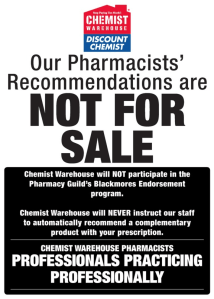
Chemist Warehouse had publically and loudly protested, promising to not participate in the deal. “Our pharmacists recommendations are not for sale” and “Professionals Practicing Professionally” stated their defiant flyer. Ouch!

Many individual pharmacists were, to put it mildly, infuriated and appalled at the Guild’s total stuff up which effected the integrity of all pharmacists.

Stuart Baker, a pharmacist from Western Victoria quit the Guild in protest. In view of the decision to drop the Gold Cross endorsement he still won’t be returning. Damage done there it seems. In light of the Guild’s inability to accept responsibility for such poor decision making the damage could be both more widespread and persistent.

Jane McCredie recently wrote in MJA Insight:

PHARMACISTS have long felt like the poor relations in the broader family of health professionals when it comes to status and respect, if not monetary reward.

In recent years, their representative bodies have lobbied for expanded prescribing rights, for recognition of their role as front-line “clinicians” and against allowing pharmacies in supermarkets for fear this would undermine the quality of health care provided.

It’s going to be a lot harder to make those arguments convincingly in the wake of the spectacularly ill advised deal between the Pharmacy Guild and Blackmores that created such a media furore last week.

October 5th saw the Pharmacist Coalition call on the Guild to dump the scheme. AusPharm News reported in part:

The Pharmacist Coalition for Health Reform (PCHR) has called on the Pharmacy Guild of Australia to axe their deal with Blackmores, following the Guild’s admission that the computer prompts to upsell dietary supplements were a pilot only and would be reviewed.

PCHR spokesperson and Chief Executive Officer of the Association of Professional Engineers, Scientists and Managers, Australia (APESMA), Chris Walton, said that pharmacists had rejected the deal and it was now time for the Pharmacy Guild to scrap the pilot. “A Pharmacist Coalition poll of over 460 people has shown that 94 per cent of community members, including pharmacists and pharmacists-in-training, disagree with the Blackmores’ deal and believe ‘it undermines the professionalism of pharmacists’.

“This has been further supported by The Age online poll which revealed that of over 2,000 voters, 94 per cent do not approve of the ‘Pharmacy Guild of Australia’s deal with Blackmores to recommend Blackmore’s supplements’. [….] PCHR spokesperson and Chief Executive Officer of The Society of Hospital Pharmacists of Australia (SHPA), Yvonne Allinson said The Pharmacy Guild has lost credibility and a failure to scrap the pilot would damage their reputation further.

Gold Cross is a fully owned subsidiary of the Guild. Now that the Gold Cross endorsement has been cancelled their logo, if you like, won’t appear on Blackmores companion range. Nor will the pilot project of software prompts at point of sale go ahead. The decision was “made in conjunction with Blackmores”.

The mutual decision has been taken in view of the strong level of public concern about the proposal, based on some media reporting of the endorsement which was ill-informed and inflammatory.

The last thing the Guild would ever want to do is deplete the credibility of community pharmacists, or damage the trust in which they are held by Australians. That trust and confidence is of paramount importance to the Guild and to our Members. The Gold Cross endorsement arrangement with Blackmores was entered in good faith, with absolutely no intention of undermining the professionalism and integrity of participating pharmacists. [….]

Additionally, an optional prompt containing clinical information for the patient to consider in relation to one product of the Companions range was to be available through the dispensary IT programs, on a pilot basis. The software pilot was not intended to commence until at least November, and will now not proceed.

Chris Walton CEO of APESMA Pharmacist division said in response:

This is a pathetic back down by an out of touch organization. The Guild has been dragged kicking and screaming to the decision and still will not take responsibility. They describe their decision to enter the deal as one made in good faith. Good faith must now be code for a bag of coin.

The profession should never forget that the Guild was willing to trade on the good reputation of pharmacists for commercial gain. While the same people are in charge why would we ever trust them again. Any pretence that they represent the pharmacy profession is over.

Still insisting that the “need for these natural health supplements for some consumers is underpinned by a body of scientific evidence”, Blackmores released a statement also with soothing noises about having listened. But they go one further and point out the “considerable confusion” in waking up to their scam. Hmmm. Perhaps they have a supplement for that? Either way, also from October 5th:

We have listened to the feedback on the Companions range and it is apparent that there is considerable confusion regarding the positioning of this range which we believe is detracting from the potential underlying benefit of these products to consumers.

As a result, and following discussions with Gold Cross, Blackmores will remove the Gold Cross endorsement from the four products, we will not feature these products on the proposed IT dispensary software and we will update the product names to reflect the key ingredients, under the Companions brand.

Blackmores have published research on their professional page for “health professionals” which is well summarised here. I suspect in response to the NPS review of evidence to sustain (cough) claims made in defence of the “companion range”. Christine Holgate opens her heart here about “misconstrued” information and accurate representation of “integrity”. Basically, it’s all good and they’re doing Aussies a favour. No, really.

All up, it’s rather shameful. The Guild haven’t in effect admitted being at fault. At most they seem to grudgingly admit to a type of PR blunder. Blackmores is sticking to it’s guns pleading misunderstanding on the part of the public and a raft of health professionals. Marcus Blackmore bemoaned that a full scale assault on complementary medicines had grown out of the same misunderstanding. ABC have a comprehensive write up with audio and video.

Jane McCredie finished her MJA Insight article in style:

The Pharmaceutical Society of Australia is due to release a new code of ethics for its members — along with a vision for the profession’s future — at its annual conference later this week. It would be nice to think that code might require pharmacists to disclose the level of evidence for any non-prescription medication they sell — hardly an unreasonable demand of people who want to be recognised as clinicians.

I’m imagining the conversations now if this code is implemented. Pharmacists selling homoeopathic remedies will be required to tell each and every customer: “There’s not a skerrick of evidence this works, but if you want to throw your money away…”

Therein lies the very source of the problem. Blackmores’ deal stood out because it officiated upselling and would have included entirely unwarranted prompts. Both the Guild and Blackmores knew it to be a grab for money. So did everybody else. Yet pharmacists do recommend and sell junk to consumers. Assistants do little if anything to dissuade from spontaneous buying.

Doctors will testify to patients at times admitting to taking large amounts of useless supplements. It’s documented that patients are reticent to admit to doctors they use alternative products. In the main doctors are missing out on vital information they need to properly treat their patients.

The only durable solution is for the TGA to move forward with sharp teeth and legislation to call CAM what it really, in the main is.

Unproven and unnecessary.

Time for Blackmores to pull that evidence out of a hat

Where are all the people dying in the street from complementary medicines?

Marcus Blackmore – September 2011

Although a seemingly innocuous if not arrogant turn of a logical fallacy called Begging The Question (and a few others as well) I was surprised at how gullible Blackmore may actually take Australians for. Four deaths in two years and 40 serious adverse reactions reported. But, not in the street to my knowledge. Forget the lead, mercury and arsenic poisoning from imported Chinese herbs.

In this case he’s trying to dismiss the vast vacuum of evidence for efficacy of Blackmores hanky panky, by confusing no medicine (or placebo) with a bad medicine. Confusing no effect with malignant effect. It’s also an inconsistent non-sequitur in that he’s applying the logic we would apply to real drugs (or consumer products under fire) to propose the absence of an outcome that by definition, cannot follow. Regardless of how you see this nonsense, it’s a pearler. It encapsulates so much of what’s wrong with regulation of alternative medicine today, in just a dozen words.

Fortunately for consumers it makes Blackmore look quite the villain. It has zero to do with the problem at hand. Namely the current Pharmacy Guild deal done during an evolving awareness of unsustainable claims and corresponding outrage. Although he hasn’t said this in response to recent criticism, he has been scathing of sound criticism, using this phrase before. More to the point it’s a taunting, if rather melodramatic version of What’s the harm? which to skeptics is a huge clanger. Professor Alastair MacLennan head of obstetrics and gynaecology at Adelaide University, cites “four harms of ‘harmless’ therapy”.

In the recent Trick or Treat article by Gary Tippet, MacLennan is summed up:

Probably most important is delay in seeking effective therapy, if there is one; increasing evidence of side effects and drug interactions, which are under-reported; a placebo effect that wears off within months and sees people ”becoming disappointed, disillusioned and depressed as they move along the health food shop counter seeking placebo after placebo”; and a multibillion-dollar industry that is a waste of the scarce health dollar, if they’re not doing any real good.

Interestingly, Marcus Blackmore’s Dirty Dozen words resonates more or less with each of those points. But back to the fallacy. Just because something isn’t doing harm doesn’t mean it’s doing good. Nor can potential benefits (such as supplements suitable for malnutrition) justify wide scale use or the – quite frankly – astonishing prices of Blackmores’ concoctions. Had he asked the question, “Where are all the people wasting money on complementary medicines?”, one could just steer him toward customer exit of any large store.

Fairfax Poll Today

Chemist Warehouse have made their position plain. But don’t abandon your trusted pharmacy/pharmacist. These guys are about slicing trade from competitors. Including (in my suburb) with the 30 plus metre aisle of junk potions bulging with Blackmores’ goods.

Their grab for the “integrity dollar” was written up today in The Age. The Life and Style section included a poll. Of note, the article continued:

However, in a sign the guild is backing away from the deal, it wrote in its latest newsletter that the Blackmores’ prompts in its computer system were a pilot only, which would be reviewed.
”Contrary to some media reports, there is no compulsion whatsoever on pharmacists to sell these products, nor is there any direct incentive to any pharmacist to sell them,” the guild’s newsletter said.

Fortunately the lack of evidence is now evident. In a great interview recently on ABC is Professor Paul Glaziou of Bond University from the Centre for Research in Evidence based practice. He went looking for and couldn’t find the evidence one would expect from Blackmores. He’s asked for them to make it available. He shouldn’t have to – nobody should be left looking for evidence here.

Or download here.

The clash of reality catching up with an industry that survives on social psychological trends such as the need to take control of ones health, distrust of pharmaceutical companies and a prevailing zeitgeist of choosing something – anything – natural in an environment we are erroneously told is highly toxic is getting louder. Marketers of this junk know this and they’ve been fighting a semantic battle against the growing doubts of efficacy, trying to head off reality at the pass.

We’ve gone from “natural”, to “alternative”, to “complementary” and now we’re getting scammed with Integrative. As though this cockypop mix of potion and ritual actually has a place waiting for it within the current model of evidence based medicine. Purveyors of naturopathy, vitamin therapy, supplemental, acupuncture, reiki, massage, kinesiology, meditation, homeopathy, chiropractic (the one stop shop for self-health sabotage) have delighted in maligning “allopathy” for years.

The paucity of evidence to defend the need for unproven products is summed up well by Dr Wendy Morrow, chief executive of the Complementary Healthcare Council:

Quite frankly, if complementary medicines didn’t work it would have been a fad that was here and gone in the blink of an eye. Their increasing use shows they’re not a fad, they do work if used appropriately, and I don’t see that people are going to stop using them.

Which could also be said about any of the useless rituals above which also come bundled with attacks on vaccination, antibiotic therapy, medication in general and ample conspiracies about “allopathy”. However, late on Friday Blackmores did publish a research summary. Bear in mind however that claims made in advertising are subject to the Therapeutic Goods Advertising Code which is something I wish to look into shortly.

Pharmacy news items reported on Monday October 3rd:

Blackmores reports that while there is evidence to suggest that some medications can affect how the body uses nutrients, this is ‘unrecognised or overlooked by many healthcare practitioners’. Blackmores says that the evidence was compiled in line with the TGA’s Levels of Evidence Guidelines for Listed products and demonstrates that ‘some prescription medicines diminish nutrients and that supplementation can improve nutritional status’, adding that the evidence for its Companion range was reviewed in consultation with ‘leading [unnamed] pharmacists’.

NPS have published Examining The Evidence and looked into each of the four “companion medicines”. They find evidence was “absent” except for the probiotic option, which was “limited”. To summarise each area:

  • Supporting evidence for using Co-enzyme Q10 with statins (none)

Evidence does not support the use of Co-enzyme Q10 to prevent myalgia (muscle pain) during treatment with a statin. No trials have shown that taking a Co-enzyme Q10 supplement with a statin prevents myalgia.

Randomised controlled trials of Co-enzyme Q10 to manage statin-associated myalgia have conflicting results and do not support routine use with statin therapy.

  • Supporting evidence for using magnesium supplements with PPI therapy (none)

Magnesium deficiency or ‘hypomagnesaemia’ has been associated with long-term use of proton pump inhibitors (PPIs). Case reports indicate that stopping the PPI is the best way to normalise magnesium levels. Taking a magnesium supplement with the PPI may not be enough to correct the magnesium deficiency.

No studies have investigated the use of a magnesium supplement to prevent magnesium deficiency during PPI therapy. A magnesium supplement should only be considered if a PPI has caused a deficiency in magnesium that requires treatment. Evidence for using a supplement with a PPI to treat magnesium deficiency is based on case reports.

  • Supporting evidence for using zinc supplements with antihypertensives (none)

Routine use of zinc supplements is unnecessary for people taking blood pressure lowering medicines (or ‘antihypertensives’). There is evidence that long-term treatment with certain types of antihypertensives may reduce zinc levels, but it is unclear how often this causes zinc deficiency.

  • Supporting evidence for using probiotics to alleviate antibiotic-associated diarrhoea (some)

There is some evidence from trials that probiotics may prevent antibiotic-associated diarrhoea in some adults and children. But limitations with the trials mean that the true effect of probiotics is uncertain, as is the most effective product or dose.

58 million prescriptions per year. Coke and fries. 90% non-compliance with regulation. No regulatory enforcement because it’s not “cost effective”. A recent audit finding the TGA has failed for decades to counter deceptive, false and misleading advertisements. If compound X is today found to be unable to make claim Y proper policing applies only to new products coming onto the market. Products already on the Australian Register of Therapeutic Goods cannot be edited.

Given what’s been leaking out about the industry and the paper tiger apathy of the TGA, it shouldn’t be surprising Blackmores’ “Coke and Fries” is geared for consumers money, not health benefits.

Floreani, Golden and the myth of homeopathic immunisation

For a mob that officially professes “no position” on vaccination the Chiroprctors’ Association of Australia disseminate ample false, misleading and quite dangerous antivaccination hanky panky.

Take CAA NSW branch vice president, Nimrod Weiner. The Weiner from Newtown Community Chiropractic whose Nimroddery was pegged as a “rant on vaccines” by The Australian. Although he feverishly ran for cover after outraging real doctors, not-a-real-doctor Weiner’s “rant” bibliography can be found here. A hodge podge of dusty conspiracy twaddle and outright lies, much from the Australian Vaccination Network it alone refutes Weiner’s claim:

I’m good at knowing how to read a research aritcle, and knowing whether it’s viable or not. I’m also good at collecting a lot of research. This vaccine topic I update every single week. So what we’re looking at is new as of yesterday morning.

He didn’t write that, but announced this to attendees of his seminar Vaccinations: An informed choice, in what can quite justifiably be called a lie. There’s more on the entire debacle along with a Radio National segment here. At times we’ve met other crackpots from the CAA. Jason Parkes and Rob Hutchings, both of whom approach their profession like a religious fundamentalist approaches taking up arms. Warren Sipser who believes vaccines cause harm yet chiropractic “repairs DNA”. Genevieve Keating is another pleasant sounding predator who specialises in convincing parents chiropractic builds super human kids. They lean toward the weird beliefs of founder Daniel David Palmer and his views on “God given energy flows”.

Sipser was the subject of an article in The Australian headed The Chiro Kids which brought home just how ludicrous (and scurrilous) the new brand of Mystical Chiropractors really are. Thanks to Dr. Rachael Dunlop we can read the CAA’s Media Release warning CAA members of that article. It’s disturbing stuff given these quacks are subsidised by our government (Medicare foots the bill for five sessions per year) and health insurers. Written by CAA national president Simon Floreani, it is a straight out attempt at damage control, obfuscation and dodging questions.

Floreani himself has run antivaccination clinics and is a member of the Australian Vaccination Network. He describes Dorey’s little fraudulent scheme as a valuable resource for patients. Simon is married to Jennifer Floreani, famous for writing an article supposedly describing (Update – as noted below the bogus article has been removed but can be found here pp. 348-349) her newborn’s battle with pertussis, picked up from an older sibling. Given the outcome and treatment the article is almost certainly fraudulent, but if perchance the diagnosis is correct then at best it is reckless neglect and at worst simple child abuse.
She writes (bold hers):

This experience did indeed test our resolve and we were forced to draw on our support network of healthcare providers. We performed chiropractic checks on our baby daily and utilised a whooping cough homeopathic. I dosed myself with an array of vitamins to boost his immunity via breast milk and kept him hydrated with constant breastfeeding.

Whooping cough is often slow to develop and may respond well to conservative management, including chiropractic, osteopathy, homeopathy, herbs, acupuncture or acupressure. Within two days, the severity of our baby’s symptoms cleared and within a two week period, each of our boys had a complete resolution of their symptoms.

Fortunately for the Floreani’s this little tale is just that – a tale and a comical one too. Every type of “conservative management” is absolutely non efficacious. Babies with pertussis gag, choke and may have profound difficulty breathing making this nonsense of super fortified breast milk as a realistic option seem laughable. More so, there’s no evidence an increase of maternal vitamin intake when breastfeeding will do anything but produce expensive maternal urine. Even more farcical is the notion of “boosting immunity” with vitamins. Either way, if their baby did have pertussis there’d be no magic recovery after two days but admission to intensive care many days later as the insanity of their hokery pokery gradually sank in. Yet, that’s not really the point.

The dangerous, deluded and unconscionable message pushed on parents here is that using your breasts, vitamins and witch doctor spells, you can clear up a potentially fatal disease within two days. It’s outrageous and a bald faced lie that I cannot even begin to comprehend the motivation for. What’s infuriating is that chiropractors exploit the confirmation bias in parents and the Floreani’s are prime examples.

Parents who believe these nonsense manipulations cure everything report that yes treatment keeps children healthy. They also report inaccurately that lapses in treatment lead to poor health. Knowing this, chiropractors are famous for setting treatment frequencies, with some even insisting on treatment contracts. That the locus lies with parental bias has been shown splendidly in trials on colic.

As we know, chiropractors claim they can “successfully treat” colic or – in their lingo – Irritable Baby Syndrome. Trials show that if parents believed their baby received chiropractic care, whether they did or did not, they reported improvement. If they believed that no chiropractic care was applied – even when it was – they reported a worsening of colic. You can catch up with Simon Floreani admitting no proper trials exist here on Lateline back in July 2009.

He’s caught out claiming injuries from neck manipulation are one in 5.85 million cases when in fact they are gauged at 1.3-5 per 100,000 manipulations, by insurer Kaiser Permanente, who refuse to cover the practice. In short Floreani is claiming instance of vertebral injury is 60 – 300 times less than it is.

On August 21st this year, a video entitled “Homeopathy evidence and research” filmed by Simon Floreani and featuring homeopath and fraud Isaac Golden, appeared on YouTube. The video below looks initially at the rise of the Mystical Chiropractors and then picks through Golden’s claims of Cuban “homeopathic immunisation” and his own so-called PhD on “homeopathic immunisation”.

When used to defend against a complaint to the TGA about homeoprophylaxis, Golden’s PhD actually helped uphold the CRP decision of misleading claims by fellow crook, Fran Sheffield. This is because even Golden admits in his thesis text that his sample was flawed in size and there was no chance of contracting infection. In short he showed nothing.

Enjoy…

Guild & Blackmores “naive money-grubbing action”

Today’s Letters to the Editor in Fairfax’s The Age offer ample criticism and no praise for the Blackmores scam (see PDF below) outlined here recently. Pharmacist and health store proprietor, Ian Collins writes;

AS A pharmacist and health store proprietor, I find the guild’s action of linking with one company a most naive and money-grubbing action. To be forced to recommend one company bringing out a new range of products, whose composition has not been widely discussed and has no track record, is beyond belief. To attempt to give all people with blood-pressure problems, no matter what the cause, one formula, ignoring all other health factors, is incomprehensible.

There are so many other products from different brands that may be more effective, products with a history of being useful; why pick this small range of untried products? Maybe the answer is that complementary medicine is basically ignored in pharmacy degrees and very few pharmacists have the knowledge to discuss or ask the relevant questions regarding complementary products.
How embarrassing for pharmacists to be caught with their hand in the till.

Prominent Mornington skeptic Graeme Hannigan writes;

I AM a health consumer and am disgusted at this agreement. If it wasn’t enough that pharmacies credulously offer such quackery as ear candles and the good old magic water of homeopathy, the agreement with Big Quacka means that any lingering vestiges of trust in pharmacies has vanished. Pharmacies are putting financial objectives well ahead of the ethical treatment of customers.
All guild pharmacies should come with a health warning and advice to customers to wash off the snake oil after visiting their pharmacy. I trust the guild will also make available the results of the peer-reviewed randomised double-blinded clinical trials of Blackmores Companion preparations so customers can make informed choices.

In a comprehensive Opinion article, Dr. Ken Harvey digs for some evidence to back this caper, finding little more than a business deal. He writes in part;

So what is the evidence to support the use of Blackmores Companions products?

Its Biotic Companion contains the probiotic strain Lactobacillus reuteri, which is claimed to reduce antibiotic-associated bloating, flatulence and diarrhoea. The risk of suffering these side-effects is relatively low. There is some evidence certain probiotics may reduce the incidence of antibiotic-associated diarrhoea in some populations, but routine use is not recommended by medical authorities. In immune-compromised patients, occasional cases have been reported where probiotic organisms have caused serious blood-stream infection.

Anti-HT Companion contains zinc gluconate to complement use of antihypertensive therapy. There are occasional reports that such therapy may lower zinc levels, but I am unaware of any independent medical authority that recommends routine zinc supplements with antihypertensive drugs.

Stat Companion contains coenzyme Q10 and vitamin D3 allegedly to support statin use. Muscle pain occurs in about one to two patients in 1000 receiving statins, especially if a high dose is used. The evidence that coenzyme Q10 and vitamin D3 can relieve statin-associated muscle pain is not clear-cut and the evidence that taking these ingredients together with statins prevents muscle symptoms is even less clear. As a result, the routine use of CoQ10 and vitamin D in statin-treated patients is not recommended.

PPI Companion contains magnesium to aid use of proton pump inhibitors. There are only occasional reports of clinically significant magnesium deficiency occurring in the many patients receiving PPI therapy. If this rare problem is diagnosed, the recommended management is to stop the PPI. Routine supplementation with magnesium for all patients on PPIs is not recommended.
The fine print of the material Blackmores provides about its products states that if a nutritional deficiency is suspected, pharmacists should refer customers to their GPs for further investigations. I agree.

When the rare person develops a nutrient deficiency on a prescription drug, the evidence-based approach is to confirm the diagnosis objectively with a blood test, case by case, and then treat accordingly. Sometimes that might mean prescribing a supplement. There is some evidence to support that.

But what the Pharmacy Guild-Blackmores arrangement implies is supplementation en masse, in the hope nutrient depletion will be prevented. I am unaware of any good evidence to support that. More importantly, this deal unnecessarily adds to the ”medication burden” and financial cost that many elderly patients already struggle with when taking multiple drugs.

Debate over the lack of evidence to justify the move as patient, not profit oriented, was also reported in Pharmacy News. CEO of APESMA, Chris Walton observed;

We are deeply concerned that pharmacists are increasingly being asked to put their expertise and professional ethics aside by pharmacy owners more interested in making money than doing what is in the best interests of their patients

Blackmores promotional material

Homeopathy is baloney

A nice video montage of various clips relating to the pros (cough) and cons of homeopathy.

If homeopathically labelled it might read Facts 40C, Baloney 15C. This means that factual material has been vastly more diluted than complete baloney. Which means there’s more impact from fact in this video than hokery pokery. That in itself makes no sense – so we’re off to a good start.

The surprisingly honest episode of Today Tonight featuring Richard Saunders of Australian Skeptics is interspersed with other material. Paul Offit explains the uselessness of Oscillococcinum, James Randi pops in with a refreshing use of the words “health scam”. Simon Singh appears on the BBC and Aussie TV and we meet Mark Wild, a British filmmaker whose decision to use a homeoprophylactic for malaria almost killed him.

Don’t miss the hilarious Charlene Werner casually redefining Einstein’s equation whilst lecturing in homeopathy. And we thank “quantum healer” Joshua Bloom just for using the word “quantum”. Kudos to the guy from Futurama.