The Therapeutic Goods Administration (TGA) is aware of misinformation in recent media and online reports that claim the COVID-19 mRNA vaccines are contaminated with excessive levels of DNA. This is not the case.
So opens the TGA report Addressing misinformation about excessive DNA in the mRNA vaccines. It is, for those of us aware of this issue, an understatement. The sheer volume and scope of misinformation, combined with relentless pressure from repeat offenders including members of the Australian parliament, more accurately suggests a campaign. A calculated campaign of misinformation designed to spread fear and intimidate the vaccine hesitant. Despite there being accepted means for discerning DNA residue in vaccines, two claims persist. Namely levels are hundreds of times greater than the accepted safe level, and that aggressive cancers will, and do, directly result.
Background
The original claim stems from a preprint paper by Kevin McKernan dated 11 April 2023. Amplitude, via the Australian anti-COVID vaccine lobby, was lent to this claim in July 2023. The legal guru behind all Australian court cases to challenge approval of COVID-19 vaccines, retired barrister Julian Gillespie, penned The Canaries in the Human DNA Mine. Falsely labelled “peer reviewed” by his anti-vaccine compatriots, it was published in the unabashedly anti-vaccine International Journal of Vaccine Theory, Practice, and Research. Gillespie also crafted the case material used by Dr. Julian Fidge, in what became known as the Fidge v Pfizer case in which Fidge was represented by Katie Ashby-Koppens of P. J. O’Brien and Associates. I summarised the unsuccessful case here, in April this year. Gillespie and Co. followed with a conspiratorial constitutional complaint against the presiding judge, Justice Helen Rofe. Then via a High Court writ they targeted Chief Justice Debra Mortimer for not accepting their complaint. Both complaints were lodged on behalf of Dr. Fidge
Around the same time, the outrage manufactured by the anti-vax lobby shifted from the claim in Fidge v Pfizer that mRNA vaccines were Genetically Modified Organisms (GMOs), to the claim that vast amounts of DNA were contaminating these vaccines. Julian Gillespie, who wants a COVID Royal Commission, publishes for his “good substack folk” regularly on DNA contamination. He claims to have commissioned Canadian molecular virologist Dr. David Speicher to pursue said contamination, ultimately announcing confirmation on 6 June. Speicher was not a surprise choice for Gillespie. He had published with McKernan, Jessica Rose, Maria Gutschi, and David Wiseman in Canada in October 2023, reaching the contamination conclusions Gillespie wants to hear about.
It bears stressing that Kevin McKernan’s preprints lost credibility long ago, when it became apparent the vials he tested were of unknown origin. More so, if origin is unknown then cold chain transport requirements are by default, breached. In October 2023, David Gorski referred to McKernan’s initial preprint as an “awful study” and follow up studies being “equally as bad”. Thus it is unsurprising further attempts were made to label COVID vaccines as DNA contaminated. The Global Vaccine Data Network provide an excellent refutation of what they call Plasmid-Gate. As a highly COVID-19 vaccinated nation, Australia is used in their piece as an example to debunk the claim of so-called “turbo cancers” resulting from COVID-19 vaccination. SBS recently reported that last year, biologist Phillip Buckhaults from the University of South Carolina spoke before a state panel postulating the possible consequences of DNA contamination. When his comments took flight on social media he quickly followed up on X with insistence that such a risk was “purely theoretical”. They further reported that:
Dr Paul Offit of the Children’s Hospital of Philadelphia said [DNA] fragments were “clinically and utterly harmless”.
“These DNA fragments would have to enter the cytoplasm, which is that part of the cell outside of the nucleus, and our cytoplasm hates foreign DNA,” Offit said. “It has innate immune mechanisms as well as enzymes to destroy foreign DNA.”
Also interested in supposed DNA contamination of mRNA vaccines are Senators Malcolm Roberts, Gerard Rennick, Ralph Babet, Alex Antic and Russell Broadbent. Rennick has pushed both the GMO and DNA contamination angle for well over a year. Broadbent remains vocal in parliament to this day, has congratulated Port Hedland Council for calling for an end to COVID vaccines and has furnished Australia’s PM with material on the matter. Broadbent raised his concerns in parliament on 18 November, and I recommend watching this 5 minute video of him speaking.
Another voice to echo Julian Gillespie, is erstwhile ABC journalist Maryanne Demasi. Perhaps her contribution is best summed up in the COVID vaccine conspiracy film she narrated, The Truth – About COVID-19 shots. Erroneously labeled a documentary, it was raved about by Gillespie. And understandably so, given that it includes all his favourite vaccine conspiracies, champions the case and complaints associated with Fidge v Pfizer and lists Gillespie as a source. Demasi also has a Substack account, and has kept her subscribers up to date with DNA contamination developments. In addition Demasi claims the TGA “hides from” reports of SIDS, post vaccination, the TGA and FDA ignored DNA contamination of the HPV vaccine Gardasil, and of course that the TGA response to the claim that mRNA vaccines exhibit DNA contamination, is wrong.
Last we visited developments related to the Fidge v Pfizer case, we had a long look at ambitious arguments arranged to convince Federal Court Chief Justice Debra Mortimer to uphold a constitutional complaint against Justice Helen Rofe. Rofe had summarily dismissed Dr. Julian Fidge’s application for injunctive relief under the Gene Technology Act on 1 March 2024. The judgement is here and my post summarising the case is here.
Fidge was found to lack standing and the case did not proceed. As I mentioned at the time, this was the latest failure of case design by solicitors Katie Ashby-Koppens and Peter Fam, and retired barrister Julian Gillespie. By 22 March Ashby-Koppens and PJ O’Brien and Associates had filed the constitutional complaint with the Chief Justice, alleging Justice Rofe had concealed “her connections to Pfizer and the pharmaceutical industry, before dismissing a case to Pfizer’s advantage”. Reading the complaint, one is struck by both the tenuous nature and the sheer range of the arguments put forward to establish motive, as alleged by the complainants.
Justice Rofe omitted to disclose her role as a barrister acting for Pfizer in patent law cases around 20 years before; hence the “connections to Pfizer”. Yet her connections to “the pharmaceutical industry” rely on one following a convoluted web of associations, that are presented by the complainants as potentially nefarious only through the lens of conspiracy theory thinking. In fact the reader must also accept there are inherent flaws and a predisposition to deception associated with scientific and medical research per se, and indeed any acceptance of COVID-19 vaccines and/or COVID public health initiatives.
On 27 June a writ of mandamus was lodged on behalf of Dr. Julian Fidge at the Brisbane registry of the High Court of Australia. The defendant named was Chief Justice Debra Mortimer. As we’ve observed before, such a writ commands or dictates that an individual or government department carry out a duty that falls within their remit. We saw this in the AVN case targeting the Secretary of the Department of Health to use his powers under the Therapeutic Goods Act to cancel or suspend the provisional registration of three Covid-19 vaccines, including the Pfizer and Moderna vaccines (Australian Vaccination-Risks Network Incorporated v Secretary, Department of Health [2022] FCA 320). They too were found to lack standing.
Clearly Julian Gillespie and Katie Ashby-Koppens feel that three months is long enough to wait. Justice Mortimer has not commented and Gillespie writes that they have argued in “countless correspondence with her office ever since the Complaint was lodged with her”, pointing out their argument. It basically runs as follows:
Helen Rofe did not disclose her prior relationship with Pfizer and thus cancelled out her own judicial authority. This invalidated her 1 March ruling. Justice Mortimer should have informed her of this, Gillespie reasons. He has also peddled ad nauseam his “not a judge” theory. So, let’s look at this. Gillespie cites the High Court ruling QYFM v Minister for Immigration, Citizenship, Migrant Services and Multicultural Affairs (May 2023), paragraph 26. He quotes:
The question arising in the circumstances of the present case falls to be resolved at the level of principle within the framework established in Ebner v Official Trustee in Bankruptcy. Foundational to that framework are two propositions. One is that impartiality is an indispensable aspect of the exercise of judicial power. The other is that “[b]ias, whether actual or apprehended,connotes the absence of impartiality” … an actuality or apprehension of bias is accordingly inherently jurisdictional in that it negates judicial power.
With the negation of judicial power Justice Rofe is apparently “not a judge”. But let’s read that paragraph again, with all the text and a minor change in emphasis:
The question arising in the circumstances of the present case falls to be resolved at the level of principle within the framework established in Ebner v Official Trustee in Bankruptcy. Foundational to that framework are two propositions. One is that impartiality is an indispensable aspect of the exercise of judicial power. The other is that “[b]ias, whether actual or apprehended, connotes the absence of impartiality”. Leaving to one side exceptional circumstances of waiver or necessity, an actuality or apprehension of bias is accordingly inherently jurisdictional in that it negates judicial power.
Exceptional circumstances of waiver or necessity. Could there be circumstances of necessity? I’ve no idea at this point, but it seems relevant. Gillespie assumes he and others so inclined deserve the attention of one of Australia’s most senior judges. Despite being wrong five times in two years, they now seek to force the hand of the Chief Justice of the Federal Court of Australia. He accuses Chief Justice Mortimer of not “properly investigating Helen Rofe, her workmate”.
Another key reason to take this position is the belief that the ruling by Justice Rofe on 1 March is “unappealable”, yet Chief Justice Mortimer “wants to see us appeal the 1 March decision despite Dr Fidge’s legal team telling her that decision is unappealable”. The logic for this also stems from the “not a judge” mantra. The Federal Court of Appeal has jurisdiction to hear a judicial decision from a single judge. As Gillespie alleges Justice Rofe negated her judicial authority, the case did not have a single judge and they “have no decision vested with judicial authority”. Thus, the Gillespie contention is that it follows that the case is “unappealable”.
Finally, this entire manufactured affair provides an opportunity for chasing donations and to promote Australia’s anti-science senators in attacking COVID-19 vaccines. An initiative of Children’s Health Defense Australia Chapter is Section 72. The website seeks to direct devotees to lobby MPs to act in response to the constitutional complaint against Justice Rofe, and to date claims almost 9,000 have “taken action”. It also claims without any evidence that, “there is also the possibility other members of the same court are implicated in this misconduct of Justice Rofe”. Also:
Senators Malcolm Roberts, Gerard Rennick, Ralph Babet, Alex Antic and Russell Broadbent all intend to support the Complaint being dealt with properly by Parliament under Section 72(ii) of the Constitution…
The Justices of the High Court and of the other courts created by the Parliament–
(ii.) Shall not be removed except by the Governor-General in Council, on an address from both Houses of the Parliament in the same session, praying for such removal on the ground of proved misbehaviour or incapacity:
The proposed aim of this constitutional complaint has been to push for Justice Rofe’s removal from the Federal Court. Allegations of corruption and COVID conspiracy theories shape the thinking of those involved. It will be interesting to see what response if any the complaint elicits and how the recent High Court filing targeting Chief Justice Mortimer for “not doing her job” plays out.
This particular anti-vax legal saga is likely far from over.
The title of “Fidge v Pfizer” given to the Federal court case file number VID 510 of 2023, tells us little about those behind the case and what motivates them. Dr. Julian Fidge stepped up to be the applicant in a case “designed”, we’re told on the Maat’s Method website (archive), by retired barrister Julian Gillespie and solicitor Katie Ashby-Koppens of P. J. O’Brien and Associates.
Those names should sound familiar to anyone with an interest in cases brought to the Federal and High courts of Australia by anti-vaccination activists represented by Peter Fam of Maat’s Method. The case was the third brought by this group, in an extended campaign to discredit COVID-19 vaccines. It alleged mRNA COVID-19 vaccines are unregistered GMOs, and their manufacturers guilty of breaching legislation. The initial two cases have been covered on this blog here and here.
Background
Seeking to invalidate the approval of COVID-19 vaccines, the so-called evidence in the first two cases relied heavily on unverified adverse reactions reported to the TGA. Having made these claims, the affidavits advanced various “gotcha” scenarios using the Therapeutic Goods Act (TG Act) in which the Secretary of the Department of Health, was supposedly duty bound to remove approval of COVID-19 vaccines. Neither case was successful in establishing legal standing to prosecute proceedings.
The second case, known as The Australian Babies Case included Dr. Julian Fidge as one of the six applicants. It also advanced a “gotcha” argument against the Secretary for failing to comply with section 30C(2) of the TG Act. This was unique in that section 30C provides for Consultation with the Gene Technology Regulator (OGTR). They argued that the mRNA vaccines were GMOs and the Secretary had failed to give written notice to the Gene Technology Regulator, as specified in section 30C. The affidavit contended:
It appears that there has been non-compliance with a statutory condition in the TG Act. […] The plaintiffs contend that non-compliance with the statutory obligation mandated by s 30C(2) leads to the invalidity of the registration decision that followed.
That case aimed to “fix the law on standing” by arguing the applicants warranted a unique “special interest”. It was filed with the High court in December of 2022 and remitted back to the Federal court in March 2023. Announcing its discontinuation in April 2023, Peter Fam observed that they had been working simultaneously on other more promising cases that would be announced within weeks. And thus, in July 2023 came the announcementWe are suing Pfizer and Moderna directly – because their shots are GMOs. They had sent letters of demand to Pfizer, Moderna, the Therapeutic Goods Administration (TGA) and the Office of the Gene Technology Regulator (OGTR).
Julian Fidge was no doubt a willing applicant, ready to take one for the team. His eagerness to reject government mandates and AMA requirements related to COVID-19 is well documented. He has a strong association with the Australian Medical Practitioners Society; a group that has been instrumental in opposing COVID-19 vaccines and related mandates. They also strongly support the claim mRNA vaccines are GMOs. Fidge also had previously challenged the Medical Board of Australia over conditions placed on him following an anti-vaccine post on Facebook and has been reported as the doctor who “reversed Australia’s ban on ivermectin”. Fidge has had regular contact with Julian Gillespie, Katie Ashby-Koppens and Peter Fam. We know this anti-vaccine legal team had been working on this case for months, and no doubt modified the application to suit Dr. Fidge. With that, let us turn to the application and ruling.
Fidge v Pfizer
The case was heard before the Hon Justice Helen Rofe. Justice Rofe delivered her ruling on 1 March 2024. Her reasons for judgement are comprehensive with respect to legislation and case law, and could be reasonably summarised as follows.
On 6 July 2023 Fidge filed an injunction against Pfizer and Moderna pursuant to section 147(1) of the Gene Technology Act 2000 (GTA), on the basis that:
The mRNA vaccines are or contain GMOs as per section 10 of the GTA.
To “deal with” GMOs Pfizer and Moderna (respondents) were required as per section 40 of the GTA to secure licences from the OGTR, but failed or refused to do so;
The respondents knew after vaccine approval that; (i) the vaccines are or contain GMOs, and (ii) the vaccines were not licensed as per s. 40 of the GTA;
The respondents dealt with and continue to deal with the vaccines in Australia by importing, transporting and distributing them. This constituted “vaccine dealings”;
The vaccine dealings without a licence are unlawful as per s. 32 and s. 33 of the GTA. This constituted “breaches” of the GTA;
Fidge is an “aggrieved person” as per s. 147(1) of the GTA because “he wasn’t fully informed that this new class of drugs is capable of transferring genetic material”, which Fidge considers poses significant adverse health risks.
Dr. Fidge asserted he had standing under section 147(1) of the GTA on “a number of grounds” citing his:
“Professional capacity” as a GP who oversaw administration of 10,000 COVID-19 vaccinations, and may be exposed to legal claims from his patients, as he was unable to advise them of the vaccine-GMO status. He has also failed to “do no harm” as he contends the vaccines are or contain GMOs, rendering them unsafe;
“Personal capacity” as the recipient of three Pfizer vaccines;
“Private capacity” due to “severe moral injury, mental harm and suffering”, due to the large number of “deaths, illnesses and injuries reported to the TGA to date”;
“Public capacity” as a doctor subject to a duty to preserve human life and protect the health and safety of the public. He is compelled to speak for all Australians and believes his professional codes of conduct mean he is obliged to inform patients about the vaccine-GMO status to properly provide informed consent.
Before going on it’s worth pausing to note that the first COVID-19 vaccine to arrive in Australia is Astra Zeneca; an adenovirus organism. It was registered with the OGTR in February 2021 as a genetically modified vaccine, with risk assessment approval describing it as a GMO. The AZ vaccine has not attracted attention from this group as a dangerous GMO. That allegation is reserved for mRNA vaccines, following intense focus on reports of plasmid DNA in mRNA vaccines, a number of animal studies into mRNA vaccines and pre-COVID studies of nanoparticles, all frequently cited by opponents of mRNA vaccines.
The respondents, Pfizer and Moderna, sought a summary judgement under s 31 A(2) of the Federal Court Australia Act and rule 26.01(1) of the Federal Court Rules on the basis that the applicant lacks standing to seek relief under s 147(1) of GT Act. Section 31 A(2) of the Federal Court Australia Act, states that, the court may give judgement for one party against another in relation to the proceeding if:
(a) the first party is defending the proceeding; and
(b) the court is satisfied that the other party has no reasonable prospect of successfully prosecuting the proceeding.
Rule 26.01(1) of the Federal Court Rules states that a party may apply to a court for an order that judgement be given against another party because:
(a) the applicant has no reasonable prospect of prosecuting the proceeding; or
(b) the proceeding is frivolous or vexatious; or
(c) no reasonable cause of action is disclosed; or
(d) the proceeding is an abuse of the process of the court.
On 10 August 2023 Justice Rofe ordered that the respondents application for summary judgement be heard in October, separately from Julian Fidge’s application for injunctive relief. Rofe did not accept that Fidge had established he had standing to bring his application, and thus, allowed the respondents’ applications for summary judgement. Rofe observed that the respondents denied the vaccines were GMOs or that they had breached the GTA. In addition she observed that the position of the OGTR, “is that the vaccines are not GMOs”.
In paragraph 15 Justice Rofe writes:
The parties agreed that the question of whether Dr Fidge has standing is premised on the assumption (for the purposes of the respondents’ applications) that the vaccines are GMOs and the respondents therefore breached the Act by dealing with the vaccines. Thus, for the purposes of this summary judgment application, I do not need to determine whether the vaccines are GMOs or the resulting question of whether Pfizer and Moderna breached the Act by failing to obtain licences for the Vaccine Dealings. I have therefore disregarded any evidence filed by the parties that address whether the vaccines are GMOs.
Alas, once again the result for the Gillespie group is to be ruled as lacking standing. Dr. Julian Fidge is not a “person aggrieved”, and thus no different from any ordinary member of the public. Also, rather helpfully Justice Rofe applies case law to expand on why summary judgement under the Federal court Rules and Act, is appropriate where standing is absent. If an applicant lacks standing there are no prospects of success. Indeed, citing precedent, Rofe observes that an abuse of process arises if the applicants case is “foredoomed to fail”, as would always be the case without standing. Rofe opens paragraph 22 with:
It is clear that without standing an applicant has no prospect of success, no reasonable cause of action and the proceeding is an abuse of process.
Standing
Justice Rofe also elaborates on the importance of standing in this case by referring to precedent. Standing dictates that a person must be an appropriate party to instigate proceedings. Various terms such as “sufficient interest”, “special interest”, “real interest” or “sufficient material interest” are one consistent test. In fact, if standing was accorded to any citizen, the law may be, “abused by busybodies and cranks and persons actuated by malice“. In addition persons or groups who feel very strongly about an issue will be prepared to put another party, whose actions have not affected them, to great cost and inconvenience in mounting a defence.
Most interestingly, Justice Rofe referred to Australian Vaccination-Risks Network Inc v Secretary, Department of Health (2022) 292 FCR (AVN’s appeal) in reinforcing the lack of standing for Fidge. Justices hearing the appeal agreed that the AVN lacked standing. We can see that Justice Rofe has not missed the similarity between Fidge seeking to enforce performance of a public duty via the GTA, and the AVN seeking to force the Secretary of the Department of Health to execute duties under the TG Act. Rofe cites:
It is quite clear that an ordinary member of the public, who has no interest other than that which any member of the public has in upholding the law, has no standing to sue to prevent the violation of the public right, or to enforce the performance of a public duty.
Over paragraphs 28 to 32 Justice Rofe references the initial AVN case and their failure to demonstrate standing to further demonstrate why Julian Fidge also lacked standing. One does not find it difficult to imagine that this would not have sat well with the brains behind these three cases; Julian Gillespie, Katie Ashby-Koppens and Peter Fam.
Justice Rofe addresses the GTA extensively, and in a manner that is beyond the purpose of this post. In doing so she notes that Fidge has only alleged Pfizer and Moderna contravened the offences in s 32 and s 33 of the Act. Rofe also rejects evidence presented by Fidge claiming Pfizer’s understanding of the Act is so “narrow, myopic and restrictive” it prevents anyone from having standing to challenge breaches of the GTA. Further, the GTA deals with GMOs that present a biosafety risk to people or the environment and not “the quality, efficacy and safety of GMO vaccines for administration to humans”. More so, the applicant failed to establish he is “any other aggrieved person” within the meaning of s 147(1) of the Act. Without standing Fidge, ” ‘has no reasonable prospect of successfully prosecuting the proceeding’ within the meaning of s 31A(2)(b) of the FCA Act and r 26.01(1)(a) of the Rules”.
In her conclusion Rofe writes that instead of making an application under the “relevant statute that regulates vaccines”; the TG Act (as the AVN had done), Fidge “seeks an injunction under an act that only tangentially deals with GMO vaccines”. In what one imagines may well infuriate the legal brains who strategised this case in the wake of AVN, Rofe sensibly observes:
That strategic decision may be understandable in light of the decisions in AVN and AVN FC but was ultimately misguided.
Dr. Julian Fidge’s application for injunctive relief under the GTA was summarily dismissed. On 22 March 2024, Fidge filed with the Federal court for leave to appeal.
Is Justice Rofe corrupt?
Within a day of the ruling came the allegation, courtesy of Julian Gillespie, that Justice Rofe had failed to disclose prior activity as a barrister, representing Pfizer in patent disputes. There are five such instances that occurred between 2003 and 2006. There is no evidence Justice Rofe was unable to act impartially or did not act impartially. Nonetheless, PJ O’Brien & Associates and Ashby-Koppens have not only examined her career, but most of her life, her extended family and affiliates, to allege nefarious intention on her part motivated by “Big Pharmaceutical interests, both domestic and international”. They have filed a constitutional complaint with the Chief Justice of the Federal court and also called on the Australian Parliament to investigate allegations of misbehaviour, which if proven may result in her removal from the bench.
In the next post we will look into the complaint, the scope of its contention and ask not only if the allegation is justified, but even feasible.
On Monday 22 January 2024 the unique home for all things COVID conspiracy, Café Locked Out, hosted a video titled The Launch of OpenDAEN, A free database of Adverse Events. Cutting to the chase, OpenDEAN, promoted and launched by Sharon Cousins, purported to be an easy and honest means of access to the Therapeutic Goods Administration, Database of Adverse Event Notification.
Like its namesake previously debunked here, OpenVAERS, the Australian analogue of misleading information, OpenDAEN, presents decontextualised data in a manner that seeks to create the illusion COVID-19 vaccines are inherently unsafe. That “vaccine injuries” are rampant. Again like OpenVAERS it presents as conclusive fact, reports of negative health experiences observed in, or claimed by, an individual after that individual received a COVID-19 vaccine.
Like the TGA, OpenDAEN uses the Medical Dictionary for Regulatory Activities (MedDRA), to classify adverse reactions. It provides filtering with the European Medicines Agency, Important Medical Events list and Pfizer’s analysis of post authorisation adverse events. An additional adverse reaction of “serious” has been added to OpenDAEN. Sharon Cousins is an erstwhile insurance executive, now presenting as an “independent researcher” with a penchant for criticising COVID-19 vaccines. Sharon could not share her screen and was directing suspended NSW anaesthetist Paul Oosterhuis, the third member of this Zoom presentation, around the site.
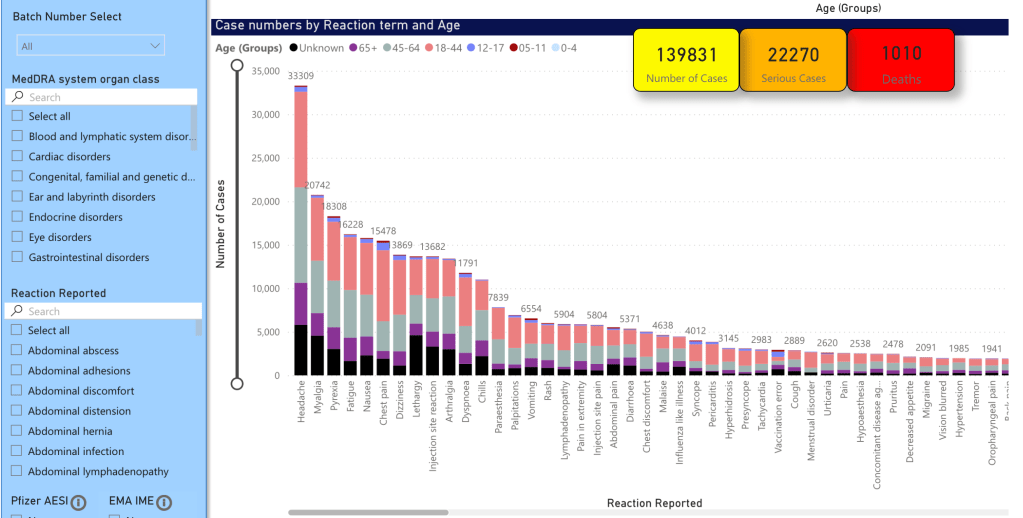
The primary data interrogation categories on the index page of openDAEN are:
Case numbers by Year, Month and Sex
Cases by COVID-19 Vaccine Type
Case Numbers by Reaction term and Age
Case by Frequency of Batch Number
Table of case number, date, vaccine manufacturer, MedDRA reactions, Death, Serious cases and the FOI request number the batch number was confirmed by.
The index page offers the following:
Above: Slideshow: OpenDAEN website
OpenDAEN is called a “free database”. Don’t be fooled. The important elements here are reports and post vaccine, combined with the fact almost all adult Australians have had two COVID-19 vaccines, as have two thirds of 5-15 year olds. Random ill health events can and do frequently occur coincidentally with vaccination. It’s also important to realise that the TGA and health authorities encourage Australians to report these events, so that over time a greater understanding of these vaccines will emerge. OpenDAEN.info provides a description on each page footer:
OpenDAEN.Info is a non-commercial and not-for-profit website for the research, study and review of the TGA (Therapeutic Goods Administration) DAEN (Database of Adverse Event Notifications) system in respect of COVID-19 vaccines. The primary source of data on OpenDAEN is the TGA DAEN system and their published FOIs (Freedom of Information).
Decontextualisation
When taken out of context and denied TGA cautionary disclaimers, the reports become hearsay temporally related to something somebody did. Nothing more. This is decontextualisation. But apparently, we are to assume causation exists. OpenDAEN claims to be able to offer up to date, conclusive data related to adverse events caused by COVID-19 immunisation. These adverse reactions are the subject of reports sent to the TGA DAEN. So, the data themselves have a recognisable source. But can absolute conclusions be made with any real confidence? In reality it takes time for clinically relevant events, specific to any vaccination to be investigated, identified and acted upon. Unless already understood and published on the TGA COVID-19 Vaccine Safety Report (2 November 2023), the quality and quantity of adverse reaction is speculation. To make matters worse, the anti-vaccination lobby has invested an exceptional amount of time spreading disinformation via social media, and one of their primary targets has been the TGA DAEN.
The anti-vaccine lobby want every report to be an absolute reality. They want the figures, diligently and honestly provided to Australia by the TGA, to be accepted without examination as conclusive, in their misguided attempt to wipe out COVID-19 immunisation. We saw this claim time and again in the court affidavits of Peter Fam, Meryl Dorey, Julian Gillespie and Katie Ashby-Koppens; reports presented as if confirmation of death and injury in huge numbers. But correlation is not causation. If you haven’t clicked the link to DAEN by now, let’s see what the TGA, but not OpenDAEN, stress about the contents.
- DAEN SPLASH SCREEN DISCLAIMER –
Okay, so it confirms what I stressed above. But most crucially, you have to tick the teeny weeny little box next to I have read and understand the above, to access the TGA data. The disclaimer can’t be missed. Only willingly ignored. The importance of what this means and the restrictions the disclaimer places ipso facto, on OpenDAEN was studiously avoided during the video on 22 January. In fairness I will note that a small header on the TGA DAEN page was visible, but also ignored. It reads; Inclusion in DAEN – medicines does not mean that the adverse event has been confirmed or that it was caused by a medicine or vaccine. Clicking it – which the presenters also studiously avoided – reveals a little more about the DAEN content. Due to size restrictions of a screenshot, I’ll pop the text in a paragraph, and include some emphasis (mine):
The DAEN – medicines allows you to search adverse event reports for medicines including vaccines received by the TGA. The TGA uses adverse event reports to identify when a safety issue may be present. The DAEN – medicines does not contain all known safety information. An assessment of the safety of a medicine or vaccine cannot be made using the DAEN – medicines alone.
Talk to a health professional before starting, stopping, or changing your prescription medicines.
Anyone can report a suspected adverse event, including members of the public, health professionals and pharmaceutical companies. We encourage reporting even when it is not clear that a medicine or vaccine is the cause. Information from these reports is published in the DAEN – medicines and reflects the observations of the person who reported the event.
People who experienced an adverse event cannot be identified. Maintaining their privacy is of critical importance to the TGA.
The DAEN – medicines is a ‘living’ database that is frequently updated. Information may change if we receive more details on an existing report or if we identify duplicate reports and combine them. Updates may also occur as part of our data quality assurance activities.
In short, the TGA DAEN database is constantly growing, contains information from any member of the public, reflects the observations of that person, provides no information about the safety or lack thereof, of vaccines and does not confirm that an adverse event was caused by a vaccine. It cannot even confirm if the event has actually occurred. I might add, dear reader, given that the anti-vaccine lobby has gone out of its way to submit to the DAEN clearly impossible and even bogus reports, one must remain extra vigilant when assessing or querying these data.
Indeed, Sharon Cousins herself relayed an abuse of the TGA DAEN system at the 8:30 mark of the video. She had queried via FOI why a reported death of a 6 year old boy was no longer available on the DAEN. Sharon noted that within her FOI report FOI 4077 (“Batch numbers of COVID-19 vaccines of reported deaths”), it was revealed the initial report was submitted as a hoax. The relevant section of the report reads:
FOI 4077 also requested information about why case number 724925 no longer appears in the DAEN. This report was rejected following review of further information for the case. The information demonstrated that the report was submitted as a hoax and as such there is no identifiable patient. The report remains in the TGA’s internal database. However, it no longer is included in the DAEN as it has been rejected because it no longer met the minimum criteria for a valid adverse event report.
Sharon Cousins
Sharon also said the TGA reply included, “Normally we wouldn’t answer this”, after insinuating she has a positive relationship with them. However, that comment is clearly not there. One appreciates Sharon sharing this information, but cannot ignore that it took an FOI query of a fatality to uncover the truth. How many other adverse or serious adverse reactions were, or will be, “rejected following review of further information for the case”. Sharon was eager to reassure viewers that OpenDAEN was not misusing the TGA website, but rather making it “more user friendly”. It will be of benefit to TGA staff Sharon opined, and she had sent the site link “to the coroners”, and to State and Territory head pathologists.
Batch Numbers
Throughout, much is made of the section allowing search of batch numbers. We learn that when it comes to accessing batch numbers, the TGA, “Doesn’t have any search engines on it, is a little bit clunky and it times out”. The TGA freely provide data in CSV format on batch release assessment of COVID-19 vaccines. One of two release pathways is taken; either based on overseas certification or based on TGA laboratory assessment. The TGA explain this in detail. So, what could be wrong with smoother navigation of COVID-19 batch numbers as a function of vaccine type, reported adverse reaction and de-identified data? Usually nothing, unless one ignores TGA advice and extrapolates to conclusion, based on other available data.
At the 50:00 minute mark Sharon directs navigation through the number of cases per batch number, highlighting batch number FP1430 – COMIRNATY, (Pfizer), in section 4. OpenDAEN has accessed the batch numbers via FOI, and that’s fine. OpenDAEN reveals inordinately more adverse reactions for male and female associated with this batch number, compared to those next to it. Sharon instructed more data access and directed navigation to the batch number table. She continued:
Look at the dates! Look at all the dates! Within 24 hours of the Pfizer being released on the younger children, the five to elevens… it was all advertised, tenth of January [2022], five to eleven year olds… within 24 hours we have reported cases. Now that for me is causal proximity.
Sharon continued on, directing suspended doctor Oosterhuis to isolate reported – not confirmed – fatalities using that batch number and age group. They isolate two boys. Zeroing in on the symptoms of one boy, Sharon reads, abdominal pain, then dismisses adverse event following immunisation as “a very bland one”, then cardiac arrest. She has Paul Oosterhuis explain eosinophilia and eosinophilia myocarditis. He assumes he is explaining the findings of both of “these boys”. In fact the data reveal clearly it is only one boy. A five year old.
The ten year old “fatality” has only Adverse Event Following Immunisation listed. The “very bland one”, dear reader. Then Sharon warns us “It’s a little bit distressing now, okay. The two boys both had the same batch number”. She gets Oosterhuis to zoom in and suggests, “So, screen print that people if you don’t believe us”. After zooming in on the case numbers Sharon has Oosterhuis zoom in on the batch numbers again, as if she hadn’t made that point enough times already.
Now, I am not a lawyer but I doubt the strength of Sharon’s “causal proximity” claim. There is another factor Sharon told us herself, that must be considered. As she points out, the roll out for Pfizer for 5-11 year olds was 10 January 2022. Thus, the first factor I would investigate would be the sheer number of children being vaccinated, at the time of release. Over 11 weeks, 76.6% of those 2.3 million children were vaccinated. 1,761,800 children had one dose. 1,552,500 (67.5%) had two doses. The vaccine for 5-11 year olds is one third the dose approved for children aged 12 years and over. Cold chain transport and storage is vital to the success of mass mRNA vaccination programmes.
Using OpenDAEN to interrogate vaccine batch numbers of adverse reports about 5-11 year olds, over the first two months of the rollout, we see virtually one result: FP1430. Yet what is more likely? Batch FP1430 is responsible for all adverse reaction reports? Or most 5-11 year olds vaccinated in the initial days, were dosed from batch FP1430? By the end of February other batch numbers begin to appear and gradually attract more reports. By late March, FP1430 is just another batch number. More so, there are over 500 unknown batch numbers for that age group. However, if you present your disinformation just right, some might believe in the deliberate harming of children:
– Facebook comment –
What do the TGA say?
There have been no deaths in children or adolescents determined to be linked to COVID-19 vaccination. More detail on these deaths is available in the safety report published on 15 December 2022… If we identify a new death likely to be related to vaccination, we will publish this information promptly, as we have for all other cases since the start of the vaccine roll-out. [Source – 2 November 2023]
Of the 14 deaths the TGA confirm are linked to vaccination, none are in the 5-11 year age group. Yet Sharon is convinced of her claim, has already convinced others and will convince more, simply because of bias. Her defence, I suspect, will be that she used FOI legislation to access reports on batch numbers and the TGA lacks the smooth batch number access and navigation of OpenDAEN. Yet Sharon made up her mind before she even started looking. In fact, Inclusion in the DAEN does not mean the event has been confirmed or determined as related to a vaccine, is utterly ignored when using OpenDAEN.
The reactions reported in January, are based on MedDRA. Seen clearly in the video, were cough, vomiting, pallor, lethargy, rash, injection site rash, syncope, cold sweat, decreased appetite, anxiety, dizziness, nausea, abdominal pain, abdominal discomfort, aggravation of existing disease, excessive sweating, hives, muscle stiffness, chest discomfort. The worst on screen were seizure, appendicitis and a seperate loss of consciousness. Searching the batch number/adverse reaction table for 5-11 year olds in my own time, revealed reports of chest pain, syncope, anaphylactic reaction, paraesthesia, ECG ST segment elevation, nystagmus, pneumonia and many others. Some reports were of one reaction and others of multiple. All reports are of conditions children experience everywhere across the globe. Establishing cause or any relationship to COVID-19 vaccines is the role of health authorities.
Elsewhere on OpenDAEN we read that:
Useful search engines, graphs and tables have been developed into a helpful user-friendly database to assist study, research, review and analysis of the Australian Government publicly available data. […] We believe in sharing this information in an open and easy-to-use format (with search engines, tables and graphs etc.) and to help make it quicker for anyone wanting to source data for their own study, research and review.
The Quack Miranda
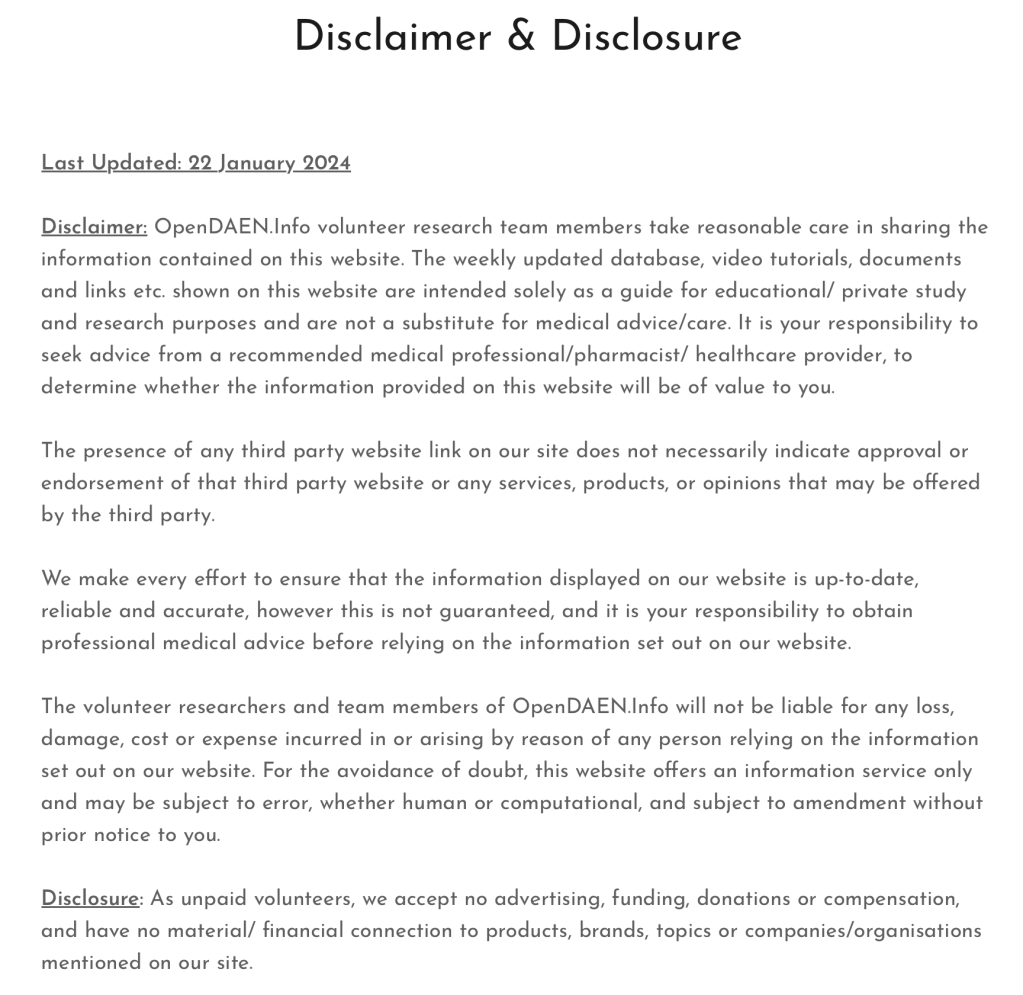
So, the team want to share information in a fast open and easy way to help with doing your own research. It sounds almost too good to be true. The Disclaimer and Disclosure tell us:
– Source: OpenDAEN –
Okay then. It is up to the user to get further professional information to confirm if the information is “of value to you”. Accuracy of the information cannot be guaranteed which places further responsibility on the user to seek advice before relying upon it. It’s information they might get wrong and as such will not be liable “for any loss, damage, cost or expense incurred” by reason of relying on that information.
It is 2024 and world search and data systems can perform enormous and complex requests with astonishing speed and accuracy, yet when Australian governments roll out never before used experimental gene therapies to millions of citizens, Australians are left to report to an antiquated adverse event reporting system (DAENs) still with both feet in last century.
This amounts to a fundamental failure of Pharmacovigilance and the Australian People. Searching through DAENs remains a nightmare for researchers, where one cannot but question the motivations of the TGA and the Australian health departments who feed it Our Information. OpenDAEN greatly assists researchers and students, and data and IT experts desperately needed to review and criticise the current DAEN system which is not fit for purpose.
Hopefully OpenDAEN will motivate Australian governments to take the needed steps towards a national real-time, transparent, and easily accessible adverse event reporting system, for properly protecting the health of Australians and better facilitating valid Informed Consent. The antiquated DAEN system deprives and seemingly hides needed health data necessary for Australians to provide valid Informed Consent.
COVID vaccine injury class action fund raiser, Dr. Melissa McCann writes:
This is amazing and meticulous work by you and your team.
Strong reminders of OpenVAERS and how decontextualised data are used by anti-vaccine activists to mislead, were apparent during the video. Alluding to what is known as the Lazarus Report, after the name of the principle investigator, one commenter offers:
– Facebook comment –
Suggesting that TGA DAEN statistics are only “(10%?)” of “ACTUAL injuries and deaths”, is linked to a bogus belief of widespread underreporting to VAERS in the USA. I addressed this in a post challenging OpenVAERS, writing.
The figure of 1% comes from a report from Harvard Pilgrim Health Care, Inc., authored by Ross Lazarus. Data examined are from 1 December 2007 to 30 September 2010. These data include all possible adverse events. Prior evaluation of the reporting rates of various events confirms that minor events are rarely reported and more serious events routinely reported. A 2014 report on surveillance of adverse events following immunisation in NSW, Australia noted that:
Only 11% of the reported adverse events were categorised as serious.
In short, most adverse events such as a sore arm, nausea, swelling, redness, headaches, vomiting and other self correcting issues are indeed underreported, but make up the vast bulk of adverse events following immunisation. Yet since the Lazarus report, anti-vaxxers love to spread tales of widespread death and terrifying injury, then solemnly add “only 1% are ever reported”.
Paul Offit is a strong supporter of VAERS which he refers to as a “hypothesis-generating mechanism”. Reports there of intussusception approximately once per 10,000 doses led to suspension of his own RotaShield vaccine which was ultimately recalled, before returning as a safe product. In fact health authorities want parents or doctors to report minor events as soon as possible. Much can be learned about self limiting reactions, and more concerning to severe reactions can be gauged by pattern changes, properly identified and suspended under section 29D of the Therapeutic Goods Act 1989.
Perhaps the most damning page on OpenDAEN is the resources page. A curated smattering of COVID-19 vaccine pseudoscience and “vaccine injury” class actions, peppered with all the anti-COVID mandate and health advice groups, it seems designed to lead readers into a field of gaping rabbit holes. Dr. Melissa McCann’s COVID class action vaccine injuries video tops the page. The World Council for Health Spike protein detox guide is there. R.F. Kennedy Jr.’s Children’s Health Defense Australia, The Zelenko Protocol, The Australian Medical Professionals Society, many of whom we’ve met here before, World of Wellness and the National Institute of Integrative Medicine to name a few.
Conclusion
OpenDAEN is not an exciting addition to the TGA DAEN database. It is not a positive, user-friendly addition to TGA staff or to genuine researchers and academics. It is created, managed, supported and provided by and for respectively, members of the anti-vaccine community, convinced that COVID-19 vaccines are the cause of multiple health ailments and death. No professionals were available for its launch. All invitations were ignored. It has no integrity and no academic standing. No coroners or State and Territory head pathologists will care.
Like its namesake in the USA, OpenVAERS, it is designed to allow users to gather misleading collections of coincidental report material and present this as causal COVID-19 vaccine adverse reactions. To be sure, the results it produces, easy to construct as they are, will find their way onto websites, social media and court affidavits. OpenDAEN won’t enjoy the success OpenVAERS did, because now only diehards remain. During the launch of OpeanDAEN, events two years old were focused on, to craft a demonstrably bogus, yet very serious accusation against COVID-19 vaccines.
In a previous post we looked at the unsuccessful attempt of the Australian Vaccination-risks Network to convince the Federal Court of Australia it had legal standing to challenge the COVID-19 vaccine rollout.
They sought a writ of Mandamus to overturn provisional registration of mRNA and AstraZeneca COVID-19 vaccines, and a Judicial Review to overturn provisional approval of Pfizer’s vaccine for 5 to 11 year olds.
The evidence was intended to demonstrate lack of safety and efficacy of the vaccines. The plaintiffs contended the vaccines should not have been provisionally approved or registered. Indeed, that they should have been cancelled or suspended because of an imminent risk of death or serious injury. Thus, the Secretary of the Department of Health had erred in his duty to “cause to be maintained” the Australian Register of Therapeutic Goods.
However the evidence and legal arguments were never heard in court. The AVN had no “special interest”, and thus standing. On 8 August 2022 their appeal against this finding was found to be incompetent. A couple of months later, lengthy correspondence went out to all “donors and potential donors”. Headed AVN Legal Actions and Strategiesthe document opined on the issue of standing:
The way that the current case law is being applied by the Federal Court is essentially to say that nobody has sufficient standing to challenge these therapeutic ‘goods’, nor indeed the Secretary of Health.
The Babies Case
The AVN had decided to take “an alternative course of action”. One that had been researched and prepared by retired barrister Julian Gillespie and solicitors Peter Fam of Maat’s Method and Katie Ashby-Koppens of PJ O’Brien and Associates. In view of the AVN’s recent outcome it was deemed wiser to approach the High Court with “The Australian Babies Case” (AuBC), and seek to “halt the provisional approval of the Moderna jab from being injected into our precious 6 month old to 5 year old infants”. The AVN would “change course” and become a co-applicant with five others.
The other applicants were:
Associate Professor Peter Parry
Dr. Julian Fidge
Dr. Shoba Iyer
Dr. Astria Lefringhausen
Mark Neugebauer
The first three applicants above are active members of the Australian Medical Professionals’ Society (AMPS), a Red Union group that formed with the specific aim of challenging the rollout of COVID-19 vaccines, fighting COVID-19 mandates and promoting controversial treatments such as Ivermectin and hydroxychloroquine. Parry is also the lead applicant challenging the State of QLD over health professional’s vaccine requirements and a key member of Doctors Against Mandates. Three months before the AuBC strategy was outlined in this document, the AVN published the full AMPS Medico-Legal Summit on its website.
The breakdown of speakers at the summit includes AVN legal consultant and primary researcher behind the AuBC Julian Gillespie, primary plaintiff Prof. Peter Parry, Senator Malcolm Roberts and Senator Gerard Rennick. We will meet Senator Rennick again, later in this post. In lobbying the SA Minister for Child Protection, plaintiff Mark Neugebauer cites AMPS correspondence from Dr. Christopher Neil, another speaker at the summit. Gillespie and Ashby-Koppens appear on AMPS Discussions From The Frontlineupdating legal activity |2|.
The document went on to outline the strategy behind this new approach:
In The Australian Babies Case, the legal strategy is to present five applicants before the High Court of Australia, and show the Court how each applicant is affected by the actions and inactions of the Secretary of Health, with respect to the Covid-19 drugs made available to babies and young children, and the rest of the Australian community in circumstances where, prima facie, preventable deaths, illnesses, and injuries in extraordinary numbers are associated with their use; and where most of the population does not need them; however despite the expertise and evidence possessed by the various five applicants, the current law on standing in Australia is deficient, and will not recognise any of the applicants as proper parties for suing the Secretary of Health.
Australian Babies Case legal research team
Julian GillespiePeter FamKatie Ashby-Koppens
It further outlined that the Babies Case would be seeking to have the High Court “fix the law on standing” such that the applicants would be accepted as having “special interest”. Namely, “the preservation of human life from preventable death, illness or injury”. It was claimed, albeit without evidence, these preventable outcomes were being seen now, due to “COVID-19 drugs” and that this constituted an “iatrogenic catastrophe”. That is to say, a catastrophe caused by the diagnosis and treatment of a condition.
Mark Robinson SC who represented the AVN in the initial failed case, confirmed this new approach was viable and advised that the High Court “has indicated that it wishes to revisit the law of standing in Australia”. They would be seeking:
A new Special Interest regarding the preservation of human life.
If successful, a court-granted injunction to halt the provisional approval of COVID-19 vaccines to babies 6 months to 5 years and children 6 to 11 years of age.
If the High court recognises this new special interest for standing, that the High or Federal Court immediately hear the Judicial Review cases for both childhood age groups and the original Mandamus case for mRNA and AstraZeneca vaccines.
If successful, the AVN expected to be able to proceed with their initial cases. As “a matter of convenience” the AVN would seek to take over the running of the Judicial Review case that involved children 6 months to 5 years (the AuBC). The AVN note that they feel joining the case “operates as a de facto appeal” from the 8 August 2022 Federal Court appeal decision.
The application was filed with the High Court on 20 December 2022. The day before, a media release was published by AVN president Meryl Dorey. It provided some initial insight into the legal tactics to be employed in this quest for a new category of standing. Resurrected anti-vaccine themes from the initial Federal Court case peppered a quote attributed to Julian Gillespie (bold mine):
The High Court of Australia is now being called upon to protect our youngest from participating in an acknowledged and ongoing Phase III clinical trial, to receive experimental drugs involving unprecedented levels of reported adverse events, including deaths… for a virus also acknowledged to pose no threat to our Babies and Toddlers…
At this point it’s worth noting that, in public discourse, the Australian Babies Case legal team studiously avoid discussing the 3 August 2022 ATAGI recommendations for this age group. Namely:
ATAGI recommends COVID-19 vaccination for children aged 6 months to <5 years with severe immunocompromise, disability, and those who have complex and/or multiple health conditions which increase the risk of severe COVID-19.
More so, the legal team make much of the fact severe cases of COVID-19 are not common in this age group, and thus provisional approval of Spikevax suggests nefarious, and not clinical, motivation. Yet ATAGI clearly state:
ATAGI’s guidance takes into account:
The very low risk of severe COVID-19 (e.g. hospitalisation due to COVID-19) in healthy children aged 6 months to <5 years. This age group is one of the least likely age groups to require hospitalisation due to COVID-19. Among the small number who are hospitalised or who die due to COVID-19, underlying medical conditions or immunocompromise are frequently present. […]
The plaintiffs alleged Spikevax is a “genetically modified organism”. As such, Brendan Murphy, Secretary of the Department of Health had failed to comply with yet another section of the Therapeutic Goods Act 1989 (TG Act). As expected a writ of certiorari would be sought to quash provisional approval of Moderna’s Spikevax vaccine for children 6 months to 5 years. A writ of mandamus (where the court orders an official) was originally sought to have the application to approve Spikevax, reviewed under law. It was ultimately abandoned. For more specific insight we must turn to the application.
Legal Arguments
The plaintiff’s argument had two grounds, and a section headed Reasons Why Remittal Not Appropriate. Those reasons argued that the case should be heard by the High Court because that court had the power to accept the need for, and then admit for hearing, a new category of standing. Thus the High Court should not remit (send back) the case to the Federal Court. They contended that the principles for standing should be more liberal when a person can establish the subject matter involves life threatening or debilitating medical conditions and they seek to preserve human life. In short:
Where the fabric of human life might be compromised or adversely impacted, interested and involved members of the public should have a right of standing in such circumstances.
Whilst I don’t accept the argument for a new category of standing in this manner, I do agree that the law is frequently lacking. In fact, it’s about here I suspect a number of Australian vaccine proponents, Skeptics and opponents of the anti-vaccination lobby may feel a dash of Deja Vu.
In 2010, following complaints from the public about misleading AVN advice, the NSW Health Care Complaints Commission published a “damning report”. The AVN successfully appealed the ruling because whilst the HCCC had jurisdiction, the complaints lacked evidence that anyone had acted on AVN advice. The appeal outcome led to the Health Legislation Amendment Bill 2013 in NSW Parliament, allowing the HCCC to act on the likelihood of harm. A follow up inquiry was launched and a second, more in depth Public Warning against the AVN was published in 2014.
Let’s return to the present. The plaintiffs also argue that there are “important questions about the lawfulness of Commonwealth officials to make provisional determinations” that impact wellbeing. They allege there is no real jurisprudence about this in the context of the TG Act. Yet in reality, the standard of evidence required to make these determinations is high and the TG Act is comprehensively designed to minimise risk. Indeed failure to make provisional determinations may risk the wellbeing of the nation.
Ground One of the plaintiff’s argument again takes us to the TG Act. Specifically Section 22D(1), which provides that the Secretary must decide to make or refuse to make a determination, when a valid application has been made. In this case the application was for Spikevax (elasomeran), which the Secretary provisionally approved for children 6 months to 5 years, on 19 July 2022. The plaintiffs argue that s 22D(1) “is subject to an implied restraint”, that the decision will be legally reasonable. They submitted:
Legal reasonableness, or an absence of legal unreasonableness, is an essential element in the lawfulness of decision-making.
Referring to “the decision” to provisionally approve Spikevax for the ages under discussion, the application is dismissive of evidence used. It cites the TGA document Australian Public Assessment Report for Spikevax, 19 July 2022. Yet the Submission overview and risk/benefit assessment, accommodates no less than half of the 31 pages. This was updated on 8 November 2022; 42 days prior to filing of the plaintiff’s application, and contains 8 subsections covering 55 of the document’s 69 pages. Subsections include, but are not limited to, Quality, Risk management plan, Risk-benefit analysis, Additional clinical data and Second risk-benefit analysis.
The plaintiffs further argued that the Secretary’s decision that Regulation 10L(1)(a) of the Therapeutic Goods Regulations 1990 (TG Regs) was met, is legally unreasonable. That particular regulation states under Provisional Determinations:
(1) For the purposes of subsection 22D(2) of the Act, the criteria are all of the following:
(a) an indication of the medicine is the treatment, prevention or diagnosis of a life-threatening or seriously debilitating condition;
In other words it was legally unreasonable to accept that the vaccine ever contributed to the prevention of serious illness brought on by COVID-19 in children 6 months to 5 years. This argument is a repeat of the AVN tactic seeking Judicial Review in the initial Federal Court Children Decision case, where they also targeted s 22D of the Act.
This was cited because the AVN also sought an order quashing any determination made by the Secretary pursuant to section 22D, that an indication of the vaccine:
“[W]as the treatment, prevention or diagnosis of a life-threatening or seriously debilitating condition for children aged 5 to 11 years of age.”
The plaintiffs continue to argue their case for “legal unreasonable decision-making” by again turning to the TG Act. They argue the Secretary has failed to satisfy requirements in s 25(1)(d)(i). Section 25 deals with evaluation of therapeutic goods, and the cited subsection provides:
(d) for an application for provisional registration of a medicine:
(i) whether, based on preliminary clinical data, the safety and efficacy of the medicine for the purposes for which it is to be used have been satisfactorily established.
Put more simply, the plaintiffs contend that when the Secretary was evaluating Spikevax, the data he used did not “satisfactorily establish” its safety and efficacy. This, they allege, amounts to legal unreasonable decision-making.
Genetically Modified Organism
Ground two of the plaintiff’s argument stated that the Secretary failed to comply with s 30C(2) of the TG Act. Section 30C provides for Consultation with the Gene Technology Regulator (OGTR). The cited subsection reads:
It appears that there has been non-compliance with a statutory condition in the TG Act. […] The plaintiffs contend that non-compliance with the statutory obligation mandated by s 30C(2) leads to the invalidity of the registration decision that followed.
Could it be that the Secretary did not have to notify the OGTR? As fate would have it we are assisted here by questions from Senator Gerard Rennick. On 16 February 2023 during a Community Affairs Legislation Committee Estimates hearing, Rennick questioned our current gene technology regulator, Dr. Raj Bhula, about s 30C of the TG Act, asking if the Secretary had written to the OGTR in regards to mRNA vaccines.
You can read the full exchange on Rennick’s website, or watch the video of it below. However, I’ll cut to the responses that matter with respect to the AuBC. Does the Secretary have to notify the OGTR?
Dr Bhula : No, because the mRNA vaccines are not required to be regulated through the OGTR.
Senator RENNICK: Did they write to you and actually ask you that question?
Dr Bhula : No, because they’re not required to be regulated through the OGTR.
Senator RENNICK: But how would they know, because you’re the expert? And, by the way, gene technology involves both replication and transcription.
Dr Bhula : Yes.
Senator RENNICK: Which is what the mRNA vaccine does.
Dr Bhula : But the mRNA COVID-19 vaccines did not involve any step of genetic modification—
Senator RENNICK: They produce proteins.
Dr Bhula : or a GMO—
CHAIR: Senator Rennick, would you allow Dr Bhula to finish her answers.
Dr Bhula : which meant that that didn’t require regulatory oversight by the OGTR.
An unambiguous answer. Interestingly, this wasn’t published on Rennick’s website at the time of the exchange. It was published 20 March 2023, which was four days after the High Court decided not to hear the AuBC. A coincidence? Unlikely, dear reader. As mentioned above, Senator Rennick, the AuBC plaintiffs, key legal researcher for the case and the AMPS are linked by their COVID-19 ideology and related lobbyist activity.
Gerard Rennick questions Dr. Raj Bhula, Office of Gene Technology Regulator
For the purposes of the AuBC affidavit, I acknowledge the confusion surrounding mRNA vaccines and GM technology. The AstraZeneca COVID-19 vaccine using a genetically modified chimpanzee adenovirus, is a clear example of GM technology. The OGTR Risk Assessment and Risk Management Plan for that vaccine is here. Years earlier the OGTR published a similar plan for a GM Live Attenuated Influenza Vaccine. The TGA acknowledges both examples as GMO medicines.
Technology applied to extract, multiply and distill the mRNA used in vaccines to instruct our cells to produce the spike protein of SARS-CoV-2 is different to the genetic modification of an adenovirus or a live influenza virus. Dr. Bhula describes it as not involving “any step of genetic modification or a GMO”.
Nonetheless, the Australian National Gene Technology Scheme lists mRNA COVID-19 vaccines, including Spikevax, as GMOs used as medicines. An Open Access Government article states, “mRNA and viral vector vaccines are derived using techniques of genetic modification (GM)”. The Alliance For Science distinguishes between the two. “This one really is genetically engineered”, it says of the adenovirus vaccine, after discussing mRNA vaccines.
We must accept Dr. Bhula’s position that mRNA vaccines are not required to be regulated through the OGTR. For the sake of the AuBC affidavit, s 30C(2) of the TG Act does not then apply, and the provisional registration of the mRNA vaccine Spikevax, is valid.
Case Remitted to Federal Court
The plaintiffs did not appear before the High Court. On 16 March 2023, Justice Stephen Gageler remitted the case to the Federal Court of NSW, as per the following order. A summary page is below.
No weight was given to the legal arguments raised, although it was noted there were “supporting affidavits totalling more than 2,000 pages”. What’s important is Justice Gageler’s observation that the Secretary had submitted that the proceedings should be remitted to the Federal Court which would have jurisdiction, under Section 39B(1) or (1A)(c) of the Judiciary Act. That section follows parliamentary action in 1997, to transform the Federal Court into one with more general jurisdiction (see p.9), including jurisdiction over any matter, “arising under any laws made by the Parliament [excluding criminal implications]”.
Justice Gageler observed:
I am satisfied that this matter is one “arising under” the TG Act for purposes of s 39B(1A)(c) of the Judiciary Act, and that the Federal Court has jurisdiction over its subject-matter and the parties on that basis.
Justice Gageler reflected on the plaintiff’s claim that the High Court was the only appropriate Court to decide on a new category of standing due to “special interest” arising when “the fabric of human life might be compromised or adversely impacted”. He stressed that the power to remit is discretionary “to be exercised after due consideration of all the circumstances of the case”. Justice Gageler cited another case as instructive, in that the power of the remitter is designed to ensure the High Court is not diverted from its principle functions by matters that “could properly be brought in an Australian trial court”. After offering his assessment of the significant scale of the case, Gageler concludes:
Having regard to these considerations, significant case management and fact finding are likely to be required to conduct a hearing of the kind contemplated by the application. Undertaking that task would unduly divert the Court from its principal functions.
“We are Discontinuing the Australian Babies Case”
The plaintiffs did not return to the Federal Court. On 12 April 2023, instructing solicitor Peter Fam of Maat’s Method published an article, and a longer explanatory video, in which he labels the vaccines “a poison”. In view of their 2022 failures with the Federal Court, further chances were poor. Even if successful, there may be repeated appeals lasting over a year. They did not have the money or time. “People are being injured and dying every day”, from COVID-19 vaccines, Fam said without evidence.
Fam added; “Too much money has been usedon facetious exploits and actions… things that haven’t been thought out in terms of strategy… people aren’t working together… doing things that are contradictory to each other… I have to take some responsibility… we lost the AVN case… a lot of money had been donated to that case”.
However:
All is not lost. This is a pivot; not a retreat, and there are other matters we have been working on simultaneously with this one, with better prospects of success than this case would have in the Federal Court. Those efforts will be formally launched within weeks, and you will hear more about them soon.
Dr. William Bay
A final mention must go to suspended GP registrar, William Bay. Bay has become a favourite amongst “cooker” watchers since he chose an AMA conference to film himself yelling anti-vaccine conspiracies, and call Chief Medical Officer, Paul Kelly “a liar”. A client of Peter Fam, Bay was asked to join the AuBC as a plaintiff. Shortly after he wanted to swap his position as plaintiff with the parent of a vaccine-injured child, believing this gave the team a greater chance at success. Fam and Gillespie disagreed. Nor could such a client be found.
Later, he filed for leave to intervene in the case as he objected to the nature of the special interest standing. He argued that if granted, the existence of standing granted via special interest in “the preservation of human life from preventable death, illness or injury”, could be used to justify COVID-19 vaccination for children. You can read Julian Gillespie’s “urgent” letter to supporters on this matter here.
Understandably, Bay further argues that such special interest standing may then be used to interfere in the application of medicine and the doctor-patient relationship in areas unrelated to COVID-19 vaccination (see video 56:45). Gillespie argues, quite rightly, that the request for standing applies to administrative and not private law. What Gillespie omits though, is any appreciation of how administrative changes impact private citizens.
Conclusion
The Australian Babies Case sought to convince the High Court to accept that medically qualified applicants had “special interest” preventing “death, illness or injury”, in babies and small children. Success would lead to a new category of standing, and this would permit the AVN to return to the Federal Court to pursue this case and its original 2022 Federal Court case, AVN v Secretary, Dept. Health.
Case evidence involved a revamping of prior legal tactics. The Therapeutic Goods Act was exploited by the plaintiffs to demonstrate regulatory failures on the part of the Secretary of the Department of Health. These failures, they again argue, justify overturning the registration or approval of COVID-19 vaccines. Driving this action was a suite of fallacious claims and misrepresented statistics.
The plaintiffs are members of and/or closely associated with the AMPS, a well organised union of medical and allied health professionals, working actively to undermine confidence in COVID-19 vaccines. Members of the legal team in this case are strident anti-vaccine activists, closely associated with AMPS, and outspoken anti-vaccine politicians.
Despite the label of “Babies Case”, this was all about giving the AVN a second chance for legal standing to have their case demanding an end to all COVID vaccines, heard in the Federal Court. Had standing been granted via a special interest as described above, it could be used to target all vaccines and help Meryl Dorey advance her life-long claim that “no vaccine is safe”.
According to the instructing solicitor of the AVN, further action should be expected soon.







 Losing In The Lucky Country