Pertussis: nothing worse than a bad cough?

Many of you will know of Meryl Dorey’s infamous claim that one didn’t die from whooping cough or measles thirty years ago.

Followed by, “and you’re not going to die from it today”. This was made on an episode of Sunday Night on the 7 Network in April 2009. Recently Ms. Dorey was queried about evidence for this. Rather boldly her response (in full below) included:

This statement was one of 3 or 4 sentences I was allowed in an interview that ran for over 3 1/2 hours and out of which, the TV station took what they could use against me and left out the rest.

Dorey had immediately prior contended that her mother intentionally placed her with other children so she would catch vaccine preventable diseases. “We were supposed to get them and we did and we were healthier for them”. 

First, let’s revisit the 26 seconds in question.


Actually there may be some truth to Dorey’s observation of no fatality from pertussis “thirty years ago”. The probable cause? Mass vaccination.

In January 2009 ABC’s The Pulse reported in A bad year for whooping cough:

Whooping cough used to be a disease that everyone got as kids, says Dr Frank Beard, acting senior director of Queensland Health’s Communicable Diseases Branch.

However, numbers plummeted following the introduction of mass vaccination in the 1950s. Cases fell to an all time low in the 1970s and 1980s…

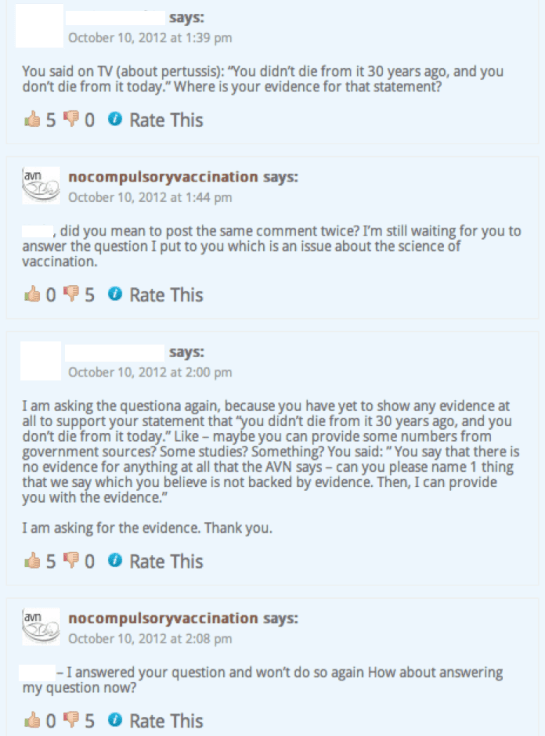
Okay let’s check out the comment thread in question.

As it turns out I’ve already examined much of Ms. Dorey’s sleight of hand pertaining to pertussis this way.

In My personal request of Meryl Dorey, back in January I break down her method of using notification data out of context. I did ask for a response but found myself banned and blocked from social media. No emails were answered.

Here’s a relevant section:

Okay, let’s use your method on another year.

We can see (using the same NNDSS data) that 2007 was the lowest year of infection on record since 1999 – http://i.imgur.com/XOrUY.png. It is also the 5th lowest year since records began.
Many discount the first recording years of 1991 and 1992 as very, very low anomalies that show a slowish start to new legislation requiring reporting of whooping cough. This would make 2007 the 3rd lowest ever. But I’m happy to take the 5th lowest year ever.

Rather different to your claim, no? But from your data source no less.

Now, looking again at your vaccination rate table (http://i.imgur.com/w9I9g.jpg) we see 2001 had only 70.6% vaccination. Infection was 9,541 Aussies. By 2007 – still using both your data tables we see 95% vaccination of babies and 4,864 cases of pertussis (http://i.imgur.com/XOrUY.png).

So, using your “technique” on merely another part of the same NNDSS table we can also claim vaccination more than halved pertussis notifications in a mere 6 years.

Your data, your method, the very same tables you quote from. Why then is this not your message? Why don’t you tell Aussies that these sources show a greater than 50% drop in whooping cough in just 6 years?

So, for the sake of this post Meryl has had that request for evidence of her claim about mass vaccination, long since shown to be the abuse of data that it is. Read the full breakdown for greater context.

Back to the comments. The poster chose to dig in and it seems seek an admission no evidence exists. The exchange is as follows.

Yes. I could ask the same Ms Dorey.

In fact along with the high diagnoses, fatalities are less than during the 1997 and 2002 outbreaks whilst hospitalisations are about the same. The alarming numbers of notifications reflect the sensitivity of PCR testing (now widely available) and the tendency of GPs to suspect pertussis.

However another question has come to mind. If the producers of Sunday Night in April 2009 edited footage they “could use against [Meryl]”, does this apply to her other comment? The one about pertussis being “nothing worse than a bad cough”. In her household it apparently lasted two weeks and was treated with homeopathy.


I wonder if this is down to those shifty producers also. Using material “against” Meryl Dorey.

Because clearly it is nonsense.

Legitimate Rape: for sufferers of Sexually Liberated Uterine Tendency

Thanks to USA Republican candidate Todd Akin we now know women need have little interest in their own body on the matter of pregnancy.

For sufferers of SLUT – sexually liberated uterine tendency – there is a way out. Legitimate Rape.

This video explains how.


FOR HELP IN AUSTRALIA

National Call Australia: Call 1800 RESPECT / 1800 737 73 28

Kids Helpline: 1800 55 1800

Lifeline: 13 11 14

Emergency: 000

Judy Wilyman: What price a life?

A radical conspiracy theorist who once reasoned infant and childhood mortality was a necessary price to prevent fictional “genetic deterioration” she blames on vaccines, has added up to 200 Australian women per year to her body count.

University of Wollongong student Judy Wilyman responded to the release of a Victorian Cancer Council advertisement (below) by republishing misleading information about HPV, and the HPV vaccine Gardasil as part of her ongoing anti-vaccination campaign. The advertisement targets cervical cancer and the importance of pap smears. Judy is unhappy that the Council correctly observe that women “only need to have sex once to risk cervical cancer”. Wilyman writes [emphasis hers]:

This statement is not reflective of the risk of cervical cancer. The majority of women in Australia are not at risk of cervical cancer even if they are infected with HPV 16 and 18.

Yes, cervical cancer makes up only 1.6% of cancers that Aussie women face, leading to about 750 diagnoses annually. The main cause of cervical cancer is HPV – human papillomavirus. Genotypes 16 and 18 are responsible for most cases of cervical cancer. As late as 2007 mortality from cervical cancer was 1.9 per 100,000. Looking at ABS population figures for 2007 this translates to something like 200 women and teens – minus young females.

Wilyman plays semantics with the reality that HPV 16 or 18 “rarely” progresses to cancer. I accept this is important and comforting knowledge. Just as I know road users will “rarely” drive into telegraph poles or be “rarely” hit with severe force from behind. Wilyman then lists what is in the Gardasil vaccine in a typical attempt to scare.

Whilst there’s a lot to pick fault with in both the article and the so-called fact sheet, what I found compelling is the insouciance with which Judy Wilyman regards the death of others. Deaths that can be prevented by vaccine and are thus accepted collateral damage in her war against this aspect of public health.

Using the figures above we can see that 53% of cervical cancer cases are terminal. Put another way a woman may need only have sex once to have about a 50/50 chance of dying from cervical cancer. This would be notably rare. Yet it would also be vastly more probable than the one in a million chance of anaphylactic shock or severe reaction following MMR that Wilyman presents as a near certainty. It would be incalculably more likely than the never substantiated deaths from vaccination.

It seems Judy Wilyman can understand risk-benefit when it suits her. She writes:

  • HPV 16/18 is a common infection in women in all countries but 90% of infections do not progress to warts or cervical cancer
  • In 2004, before the vaccine was introduced, the death rate from cervical cancer in Australia was 1.9/100,000 women. This represents a very low risk to Australian women

It’s just too bad if you’re in the 10% or one of the 200 Aussie women to develop cervical cancer each year. But this isn’t Wilymans only stint at suggesting death should take precedence over vaccination.

At an Australian Vaccination Network seminar at the W.A. State Library in mid 2010, Wilyman told the audience that “it is known” that vaccines switch on otherwise dormant genes. “This is called predisposition to disease”, Wilyman continued without providing evidence. “Things like autism, diabetes and asthma”.

This has been refuted in reproduced studies across the globe. The Australian Immunisation Handbook lists these three conditions along with SIDS, inflammatory bowel disease and MS as conditions in which “research has constantly replicated no link”. Wilyman, who wrote to Australia’s federal health minister in November 2011 contending incentives to immunise are a “crime against humanity”, defends this falsehood with two criteria.

Firstly she conveniently dismisses scientific consensus and reputable government backed advice as part of a “conflict of interest” conspiracy driven by profit. This includes the media for publishing reports of fatalities from vaccine preventable disease and even the parents of deceased infants. The practice of accusing grieving parents of being paid to promote vaccination or even to not blame vaccination as the cause of their child’s death is common within the AVN. Despite public claims to the contrary it is a practice sanctioned by AVN president, Meryl Dorey.

The second criteria Wilyman exploits is the misrepresentation that environmental factors that may influence DNA include vaccines. Wilyman asserts vaccine components have “synergistic, cumulative and latent effects” on both health and DNA. Well aware that components are not present at toxic levels, Wilyman set out to scare her W.A. audience:

Your doctor will say “oh yes but they’re only in trace amounts”. I say to you, what is a trace amount? How much is a trace amount? It sounds minute, it sounds small but it’s all relative. And I’ll say to you, what is a safe level of a safe amount of a trace amount in an infant? How does a trace amount of mercury combined with a trace amount of aluminium adjuvant react in an infants body? They don’t know. It is counterintuitive to suggest adding toxins to infant’s bodies makes them healthier. It doesn’t make them healthier. Black is not white.

Source W.A. Audio  (at 26min, 06sec)

Wilyman then goes on to misrepresent a 60 year old quote from Sir Frank Macfarlane Burnet. Burnet notes that infant and childhood mortality is (to be blunt) a way in which seriously defective genes are removed from the gene pool. He observes that preventative and curative medicine may have an impact on this. Wilyman quotes Sir Frank:

In future years we may have some hard thinking to do. It may be that we will have to realise that mortality in infancy and childhood in the past has been the necessary price that had to be paid to prevent genetic deterioration and that some of our modern successes in preventative and curative medicine, may on the longest view be against the best interests of the state.

A rather challenging ethical and moral dilemma to ponder indeed. Fortunately in the sixty years since Burnet apparently made that statement the science of genetics, modern medicine and our grasp of what it means to be human have marched forward. So much so that we now seek to enrich developing nations with the same advances that have dramatically improved our lives.

We cannot ignore either that modern successes of that time are now long passed. We’ve pursued and realised preventative and curative medicine Burnet could only have dreamed of. Today the hard thinking we have to do surrounds our potential to select genetic perfection.

Yet Wilyman is either so deluded as to see what isn’t there or so deceptive as to bend its meaning to suit her own fantasy. I strongly suspect the first. Whilst Burnet’s comment can be seen in proper context, there’s no doubt Wilyman selected that passage to convey that vaccines inflict such “synergistic, cumulative and latent effects… epidemics of genetic diseases“, that it’s time to realise infant and childhood mortality is arguably a necessary price.

“Today”, she offered publically, the “overall health of children in the 21st century would appear to be supporting Burnet’s prophecy”. Genes, the environment (vaccines) and timing “interact together in the occurrence of disease.”

The intellectual paucity of her so-called reasoning is truly stunning. There is absolutely no evidence that “the chemicals” in vaccines are deleteriously effecting children’s health so as to be placing our genome at risk of deterioration. That the research Wilyman wants to see is deemed unnecessary by experts, does not by default validate her wild speculation.

This is a fiction of her own making. The scale of paranoia and delusion driving her belief in conspiracy has already made way for the callous abuse of others and a career of deception. That the lives of innocent women and seemingly infants and children rate lower than adherence to an ideology is perhaps not surprising.

Judy Wilyman is supposedly “researching” to complete a PhD under the auspices of anti-vaccine academic, Brian Martin. To date no actual research has been produced.

One hopes the University of Wollongong will ultimately address this matter ethically.

Cancer Council Victoria Advertisement

Dealing with the Brian Martin dilemma

Recently Brian Martin a Professor of Social Sciences at the University of Wollongong, published an article in Health Promotion International.

Dealing with dilemmas in health campaigning appears to be a bipartisan analysis of social dynamics and some areas of public health. However whilst Martin relies upon science and methods employed by the scientific community to sustain his argument he demonstrates his signature ignorance of the scientific method and the import of evidence.

In short Martin has continued his campaign to elevate supporters and perpetrators of scientific fraud, pseudoscience, censorship, personal vitriol, calculated deception and dangerous scams to the status of legitimacy. Rather than admit his role in supporting and coaching Australia’s premier anti-vaccination lobby, Martin hides this affiliation behind:

I give a few examples, especially from the vaccination controversy in Australia.

I selected the dilemmas discussed here based on my studies of a large number of public controversies, including informal conversations with prominent as well as lower-profile campaigners. […]

A key aim of this paper is to make these dilemmas explicit so they can be given the scrutiny they deserve.

Health campaigners today face intractable ideological devotion manifesting as evidence denial. The resistance of certain scientifically durable realities that play important roles in the maintenance of public health, is commonly presented as “the other side”. In fact cursory examination reveals malignant intent, bogus information, illegal pursuits, frequent monetary scams and outright fraud.

Certain areas have become key targets of a persistent opposition that uses pseudoscience, conspiracy theory, evocation of public fear and the exploitation of scientific ignorance in an attempt to mask ideological persuasion as legitimate science. Whilst the intellectual paucity of these proposals are immediately apparent to scientists, and consequently dismissed out of hand, the mechanisms behind why this is so are not apparent to the lay reader.

As such, scientists face a dilemma in managing, preventing or containing what may be a disproportionately negative effect on public confidence in crucial areas of health policy. The problem with engaging vested interests that promote pseudoscience and scientific denial is that the risk of lending legitimacy to demonstrably false contention, is significantly heightened when recognised scientists (or health authorities) respond.

On the one hand the public have a right to expect reputable authorities address falsehoods in a transparent manner. On the other hand, notions such as the scientific method, scientific consensus, the impact of evidence and abuse of statistics is poorly understood by the general public. Understanding risk-benefit is a skill the largely scientific illiterate public in developed nations lack. Poor, and at times, irresponsible reporting by media outlets compounds this problem.

Recently a bogus claim by Natasha Bita of The Australian drew immediate condemnation from Australia’s Therapeutic Goods Administration. Influenza vaccination has been conclusively linked to no deaths in Australia. However Bita misused information from the Database of Adverse Event Notifications, to insinuate ten deaths were “linked to anti-flu vaccine”. Meryl Dorey, president of the anti-vaccination group Martin is a member of has been continually pushing the falsehood launched by Bita.

Interestingly in another of his articles, Suppressing Research Data: Methods, Context, Accountability, and Responses Brian Martin offers an excellent account of Dorey’s conduct:

Censorship, fraud, and publication biases are ways in which the availability of research data can be distorted. A different process is distortion of the perception of research data rather than distortion of the data itself. In other words, data is openly available, but efforts are made to shape people’s perception of it.

Although he’s referring to publishers, the above paragraph adequately describes how Dorey conducts herself. In Dealing with dilemmas in health campaigning, Martin raises the prospect that not engaging anti-science proponents such as anti-vaccination lobbyists may have a negative effect on public perception. Yet the complex reality of how adverse reactions are reported, accepted, documented and how they must be interpreted would be lost on the bulk of the public. The catchy, but false, ten deaths linked to anti-flu vaccine would have an impact.

More so, placing a callous, dishonest, unqualified opportunist such as Dorey alongside a genuine health authority creates the illusion that there actually is a debate to be had. Worse is that the individual lies and tricks of the anti-science identity by extension gain credibility. As I note below new research reinforces that opponents to public health and even the myths they create are best ignored when seeking to address they mess they’ve created.

Consequently, engaging such extreme minority views can be detrimental to public confidence and rather than removing respect for ideological falsehoods may well create an impression of legitimacy. Given his affiliations it is almost certain Brian Martin seeks to do exactly this in his article.

In fact the above quote splendidly describes Martin’s own generalised distortion of data. A suitable example follows. Rather than tackle the disparity between anti-vaccination propaganda and say, the risk of flying, driving, overseas travel or any day to day task he writes:

Supporters of vaccination emphasize the large benefits from being vaccinated, notably a reduction in disease, including associated deaths and disabilities. They also emphasize the social benefits, due to herd immunity, from high levels of vaccination (Andre et al., 2008). That is straightforward. But is it wise to mention that a small number of individuals will have adverse reactions, including death and permanent disability?

The advantage of sticking to positives and not admitting shortcomings is that the message is much more powerful. ‘Vaccines are safe’ is far more reassuring than ‘Vaccines are nearly always safe’. ‘Vaccines are safe’ is also clear and uncomplicated and hence far easier to sell. Furthermore, any admission of weakness is likely to be seized upon by opponents and trumpeted far and wide.

Unsurprisingly the second paragraph is without citation. What Martin is doing is constructing a faux dilemma that resonates with poor appreciation of risk-benefit. The fact is vaccines are safe. They are monumentally safe and to use such a vague term as “nearly always safe” conveys a risk-benefit somewhat more dangerous than riding high speed motorcycles on city streets.

To then suggest without breaking stride the proper description of vaccine safety makes them “far easier to sell”, is simply outrageous. This is exactly the sort of bogus information I mentioned above. It is the perpetuation of the malignant untruth that vaccines need a market and supporters of vaccines will pursue this. At one point we read an equally outrageous slur on scientists:

The most common way to deal with vested interests on one’s own side is not to mention them, relying on the belief held by scientists that they are objective, so it does not matter if corporations offer research funding and perks.

Recent research into debunking myths has underscored the perils of not only engaging proponents of evidence denial, but of simply repeating the myth itself. This material may help explain why, on the topic of scientific dissent, Brian Martin continues to give unjustified credence not only to soundly scientifically refuted notions (fluoride in drinking water, vaccination, conspiracy theory put forward as “vested interests” and even HIV/AIDS denialism), but also to the view that a “debate” may be legitimate.

Indeed not only are terms such as “debate” entirely inaccurate in a scientific sense, they at once distract from the true dynamics at play and arguably with tragic consequences, lend even more false legitimacy to what is essentially pseudoscience, abuse of science and denial of evidence.

Martin continues to place anti-science lobby groups on equal footing with public health authorities or refer to unqualified saboteurs of public confidence as “citizen campaigners” seemingly simply raising legitimate concerns. This fails to acknowledge scientific consensus, its import and value to community health, and its dependence upon the rigours of the scientific method.

In short Martin demonstrates an alarming ignorance of the scientific method and its ability to expunge in totality such ill conceived ideas that “debate” rightly applies to numerous areas of outright denial of evidence. Martin is a financial member and published supporter of Meryl Dorey’s anti-vaccination group and the PhD supervisor of radical anti-vaccine conspiracy theorist, Judy Wilyman. Yet again he has labelled volunteers who deconstruct the harmful messages of Meryl Dorey to suit himself.

Thus it is right and just to call into question Brian Martin’s acceptance or not of moral responsibility. Prior to this article he was furnished with ample facts that he’s chosen to ignore despite claiming to have been in discussion with participants. Clear demonstration of the bogus claims of the AVN that impact heavily on his subject material have been omitted. Impartiality is clearly irrelevant if not inconvenient to Brian Martin.

Amusingly he again raises the silliness of Dorey’s obsession with global conspiracies as an apparent fiction invented by her critics. After a frustrating exchange of emails over a year ago I demonstrated that yes, in their own words the AVN do believe in vaccine delivered microchips and global culling. I’m quite surprised he saw fit to republish such a ridiculously irrelevant aspect to this ongoing saga.

More seriously, the scientific community would quite rightly be justified to review reference to the bulk of scientific methodology and accepted consensus as “the dominant paradigm” or “the dominant epistemological position” in dismissive terms. Whilst it is true that scientific findings remain always open to further inquiry and challenge, this process cannot be jump-started by suggesting evidence denial constitutes scientific “debate” or that the very methods and practices that led to The Enlightenment constitute a “paradigm”.

It can be far more adequately argued that proponents of pseudoscientific beliefs and evidence denial have not, over the entire course of their existence, altered scientific consensus as it pertains to their chosen ideology. This is especially true of anti-vaccination, anti-fluoridation, alternatives to medicine and the denial of HIV/AIDS.

In this light we can see such groups as disempowered and effectively divorced from scientific and genuine skeptical inquiry. With no evidence to further their belief structure or force their ideology into reality we witness a constant recycling of well documented falsehood. This is backed by predictable contrariness that is more and more prone to argue their evidence is not flawed, but suppressed or censored by a covert conspiracy. Needless to say this has never been demonstrated.

Alienated, irrelevant and left to defend overwhelmingly debunked and thoroughly refuted notions, those incapable of accepting this reality predictably lash out and attack conventional science in an increasingly extremist fashion. Clearly these groups crave acceptance by the scientific community as they continue to use scientific terminology and mimic scientific research, discussion and reasoning.

However since their inception they have never once produced material that is accepted as genuine research or conclusive evidence. Their modus operandi is to shirk genuine research and produce bogus reviews they falsely label as “critiques”. These are carefully produced selections of cherry picked data presented with a false argument.

In addition they rely overwhelmingly on the alarmist and pseudoscientific work of a small number of faux professionals, whose greatest skill is the abuse of science – not its application.

This impasse has been manifestly apparent for many years. Thus far from accepting these groups have any legitimate contribution to make it should be stressed that the areas they continue to challenge are indeed settled scientifically. Yet Martin writes:

Supporters of the dominant position often say that the existing research base is more than sufficient to conclusively support their stand. Sticking with this claim has the advantage of not admitting weakness. It also can have an economic justification: unnecessary research is avoided.

The disadvantage of rejecting calls for more research is that the critics have a continual source of complaint. When critics have little capacity to undertake their own research—at least research requiring substantial funding—they can portray the defenders of orthodoxy as stonewalling in the face of legitimate doubt.

Again this is manufacturing a dilemma. With respect to vaccination health authorities have gone to extreme lengths researching, and continue to research, every possible adverse reaction or problem with vaccines. The research called for is today unethical and methodologically impossible. Other research demanded has already been conducted. Yet the goal posts are continually moved.

Consequently it is regrettable that certain authors appear to go to extreme lengths to cast denial as genuine dissent whilst insinuating that science has, and will, progress from those who consistently attack the process that does not produce the results they seek.

It should be noted Martin’s article has clearly been firmly edited away from his usual obvious slant in praise of scientific dissent. Its overall tone is seemingly reasonable. Nonetheless that’s not the real point.

Brian Martin has again shown he will be deceptive in the pursuit of his own interests.