Recently there has been some press coverage that potential running mates for Robert F. Kennedy Jr., are themselves well versed in conspiracy theories.
Kennedy, the driving force behind anti-vaccine pressure group Children’s Health Defense, which includes Children’s Health Defense Australia (recently abandoned website), is running as an independent for President of the USA. One possible running mate is Jesse Ventura who was mentioned here when the antics of Rima Laibow were reviewed. The other is Aaron Rodgers who has entertained a number of conspiracy theories including denial of the Sandy Hook shootings. Both are anti-vaxxers.
Kennedy has lobbied for years promoting the debunked link between MMR vaccines and autism. In the early days of the COVID pandemic he emerged as a vocal critic of COVID-19 vaccines. Which for a presidential contender, is understandably proving to be a problem. As measles cases rise across the US it isn’t surprising that Kennedy is not attacking vaccines on the campaign trail. In April last year Kennedy announced he would take leave of his roles as Chairman and Chief Legal Counsel of CHD, although the US site still lists him as both.
Exactly why the CHD Australian chapter URL is parked, just seven months after launching is unclear, although the Instagram page remains. What can’t be denied is Kennedy’s long history of spreading vaccine disinformation. In the early days of his campaign Kennedy talked about plans to tell NIH scientists it is time “to give infectious disease a break for about eight years”. However as his presidential campaign continues he is, according to NBC in the below clip, keeping his usual anti-vaccine message “relatively quiet”.
RFK Jr. relatively quiet on antivax message despite past ties
Critical overdose events at three Australian dance parties in January this year, have led to more calls for Pill Testing (PT) to be introduced as part of our nation’s effective Harm Minimisation drug policy. Harm Minimisation consists of three prongs: Demand Reduction, Supply Reduction and Harm Reduction.
Strong evidence
Pill testing is an evidence-based, harm reduction initiative backed in peer reviewed literature. It reduces drug harms and protects the health of those who access the service. Whilst Australian drug markets are uniquely sourced and specifically affect Australians, Harm Reduction Australia cites Harm Reduction International, in answering the question, What is harm reduction?
Harm reduction refers to policies, programmes and practices that aim to minimise negative health, social and legal impacts associated with drug use, drug policies and drug laws. Harm reduction is grounded in justice and human rights. It focuses on positive change and on working with people without judgement, coercion, discrimination, or requiring that they stop using drugs as a precondition of support.
PT has been demonstrated via live trials at Canberra’s Groovin The Moo festival in 2018 and 2019, to be effective in positively changing behaviour related to drug use. The trials were conducted by Pill Testing Australia, and resulting evidence greatly contributed to the fixed-site testing facility CanTEST, an ongoing trial in Canberra, introduced in July 2022. Indicating the controversy of PT, days before a third dance festival trial was scheduled to begin in 2022, Pill Testing Australia had public liability insurance withdrawn, without explanation.
A 2019 election study found two thirds of Australians support PT at music festivals. Examining deaths, PT initiatives, the success of harm reduction and drug user responses, Andrew Groves wrote in The Harm Reduction Journal in 2018:
Using a theoretical frame of pragmatism and drawing from national and international research evidence, this paper recommends the integration of pill testing into Australia’s harm minimisation strategy.
Australia’s Alcohol and Drug Foundation have published an excellent summary of the evidence supporting PT, and provide data on its successful international uptake. They also point out that public health experts have demonstrated support for PT. These include:
In February 2023, directly citing the success in Canberra, the QLD Palaszczuk government announced plans to develop Drug Checking at fixed and mobile sites. This very shortly followed the state’s plans to reduce penalties for illicit drug possession, including heroin, ice and cocaine. More so, use of the term “drug-checking” is more realistic, inclusive and in line with international practice, as summed up in this opening paragraph from the QLD Network of Alcohol and other Drug Agencies (QNADA):
Drug checking – also sometimes referred to as ‘pill testing’ – involves members of the public voluntarily providing samples of suspected illicit substances they are intending to consume (e.g. tablets, capsules, powders, tabs/blotter paper etc) for chemical analysis.
Test results are provided back to the individual by health professionals as part of a personalised health and harm reduction intervention. The purpose of the intervention is to increase the person’s awareness of the risks associated with the substance with the aim of effecting behaviour changes that result in fewer harms or incidences of drug-related death.
In September last year the QLD government sought private providers to offer plans for two fixed drug-checking sites and mobile services. Of course, great strides like this rarely escape unhelpful politicisation. It was impossible to miss that when announced, the decision was called “soft on drugs” by QLD opposition health spokeswoman, and registered nurse, Ros Bates. It’s been a long time since I’ve heard that phrase used seriously.
Victoria
It is Victoria, to where we must turn our attention to partly examine the recent overdose events. RACGP reported eight people, most in their 20s were intubated and placed in induced comas after MDMA overdose at the Hardmission dance party in early January. Jollyon Attwooll reported:
Chair of RACGP Specific Interests Addiction Medicine Dr Hester Wilson described the introduction of festival pill testing as ‘a no-brainer’. ‘[Pill testing] actually does change people’s behaviour, and therefore it makes it safer,’ she told newsGP. Dr Wilson said that pill testing is ‘not a silver bullet’ but should be used as part of a range of measures to address drug use.
Following the Hardmission OD events, two women were taken to hospital on January 12 after suspected drug use at Juicy Fest. Current Victorian Premier Jacinta Allan initially stated she had no plans to introduce PT. Not long after, Allan advised that she would seek more information from the health department. The Premier sensibly observed:
I think it’s important to examine the evidence and advice and consider that in the policy setting that we have across all of our alcohol and drug policy measures, which is taking a harm minimisation approach, looking at the safety of people going to events.
The ACT
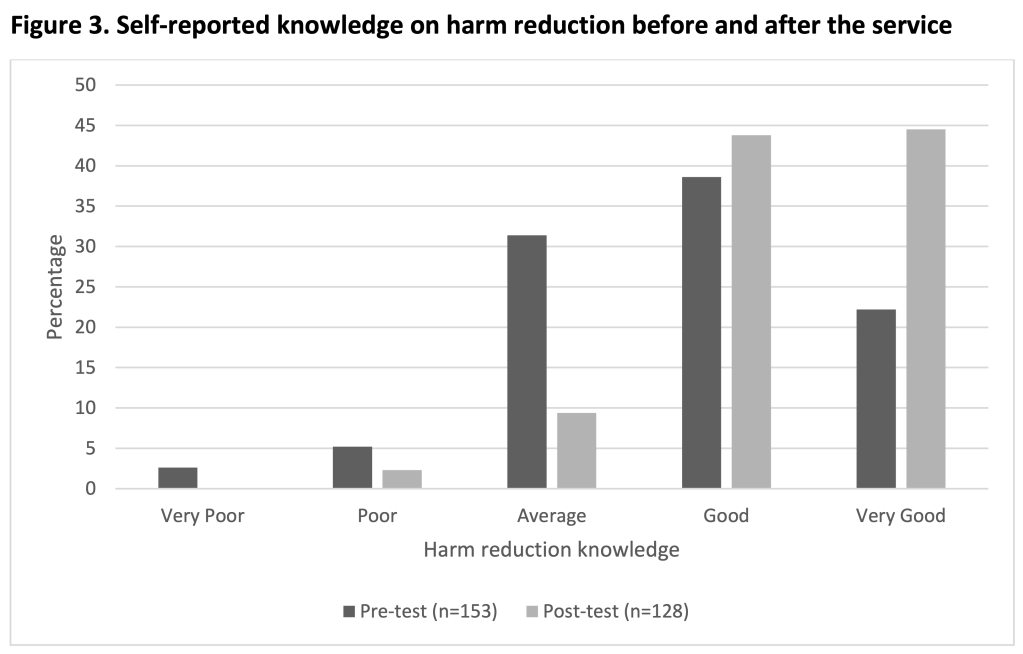
The evaluation document of the 2019 ACT Pill Testing trial is a lengthy read, with confirmation of Dr. Hester Wilson’s words coming through in data and discussion. I won’t copy/paste quotes from patrons who attended the PT facility, but I do recommend skimming through to appreciate that PT, like other harm reduction initiatives, changes drug users behaviour for the better. I did appreciate the graphs on self-reported knowledge of harm reduction before and after having a drug tested. Likewise, when it came to choice of information source, positive changes are evident.
Detailed explanation of the slides below can be found at section/s 6.1 (fig. 1), 6.4.1. (fig. 3) and 6.4.5. (fig.4).
Sydney
At the end of January a challenging scenario unfolded at Sydney’s HTID festival. Having taken what he thought was MDMA, an attendee fell unwell. Ultimately he responded to naloxone, a drug that reverses the effect of opioids. He had taken a tablet cut with nitazene, which is a synthetic opioid reported as “stronger than” fentanyl or heroin. Health workers and members of drug safety volunteers DanceWize, worked to advise the crowd. No doubt they saved lives. It turned out others from around Sydney had been hospitalised that weekend. One pill analysed, contained nitazene and no MDMA. Guardian reported:
Chris Gough, chief executive of the nation’s only pill testing venue in Canberra, said the detection of nitazenes in pills sold as MDMA showed the need for similar services in other states.
“In this case, where a nitazene has been sold as MDMA and therefore people are completely unprepared and potentially opioid naive, the risk of overdose is extreme,” said Gough, who is the executive director of the Canberra Alliance for Harm Minimisation and Advocacy.
“As we have now seen nitazenes in several jurisdictions in Australia it is time to act swiftly to provide drug-checking services throughout Australia so that we can respond to these drug trends as they emerge and thereby save lives and inform the community.”
Canberra
Saving lives is far more about probability than possibility. Indeed that’s been the case with MDMA overdose, MDMA pills cut with N-ethylpentalone or other adulterants. Early last year the Canberra walk-in site CanTEST discovered a pill cut with metonitazene; a synthetic opioid with a potency up to 200 times that of morphine. The owner chose to dispose of the drug on site. In January this year, ANU chemists made an Australia-first discovery of three new recreational drugs. All came from preparations sold as something else. CanTEST staff were able to discern the drugs were not what they were supposed to be, but tests were inconclusive. They were however, able to warn the community. One substance thought to be a derivative of Ritalin was in fact a new variant of cathinone, commonly known as “bath-salts”.
ACT Health have also developed a comprehensive document for festival planners. The Festivals Pill Testing Policy, examines PT options as a service available for festival attendees and how it relates to harm minimisation. Advice on general and specific health and safety measures, the importance of peer support, relaxation areas, emergency services and how PT works with providers and the event itself, is only part of the clear information presented.
Coronial support
A number of fatalities, and the fact that PT promotes positive decision making led to multiple calls to introduce the practice as a policy initiative. Over the last six years, four state coroners have spoken out. A 2020 inquest into five deaths from July 2016 to January 2017, led Victorian coroner Pares Spanos to urge the Victorian government to “urgently” introduce drug checking and a system to warn the community about dangerous substances sold as MDMA. The males aged from 17 to 32 died in a variety of tragic ways after taking what they believed was a modest dose of MDMA. Autopsy revealed the substances 25C-NBOMe and 4-Fluoroamphetamine in their systems. The cluster was discovered after 20 hospitalisations stemming from the Chapel Street nightclub district in January 2017. Victoria Police knew of the dangerous drug’s presence and later defended their decision to not warn the community.
In September last year, Victorian coroner John Cain also called on the government to introduce PT after the death of a man from an MDMA overdose in March 2022. The man had been observed taking a Blue Punisher, a pill with dangerously high levels of MDMA. He was admitted to the Royal Melbourne with brain swelling and multi-organ failure and died four days later. In his findings Cain wrote:
It is impossible to know whether, had a drug checking service existed, [the man] would have submitted a sample of an MDMA pill for testing before taking it at Karnival […] Notwithstanding this, a drug-checking service would have at least created the opportunity for him to do so, and for him to receive tailored harm reduction information from the drug-checking facility.
It is likewise impossible to know whether, had [the man] been provided information of this type, he would have changed his drug consumption behaviour; but likewise, in the absence of a drug checking service, this was not a possible outcome.
Politics
NSW and Victoria have established histories of resisting PT. After the death of a 26 year old at a Sydney music festival in February 2023, Dominic Perrottet mused about his government’s inquiry into methamphetamine and, rejecting any notion of PT offered a most unhelpful contribution:
But my clear message to people right across NSW [is] stay safe, and don’t take drugs and you will be safe.
Associate Professor David Caldicott, one of the driving minds behind CanTEST, suggested Perrottet had engaged in “magical thinking”. In Victoria we have the legacy of Dan Andrews who, citing the demonstrably false [HRJ] claim that PT encouraged pill taking (a belief favoured by Craig Kelly), insisted that under his leadership PT would never be introduced. The state opposition has been steadily opposed to harm reduction measures for conservative political reasons. Ignoring evidence, consecutive opposition leaders have opposed Safe Injecting Facilities and PT alike. I do acknowledge however, that the Victorian opposition has lobbied the state government for more effective emergency drug alert systems.
Recent research
A recent paper Drug-related deaths at Australian music festivals, was published last month in the International Journal of Drug Policy. Examination of the National Coronial Information System (NCIS) yielded the following results about fatalities at music festivals between 2000 and 2019:
There were 64 deaths, of which most involved males (73.4%) aged in their mid-20s (range 15-50 years). Drug toxicity was the most common primary cause of death (46.9%) followed by external injuries (37.5%). The drug most commonly detected or reported as being used was MDMA (65.6%), followed by alcohol (46.9%) and cannabis (17.2%), with most cases reporting the use of two or more drugs (including alcohol) and 36% reporting a history of drug misuse in the coroner’s findings. Most deaths were unintentional, with less than a fifth of cases (17.2%) involving intentional self-harm. Clinical intervention was involved in 64.1% of cases and most festivals occurred in inner city locations (59.4%).
There are complex factors identified in the paper, such as inner city events and multi-day events being more likely to be the site of a fatality. This may reflect policing strategies and the need for harm reduction strategies, respectively. Alcohol is known to be a compounding factor and its use is clearly identified as the second most prevalent substance (see bar graph below). Males are more likely to drink and use MDMA and this is reflected in them making up just under three quarters of deaths. Of 2000 festival goers surveyed, 52% were male. Poor decision making associated with alcohol intake is always a potential factor with illicit drug use.
Total number of drug-related deaths, deaths primarily attributed to MDMA, and deaths primarily attributed to alcohol, at music festivals in Australia by year ranges (n=64)
Harm reduction flexibility
What I took away from this paper was the recommendation that a range of harm reduction measures would each have something to offer in solving this persistent, multifactorial problem. More so, understanding data yielded by such research is vital to establishing the correct harm reduction approach for the Australian population in these instances. In conclusion, the authors write:
Harm reduction strategies such as roving first aid volunteers, mobile medical care, spaces to rest, hydration stations, and drug checking services, may best address some of the risks associated with illicit drug use at festivals, in addition to increased consumer education and awareness. It is important to understand the factors involved in these incidents in order to inform policies around harm reduction and law enforcement at music festivals in future to prevent further deaths.
Just as is the case with injecting facilities, substance checking is a successful, global health policy dynamic. Like all aspects of harm reduction the evidence supporting it is strong, persisting through variations specific to where it is a reality. In Canada, Toronto ran a comprehensive trial from 2019 to 2023. Switzerland has had drug checking available since the 1990’s. Now in a number of cities, the past decade saw a 250% increase in samples tested there. The UK has drug checking services, as does New Zealand.
Despite certain dynamics in NSW and Victoria leaving state governments out of touch with most Australians, there are cabinet ministers and cross-bench teams respectively, raising awareness and pushing for change in each state. When we look at arguments for and against PT, it appears arguments against, lack realistic substance. Indeed these documents recognise the importance of harm minimisation and its place in the National Drug Strategy. The most comprehensive argument “against” is criticism of the limitations of on-site drug checking, compared to laboratory testing. This is well understood and has been directly addressed by Dr. Monica Barratt. Of course the inevitable case that flexible harm reduction measures encourage or create the illusion of safety around illicit drugs is always mentioned. The evidence simply does not support this.
Drug Free Australia
This brings us to the anti-drug lobby. Certain groups contend that law enforcement and zero tolerance are superior in managing drug related harms. Stridently anti Harm Minimisation, they promote the ideology of a drug free world, consistently undermining evidence. In fact my own interest in the anti-vaccination lobby, began in 2009 and I was struck by similarities between their tactics, and those of the more lethal anti-drug lobby, I was long familiar with.
One group, Drug Free Australia (DFA), operate similarly to The Australian Vaccination-risks Network (AVN). DFA aggressively lobby government and an unsuspecting public, frequently using alarming irrelevant information. They attack the media, use meaningless or decontextualised data to dispute published evidence or argue that acknowledging a need for more research, reveals lack of any research. DFA dismiss harm reduction techniques by highlighting the ongoing presence of harm (eg; MDMA has caused deaths, thus no rationale for PT exists) or blame harm reduction for drug user risk-taking, and the familiar contention that PT “green lights” the taking of MDMA.
Such contentions stem from ignoring that high risk behaviour via illicit drug use continues all day, every day in Australia. Harm reduction aims to reduce the harms associated with this behaviour. It provides education, promotes safe choices, saves our health-system money, and yes, saves lives. One way DFA contend PT actually kills, is by misrepresenting the PT card system. A drug found to contain what the owner expected is “white-carded”; as is say, an MDMA pill free of any pollutant. Yet, MDMA causes most overdoses say DFA, so a white-card result must be potentially lethal. Well, no. The drug is what the person expected. Not double or five times the amount. So the patron may take the drug they bought and, remembering the slide show above, will henceforth access reputable information on harm reduction.
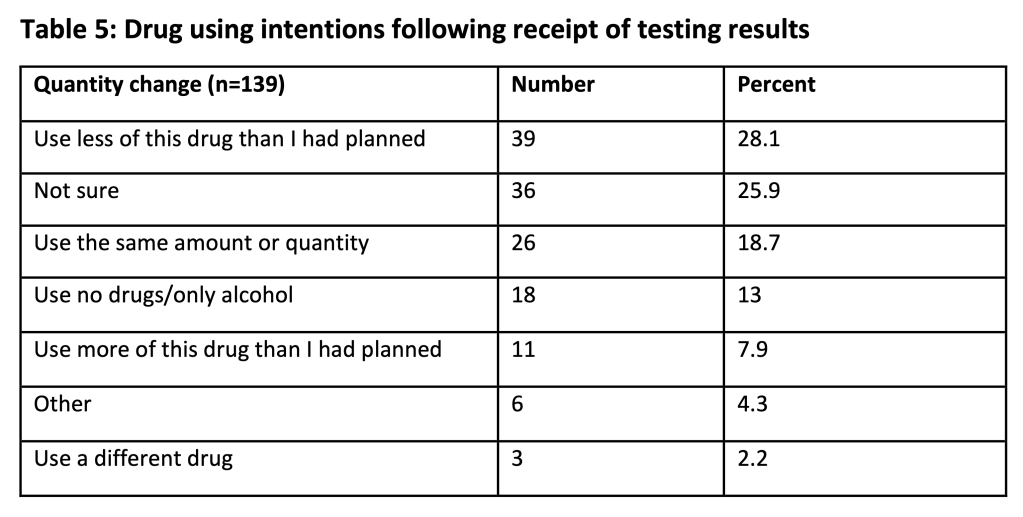
Those slides are from the ACT Pill Testing Trial 2019. DFA attack those findings in a deceptive piece, arguing the opposite to accepted findings. On page 7, they selectively quote from evaluators who discuss that someone who discovers that the drug is what they thought, “…are likely to take as much or more” (p.33). And that “…concordance between expectation and identification is associated with stable or increased intention to take a substance” (p.34). DFA use this to extrapolate to the conclusion that PT will lead to more use and thus, more death. This requires logical fallacies: Decontextualisation and cherry picking of data. Reading the full sentences and paragraphs in which those terms appear leaves the reader with a positive, not negative view of the evaluation. See pp. 33-34, and consider Table 5 from p. 32, below:
When read in context we see that patrons intent to use drugs did not dramatically change, but their intent to engage in harm reduction behaviour notably increased. Eg, also on p.33 (bold mine); Many interviewees reported that the quantity of drugs that they intended to use did not change after testing, as the drug was identified to be what they expected. And, Many interview patrons indicated that their intention to use did not change, but their intention to engage in harm reduction behaviours did increase. Also, this and other evaluations have found non-concordance between patrons’ expectation of what a substance is and what a substance is identified to be, commonly leads to reduced intention to take that substance.
So, the comment pulled from p. 33 by DFA, omits crucial clarification from the evaluation. Some was printed on the same page, just two paragraphs above. For example:
Interview data suggests that this group were looking for confirmation of the contents of the presented drug, and information about how to reduce potential harms. Many interview patrons indicated that their intention to use did not change, but their intention to engage in harm reduction behaviours increased.
Prior research also indicates concordance is associated with an increased likelihood of taking the drug, and non-concordance with a decreased likelihood (Valente: 2019, and Measham: 2018). More so, the evaluators stress that modification of drug consumption can’t be measured alone. Contextual factors, such as type of festival influencing available drugs, need to be considered during interpretation of results and future study design.
Finally, the insistence by DFA that MDMA, not impurities, lead to most fatal overdoses is fashioned only to discredit PT. Still, five deaths in the six months leading up to January 2017 and investigated by Coroner Pares Spanos involved 25C-NBOMe and 4-Fluoroamphetamine. Recent discovery of potent opioids nitazene and metonitazene raise further concern. N-ethylpentalone is regularly found in so-called MDMA pills. But why get hung up on MDMA? Drug checking can check any drugs and CanTEST discovered three unknown substances, later confirmed at ANU. This is how a new type of cathinone (bath salt) was found. Supposed ketamine was actually a new type of benzylpiperazine (BZP) stimulant. The third find was propylphenidine.
Conclusion
Pill testing or drug checking is a harm reduction measure supported by consistent evidence in peer reviewed literature. Globally, where introduced, it has demonstrated success and improved understanding of behaviour. It is supported by most Australians, where valuable data has been gathered from on-site testing at music festivals, and the fixed site CanTEST, in Canberra.
This has expanded the nation’s understanding of drug user insight into, and uptake of harm reduction dynamics. QLD is the most recent state to confirm permanent drug testing. Arguments against the initiative are morally subjective and/or deceptive, leading to their swift deconstruction.
Drug checking saves lives and is supported by public health experts across Australia. As a dynamic, expanding, harm reduction initiative, it should be introduced nation-wide into Australia’s harm minimisation strategy.
♠︎ ♠︎ ♠︎ ♠︎
Originally published as Pill Testing: The harm reduction initiative supported by strong evidence
On Monday 22 January 2024 the unique home for all things COVID conspiracy, Café Locked Out, hosted a video titled The Launch of OpenDAEN, A free database of Adverse Events. Cutting to the chase, OpenDEAN, promoted and launched by Sharon Cousins, purported to be an easy and honest means of access to the Therapeutic Goods Administration, Database of Adverse Event Notification.
Like its namesake previously debunked here, OpenVAERS, the Australian analogue of misleading information, OpenDAEN, presents decontextualised data in a manner that seeks to create the illusion COVID-19 vaccines are inherently unsafe. That “vaccine injuries” are rampant. Again like OpenVAERS it presents as conclusive fact, reports of negative health experiences observed in, or claimed by, an individual after that individual received a COVID-19 vaccine.
Like the TGA, OpenDAEN uses the Medical Dictionary for Regulatory Activities (MedDRA), to classify adverse reactions. It provides filtering with the European Medicines Agency, Important Medical Events list and Pfizer’s analysis of post authorisation adverse events. An additional adverse reaction of “serious” has been added to OpenDAEN. Sharon Cousins is an erstwhile insurance executive, now presenting as an “independent researcher” with a penchant for criticising COVID-19 vaccines. Sharon could not share her screen and was directing suspended NSW anaesthetist Paul Oosterhuis, the third member of this Zoom presentation, around the site.
The primary data interrogation categories on the index page of openDAEN are:
Case numbers by Year, Month and Sex
Cases by COVID-19 Vaccine Type
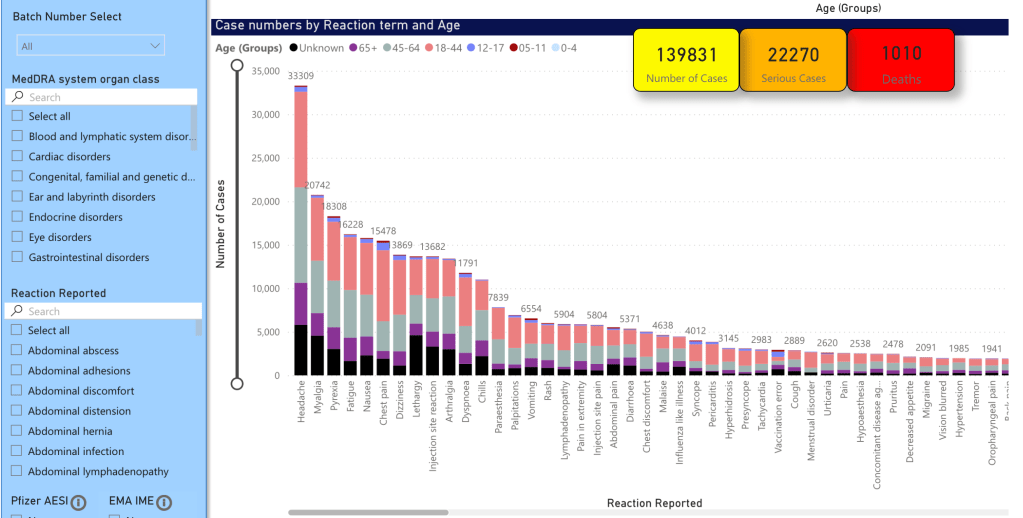
Case Numbers by Reaction term and Age
Case by Frequency of Batch Number
Table of case number, date, vaccine manufacturer, MedDRA reactions, Death, Serious cases and the FOI request number the batch number was confirmed by.
The index page offers the following:
Above: Slideshow: OpenDAEN website
OpenDAEN is called a “free database”. Don’t be fooled. The important elements here are reports and post vaccine, combined with the fact almost all adult Australians have had two COVID-19 vaccines, as have two thirds of 5-15 year olds. Random ill health events can and do frequently occur coincidentally with vaccination. It’s also important to realise that the TGA and health authorities encourage Australians to report these events, so that over time a greater understanding of these vaccines will emerge. OpenDAEN.info provides a description on each page footer:
OpenDAEN.Info is a non-commercial and not-for-profit website for the research, study and review of the TGA (Therapeutic Goods Administration) DAEN (Database of Adverse Event Notifications) system in respect of COVID-19 vaccines. The primary source of data on OpenDAEN is the TGA DAEN system and their published FOIs (Freedom of Information).
Decontextualisation
When taken out of context and denied TGA cautionary disclaimers, the reports become hearsay temporally related to something somebody did. Nothing more. This is decontextualisation. But apparently, we are to assume causation exists. OpenDAEN claims to be able to offer up to date, conclusive data related to adverse events caused by COVID-19 immunisation. These adverse reactions are the subject of reports sent to the TGA DAEN. So, the data themselves have a recognisable source. But can absolute conclusions be made with any real confidence? In reality it takes time for clinically relevant events, specific to any vaccination to be investigated, identified and acted upon. Unless already understood and published on the TGA COVID-19 Vaccine Safety Report (2 November 2023), the quality and quantity of adverse reaction is speculation. To make matters worse, the anti-vaccination lobby has invested an exceptional amount of time spreading disinformation via social media, and one of their primary targets has been the TGA DAEN.
The anti-vaccine lobby want every report to be an absolute reality. They want the figures, diligently and honestly provided to Australia by the TGA, to be accepted without examination as conclusive, in their misguided attempt to wipe out COVID-19 immunisation. We saw this claim time and again in the court affidavits of Peter Fam, Meryl Dorey, Julian Gillespie and Katie Ashby-Koppens; reports presented as if confirmation of death and injury in huge numbers. But correlation is not causation. If you haven’t clicked the link to DAEN by now, let’s see what the TGA, but not OpenDAEN, stress about the contents.
- DAEN SPLASH SCREEN DISCLAIMER –
Okay, so it confirms what I stressed above. But most crucially, you have to tick the teeny weeny little box next to I have read and understand the above, to access the TGA data. The disclaimer can’t be missed. Only willingly ignored. The importance of what this means and the restrictions the disclaimer places ipso facto, on OpenDAEN was studiously avoided during the video on 22 January. In fairness I will note that a small header on the TGA DAEN page was visible, but also ignored. It reads; Inclusion in DAEN – medicines does not mean that the adverse event has been confirmed or that it was caused by a medicine or vaccine. Clicking it – which the presenters also studiously avoided – reveals a little more about the DAEN content. Due to size restrictions of a screenshot, I’ll pop the text in a paragraph, and include some emphasis (mine):
The DAEN – medicines allows you to search adverse event reports for medicines including vaccines received by the TGA. The TGA uses adverse event reports to identify when a safety issue may be present. The DAEN – medicines does not contain all known safety information. An assessment of the safety of a medicine or vaccine cannot be made using the DAEN – medicines alone.
Talk to a health professional before starting, stopping, or changing your prescription medicines.
Anyone can report a suspected adverse event, including members of the public, health professionals and pharmaceutical companies. We encourage reporting even when it is not clear that a medicine or vaccine is the cause. Information from these reports is published in the DAEN – medicines and reflects the observations of the person who reported the event.
People who experienced an adverse event cannot be identified. Maintaining their privacy is of critical importance to the TGA.
The DAEN – medicines is a ‘living’ database that is frequently updated. Information may change if we receive more details on an existing report or if we identify duplicate reports and combine them. Updates may also occur as part of our data quality assurance activities.
In short, the TGA DAEN database is constantly growing, contains information from any member of the public, reflects the observations of that person, provides no information about the safety or lack thereof, of vaccines and does not confirm that an adverse event was caused by a vaccine. It cannot even confirm if the event has actually occurred. I might add, dear reader, given that the anti-vaccine lobby has gone out of its way to submit to the DAEN clearly impossible and even bogus reports, one must remain extra vigilant when assessing or querying these data.
Indeed, Sharon Cousins herself relayed an abuse of the TGA DAEN system at the 8:30 mark of the video. She had queried via FOI why a reported death of a 6 year old boy was no longer available on the DAEN. Sharon noted that within her FOI report FOI 4077 (“Batch numbers of COVID-19 vaccines of reported deaths”), it was revealed the initial report was submitted as a hoax. The relevant section of the report reads:
FOI 4077 also requested information about why case number 724925 no longer appears in the DAEN. This report was rejected following review of further information for the case. The information demonstrated that the report was submitted as a hoax and as such there is no identifiable patient. The report remains in the TGA’s internal database. However, it no longer is included in the DAEN as it has been rejected because it no longer met the minimum criteria for a valid adverse event report.
Sharon Cousins
Sharon also said the TGA reply included, “Normally we wouldn’t answer this”, after insinuating she has a positive relationship with them. However, that comment is clearly not there. One appreciates Sharon sharing this information, but cannot ignore that it took an FOI query of a fatality to uncover the truth. How many other adverse or serious adverse reactions were, or will be, “rejected following review of further information for the case”. Sharon was eager to reassure viewers that OpenDAEN was not misusing the TGA website, but rather making it “more user friendly”. It will be of benefit to TGA staff Sharon opined, and she had sent the site link “to the coroners”, and to State and Territory head pathologists.
Batch Numbers
Throughout, much is made of the section allowing search of batch numbers. We learn that when it comes to accessing batch numbers, the TGA, “Doesn’t have any search engines on it, is a little bit clunky and it times out”. The TGA freely provide data in CSV format on batch release assessment of COVID-19 vaccines. One of two release pathways is taken; either based on overseas certification or based on TGA laboratory assessment. The TGA explain this in detail. So, what could be wrong with smoother navigation of COVID-19 batch numbers as a function of vaccine type, reported adverse reaction and de-identified data? Usually nothing, unless one ignores TGA advice and extrapolates to conclusion, based on other available data.
At the 50:00 minute mark Sharon directs navigation through the number of cases per batch number, highlighting batch number FP1430 – COMIRNATY, (Pfizer), in section 4. OpenDAEN has accessed the batch numbers via FOI, and that’s fine. OpenDAEN reveals inordinately more adverse reactions for male and female associated with this batch number, compared to those next to it. Sharon instructed more data access and directed navigation to the batch number table. She continued:
Look at the dates! Look at all the dates! Within 24 hours of the Pfizer being released on the younger children, the five to elevens… it was all advertised, tenth of January [2022], five to eleven year olds… within 24 hours we have reported cases. Now that for me is causal proximity.
Sharon continued on, directing suspended doctor Oosterhuis to isolate reported – not confirmed – fatalities using that batch number and age group. They isolate two boys. Zeroing in on the symptoms of one boy, Sharon reads, abdominal pain, then dismisses adverse event following immunisation as “a very bland one”, then cardiac arrest. She has Paul Oosterhuis explain eosinophilia and eosinophilia myocarditis. He assumes he is explaining the findings of both of “these boys”. In fact the data reveal clearly it is only one boy. A five year old.
The ten year old “fatality” has only Adverse Event Following Immunisation listed. The “very bland one”, dear reader. Then Sharon warns us “It’s a little bit distressing now, okay. The two boys both had the same batch number”. She gets Oosterhuis to zoom in and suggests, “So, screen print that people if you don’t believe us”. After zooming in on the case numbers Sharon has Oosterhuis zoom in on the batch numbers again, as if she hadn’t made that point enough times already.
Now, I am not a lawyer but I doubt the strength of Sharon’s “causal proximity” claim. There is another factor Sharon told us herself, that must be considered. As she points out, the roll out for Pfizer for 5-11 year olds was 10 January 2022. Thus, the first factor I would investigate would be the sheer number of children being vaccinated, at the time of release. Over 11 weeks, 76.6% of those 2.3 million children were vaccinated. 1,761,800 children had one dose. 1,552,500 (67.5%) had two doses. The vaccine for 5-11 year olds is one third the dose approved for children aged 12 years and over. Cold chain transport and storage is vital to the success of mass mRNA vaccination programmes.
Using OpenDAEN to interrogate vaccine batch numbers of adverse reports about 5-11 year olds, over the first two months of the rollout, we see virtually one result: FP1430. Yet what is more likely? Batch FP1430 is responsible for all adverse reaction reports? Or most 5-11 year olds vaccinated in the initial days, were dosed from batch FP1430? By the end of February other batch numbers begin to appear and gradually attract more reports. By late March, FP1430 is just another batch number. More so, there are over 500 unknown batch numbers for that age group. However, if you present your disinformation just right, some might believe in the deliberate harming of children:
– Facebook comment –
What do the TGA say?
There have been no deaths in children or adolescents determined to be linked to COVID-19 vaccination. More detail on these deaths is available in the safety report published on 15 December 2022… If we identify a new death likely to be related to vaccination, we will publish this information promptly, as we have for all other cases since the start of the vaccine roll-out. [Source – 2 November 2023]
Of the 14 deaths the TGA confirm are linked to vaccination, none are in the 5-11 year age group. Yet Sharon is convinced of her claim, has already convinced others and will convince more, simply because of bias. Her defence, I suspect, will be that she used FOI legislation to access reports on batch numbers and the TGA lacks the smooth batch number access and navigation of OpenDAEN. Yet Sharon made up her mind before she even started looking. In fact, Inclusion in the DAEN does not mean the event has been confirmed or determined as related to a vaccine, is utterly ignored when using OpenDAEN.
The reactions reported in January, are based on MedDRA. Seen clearly in the video, were cough, vomiting, pallor, lethargy, rash, injection site rash, syncope, cold sweat, decreased appetite, anxiety, dizziness, nausea, abdominal pain, abdominal discomfort, aggravation of existing disease, excessive sweating, hives, muscle stiffness, chest discomfort. The worst on screen were seizure, appendicitis and a seperate loss of consciousness. Searching the batch number/adverse reaction table for 5-11 year olds in my own time, revealed reports of chest pain, syncope, anaphylactic reaction, paraesthesia, ECG ST segment elevation, nystagmus, pneumonia and many others. Some reports were of one reaction and others of multiple. All reports are of conditions children experience everywhere across the globe. Establishing cause or any relationship to COVID-19 vaccines is the role of health authorities.
Elsewhere on OpenDAEN we read that:
Useful search engines, graphs and tables have been developed into a helpful user-friendly database to assist study, research, review and analysis of the Australian Government publicly available data. […] We believe in sharing this information in an open and easy-to-use format (with search engines, tables and graphs etc.) and to help make it quicker for anyone wanting to source data for their own study, research and review.
The Quack Miranda
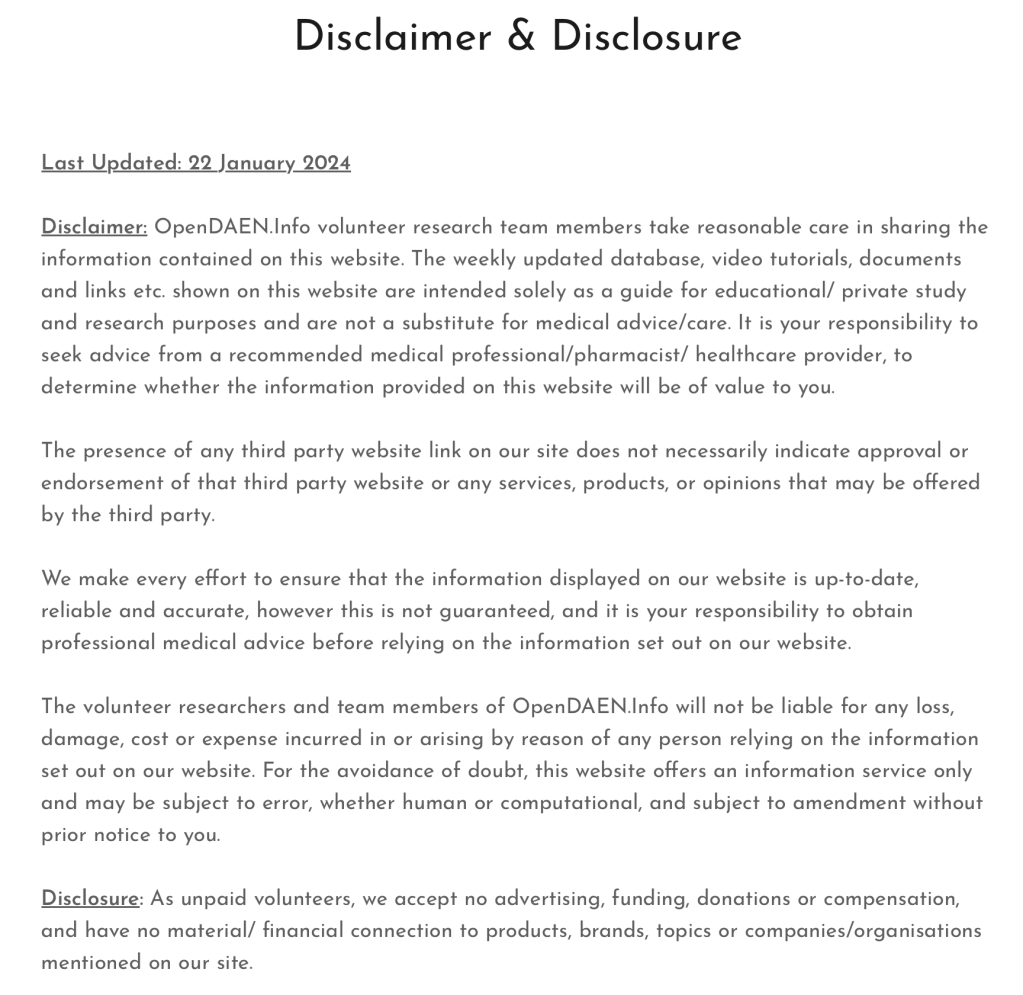
So, the team want to share information in a fast open and easy way to help with doing your own research. It sounds almost too good to be true. The Disclaimer and Disclosure tell us:
– Source: OpenDAEN –
Okay then. It is up to the user to get further professional information to confirm if the information is “of value to you”. Accuracy of the information cannot be guaranteed which places further responsibility on the user to seek advice before relying upon it. It’s information they might get wrong and as such will not be liable “for any loss, damage, cost or expense incurred” by reason of relying on that information.
It is 2024 and world search and data systems can perform enormous and complex requests with astonishing speed and accuracy, yet when Australian governments roll out never before used experimental gene therapies to millions of citizens, Australians are left to report to an antiquated adverse event reporting system (DAENs) still with both feet in last century.
This amounts to a fundamental failure of Pharmacovigilance and the Australian People. Searching through DAENs remains a nightmare for researchers, where one cannot but question the motivations of the TGA and the Australian health departments who feed it Our Information. OpenDAEN greatly assists researchers and students, and data and IT experts desperately needed to review and criticise the current DAEN system which is not fit for purpose.
Hopefully OpenDAEN will motivate Australian governments to take the needed steps towards a national real-time, transparent, and easily accessible adverse event reporting system, for properly protecting the health of Australians and better facilitating valid Informed Consent. The antiquated DAEN system deprives and seemingly hides needed health data necessary for Australians to provide valid Informed Consent.
COVID vaccine injury class action fund raiser, Dr. Melissa McCann writes:
This is amazing and meticulous work by you and your team.
Strong reminders of OpenVAERS and how decontextualised data are used by anti-vaccine activists to mislead, were apparent during the video. Alluding to what is known as the Lazarus Report, after the name of the principle investigator, one commenter offers:
– Facebook comment –
Suggesting that TGA DAEN statistics are only “(10%?)” of “ACTUAL injuries and deaths”, is linked to a bogus belief of widespread underreporting to VAERS in the USA. I addressed this in a post challenging OpenVAERS, writing.
The figure of 1% comes from a report from Harvard Pilgrim Health Care, Inc., authored by Ross Lazarus. Data examined are from 1 December 2007 to 30 September 2010. These data include all possible adverse events. Prior evaluation of the reporting rates of various events confirms that minor events are rarely reported and more serious events routinely reported. A 2014 report on surveillance of adverse events following immunisation in NSW, Australia noted that:
Only 11% of the reported adverse events were categorised as serious.
In short, most adverse events such as a sore arm, nausea, swelling, redness, headaches, vomiting and other self correcting issues are indeed underreported, but make up the vast bulk of adverse events following immunisation. Yet since the Lazarus report, anti-vaxxers love to spread tales of widespread death and terrifying injury, then solemnly add “only 1% are ever reported”.
Paul Offit is a strong supporter of VAERS which he refers to as a “hypothesis-generating mechanism”. Reports there of intussusception approximately once per 10,000 doses led to suspension of his own RotaShield vaccine which was ultimately recalled, before returning as a safe product. In fact health authorities want parents or doctors to report minor events as soon as possible. Much can be learned about self limiting reactions, and more concerning to severe reactions can be gauged by pattern changes, properly identified and suspended under section 29D of the Therapeutic Goods Act 1989.
Perhaps the most damning page on OpenDAEN is the resources page. A curated smattering of COVID-19 vaccine pseudoscience and “vaccine injury” class actions, peppered with all the anti-COVID mandate and health advice groups, it seems designed to lead readers into a field of gaping rabbit holes. Dr. Melissa McCann’s COVID class action vaccine injuries video tops the page. The World Council for Health Spike protein detox guide is there. R.F. Kennedy Jr.’s Children’s Health Defense Australia, The Zelenko Protocol, The Australian Medical Professionals Society, many of whom we’ve met here before, World of Wellness and the National Institute of Integrative Medicine to name a few.
Conclusion
OpenDAEN is not an exciting addition to the TGA DAEN database. It is not a positive, user-friendly addition to TGA staff or to genuine researchers and academics. It is created, managed, supported and provided by and for respectively, members of the anti-vaccine community, convinced that COVID-19 vaccines are the cause of multiple health ailments and death. No professionals were available for its launch. All invitations were ignored. It has no integrity and no academic standing. No coroners or State and Territory head pathologists will care.
Like its namesake in the USA, OpenVAERS, it is designed to allow users to gather misleading collections of coincidental report material and present this as causal COVID-19 vaccine adverse reactions. To be sure, the results it produces, easy to construct as they are, will find their way onto websites, social media and court affidavits. OpenDAEN won’t enjoy the success OpenVAERS did, because now only diehards remain. During the launch of OpeanDAEN, events two years old were focused on, to craft a demonstrably bogus, yet very serious accusation against COVID-19 vaccines.
In June this year we briefly met suspended GP registrar, William Bay, thanks to his attempt to intervene in the Australian Babies Case. He has summarised his reasons for doing so here. Suffice it to say the Australian Vaccination-risks Network were not happy, making me very happy.
Fast forward to the present, and former AVN president Meryl Dorey, who has taken to feverish promotion of cooker-conspiracy theories on Substack, revealed Saturday that the same William Bay had sent her a formal Letter of Concern. It lists numerous comments about him on her Substack site, that he believes are defamatory. Billy wants the article and every comment removed, topped off with a public apology. This is the latest event since Billy, who proudly refers to himself as the Suspended Dr. William Bay, falsely declared his High Court challenge to have the Voice referendum declared unconstitutional, was a success.
This was not the first time Billy, who often proclaims he’s doing God’s work, declared victory in stark dissonance to the facts. He is soundly refuted by AAP FactCheck here. AAP provide insight into how quickly disinformation spreads between cookers. Billy’s proclamation of victory is a great example of how the uncritical acceptance of a claim can influence belief. It also underscores the power of social media, in this regard. Billy gave a performance of confidence and credibility in a Cafe Locked Out interview, citing as proof documents that actually confirmed his failure.
During the interview he referred to a document on his website’s legal docs page headed “Application For A Constitutional Or Other Writ”. Billy directs viewers to his site then says:
I’m looking at it on my computer right now. It’s a miracle, it’s gorgeous, it’s great. It is a stamped document by Justice Jagot of the High Court itself who has declined to rule on the constitutionality of the referendum. So with this case being dismissed from further need for analysis, in legal circles as my lawyer friends will know… if jurisdiction is not proven it is invalid.
The gorgeous and great miracle was the exact document Billy had submitted for filing. The stamp added by Justice Margaret Jagot references High Court Rule 6.07.2, which deals with the management of frivolous or vexatious applications, and includes:
I direct the Registrar to refuse to issue or file this document without the leave of a Justice first had and obtained by the party seeking to issue or file it.
The upper part of the stamped application is below.
Screenshot – Billy Bay’s rejected application
Of course I am not a lawyer, and neither is Billy for that matter, but he has filed documents with the High Court before this. The Notice Of Filing cover page is part of previous documents he has lodged, displayed on his website. This includes file number, title, registry, type of document; in this case Application for constitutional or other writ, filing party and date. Think of it as confirmation that legal proceedings will take place. Plainly absent from his gorgeous miracle, it also clearly states:
Notice of filing page: Important Information
Staying in theme dear reader, I submit that the evidence before you supports the contention that the Suspended Dr. William Bay did know or should have known that his application was unsuccessful, and did know or should have known that the 2023 referendum is not unconstitutional. This conduct is not unusual for Billy who frequently offers baseless beliefs as fact.
Nonetheless, what followed was an old fashioned pile-on by various “freedom fighters” who took three days and more to decide Billy was wrong. Which interestingly, although they’d never admit it, was how long it took for AAP FactCheck to publish their rebuttal. More so, the stamped rejection of Billy’s application was available on 5 September receiving comment on social media by critics of the so-called freedom movement.
Then on 8 September, long time anti-vaxxer, AVN member, self-proclaimed “journalist” and founder of The People’s Revolution, Tristan Van Rye, better known as Triccy Triddy took to Facebook. Triccy lives in that alternate universe where nefarious global conspiracies of momentous proportion are accepted as fact. His tactics deserve proper deconstruction, but for now bear in mind he is driven by base neoconservatism. There is the ever-changing enemy to fear and there is “us”, constantly threatened by the enemy. Triccy’s a true believer and whilst he’s sowing fear, disinformation and social harm, appears genuinely convinced he is doing good.
In this video Triccy does a sound job of pointing out why Billy’s claim that the referendum is unconstitutional, can only be bogus. Chatter in the cookerverse following Billy’s announcement was reinforcing his other claim, that voting is unnecessary. Triccy had spent months sewing disinformation and anxiety about voting “Yes” and understandably couldn’t allow the chance of lost votes to go unchallenged. Other seasoned curators of disinformation felt the same way and rushed to their live streams. Senator Malcolm Roberts (who himself alleged in parliament that the ballot was unconstitutional), AVN president Aneeta Hafemeister, SovCit grifter Mike Palmer, former MMA fighter and Peacemaker founder Nick Patterson and pseudolaw obsessive Derek Balogh, all had a sudden concern for the spread of misinformation.
In the wake of Triccy’s video, Billy sent him a text message. It was reposted on Telegram:
Triccy, I hearby request and direct you to take down that FB live that you just did about me because I consider it defamatory. We have WON in the High Court. I will continue to show and explain that to the people of Australia; until it’s crystal clear for everyone I encourage you to keep an open mind to things, and in the meantime, I would appreciate it to save us all the trouble if you would remove that video please. Dr William Bay
Billy also sent a Letter of Concern to Triccy in response to said defamatory video. Triccy, in a rare moment of near jocularity, burnt it in his favourite faux lounge fire-pit. Billy however, kept up his booming confidence and applied for leave to issue or file the original application. This matter was heard on 15 September and ruled the original application an abuse of process. See p. 5, para 8:
It is not necessary to consider the question of standing, here in the context of a referendum. By r 6.07.1 leave to issue or file should be refused where the document would amount to an abuse of process. The latter term encompasses proceedings which are foredoomed to fail, as the proposed proceedings are.
Ah, foredoomed to failure, dear reader. A weighty yoke for our suspended doctor to bear. By 19 September, Billy had apologised to Triccy and withdrawn “proceedings”. Triccy was not amused, and announced an end to any further cooperation with Billy. He also took issue with a claim Billy made about employment restrictions imposed by AHPRA. We’ll get to that. First, we don’t want to forget that when Billy was gearing up to sue Triccy for defamation, someone else got their bad ass boots on. In fact there was bad assin’ and chin juttin’ aplenty from our Meryl, all with the hope of provoking Billy.
He was easy to provoke and Meryl went in hard. In a piece titled Distinguishing truth from bullsh*t 101, Meryl hit him where it hurt. It began with humour, as Australia’s most pernicious antivax liar laid out the section heading; Unity is vital – but truth is paramount. Oh, how we laughed! But next came mockery with; Billy Bay’s High Court “Victory”. Ah, the sting of those quotation marks. Then Not the first time Billy has done this, opened the way to a recounting of the failure of the Australian Babies Case. But ultimately came the totally bad ass; Will Billy Bay now come after me for telling the truth about his actions?
Having got the desired reaction, Meryl posted an article, referring to him only as “Bully” as she outlined the specifics of Billy’s letter of concern. The subheading; I don’t take well to threats, can only be described as (need I say it?) totally bad ass, and the article swiftly dispenses with any notion that Meryl is concerned. Within, she refers to a comment reply she wrote in response to Billy’s comment requesting her to “stop attacking” him. She raises the same issue Triccy Triddy had done regarding Billy’s claim on Voice of Freedom that AHPRA had prevented him from working in “any job at all”.
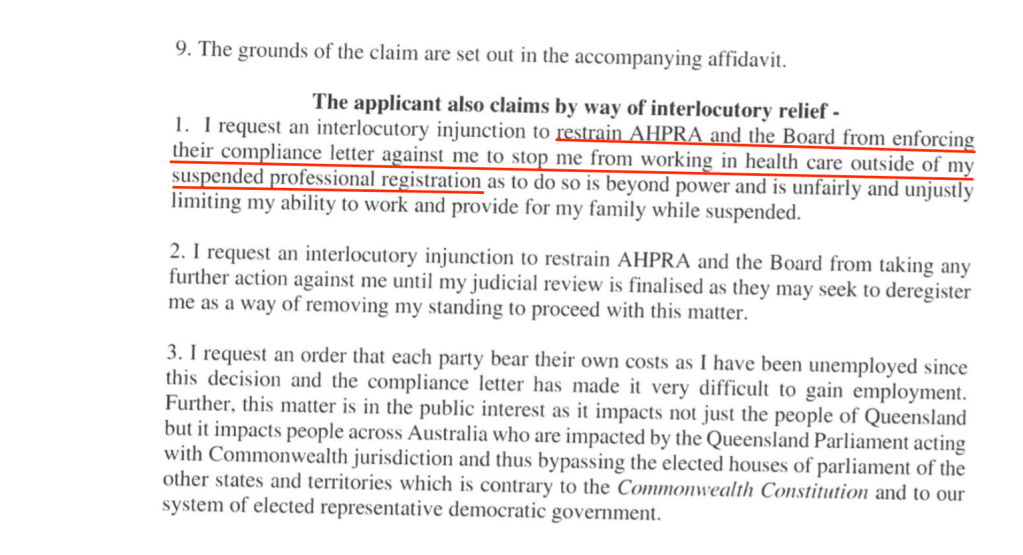
This is another jolly example of that area between remote possibility and reality that Billy exploits. Just as he continued to claim victory in the High Court because he had filed for leave to have his (already rejected) application accepted, there is a submission Billy refers to in the hope of convincing his followers. Simply put it is material submitted in reply from Billy to AHPRA, The Medical Board of Australia and QLD State, in the wake of his suspension. It happens to include:
So, he sought an injunction to prevent AHPRA and the Board from further enforcement of their “compliance letter” so that he can work in positions that don’t “require current registration with AHPRA as a condition of employment”. Neither AHPRA nor the Board have the power to enforce conditions outside their purview. Billy has always been free to work in areas where registration with AHPRA is not required.
Prior to this Billy had submitted an Application for Review of the findings of AHPRA and the Board. On page 7 is a request for an injunction to limit enforcement of the “compliance letter”, so that Billy could work in health care roles seperate from those of a GP Registrar.
The “compliance letter” is clear in that Billy is prohibited from working in health care. All health care, and only health care. In fact, the same document includes a November 2022 affidavit from Billy Bay which presents a clear summary of that letter on page 4, item 15:
The evidence that AHPRA ever sought to prevent Billy working “at all” doesn’t exist. Yet Billy chose to zero in on one part of a much larger, failed application to the Supreme Court. From 27:20 to 28:45 in the interview with Carl Lieberman, Billy talks about what he then thought were defamatory comments from Triccy Triddy. It was “a matter of life and death” for him because if his followers don’t trust him, donations would dry up and this was his only income. You can grab the mp3 file here or listen below. The important part is:
Billy: I even filed an application in the Supreme Court to let me work in any job at all and I lost that one…
Carl: Is that any job in health or any job at all?
Billy: At all, at all Sir… at all! It’s an outrage. It’s a disgrace and a disgust and the people of Australia need to know that, to see how unlawful this AHPRA agency is that they think they can regulate me that much. If they can do that to me they can do that to you.
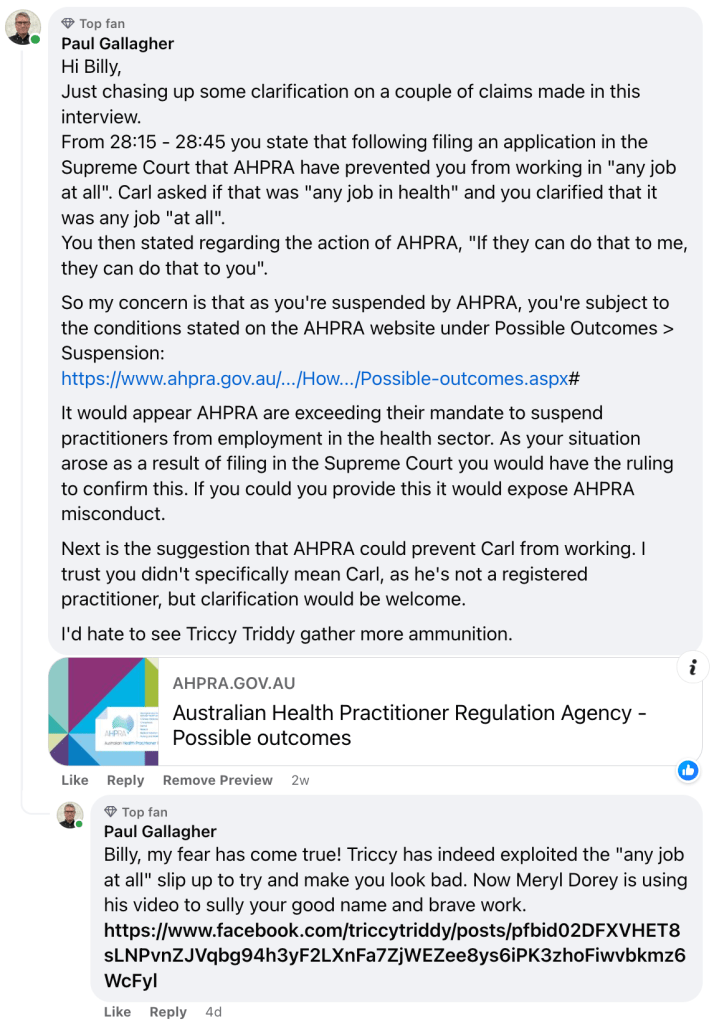
Carl’s face is priceless as he can’t hide his incredulity. He asks Billy about responding to AHPRA under basic trade-law rights, but Billy had already tried “the international covenant on political and civil rights”. And so it came to pass that Triccy and Meryl called foul on this claim of Billy’s. But they were ten and fourteen days late respectively. Where did they get such bad ass information? Could it be that badder asses had earlier sought to hold Billy to account? A quick visit to Billy’s Facebook page gave me an answer of sorts. Some devious character with an obviously fake name had commented under the video, a day after it was posted:
The plot thickens! There’s also some lucky losing cast iron flying pig standing on an old copy of The Skeptic magazine and snooping around X.
@DrBillyBay Can you support your claim of being prevented by AHPRA to work in “any job at all” please? You’re suspended, and AHPRA suspension outcomes are clearly stated on their website. I’m worried you might inadvertently reinforce Triccy’s claim you “spruik misinformation”.
Humour aside, there are serious elements to consider in the wake of Billy’s ultimately harmless threats against seasoned con-artists. It’s breath-taking to witness Meryl Dorey, architect of the 2016 No Jab No Pay High Court scam, levelling accusations of donation fraud against him. NSW Fair Trading found the AVN guilty of breaching the Charitable Fundraising Act 1991, yet decided not to press charges. As for the money Dorey admitted to hoarding, furious AVN donors had to swallow the loss of their $160,000. Yet she recently wrote about Billy:
So Bully is gaining money from our suffering community under false pretences and I exposed that along with several other long-time supporters of health freedom and informed choice.
Meryl exposed nothing others hadn’t revealed two weeks before. Her own false pretences ensured a career sabotaging public health initiatives and scamming donors. Prior to the formation of the unfunded volunteer group, Stop The AVN, her unceasing schemes ran unchecked. COVID was a double-edged sword; bringing more followers to anti-vaccine conspiracies, but ensuring the increasing irrelevance of the Cult of Meryl. Even the AVN court cases failed. The frustration seeps through in this stand-over advice she offered Billy.
Better than you have tried to censor me for nearly 3 decades and they have not been successful. Perhaps it’s time for you to do some deep soul searching Bully and try to work out why you are actually involved with this issue. Because as far as I can see, it doesn’t appear that caring for our community and the lives of the children and adults therein is your main motivator.
Triccy was far more diplomatic in his criticism, stressing that he meant Billy “no harm”. Unlike Dorey, Triccy appears genuinely focused on change rather than profit and ego. That said, his belief that “we are experiencing World War III, which will be known in the future as The War Against the People”, is based on harmful conspiracy theories of shadow governments. Whilst a key aspect of his rhetoric is that “people will forget their differences”, he is quite skilled at ensuring division between what he wants and what most of us identify as progressive thought.
Billy himself has spent over a year filing for court cases, circling social media and attending protests, after he publicly sabotaged his medical career at an AMA conference in July 2022. Like these other two judging him, he spends a great deal of time spreading disinformation to suit his own bizarre ideology. He also scoops up donations from gullible supporters drawn to conspiracies.
Ultimately, trouble in cooker paradise is nothing short of great news. Belief in conspiracy theories and suspicion of vaccines have both increased post COVID. Researchers are refining their understanding of the factors behind distrust of health authorities. Yet the role social media played in warping uncritical minds during lockdown, has today been replaced by quick-changing narratives adapted to suit. Attacking the Voice referendum is a case in point.
For a long time yet, anything that reflects positive social change will be seen by these players as the latest phase of dark conspiracies. I for one wish them all the infighting and trouble they can muster, and may they tear their angry little worlds asunder.
The COVID-19 pandemic created, embellished and gave impetus to a range of movements that have at their core a belief in one concept. Namely, that the pandemic itself revealed or confirmed that global conspiracies are in play, as governments and authorities ultimately seek to harm the populace.
Enter “My Place”. One of the many anti-vaccine groups to percolate from the barrage of disinformation during COVID, it was formed by Darren Bergwerf to oppose COVID vaccinations. It began to attract attention after disrupting council meetings earlier this year. Brandishing all the attributes of the freedom movement, My Place urges adherents to form council action groups with the aim of “controlling council decisions”.
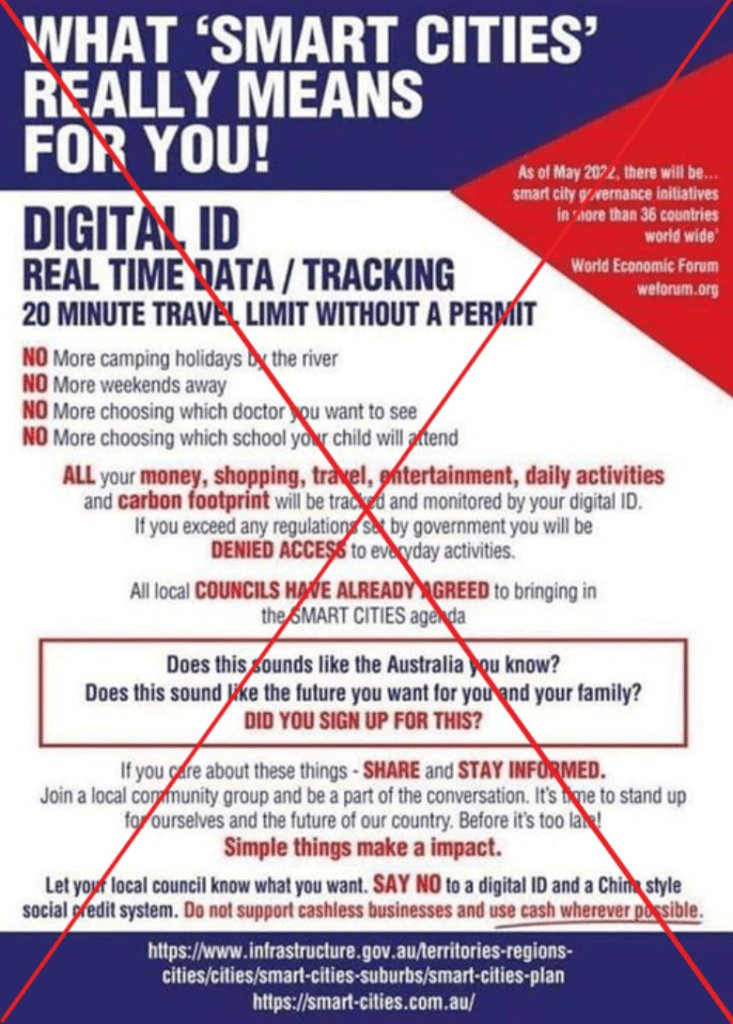
Amongst councils targeted this way was Yarra Ranges Council which, in response to abusive and intimidatory behaviour from the public gallery, took council meetings online in April this year, temporarily closing the gallery. Foremost amongst My Place obsessions is the concept of 20 Minute Neighbourhoods or Smart Cities, which conspiracy theorists believe are covert plans to restrict movement, monitor activity, remove freedom of choice and launch an all-seeing digital ID. With textbook conspiracy theory thinking, My Place wrongly assumed the Monbulk Urban Design Framework (UDF) draft plans, accommodated such a nefarious scheme.
Yarra Ranges had openly encouraged community consultation on the UDF, from 16 December 2022. My Place action group members attended the 31 January 2023 council meeting causing enough disruption to temporarily stop proceedings. Council members were yelled at, called a range of names, accused of hidden motives and had their professional integrity questioned. Council then published Statement regarding misinformation on social media on its website, in which it clarified the purpose behind 20 Minute Neighbourhoods and the manner in which technology may be used. This included:
The intent is for people to be able to move about easily and freely without being burdened by excessive travel or costly transport options. It improves movement and access, rather than preventing it.
Sometimes technology can be used to understand where there is congestion on a path or road network or an intersection… [or] when a bin is full or when a drain is blocked, helping to stop litter entering waterways and flooding.
The decision to move council meetings online is permitted under security provisions in the Local Government Act 2020 [see 66 (2)(b)(c)]. Online meetings were available to the public, and at the time, Yarra Ranges mayor Cr. Jim Child stressed he would review the situation in June. In-person council meetings with registration requirements resumed on 11 July. However in a June media release, My Place contended they had been “locked out” of meetings and more so, Council had done this merely due to “perceived” threats to safety. It was a breach of the human rights of residents by Council, and “deeply insulted” by comments that the mayor had made, My Place submitted an application to the Supreme Court. Their orders are laid out below.
And so it came to pass. On 4 July 2023 the matter came before Supreme Court Justice Melissa Richards. The sole plaintiff seeking an interlocutory injunction to prevent Council from adopting the proposed UDF was Darren Dickson, who represented himself and had submitted affidavits from 18 members of the Yarra Ranges community. Dickson has been described on social media as a “pseudo-law guru”, although I cannot attest to the import of this particular honorary. Justice Richards set a trial date for 3 August 2023.
Dickson sought the injunction based on a lack of community engagement, and further:
An extended 12 month consultation period.
Council to reopen the public gallery for meetings.
Clarification on filming from the public gallery.
Contended Council did not meet Local Government Act 2020 (Vic) requirements.
Contended Council was in breach of the Charter of Human Rights and Responsibilities Act (Vic) 2006, namely right to privacy, to freedom of expression and participation in public life.
Mr. Dickson also sought answers to two questions specific to the manner in which he perceived the implementation of 20 Minute Neighbourhoods (20MN). Namely:
Whether Council’s role includes power to develop three storey accommodation for local areas.
Whether Council can engage with and adopt United Nations policies.
Whilst not living in the municipality Dickson identifies as a member of the community. He works and socialises there and cares for his mother who is a Yarra Ranges resident. Dickson had attended the disruptive 11 April council meeting that led to temporary closure of the public gallery.
Lilydale resident Martin Dieleman was concerned that the UDF proposed by Council would permit 20 Minute Neighbourhoods and in turn, this would ensure increased surveillance and housing density along with restricted choice and freedom of movement. He started a petition in March this year, promoting the well debunked conspiracy theory view of 20MN and by June had over 2,000 signatures from across Victoria. Absurd claims about smart cities had by then become an increasing feature of social media, resonating with those convinced by the “freedom movement”. Dickson had bought the narrative and learned of growing attention to the Monbulk UDF from Dieleman in April this year.
Throughout the consultation period Council had made themselves available to discuss and clarify aspects of the UDF. Specific community engagement programmes organised by Council were provided, along with multiple interactions with individual community members. The draft UDF is discussed in the below video published on 11 February 2023.
Nathan Islip, Manager Design and Place talks about the Monbulk UDF
Edward Gisonda, counsel for Yarra Ranges Council, submitted that being part of the community does not give Darren Dickson standing to seek public law remedies regarding approval of the UDF, conduct of Council meetings and the two questions regarding 20MN. In her judgement of 199 paragraphs over 62 pages, Justice Richards found Darren Dickson did not have standing to pursue legal action. More specifically Dickson did not demonstrate that he had special interest in the UDF, or that if approved by Council, it would have a legal or practical effect on him. His interest is no different to that of any member of the public.
I accept that he is concerned about aspects of the UDF, although these concerns seem to be based on misunderstandings of the UDF’s content and effect. An intellectual or emotional concern, however strongly held, is not enough to give Mr Dickson standing to obtain public law remedies in relation to the Council’s consideration of the UDF.
Nor could Dickson demonstrate a special interest in how Council held its meetings, and he did not submit that he had difficulty accessing or viewing council meetings when held online. Dickson did submit affidavits for 11 local residents who had privacy concerns about the registration process for attending in-person meetings but Dickson himself was not one of them. Nor had he sought consent to record any council meeting.
At its highest, Mr Dickson’s interest is a strongly held belief that the Council should conduct its meetings in a particular way. On its own, that is not enough to establish standing to obtain orders compelling the Council to conduct meetings in that way.
Justice Richards went further and considered if someone with standing would secure the legal remedies that Mr. Dickson sought. This involved examining evidence and testimony presented at trial and viewing Council performance through the lenses of the Local Government Act, the Planning Act, Charter of Human Rights and Responsibilities Act 2006 [Vic] (the Charter) and Plan Melbourne 2017-2050: Metropolitan Planning Strategy. There are some interesting aspects to the judgement.
One contention raised by the plaintiff and revisited during questioning was that the council had failed to “meaningfully engage” over the UDF, with particular emphasis on the temporary closure of public meetings. Council is bound by the Charter to ensure the right to engage with public affairs is observed. Yet this doesn’t give an individual the right to dictate terms of their involvement. Council’s community engagement with respect to the UDF, and the involvement of Nathan Islip in attempting to assuage concerns of some residents, covered 10 pages of the ruling.
Mr. Islip’s patience is evident, in that he was clearly repeating answers to the same questions from the same resident/s via email, over the phone, in person and during council meetings. He fielded questions over freedom of movement, privacy and “tracking of movements” in 20MN. At one meeting he was asked if there would be “consequences for travelling outside of our 20MN”. Addressing whether or not Council met community engagement obligations specific to the UDF, Justice Richards ruled overwhelmingly that they did [para. 70 – 125].
Justice Richards rejected six complaints raised by Mr. Dickson highlighting different means by which Council purportedly failed to provide adequate community engagement. Addressing each in turn Her Honour ultimately wrote:
Mr Dickson has not established that the Engagement Plan adopted by the Council for the UDF limited his or anyone else’s Charter right to participate in public affairs. The right does not enable any member of the public, regardless of their interest in the UDF, to dictate the terms of the Council’s engagement with the community about the UDF, or to demand immediate answers to questions about matters not contained in the UDF.
As had been clear from the My Place media release and questions raised by David Dickson during the hearing, the fact that online council meetings had been held from 26 April to 27 June 2023 was considered a breach of the Local Government Act by the plaintiff, because these meetings were not “open to the public”. However the Local Government Act is clear in this regard. Justice Richards wrote:
Mr Dickson’s complaint that the Council had closed its meetings to the public between 26 April and 27 June 2023 was misconceived. […] A council meeting is ‘open to the public’, as that term is defined in s 66(6) of the Local Government Act, if the meeting is broadcast live on the internet site of the council.
Let’s recall, dear reader, that meetings moved online in response to repeated abuse and aggressive behaviour from the public gallery. Justice Richards recounts in detail, evidence from witnesses concerning the intimidation [para. 157 – 169]. During the trial David Dickson cross examined witnesses, seemingly intent on dismissing what they had already reported as intimidating or threatening experiences. Nathan Islip had given evidence that “threatening comments” were made at the 31 January council meeting, to which police were called. Dickson asked Mr. Islip if he knew what “the definition of a threat is”. Here, Dickson is focusing on the threat of harm, seemingly unaware that intimidation in pursuit of coercion is also a threat.
There was a group of people among the large public gallery who were intent on disrupting the meeting, and who did so. They interjected frequently and loudly and did not recognise the authority of the Mayor as Chair of the meeting. Their behaviour was contrary to r 73.3 of the Governance Rules, in that they did not extend due courtesy and respect to the Council and its processes, and they did not take direction from the Chair.
With respect to filming council meetings, attendees wanting to do so must seek consent of the Chair. Pre-registration with photo ID for those who want to attend in-person meetings has not been shown by Mr. Dickson to be unlawful. It is permitted under the Local Government Act and the Occupational Health and Safety Act 2004. Evidence was given by Andrew Hilson, Yarra Ranges Director of Corporate Services, that information collected is in accordance with the Privacy and Data Protection Act 2014. Justice Richards ruled that given prior disruption to council meetings, registration is proportionate and not an unlawful interference with the right to privacy.
This brings us to the two additional questions Dickson wanted answered regarding three storey accomodation and the adoption of UN policies. In fact they arise from a misunderstanding of the origin and scope of the UDF. There is no evidence that Council is seeking to develop three storey accomodation for local areas. Nor is there evidence that the UDF heralds adoption of UN policies. Rather, the UDF does not actually refer to 20 Minute Neighbourhoods. In the event that it did, it would in fact be Victorian Government policy and an existing part of the Yarra Ranges Planning Scheme.
More importantly however, is that David Dickson does not have standing to seek answers to these questions. Again, his interest is no different to any other member of public. Justice Richards wrote:
In short, the additional questions should not be answered because they do not relate to any legal controversy between the Council and Mr Dickson, or the Council and anyone else identified in the evidence.
Ultimately, there were no democratic principles or legislation breached by Yarra Ranges Council during UDF consultation, or as a result of temporarily changing meetings to online. Online meetings are not only available to the public but are the preferred option for many. Yarra Ranges Council posted a response to the ruling on their website here.
Darren Dickson was ordered to pay Council’s costs. If in disagreement, he has until 1 September 2023 to submit his reasons as to why a different order should be made.
One cannot ignore that as sovereign citizens, My Place supporters reject the notion that Australian courts, laws and institutions hold any valid power. Exactly how this ruling will be accepted remains to be seen. Might it be rejected outright, or woven into the complex tapestry of the parallel society My Place founder Darren Bergwerf aims to create? Sov Cits are skilled at rationalising dissonant outcomes as victory. It may be that taking a Council to the Supreme Court can be accepted as a win. Of sorts.
Either way, the theme of corrupt public authorities was also evident in the many unsuccessful cases involving anti-vaccination groups and vaccine mandate opponents, recently making their way to court. They too had “woken up” to a new reality. Many were exploited or left in debt. Established anti-vaccine pressure groups had retooled for COVID. They continue to promote themselves, and financially profit to this day.
Not one has been, or will be, denied an opportunity to access the court system and bring their evidence, no matter how disjointed and deceptive, before a judge. Ultimately, this particular case has, like the others, reinforced the strong democracy Australia has.
Evidence for a corrupt global cartel however, remains elusive.











 Losing In The Lucky Country