Harm Reduction: How Australia Stopped HIV

In 1985 before the introduction of needle and syringe programmes (NSP) 90% of Australian injection drug users reported sharing injection equipment. By 1994 following introduction of NSPs this figure had fallen to 20%. In 2009 this figure was around 15% possibly reflecting the constant number of distributions from NSP programmes over the previous decade.

One of the most powerful modes of resistance to the spread of HIV/AIDS is Harm Reduction (HR) measures.

In Australia, HR exists as one of three pillars of Harm Minimisation (HM) – our official illicit drug control policy. The other two pillars are Supply Reduction and Demand Reduction. Reduction in supply receiving the lions share of funding directs energy at reducing international and domestic supply. Reduction in demand receiving less funding delivers programmes and initiatives designed to reduce the demand for drugs within communities.

Harm Reduction receiving the least funding from the HM pile targets the harm to individuals that eventuates from behaviour. HR has always drawn condemnation from conservative groups because of the association with drug use and sex. Initially men who have sex with men (MSM). Then later through maximal exploitation of drug using pop culture. Nonetheless, study after study comparing countries and districts within countries to have implemented HR or not done so, show a stunning success in favour of HR.

This post will look almost exclusively at IV drug use. HR for Injection Drug Users (IDU) includes provision of clean needles and sterile water, swabs, sharps containers for disposal and specialised filters capable of removing bacteria. Opioid Substitution Therapy (OST) including methadone and buprenorphine and safe injecting facilities are pivotal aspects of HR. Heroin on prescription is not available in Australia but has shown unprecedented success as a HR measure where it has been implemented.

Despite the evidence supporting HM as an effective policy and the reality that Supply Reduction [law enforcement] is the most highly funded pillar, Aussies are still subject to notions such as “Tough on drugs” and code words such as Drug Free Australia’s Harm Prevention. Intuitively it sounds fine. Why minimise harm if you can prevent it?

Yet on examination “harm prevention” is the abandonment of HM for the reintroduction of Just Say No approaches. Known to have had deleterious effects on self esteem, no effect on lowering drug use and providing the field upon which drug use flourished, Just Say No quite simply failed, and failed Epically. Today of course, skeptics are well aware of how beliefs and behaviours are reinforced through attacking them. Harm Prevention even more so is code for punitive, custodial and forced behaviour control.

It is at times perplexing as to why so much energy is spent on attacking HM entirely. Supply Reduction however is based in part upon the reality that people want, seek, use and enjoy illicit drugs. Education to accompany this is open and honest – not promotion of illicit drug use . Yet to the conservative mind the idea that their children, friends or the community at large is the demographic from which drug demand comes, is morally untenable.

With HR it is aspects of this pillar that equally cannot be accepted. To the conservative mind, just as condoms cause AIDS and promote sexual promiscuity so too do clean needles, safe injecting facilities and safe injecting education encourage drug use. Drug Free Australia write:

We need to re-focus our drug policy and practice on an approach that prioritises primary prevention, if we are to see any real change in the health and wellbeing of our current and future generations of young people. We need to acknowledge that Australia has one of the highest rates of drug use, because of a priority on Harm Minimisation rather than Harm Prevention, and we now need to take a leaf out of the books of the policy makers in the UK and United States. Both these countries have given greater emphasis to prevention initiatives, while still aiming to help people who are drug dependent, to recover.

The towering dishonesty inherent in this nonsense is typical of the tactics used by DFA in what has become over just a few years, one of the most immoral lobbying groups on the illicit drug landscape. Australia has high levels of cannabis use and abuse. This is handy in arguing that we have high drug use generally. A synopsis of the above is simply: Harm Minimisation has caused Australia to have one of the highest drug use levels in the world. We should be doing what America and the UK do.

The UK get a mention because they reclassified cannabis to a Class B (like speed/other amphetamines) from a Class C drug and punish users accordingly. Of 2.3 million USA prisoners in 2010, over 65% or 1.5 million meet DSM IV medical criteria for substance abuse or addiction. On top of this another 458,000 have a history that meets DSM IV criteria for addiction, were under the influence when they committed their crime, committed a crime to finance the purchase of drugs or were incarcerated for a drug law violation.

Between 1960 and 1990 official crime rates in Finland, the USA and Germany were similar. Incarceration in Finland dropped 60%, remained stable in Germany and quadrupled in the USA, driven primarily by drug convictions.

Today around around 80% of USA prisoners are incarcerated due to illicit drugs. 11% are receiving some type of “treatment”. The last thing Aussies need is a dose of the USA nightmare.

What of the impact of changing our strategy on HIV and consequently other types of blood borne virus transmission? The graph below is from a TED talk by Sereen El-Feki, vice-chair of the Global Commission on HIV and the law:
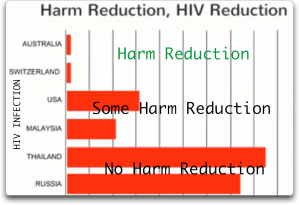
HIV infection in Injection Drug Users

Whilst Thailand and Russia have ignored Harm Reduction and Australia and Switzerland have embraced it the USA and Malaysia employed only some Harm Reduction techniques. Should Australia embrace USA tactics our prison population will explode, HIV infection in IV drug users will increase by about eight times the present rate and treatment – presently some of the best in the world with plunge to 11%. The cost to the public health purse would simply gut present programmes and destroy any hope of improvement for say, dental, mental health, public hospital care, nursing home care etc.

There is a 4 minute out-take from Sereen El-Feki’s TED talk in April this year below. Or download MP3 here.

The first case of AIDS was reported in Australia in 1983. At that time morbidity rates to rival World War II were expected. Following the innovative approach of HR, levels of infection in all demographics fell from 2,500 per year to 500 in the decade following inception of HR. This infection rate has remained stable.

At the time, initiation of clean needle supply contravened the states Drug Offensive which, already highly criticised, had regrettably escalated drug use and criminalisation via the failed “Just Say No” approach. The pilot programme ran from St. Vincents Drug and Alcohol Service on November 13 1986. It was run in the suburb of Darlinghurst. An evaluation recommended they should be adminstered by social workers, drug agencies, pharmacies, medical professionals and urged:

The urgent widespread introduction of needle exchange programmes in all states and territories

There needed to be an amendment to the Drug Misuse and Trafficking Act following which NSW pharmacies sold “anti-AIDS kits”. By mid 1989 there were 40 public outlets run across Sydney. By 1994 there were 250 outlets run by NGOs, government agencies and pharmacists distributing 3.5 million syringes annually. For the year 1993-1994 10.3 million syringes were distributed across Australia. The USA with 15 times the population of Australia distributed 8 million syringes in 1994-1995.

More comprehensive analyses refuted the concerns of increasing drug use. No increase in drug use was seen in any country that had instigated needle exchange and more so, attendance at rehabilitation and abstinence programmes had increased. Australia’s Commonwealth Department of Health (now Dept. of Health and Ageing) estimated that 25,000 cases of HIV were averted in the 12 years from 1988 – 2000 due to needle exchange alone (page 10 – 3.5.3).

The infection rate among Aussie IDU sat at around 3%. Users who were also MSM had an infection rate of 27%. In Russia where HR for drug users was denied, the figure for IDU was between 75 and 90%. One study in 1997 looked at 81 European cities with and without needle exchange programmes. Seroprevalence (measured from the presence of HIV within blood taken from used syringes) increased 5.9% annually in cities without clean needle distribution, and decreased 5.8% in cities with needle exchange.

In an astonishing comparison, Edinburgh with no NSP experienced a 65% HIV infection rate amongst IDU. Glasgow, less than an hours drive away and with NSP experienced a 4.5% increase in HIV infection amongst IDU. The one issue Australia faced was return of used syringes. Users were placing them in sharps bins. Yet to return any syringes to Exchanges meant risking being questioned by police. A used syringe is evidence of illicit drug use and this acted as a disincentive to return items for safe disposal.

Of note however is that fears and front page headlines of beach goers and joggers stepping on syringes and undergoing “agonising waits” for blood tests to be cleared of HIV infection are out of proportion. HIV dies very quickly once outside the body and syringes on beaches have been discarded into drains, washed out to sea and then beached. Nonetheless despite the absence of actual transmission it is an unpleasant experience which can be lessened by removing all offences for possession of a used syringe.

Clearly, Australia’s decision to take the necessary steps and bring together members of drug using demographics, gay rights advocates and prostitutes collectives and allow them to consult upon and shape this programme was one of it’s greatest public health initiatives ever.

Between 2000-2009 NSPs have averted 32,050 new cases of HIV and 96,666 Hepatitis C infections. Needles distributed increased from approximately 27 million to 31 million in that decade. For every one dollar invested, four dollars have been saved. 140,000 Disability Adjusted Life Years were gained over the same decade.

Still, conservative biblical fundamentalist group Drug Free Australia boldly inform us that Return On Investment is quite wrong and should show an expense. In earlier posts you can access from the tag on the right, I highlight how they cherry pick phrases and select data out of context. At other times they simply dismiss WHO findings based solely on the reviews of just one Swedish researcher, Dr Kerstin Käll.

So to be very clear, Dr Kerstin Käll, working for the Swedish government who are dodging UN demands to establish more Needle Exchanges and accelerate HR or remain in breach of the international right to health, conducted no research but criticised methodology that was favourable of NSP success. Her own research argues regular testing for HIV is more of a prevention – yes prevention – than clean needle supply.

It’s easy to get confused because whilst Käll supports NSP programmes as reducing hepatitis C in prisons DFA refute any change in HCV attributable to NSP programmes… anywhere. They also lobby stridently against the establishment of needle exchange in Australian prisons. Of course, despite the evidence above they insist the impact of NSP on HIV is “inconclusive”.

Ultimately it’s irrefutable how successful Harm Reduction has been in controlling the spread of blood borne viruses. Paramount amongst these is HIV, Hepatitis C and Hepatitis B. The most significant and visionary measure to now apply would include steps to decriminalisation and regulation.

Today however, this is where Australia is falling behind.

Bob Brown seeks to dodge AVN bullet

Senator Bob Brown’s resignation as Greens party leader and a Senator does not erase a much needed explanation for his “bizarre outburst” in defence of The Australian Vaccination Network, it was revealed within minutes today.

A spokespig for Stop the AVN said that Brown’s “manifest cowardice” in using Parliamentary Privilege to, “rattle off every crackpot, debunked and discredited conspiracy theory linked to vaccines – including the cause of AIDS – was one of the lowest points in Australian political history”.

The naked spokespig with wings, appeared to be made of cast iron and carried a copy of The Skeptic. He quickly handed out sections of a 1997 Tasmanian State Parliament discussion on vaccination policy recorded in Hansard to reporters outside Parliament House (see below).

Asked whether this was a case of sour grapes over The Green’s long standing criticism of iron mining, or mining industry opposition to the carbon tax, the unusually handsome spokespig bristled, insisting:

My constitution has absolutely nothing to with the evidence on the subject of vaccination. And that evidence shows that Brown was wrong then, and his comments left undefended on record, are even more ridiculous today. I might be a Cast Iron Flying Pig but would suggest the evidence for vaccine efficacy and anthropogenic climate change are subject to similarly irrational opposition.

The spokespig went on to say that he was definitely not a climate change sceptic, but an “evidence seeking skeptic”. It was thus axiomatic that Brown should be able to judge the integrity of information and that his 1997 comments actually made a mockery of his so-called “scientific understanding” of global warming. “As a trained medical doctor he makes a very good doorstop”, intoned the spokespig.

When one reporter pointed out that Cast Iron Flying Pigs actually WERE doorstops, and that her elderly grandmother had one, he maintained that he was thus highly qualified to judge.

“The problem is that without verification, (then) Senator Brown cited the AVN’s magical “300 Reports of Serious Adverse reactions from vaccines, [of which they claim] not one was reported from the doctors involved”. Today 14 and a half years later, the AVN are yet to produce one of these properly verified reports, the spokespig announced to gasps of disbelief.

All Australians have a right to clear, unambiguous feedback on matters of public health, insisted the spokespig. “Bob Brown has failed in that respect, and his smokescreen of reasons for resignation can’t hide the fact that he’s now running scared from Stop The AVN”.

Bob Brown did not return phone calls this afternoon.

  • Hansard pages 8725 and 8726 covering Bob Brown’s bizarre November 11th, 1997 anti-vaccination diatribe:

Tas. Parliament Hansard

Australia’s role on the global vaccine stage

Last Thursday evening The University of Melbourne’s Spot Theatre hosted a unique and impressive event.

Australia’s Role In The World is an initiative of UN Youth Australia, the Australian Institute of International Affairs and the University of Melbourne. It’s purpose is to “engage young people, academia and the wider public in debate
about major global issues”. The official launch of the initiative was a forum entitled Vaccines To Change The World and made for a perfect Live @ Melbourne event.

The panelists were Dr Seth Berkley, CEO of the GAVI Alliance (formerly the Global Alliance for Vaccination and Immunisation), Tim Costello, CEO of World Vision Australia, Sir Gustav Nossal, University of Melbourne and Dr Kate Taylor from the Nossal Institute for Global Health. ABC Correspondent, Ben Knight having just returned from the Middle East made for an appropriate and excellent moderator.

When it comes to funding vaccination in developing nations and contributing to vaccine research and development, “Australia punches way above it’s weight”, Seth Berkley informed a large audience shortly into his address. Given the global challenge, and the positive impact of these programmes, this is something to feel good about.

Presently one child dies every 20 seconds from VPD. 270,000 women die annually from HPV related cancer with 85% in developing nations. More so, the percentage of mortality to cervical cancer incidence is disproportionally high in low to middle income nations. HPV vaccine coverage is least in these nations – something GAVI is working to address.

Lower income nations experience higher incidence and mortality from HPV related cancer

With pneumonia and diarrhea the top killers it’s satisfying to know Aussies contribute significantly to the “huge task” of rolling out of Pnuemococcal and Rotavirus vaccines. Along with Hepatitis B, DTP3 and Hib, GAVI has slashed the cost of access. In the case of the Pneumococcal vaccine market GAVI fund 97% of cost as compared to the USA market.

Pneumococcal and Rotavirus vaccines directly target two major child killers

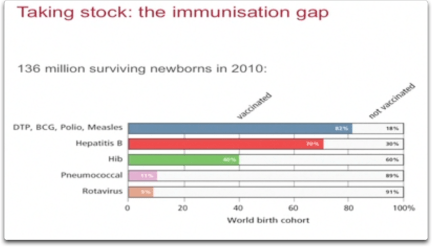
However with 19 million children still missing out on immunisation and 15.4 million of those in GAVI eligible nations, one can appreciate the significance of GAVI’s mission and goals. Along with the mission to save lives and improve health via access to immunisation, GAVI seek to accelerate the uptake and use of underused and new vaccines. Helping strengthen the capacity of integrated health systems will be crucial in achieving this.

One child dies every 20 seconds from a VPD. Of 19 million missing out, 15.4 million are GAVI eligible

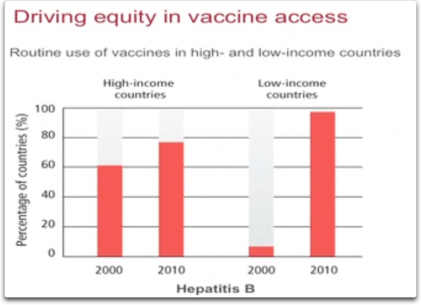
Increasing the predictability of global financing and improving the sustainability of national financing for immunisation, along with shaping the vaccine market are GAVI’s final two goals. GAVI also aim to drive equity in vaccine access across the globe. An impressive example of this is the uptake of the Hepatitis B vaccine in the decade from 2000.

High income nations increased uptake from 60% to around 77%. Low income nations shot from just over 5% to 98%. The impact of the consequential lowering of liver cancer incidence, particularly in China which experienced epidemic levels, cannot be understated.

“Only good for junkies and hookers” – anti-vaccination slurs of the HBV vaccine reflect pop culture mentality

This brings into focus how important immunisation is not only in preventing disease but in sustaining economies, and earning potential in adults. Immunised children maintain the health to attend and complete school. Reaching adulthood they have the potential to earn a competitive wage and thus contribute significantly to family income.

Parents need not produce large families to combat childhood sickness and death, or to meet the need for labour and their own care in old age. The cost of a disabled child or adult added to the tragedy of a deceased parent is a reality for many in developing nations. It’s estimated a one year increase in life expectancy equates to increased labour productivity of 4%. In this light it’s been estimated immunisation programmes have a rate of return between 12.4 – 18%.

One study cited by Seth Berkley noted that a fully immunised 11 year old would present with increased IQ, language skills and math testing results. Over time the “democratic dividend” is to invest more in fewer children. Thus we can see that by ensuring healthier children and smaller populations immunisation can pull families, villages, districts and  entire nations from poverty. According to Dr. Kate Taylor 100 million people per year are driven back into poverty due to illness.

Hib meningitis in Kenya’s Kilifi region fell 88% in three years following vaccine introduction

Results from immunisation are undeniable. With a 54% increase in population from 1980 – 2010 came a 95% reduction in diptheria and tetanus cases, a 92% reduction in measles and pertussis and a 97% reduction in polio. $1.3 billion per year is saved due to the absence of smallpox, which is over ten times the cost of the 1979 eradication programme.

When the Global Polio Eradication Programme was launched in 1988, 125 countries were endemic and 350,000 children were paralysed annually. Today only three countries remain endemic. India is an example of strong political will and determination in that two years ago it had the largest number of cases, yet today has been free of polio for a full year.

Rolling out new vaccines to close the immunisation gap is a major GAVI priority

Future challenges for GAVI will be expanding it’s reach and overcoming political apathy to make the most of emerging new vaccines and to roll out those yet to hit the market. The newer the vaccine the higher the percentage of those unimmunised. Poor political will is an obstacle. Part of the answer is to get the public and the global community to care, without placing excessive reliance on ministries of health by also including financial and planning ministries.

Australia is presently the sixth largest supporter of GAVI. Recently, thanks to Kevin Rudd, our commitment rose from $6 million to $250 million in the lead up to 2015. Kate Taylor underscored that private individuals with enormous wealth had dramatically also changed the landscape in securing funding dollars.

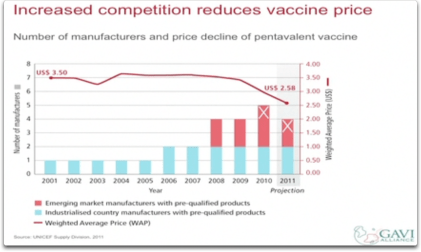
As competition drives down vaccine prices quality control in emerging markets is vital

Focusing on two research initiatives Sir Gus Nossal declared, “The future is bright”. Australia is contributing strongly to the “second generation” malaria vaccine, which given that the RTS,S is 56% effective in toddlers, is an essential avenue of pursuit.

Closer to home he mentioned emerging research into a vaccine for Group A Streptococcus. This disease has given Australia the unenviable status of having the highest incidence of rheumatic fever and rheumatic heart disease in remote indigenous communities.

Tim Costello reinforced that Australia and AusAID is committed to 0.5% of Gross National Income. Presently Australia has no billionaire analogues to the Bill Gates’ of this world. Letting no-one off the hook, Tim pointed out that, per capita, W.A. also donate the least to charity despite their expanding wealth. Aussies donate 35 cents per $100 of tax payer monies to global charity.

Over 90 or so minutes a fascinating account of Australia’s role in the World was presented by some rather heavy hitters in global charity and health.

Aussies can be proud that an unmistakable message is that when it comes to global vaccine equity, our nation is an accomplished heavy hitter also.

How can anyone doubt? Vaccination Saves Lives.

All slides © GAVI

Science Under Attack

© BBC

Sir Paul Nurse, President of The Royal Society of London for Improving Natural Knowledge [Wiki] aka The Royal Society hosts an excellent round up of some of Reason’s more blatant enemies.

AIDS denialism, climate science cynics, antivaccination lobbyists and opponents to genetically modified food research. Nurse covers this and more. He does an excellent job of scrubbing constructed controversy from the “Climategate” email tale. This includes an interview with perhaps the most famous twonk ever to profit continuously from just one story, James Delingpole of The Telegraph.

All that can be added is that at the time of filming the recent revelation of well funded, coordinated efforts to undermine climate science, were unknown. This involved leaked memos, of all things, from anti-climate science “conservative, libertarian” think tank The Heartland Institute. Blogger Anthony Watts is being paid a nifty $90,000. They want to help the lad with his new website devoted to interpreting temperature station data. Crucially this actual scandal exposed Heartland’s intent to sabotage K-12 science with it’s own “Global Warming Curriculum”.

“K-12” refers to the sum of education from Kindergarten to Year Twelve in Australia, Canada and the USA. The Guardian wrote on February 15th that this included a proposal from journalist and epistemologist Dr. David Wojick which:

…will focus on providing curriculum that shows that the topic of climate change is controversial and uncertain – two key points that are effective at dissuading teachers from teaching science.

Julie Leask on Roxon’s immunisation incentive

Julie Leask, a research fellow and lecturer at the National Centre for Immunisation Research & Surveillance is a social scientist specialising in vaccination issues. Julie also lectures at the University of Sydney and Sydney Medical School.

She chats with Louise Maher on ABC 666, Friday November 25th about the government’s linking of vaccination to financial incentives.

Download audio here.

Grab some NCIRS fact sheets from here.

Follow Julie on Twitter – @JulieLeask