Just over a year ago I posted that 12 charges had been brought by the Director of Public Prosecutions against Belinda Gae Harris over the supply and advertising of black salve products. This followed an investigation by the Therapeutic Goods Administration (TGA), which confirmed alleged criminal offences under the Therapeutic Goods Act 1989 (the Act), against Harris.
Harris insisted on her blog she was “helping people” and had written on Facebook about using the dangerous corrosive to “suck out” snake bite poison and COVID-19 vaccines from the injection site. The TGA reported at the time she faced up to “a maximum penalty of 12 months’ imprisonment and/or a fine of up to $222,000 for each charge”. Harris, who traded under ‘Tickety Boo Herbal’, was manifestly spared the maximum sentence. Found guilty of 10 charges on 30 October 2025 in Deniliquin Local Court, the TGA reported on 16 January 2026, that Harris had been:
[S]entenced today to 7 months imprisonment, a community corrections order, and fines of $20,000 for unlawfully advertising and supplying black salve and bloodroot capsules, and for advertising other unapproved therapeutic goods to treat serious conditions such as anxiety.
And that:
Ms Harris was released on recognizance of $2,000 and on condition of good behaviour for a period of 3 years with 6 months supervision. Ms Harris is prohibited from making restricted and prohibited representations about therapeutic goods by any means, including on social media. The term of imprisonment can be imposed if the conditions of the good behaviour bond are breached.
Ms Harris is also subject to a community corrections order with a supervision period of 3 years.
The prohibitions regarding publication about therapeutic goods, particularly on social media, and the threat of prison linked to the good behaviour bond, are certainly welcome. Let’s revisit some of Harris’ response to the charges last January:
I’m just going to keep doing it, because I’m helping people and I’m saving lives. My angels managed to keep this at bay until 2025… This matrix is bullshit. Bullshit lies. They’re allowed to administer carcinogenic chemotherapy to people and fry the fuck out of them with their radiation.
But I’m not allowed to do a simple herbal remedy that I have tested over and over again… I’ll see you in court government… You can’t shut me up. If you put me in jail I’ll just be educating everybody around me. Okay. Namaste. Loving you. Ben Abou.
Okay. Namaste it is.
Her Honour, Magistrate Humphreys, said “the offending was deliberate and planned”. She added:
The Court has an obligation to deter similar offending as it is of a kind that could cause great harm…
…The existence of a community of persons interested in the use of potentially dangerous alternative treatments for serious illnesses such as cancer adds weight to the need for general deterrence. Others involved in such communities must be dissuaded from engaging in similar conduct
In a welcome addition the magistrate also noted the indirect harm Harris’ actions had caused, in that there was, “a real potential for users of the product to delay seeking or obtaining conventional treatment”. This is an important point and often overlooked. Regardless of potential harm, any treatment that interferes with evidence-based medicine or leads to patients withholding information from specialists, can prove disastrous.
Deputy Secretary of the Department of Health, Disability and Ageing and head of the TGA, Professor Anthony Lawler said he was pleased with the outcome. He continued:
This significant penalty sends a clear message to anyone seeking to profit from the unlawful supply and advertising of therapeutic goods. The TGA’s highest priority is protecting the health and safety of the Australian public, and products like black salve have the potential to cause serious harm to people.
We will continue to take strong and decisive action against those who disregard their legal obligations under the Therapeutic Goods Act 1989 by advertising and supplying unapproved therapeutic goods.
Sanguinarine, a primary corrosive agent in black salve, is listed as a Schedule 10 substance in the Poisons Standard. These are described as substances “so dangerous to health that they are prohibited from sale, supply and use in Australia”.
Black Salve is a substance that helps nobody. Don’t be fooled by high-risk, untested so-called “alternatives”.
The fact that mRNA COVID-19 vaccines are not contaminated with excessive or dangerous levels of residual DNA should not really have to be addressed. Nonetheless, doing so often comes up in arguments to debunk what is becoming a persistent trope of the anti-vaccine lobby.
In November last year I looked at an excellent report from Australia’s Therapeutic Goods Administration (TGA), which plainly called the claim, misinformation. In March this year refuting the myth of “Turbo Cancer”, I went through a bunch of already well debunked attempts to justify the existence of this non-existent cancer. DNA contamination of COVID mRNA vaccines took up a few paragraphs.
The popularity of residual DNA contamination as a cause of invented harms favoured by anti-vaccine fear mongers shouldn’t surprise us. We received easy to understand information from health authorities well before the COVID vaccine rollout, that mRNA in vaccines never penetrates the cell nucleus and thus, DNA would remain untouched. Yet that very notion was targeted early and often by contrarians. Then came the flawed science with flawed methodology, that still remains unpublished. Remember the testing of vials that arrived anonymously in the mail without cold packs? Don’t forget mRNA vaccines require storage at about -20ºC. Then came sleight of hand by Kevin McKernan et al, using Qubit Fluorometric Quantification (fluorometry) in an unwarranted addition to the original testing regime of Quantitative PCR (qPCR). qPCR indicated DNA below FDA guidelines. Fluorometry significantly and inaccurately inflates results because it measures mRNA when calculating total DNA levels.
In fact there’s a few elements to understanding why DNA in mRNA vaccines is a non-event. That’s why I recommend watching Dr. Dan Wilson of Debunk the Funk on YouTube. Dan’s been flattening bogus bumps in the anti-vaccine world for quite a while now. His video on 2 July called Update on DNA contamination is one of a few he’s done tackling this particular myth. Interestingly, what recently caught my eye was Dan’s praise for the TGA report on misinformation about excessive DNA in mRNA vaccines.
Dan wrote to the TGA to check how they determine COVID DNA in their samples, as there are various ways to do this (see video 7:15). It turns out the TGA used the method that “most over-estimates the amount of DNA that could possibly be in that vial”. This still yielded “zero batches that exceeded the limit of residual DNA”.
So again, what this tells us is that DNA contamination of mRNA vaccines is a total furphy and they remain completely safe. Still, I sincerely recommend spending 10 minutes checking out Dan’s video, and having a look through his others for sound information to educate yourself about persistent and evolving anti-vaccine disinformation and misinformation.
January has ushered in some interesting developments for skeptics in Australia as dodgy practices seemingly jostle for attention. Australia’s Therapeutic Goods Administration (TGA) has published welcome updates and warnings, a QLD influencer sank to a new low, our most insistent anti-vaccine fantasist copped yet another fact-check from the Australian Associated Press (AAP) and 14 members of a faith healing cult have been found guilty of manslaughter.
Black Salve
Black Salve has been a long term problem for the TGA as it remains a dangerously reckless alternative cancer treatment, linked to the unwarranted belief it offers a cure. A company and its director were convicted in 2022 for advertising alternatives to medicine not on the Australian Register of Therapeutic Goods. A significant seizure of black salve also took place in late 2023. On 6 January this year, the therapeutic watchdog published information that following an investigation in conjunction with the Commonwealth Director of Public Prosecutions, an individual faced 12 charges for alleged criminal offences under the Therapeutic Goods Act 1989.
The alleged offences relate to the advertising and supply of black salve, bloodroot capsules and other unapproved therapeutic goods. It is alleged that the individual made claims about the products’ ability to treat serious health conditions, including anxiety and cancer.
The defendant faces a maximum penalty of 12 months’ imprisonment and/or a fine of up to $222,000 for each charge.
Sanguinarine, a primary corrosive agent in black salve, is listed as a Schedule 10 substance in the Poisons Standard. These are described as substances “so dangerous to health that they are prohibited from sale, supply and use in Australia”. Whilst the TGA has not named the individual, a certain Belinda Gae Harris (pictured) who operates Tickety Boo Herbal, had prior to Christmas, revealed via video on Rumble that she had been charged in the exact manner later outlined by the TGA.
Harris remains adamant she is being charged for “helping people” and wrote, “I have been persecuted for being a healer for many lifetimes”. In her video Harris announced she has spent her life finding solutions for the damage [the TGA] have done with mRNA vaccines and “allopathic treatments”. On the topic of mRNA vaccination, Harris wrote last month on social media she used black salve and, “sucked the jab out of people straight after that poison injection”. She continued on her Rumble channel:
I’m just going to keep doing it, because I’m helping people and I’m saving lives. My angels managed to keep this at bay until 2025… I need to have a stack of evidence saying these are all the people whose lives I have saved… Oh my God, Oh my God. It just never ends with this world. This matrix is bullshit. Bullshit lies. They’re allowed to administer carcinogenic chemotherapy to people and fry the fuck out of them with their radiation. But I’m not allowed to do a simple herbal remedy that I have tested over and over again… I’ll see you in court government – who always seem to be loving watching me. I bet you’ve got the hots for me. You probably do, just like the trolls… You can’t shut me up. If you put me in jail I’ll just be educating everybody around me. Okay. Namaste. Loving you. Ben Abou.
Harris was scheduled to appear before Deniliquin local court on 4 January for Commonwealth and Police criminal mentions. One awaits updates on the matter, which aren’t presently coming from the Tickety Boo Facebook page.
Melanotan tanning products
On 24 January the TGA published a warning about the risks of using tanning products containing melanotan. Illegally sold and advertised online they consist of nasal sprays and injectable and indigestible tanning products. Unapproved for sale in Australia, they may contain toxic or counterfeit ingredients. Melanotans are synthetic peptides that increase melanin production in the skin. The risk of serious side effects mean melanotans should only be used under medical supervision. However they are being illegally promoted as safe, including by social media influencers. Vulnerable young Australians struggling with body image issues are at significant risk. The TGA write:
While the most common side effects include headache, nausea, vomiting, loss of appetite, and facial redness, the most concerning one is the risk of serious skin cancers. With melanotan-II, there have been reports of increased moles and freckles, kidney dysfunction and swelling of the brain.
Melanotan is not approved for sale or use as a tanning agent in Australia. These tanning agents haven’t been assessed for their quality or safety. Since these tanning products are not approved for sale or use in Australia, you also have no way of knowing what’s in them, no matter what’s written on the label. They could be made with toxic, poor quality or counterfeit ingredients.
The TGA also warn about advertising such products and leave little to the imagination by reminding readers that “all media types visible to the public” are included and liable as breaches under the TGA Advertising Code. More so, they have “a dedicated workforce to investigate the inappropriate and unlawful manufacturing, distribution, sale, import and advertising of therapeutic goods”. Let’s hope the warning is heeded.
Meryl Dorey
Regularly warned, reminded, debunked, corrected and revealed to have a striking aversion to the truth is one Meryl Dorey, founder of The Australian Vaccination-risks Network and owner of a Very Big Tag (VBT) on this website. Meryl has been fact checked by AAP in the past for cultivating notions about child suicides, and claiming later the same year that vaccinated people are more likely to die from COVID. The latest very, very old chestnut wheeled out by Meryl during an interview on YouTube [relevant section here] with Australian Liberal MP and vaccine cynic, Russell Broadbent, is the baseless claim that medical students spend a mere few hours discussing vaccines during their entire time at medical school. This is a decades old lie and serves to support the preposterous assertion that anti-vaccine activists know more than medical professionals. Dorey told a gullible Broadbent:
When doctors study vaccination, and we had the curriculum for the New South Wales school of medicine at UNSW – University of New South Wales – and it was out of four years of medical school there was one morning where vaccinations were discussed. […]
I think that any parent who’s done a modicum of research will be able to know more about this issue than the average doctor.
Ah yes, doing your own research. Busted by AAP, Dorey replied to their queries saying the curriculum was from “many years ago” and she had spoken to “probably thousands” of doctors about vaccines. Doctors apparently supporting her version of vaccine risks. Both replies should be regarded as monumentally dubious. I recommend reading the AAP piece to appreciate medical training around immunisation, population health and the use of vaccines. However, one paragraph stood out for me. A spokesperson for the Royal Australian College of General Practitioners observed:
When it comes to vaccines, as with other health issues, GPs are trained to consider the patient’s history and relevant risk factors, discuss the options available to the patient and any risks associated, and enable the patient to determine the most appropriate decisions about their own health care.
This isn’t the post to dig into this point, but bear in mind that anti-vaccine activist Judy Wilyman was awarded a PhD for a meandering literature review that made much of so-called “undone science” and unverified claims that vaccination programmes pose serious risks because they do not accomodate the genetic diversity and unique health needs of individuals. The above quote should serve as yet another reminder that the decision by the University of Wollongong to award that PhD, was and is demonstrably flawed.
Influencer charged with poisoning
The ABC joined the world’s media reporting on a 34 year old QLD mother and social media influencer, who has been charged with torture and giving her baby unauthorised medications, with the aim of attracting donations. It was a simple, if repulsive tactic; inform followers of your child’s illness, then create and exacerbate symptoms filmed to elicit sympathy. Police allege up to $60,000 was raised this way. The crowdfunding platform, GoFundMe, is presently refunding donors. It was also reported that after hospital staff improved the child’s health, the woman filled additional prescriptions and recommenced the abuse. The drug, carbamazepine, had been stopped by treating doctors due to fears it was causing seizures. Last week the woman was charged with 11 offences.
5 counts of administering poison with intent to harm
3 counts of preparation to commit crimes with dangerous things
Torture
Making Child Exploitation Material
Fraud
On 28 January a Brisbane Magistrates Court heard the woman allegedly hid her then 12 month old daughter under a blanket prior to administering unprescribed substances via a nasal tube. The child, now 18 months, was born with tuberous sclerosis, a genetic disorder which caused benign tumours in organs and can lead to epileptic seizures. Doctors believe the illegal medication administration caused further seizures in this child. The woman was caught on CCTV fiddling with her daughter’s nasogastric tube and handling a syringe, which was unrelated to her daughter’s medication. In the timeframe observed, the child went from being alert and awake to unconscious – a symptom not related to her condition.
The ABC reported on 29 January that the seizures, unexplained loss of consciousness and a cardiac arrest between August to October 2024, led the baby’s medical team to carry out high risk surgeries on intra-cranial tumours caused by the child’s genetic condition, believing them to be the causal factor. However, after the surgery the woman’s conduct was discovered. Drug screening revealed “the presence of carbamazepine and other non-prescribed medications in the baby’s system”. Bail was granted on condition the woman have no contact with her daughter other than via supervised audiovisual visits.
This will prove an interesting case with respect to the woman’s defence or indeed the reasons behind her behaviour. No doubt Factitious disorder imposed on another (FDIA), originally Münchausen syndrome by proxy, is an explanation that provides answers. But in the age of social media speckled with complex reasons driving individuals to behave antisocially, illegally or in pursuit of their own malignancies, might this be too simple an answer? Critical thinking and rationality are frequently jettisoned by influencers. Perhaps we should be seeking to understand how social media influences certain users, as much as we seek to grasp how they use it to influence others.
Religious cult guilty of manslaughter
Fourteen members of a religious cult that believed God would heal an 8 year old insulin dependent type 1 diabetic and later raise her from the dead, have been found guilty of manslaughter in a judge only trial in the Brisbane Supreme Court, report the ABC. Elizabeth Struhs was denied her insulin, became critically unwell over several days and died in Toowoomba 3 years ago this month. As she suffered, the cult “prayed and sang” rather than contact emergency services. After Elizabeth died, they waited for more than 24 hours before contacting police. The Court heard the group rejected modern medicine “and put their full trust in the healing power of God”.
Being questioned by police the child’s mother, Kerrie Struhs, told police she hadn’t lost faith in God, who could raise her daughter up regardless of where she was. In a classic example of biblical fundamentalist literacy, she rejected a funeral for her daughter because, “the bible says let the dead bury the dead”. Elizabeth’s father Jason Struhs was originally charged with murder, and also told police that he expected his daughter to rise from death. The deceased’s brother Zachary, told police:
We saw the healing and we know that she was healed from the diabetes. The sickness of her natural death could have been anything that comes up on anyone — that’s not for me to know, I’m not God.
Another member, Therese Stevens, sounded quite chuffed as she explained that Elizabeth will rise again and because of their beliefs they are not “as stressed out and freaked out and emotionally damaged as you would be if you knew you’d never see that person again”. In a ruling that should prove controversial, Justice Martin could not find the child’s father guilty of murder unless he had a full realisation his daughter would die from withdrawal of her insulin. The ABC reported:
Justice Burns said he was not satisfied of this beyond a reasonable doubt, stating there was a possibility in the “cloistered atmosphere of the church which enveloped [him] and which only intensified once he made the decision to cease the administration of insulin, he was so consumed by the particular belief in the healing power of God … that he never came to the full realisation Elizabeth would probably die”.
For a similar reason he did not find cult leader Brendan Stevens guilty of murder, but found his claim that he did not influence Jason Struhs to be “arrant nonsense”. Justice Martin also found all other members influenced Jason to withhold insulin and medical care and thus, “counselled and aided in the unlawful killing of Elizabeth”. Of the 14 members, 8 were from the Stevens family, 3 from the Struhs family, there was one couple and one individual. Elizabeth’s sister Jayde who had not been on trial spoke outside the court. Whilst happy with the outcome of the trial she said the “system failed to protect Elizabeth in the first place”. In a revealing comment Jayde added:
We are only here today because more wasn’t done sooner to protect her or remove her from an incredibly unsafe situation in her own home.
The Therapeutic Goods Administration (TGA) is aware of misinformation in recent media and online reports that claim the COVID-19 mRNA vaccines are contaminated with excessive levels of DNA. This is not the case.
So opens the TGA report Addressing misinformation about excessive DNA in the mRNA vaccines. It is, for those of us aware of this issue, an understatement. The sheer volume and scope of misinformation, combined with relentless pressure from repeat offenders including members of the Australian parliament, more accurately suggests a campaign. A calculated campaign of misinformation designed to spread fear and intimidate the vaccine hesitant. Despite there being accepted means for discerning DNA residue in vaccines, two claims persist. Namely levels are hundreds of times greater than the accepted safe level, and that aggressive cancers will, and do, directly result.
Background
The original claim stems from a preprint paper by Kevin McKernan dated 11 April 2023. Amplitude, via the Australian anti-COVID vaccine lobby, was lent to this claim in July 2023. The legal guru behind all Australian court cases to challenge approval of COVID-19 vaccines, retired barrister Julian Gillespie, penned The Canaries in the Human DNA Mine. Falsely labelled “peer reviewed” by his anti-vaccine compatriots, it was published in the unabashedly anti-vaccine International Journal of Vaccine Theory, Practice, and Research. Gillespie also crafted the case material used by Dr. Julian Fidge, in what became known as the Fidge v Pfizer case in which Fidge was represented by Katie Ashby-Koppens of P. J. O’Brien and Associates. I summarised the unsuccessful case here, in April this year. Gillespie and Co. followed with a conspiratorial constitutional complaint against the presiding judge, Justice Helen Rofe. Then via a High Court writ they targeted Chief Justice Debra Mortimer for not accepting their complaint. Both complaints were lodged on behalf of Dr. Fidge
Around the same time, the outrage manufactured by the anti-vax lobby shifted from the claim in Fidge v Pfizer that mRNA vaccines were Genetically Modified Organisms (GMOs), to the claim that vast amounts of DNA were contaminating these vaccines. Julian Gillespie, who wants a COVID Royal Commission, publishes for his “good substack folk” regularly on DNA contamination. He claims to have commissioned Canadian molecular virologist Dr. David Speicher to pursue said contamination, ultimately announcing confirmation on 6 June. Speicher was not a surprise choice for Gillespie. He had published with McKernan, Jessica Rose, Maria Gutschi, and David Wiseman in Canada in October 2023, reaching the contamination conclusions Gillespie wants to hear about.
It bears stressing that Kevin McKernan’s preprints lost credibility long ago, when it became apparent the vials he tested were of unknown origin. More so, if origin is unknown then cold chain transport requirements are by default, breached. In October 2023, David Gorski referred to McKernan’s initial preprint as an “awful study” and follow up studies being “equally as bad”. Thus it is unsurprising further attempts were made to label COVID vaccines as DNA contaminated. The Global Vaccine Data Network provide an excellent refutation of what they call Plasmid-Gate. As a highly COVID-19 vaccinated nation, Australia is used in their piece as an example to debunk the claim of so-called “turbo cancers” resulting from COVID-19 vaccination. SBS recently reported that last year, biologist Phillip Buckhaults from the University of South Carolina spoke before a state panel postulating the possible consequences of DNA contamination. When his comments took flight on social media he quickly followed up on X with insistence that such a risk was “purely theoretical”. They further reported that:
Dr Paul Offit of the Children’s Hospital of Philadelphia said [DNA] fragments were “clinically and utterly harmless”.
“These DNA fragments would have to enter the cytoplasm, which is that part of the cell outside of the nucleus, and our cytoplasm hates foreign DNA,” Offit said. “It has innate immune mechanisms as well as enzymes to destroy foreign DNA.”
Also interested in supposed DNA contamination of mRNA vaccines are Senators Malcolm Roberts, Gerard Rennick, Ralph Babet, Alex Antic and Russell Broadbent. Rennick has pushed both the GMO and DNA contamination angle for well over a year. Broadbent remains vocal in parliament to this day, has congratulated Port Hedland Council for calling for an end to COVID vaccines and has furnished Australia’s PM with material on the matter. Broadbent raised his concerns in parliament on 18 November, and I recommend watching this 5 minute video of him speaking.
Another voice to echo Julian Gillespie, is erstwhile ABC journalist Maryanne Demasi. Perhaps her contribution is best summed up in the COVID vaccine conspiracy film she narrated, The Truth – About COVID-19 shots. Erroneously labeled a documentary, it was raved about by Gillespie. And understandably so, given that it includes all his favourite vaccine conspiracies, champions the case and complaints associated with Fidge v Pfizer and lists Gillespie as a source. Demasi also has a Substack account, and has kept her subscribers up to date with DNA contamination developments. In addition Demasi claims the TGA “hides from” reports of SIDS, post vaccination, the TGA and FDA ignored DNA contamination of the HPV vaccine Gardasil, and of course that the TGA response to the claim that mRNA vaccines exhibit DNA contamination, is wrong.
As The Australian Vaccination-risks Network celebrate thirty years of spreading anti-vaccine and dangerous health advice to unsuspecting Australians, some satisfying memories of yesteryear have come to mind. Foremost is the delightful own goal scored by AVN founder Meryl Dorey, when promoting Black Salve as she bemoaned the Therapeutic Goods Administration (TGA) for taking action against the AVN for advertising a DVD, which itself promoted Black Salve. Let me explain.
It all began way back in 2012 with increasing interest in a fraudulently marketed so-called skin cancer “cure”. Namely, a corrosive salve known as an escharotic, being marketed as the near-miraculous Black Salve. A DVD sold by the (then) Australian Vaccination Network (AVN) titled One Answer to Cancer, was packed with anecdotal testimonies praising Black Salve and criticising Aldara, the medically approved treatment for keratoses and superficial basal cell carcinomas. I blogged about this at the time, and you can catch up here. It’s indicative of how quickly interest in Black Salve and the dubious DVD was spreading, to see that on 19 March 2012 the TGA published a warning about black and red salves in treating cancer. This included:
The recent use of products marketed as containing ‘Black salve’ in Australia has resulted in serious harm to the skin of three Australian consumers who used the black salves for various skin conditions including the treatment of a skin cancer.
The TGA is not aware of any credible, scientific evidence which shows that any black or red salve preparation is effective in treating cancer. These types of salves have not been formally assessed by the TGA and are not included in the Australian Register of Therapeutic Goods or exempted from inclusion.
All therapeutic goods, including those used for treating cancer, must be included in the Register unless exempted. Penalties of up to $5.5m apply to the illegal importation or supply of therapeutic goods.
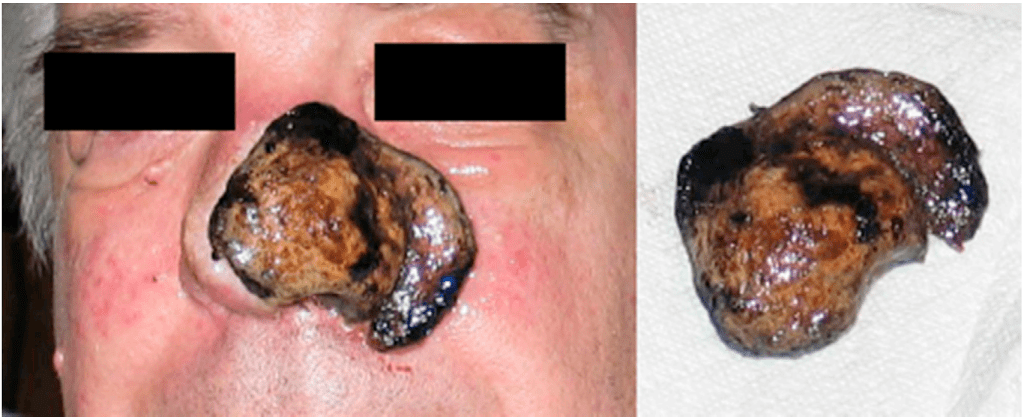
The TGA was investigating importation and a complaint made about supply via the internet. The Australian Pesticides and Veterinary Medicines Authority were also investigating sales purportedly proffered for pets. The TGA stressed that the problem with corrosive salves is that they “essentially burn off layers of the skin and surrounding normal tissue. They can destroy large parts of the skin and underlying tissue, and leave significant scarring.” The corrosive quality is unpredictable and almost impossible to control. Indeed Black Salve is also referred to as a pro-necrotic agent, which I blogged about in 2019. Once the process begins, widespread necrosis follows, leading to the release of enzymes which cause the breakdown of neighbouring cell membranes. A domino effect ensues causing widespread cell death. It brings to mind the “acid for blood” scene in the movie, Alien.
Necrosis of left nostril and surrounding tissue caused by Black Salve (Wikipedia)
Proponents misleadingly call it Nature’s Scalpel. The purpose of One Answer to Cancer was to promote Black Salve and offer instructions on how to prepare your own batch, using zinc chloride and sanguinaria canadensis, also known as bloodroot. This way the DVD producers could side step charges of selling the illegal corrosive. In December 2018, The Royal Australian College of General Practitioners published a comprehensive article on Black Salve, its history and use, noting that the main ingredient is the synthetic corrosive, zinc chloride. Thus claims of a “natural alternative” are inaccurate, and “catastrophic consequences can occur”. The dangers were well documented in 2012 and warnings were abundant. Nonetheless, in the AVN shop Meryl Dorey had included the following blurb with the DVD ad’.
50% of us will face cancer in our own lives at one time or another… we will have to face the choice of how to treat our illness – using toxic drugs or safe, effective, time-tested natural remedies… If you or someone you know is facing this issue or if you just want to be prepared for any future cancer diagnoses, this will be the best $25 you have ever spent!
The advertisement was in breach of the Therapeutic Goods Act 1989 (the Act) and numerous sections of the TGA Advertising Code (the Code). The Code is an effective legislative device for drawing up complaints against the peddling of quack remedies. Once content meets the definition of an advertisement, that content is subject to a number of principles outlined in the Code. More so, persons who publish what meets the definition of an advertisement may be guilty of an offence if other other medications are criticised or if a risk of harm applies. To read the advertisement and understand how the Code and the Act applied in 2012 you can check out the complaint I lodged on 19 April that year.
Prior to 1 July 2018, advertising complaints lodged with the TGA were handled by a Complaints Resolution Panel (CRP). A media release announcing that the TGA would take on the role of complaint management is available here. Way back in 2012 my complaint was handled by the CRP, and their findings from December 2012, can be accessed here. Fifteen sections of the Code and one section of the Act were found to have been breached. The AVN were told to remove the advertisement and publish the notice below.
However long before this, the TGA informed Meryl Dorey that a complaint had been lodged, as is her right. Unsurprisingly, Meryl felt both the complaint and the request of the TGA to remove the offending advertisement was an abuse of her network’s rights. On 5 May 2012, which was about two weeks after being notified, Meryl gave an interview on Fairdinkum Radio, a production of Resistance Media. This was an early freedom fighter production, and host Leon Pittard opened the show announcing the title as, The Australian Government’s Assault on Health Freedom. For me, the highlight of the show was Meryl’s interview which you can access below, or download here.
Meryl waxed lyrical about the benefits of Black Salve and the horror of Aldara, which she falsely claimed was “banned in many parts of the world”. Meryl also managed to call the TGA Cost Recovery model, “a fairly evil policy”. She provided a dubious anecdote of her own apparent use of Black Salve and wrongly claimed it has a “two thousand year history”. She mentioned the DVD and wrongly claimed Black Salve was a combination of herbs and minerals. The interview went on for over five minutes and easily met the definition of an advertisement. An advertisement for Black Salve published in broadcast media, no less. I lodged a second complaint.
The complaint makes clear how both Meryl and host Leon Pittard were liable as advertisers. It also contains a transcript of the interview. Application of appropriate sections of the Code, the Act and the Therapeutic Goods Regulations 1990, justified removal of the interview/advertisement and publication of a retraction (below). By the end of January 2013 the CRP had published their findings which can be accessed here. Thirteen sections of the Code were breached along with two sections of the Act. No sections of the Code raised in the complaint were found not to be breached. More so, over five paragraphs the panel raised additional matters not in the complaint. These included a possible breach of the Act relating to the Register of Therapeutic Goods, and nine possible breaches of the Code relating to criticism of Aldara, promoting a dangerous compound for serious disease, comments about the TGA and more (see pp. 2-3).
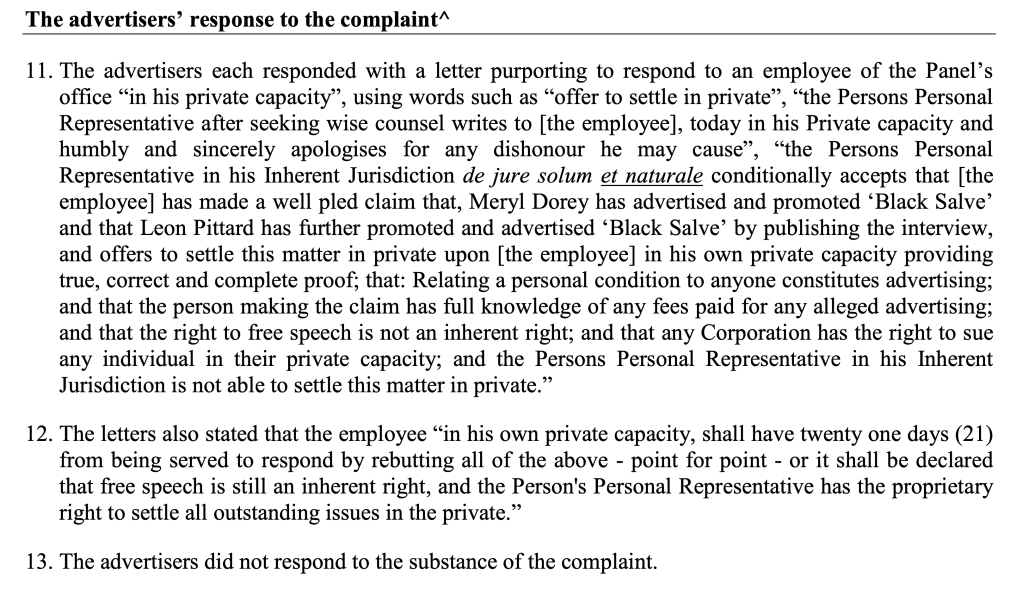
Page 3 of the CRP report includes reference to a somewhat bizarre response to a member of the panel from both Dorey and Pittard. In essence they would cop to the findings of the panel if the member would, in his private capacity, present “true, complete and correct proof” that relating a personal condition to anyone constitutes advertising, that the person making the claim is aware of fees paid for advertising, that free speech is not an inherent right, that any corporation has the right to sue an individual and that the matter couldn’t be settled in private. Leon Pittard had long boasted of monitoring the New World Order, employed a watered-down sovereign citizen logic to his world view and, like Dorey, was a fan of conspiracy theorist, Senator Malcolm Roberts. Pittard no doubt penned the response attributed to both he and Dorey (summarised below).
To my surprise, a short time after lodging the complaint I stumbled across this ridiculous video from the USA which was defending the position of Leon Pittard and Meryl Dorey. I wonder if in the rush to defend free speech the producers did any serious research on Black Salve, or understood the danger their support posed to an unsuspecting public.
Ultimately it was rewarding to have these particular complaints upheld. The second complaint – a veritable own goal – was particularly satisfying. However as is often the case with groups beholden to anti-science ideologies and belief in a fight for “health freedom”, such advertisements aren’t always removed when requested. Non-compliance is met with further warning notices, whilst more serious penalties reflect the nature of the breach and risk to the public. There’s little doubt that Black Salve caused serious injuries at the time and a quick search reveals that it continues to cause harm and generate health authority warnings in developed nations. The TGA seized Black Salve capsules on the Gold Coast in May 2019 and again in Brisbane, in December 2023.
The TGA publish regulatory decisions and announcements and the outcomes of advertising compliance investigations. As members of the public it’s up to us to report harmful products and dodgy advertisements to the TGA. It may involve a bit of reading but not every complaint needs to begin with every potential breach.
You can report perceived breaches or questionable practices here. There’s more information on reporting, what you need to provide and accessing support to complete forms here.




 Losing In The Lucky Country